
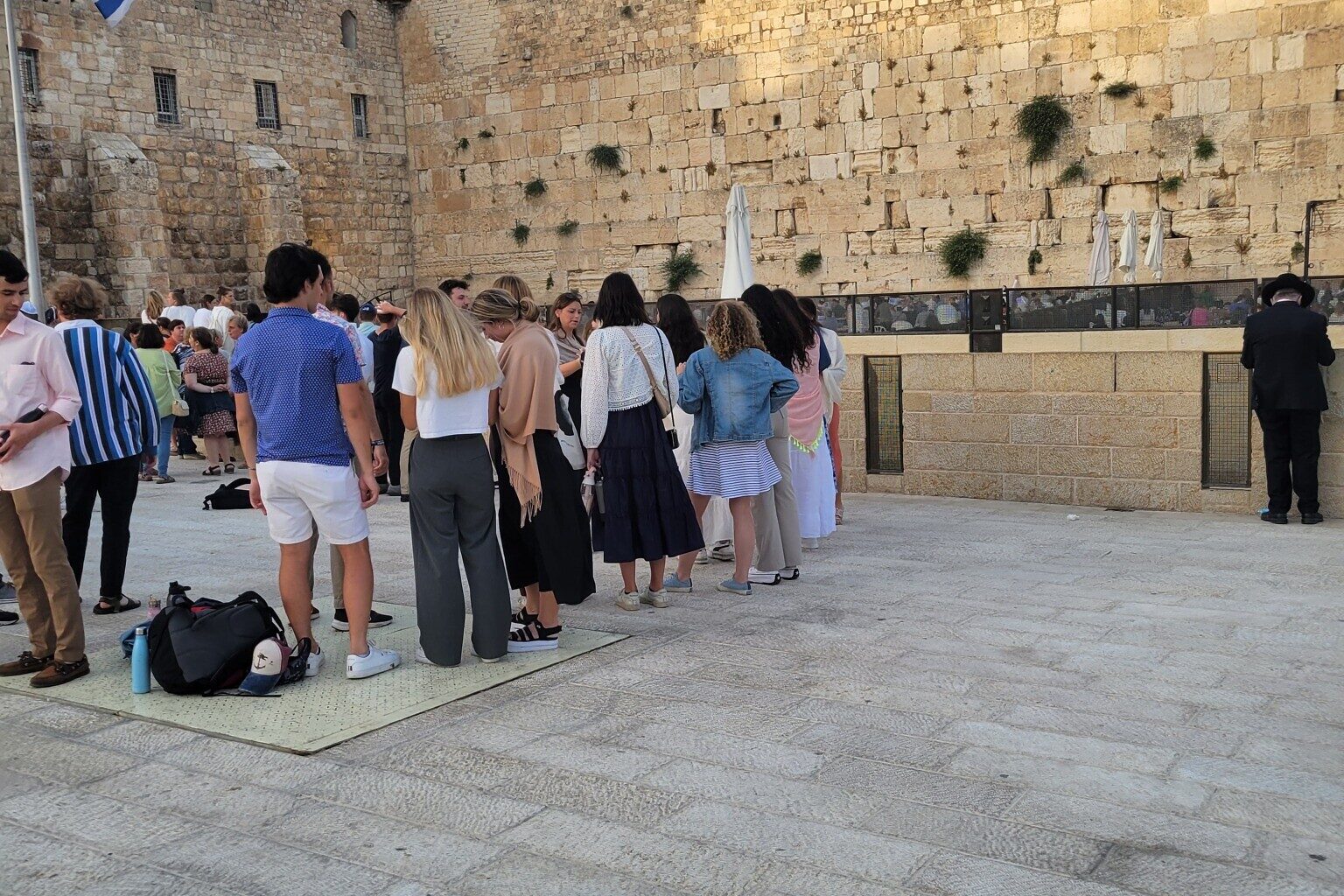
Israel’s chief rabbinate may soon have full control over prayer at all parts of the Western Wall, following a Feb. 25 vote (56 to 47) in favor of a preliminary reading of a bill in the Knesset, introduced by Knesset member Avi Maoz, who is part of the far-right Noam party.
The bill, which would imprison anyone for up to seven years for praying at the Kotel contrary to Orthodox standards, has caused anxiety and alarm for progressive Jewish groups both in Israel and the Diaspora.
The Association of Reform Zionists of America, the Israel arm of the Reform movement, released a statement saying, “the holiest site of the Jewish people must allow all Jews to pray as they wish — Israelis and Jews from the Diaspora alike.”
It went on to say that “at a time when Jewish unity is needed, the Israeli government is isolating 85% of the world’s Jewish population from one of our faith’s holiest sites. This affects bar/bat/b’nai mitzvahs, conversions, life-cycle moments, and basic dignity of prayer. It is a backwards step from a democratic Israel that celebrates religious pluralism, where all forms of Jewish identity are celebrated.”
The Union of Reform Judaism condemned the preliminary vote, calling it “unprecedented,” and saying that the Kotel “does not belong to one stream of Judaism.”
It noted that outside of Israel, 85% of Jews worship in egalitarian communities. Criminalizing non-Orthodox prayer at the Western Wall, it said, “would alienate millions of Jews from the State of Israel at a time when Jewish unity is both fragile and essential.”
The United Synagogue of Conservative Judaism, the largest network of Conservative Jews, called the Knesset vote a “dangerous escalation — and is a clear warning.”
In a press release, the USCJ urged members of the Jewish community to sign a petition against the bill and to reach out to the nearest Israeli ambassador or consul general voicing concern about the legislation.
The bill also caused concern in Prime Minister Benjamin Netanyahu’s government. He canceled a meeting of the Ministerial Committee for Legislation in order to prevent the government from backing the bill in a bid to avoid pushback from Diaspora Jews, according to The Times of Israel, but allowed members of his coalition to vote freely.
Maoz nonetheless celebrated the passage of the preliminary reading of the bill, saying it would “unify the Jewish people, both those in Israel and those in the Diaspora.”
The bill is meant to undercut a Feb. 19 ruling by the Israeli High Court of Justice instructing the government to move forward with upgrades to the Western Wall egalitarian plaza, which was created by the Israeli government as a compromise in 2013 to allow mixed-gender prayer. The plan was approved by the Israeli government in 2016.
As part of the plan, one entrance was created, divided into three routes of inspection stations: one for women, one for men and a “mixed” entrance enabling visitors to choose which path they are taking. The northern prayer plaza maintains the customs of Orthodox Judaism. The southern prayer plaza follows Conservative and Reform traditions.
Prayer at the Western Wall has been a flashpoint between Orthodox and progressive Jewish groups. Members of the group Women of the Wall — whose mission includes attaining “social and legal recognition of our right, as women, to wear prayer shawls, pray, and read from the Torah, collectively and aloud, at the Western Wall,” according to its website — have been arrested for various activities.
A day after the High Court’s decision, two leaders of Women of the Wall — Yochi Rappaport and Tammy Gottlieb — were detained on suspicion of obstructing access at a security checkpoint, an allegation Women of the Wall denied.
Rabbi Emily Meyer, lifelong learning coordinator at Temple Emanuel of South Hills, said she believes there is a way to “honor traditional values” and “be inclusive of a broader Jewish community.”
“I hope the government can figure out how to make sure that everyone feels at home at the Wall,” she said.
Meyer said she traveled to Israel with her family last year and visited the Kotel, calling it an “amazing sight.”
“It’s so important throughout Jewish history,” she said. “For the same reason that we read the Torah, visiting those places hold layers of meaning, which are valuable to me personally. I want to be able to pray at the Kotel. I want my children to be able to pray at the Kotel.”
Noting the arrests of leaders of the Women of the Wall, a group with whom she has prayed, Meyer said “it doesn’t show our best Jewish values to have the holy site be a place that feels dangerous.”
“I’ve heard the boos and jeers and whistles blown from people who don’t want those voices at the Wall,” she said.
Congregation Beth Shalom Senior Rabbi Seth Adelson said that access to the Western Wall for the vast majority of American Jews, who he said aren’t Orthodox, is “a special blessing.” It would be “an insult to the vast majority of Jews in Pittsburgh and around the world” if the proposed bill were to pass, he added.
Adelson said he celebrated his son’s bar mitzvah at the egalitarian plaza in 2014.
“If this had passed in 2014, I could have been arrested for having a service there, for holding a bar mitzvah service there and serve jail time in Israel,” he said. “That seems especially egregious.”
The Western Wall, he said, is large enough to have a small area set aside for “Reform, Conservative and Reconstructionist-identified Jews to be able to pray according to their tradition.”
Adelson draws inspiration for his beliefs from the Talmud which, he said, teaches that the Second Temple was destroyed because of Jewish infighting.
“I think that such infighting in today’s world would do more harm than we can even see from this vantage point.”
Rabbi Amy Greenbaum, associate rabbi of Beth El Congregation of the South Hills, also drew inspiration from Jewish tradition, which, she says, “teaches that every Jewish soul stood together at Sinai. It may be that each of us always feels that we have a place to stand and be in prayer in the sacred places of our people.”
The Western Wall, she said, is a place where all people come to “pour out their hearts and bring our love, our pain and our hopes to God in our own voice in our own way.”
She hopes there will be a return to the 2016 agreement.
“As a woman, and as a Jew, I want to feel that I have a place to pray and connect with God and Israel,” she said.
It isn’t simply for religious reasons that Greenbaum is drawn to the Kotel. She recalls images of soldiers standing at the Wall in 1967, kissing the stones. The Kotel, she said, represents the hope of the entire Jewish people for this “holy place and by extension the entire state of Israel, even among those who haven’t had the privilege to travel to Israel.” PJC
David Rullo can be reached at drullo@pittsburghjewishchronicle.org.