
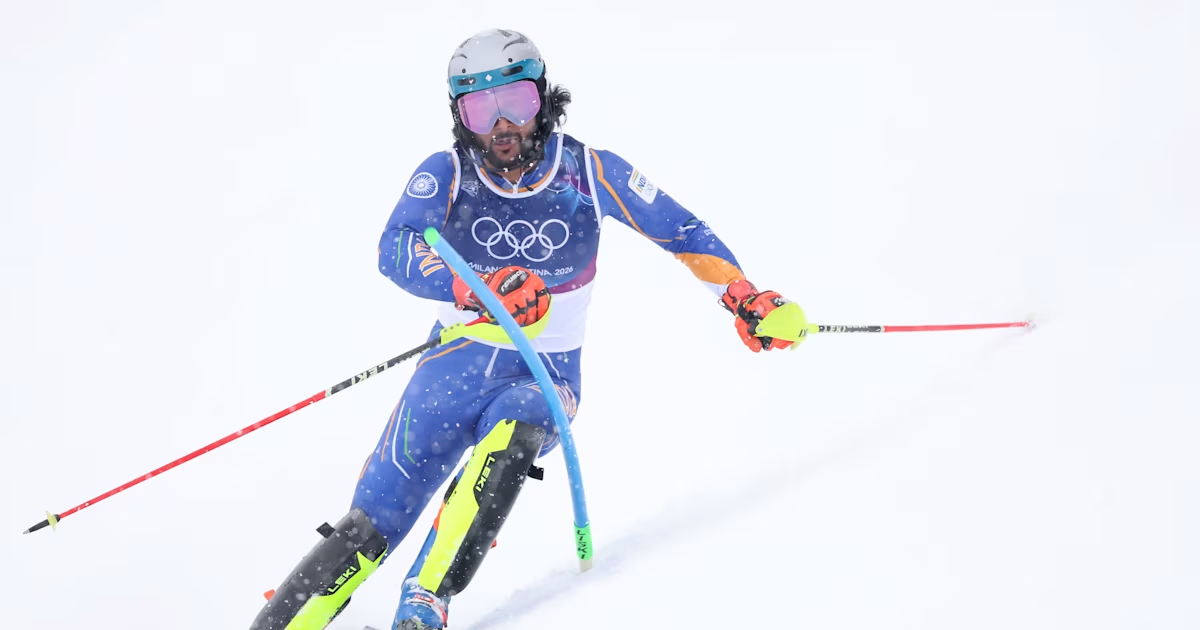
Alpine skier Arif Mohammad Khan says a third straight Winter Olympics seems “highly unlikely” and now wants to focus his entire experience in “uplifting” winter sports in India.
“There is a lot of work to do at home,” Arif Khan told Olympics.com
The 36-year-old from Gulmarg in Jammu & Kashmir took part in the recently-concluded Milano-Cortina 2026 Winter Olympics and entered the history books when he finished 39th in the men’s slalom race.
It was an improvement of 10 places on India’s previous best Winter Olympics result in the event, set by Kishore Ratna Rai at Calgary 1988.
Chances of a third consecutive Winter Olympics looks difficult, hinted Arif. “With the health issues I am facing, I don’t think a hat-trick is possible. In the last two years I have been suffering with a back problem. I have a disc bulge and there is always a gap in my back which is impacting my performance.
“To be able to continue in this sport I have to work harder and my body may not be able to withstand that. After my crash two years ago, I have been in rehab and in recovery mode all through.”
Arif recalled his slalom race on the slopes of the challenging Bormio mountains in Italy. “First and foremost the important thing was to be at the finish. This was one of the biggest concerns during the Games because the weather was rough and the slope was hard to negotiate. It was so tough that most of the athletes were not able to finish.
“So I had to make this strategy that if I want to ski down fast, there would be a 90 per cent probability that I may end up losing a position. I skied safer because in my mind, I wanted to finish the race and the position did not matter because we were not competing for medals. Finishing the race will put India in the ski map globally. The presence of India in the winter Olympics was a priority and I have been able to do that.”
It’s been a tough road for Arif. He has ploughed a lonely journey since 2005 when he first explored the mountains of Europe to seek his dreams. Ahead of the Winter Games this February, Arif trained for just three-four months in Italy. Most European athletes train for about seven to eight months on average.
Affordability has been a major issue. Son of a ski shop owner in Gulmarg, Arif breaks up the expenses under four heads: a support team consisting of a quality coach, equipment, travel and accommodation and last but not the least, training and competition.
Arif pointed out that athletes in established winter sports nations benefit from far greater support systems in the build-up to the Olympics. In India, however, resources for the sport remain limited.
He also noted that the absence of a national skiing federation makes it difficult for athletes to access the full range of government assistance available under the sports ministry’s Target Olympic Podium Scheme during an Olympic cycle.
So how did he manage himself?
“JSW’s assistance covers about 15 per cent of my expenses, the International Olympic Committee provides some funding that enables me to buy equipment and the rest is my own funding,” explains Asif, adding that the sports ministry has reimbursed some expenses after the Milano-Cortina 2026.
Arif still opined that a lot more investment is needed to match the European standards.
Arif is now focusing on “upliftment” of winter sports in India. He has urged the Union sports ministry to provide for at least one infrastructure that will help training on the slopes of Gulmarg for at least five months.
“The Khelo India Winter Games have been a fantastic initiative by the government. We have had six editions of KIWG but we now have to think of winning medals, at least at the Asian level,” said Arif.
“We have talented skiers in Jammu & Kashmir, Himachal Pradesh and Uttarakhand. Athletes from South India are also showing their skills. I can guarantee that if we can build infrastructure, receive government blessings and plan proper programmes for training and competition, we will win medals at top Asian meets in 10-15 years,” said Arif.