
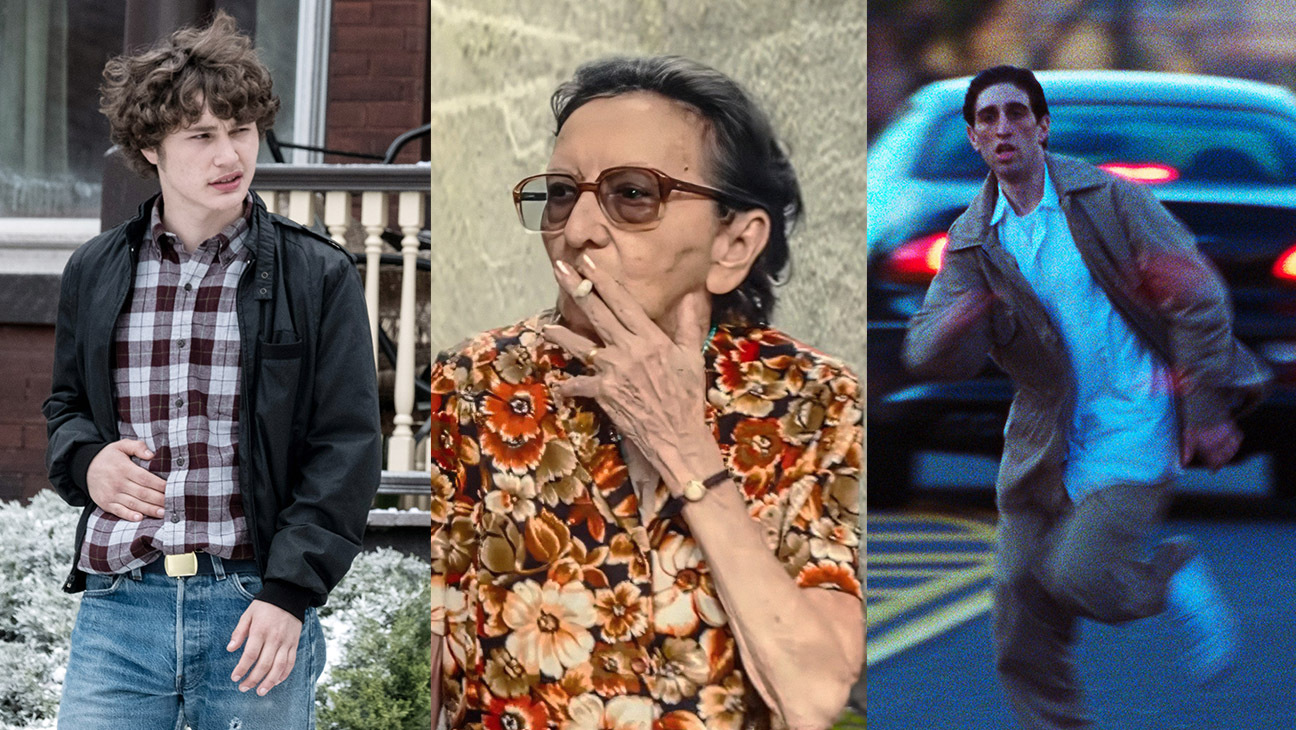
Richie Merritt didn’t even know who Matthew McConaughey was when a casting pro waltzed into his high school in the 2010s, intent on finding a teen to co-star with the actor in a film. Then a freshman, Merritt wasn’t a movie fan and wasn’t considering acting as a career. That is, until the scout told him he bore an uncanny similarity to the character she was casting, a young FBI informant turned drug dealer from Detroit based on the real-life Richard Wershe Jr.
Before he knew it, Merritt was traveling from his native Baltimore County to L.A. to meet the Dazed and Confused star himself. “They wanted somebody who wasn’t polished,” Merritt says now of the filmmakers behind the 2018 film White Boy Rick, which marked his film debut. “They wanted the real deal, they wanted somebody that comes from that type of environment.”
Merritt was so much the real deal, in fact, that he initially struggled with the idea of playing an informant. In his community, “you don’t want to be looked at as a snitch or a rat,” he explains.

Richie Merritt in White Boy Rick.
Scott Garfield/Columbia Pictures/Courtesy Everett Collection
Welcome to the wild world of casting non-professional actors, a practice that is in the spotlight this year as the Academy inaugurates the casting Oscar. Several nominated films are being celebrated for their use of Hollywood newcomers, including Marty Supreme, which is packed with non-actor celebrities (Kevin O’Leary, Pico Iyer) and total unknowns. The Secret Agent and One Battle After Another recruited novices including a seamstress (Tânia Maria) and a retired Department of Homeland Security Investigations special agent (James Raterman), respectively. Sinners casting director Francine Maisler found her central character in a musician without a Hollywood résumé, Miles Caton, while best international film and best sound nominee Sirat canvassed European raves for performers.
The practice, a bid to boost the realism or apparent authenticity of a project, brings its own risks and rewards. Listen to any casting director who’s orchestrated an open call or done “street casting” (i.e., found a non-professional out in the world), and odds are they have a few wild stories.
“I’ve had knives and guns brought into the audition space and it’s like, ‘OK, this is a non-starter,’ ” recalls veteran casting director Kerry Barden, who considered real bikers for 1994’s The Crow, among other experiences. But weapons aren’t a disqualifier for others. “I’m a street kid from Glasgow, and in the films I’ve cast, it would probably be unusual if they don’t have a weapon on them,” Des Hamilton, a Scottish casting director who specializes in street casting, says with a laugh.
Violence is something of a theme. Hamilton recalls working on an improvisation with one very early career actor and encouraging her to react to a situation naturally. “During the next take, she picked up a chair and threw it at me,” he says. “She should have been a pitcher for the Dodgers.” She got the job; his knee still occasionally hurts on cold winter mornings. (Hamilton did not name the actor, but Top Boy and MobLand’s Jasmine Jobson has publicly discussed the incident.)
For Jonathan Glazer’s 2013 film Under the Skin, casting director Kahleen Crawford vetted a non-actor auditioning for a violent part by having him try out the thwacking on her. “I had him run at me, I had him grab me. I had him try to push me down again. I mean, listen, I was black and blue,” Crawford says. Nevertheless, the actor passed her test, as she says he was having a difficult time with the actions (Crawford didn’t want to cast anyone who had real instincts toward violence).
Tânia Maria in The Secret Agent.
Neon/Courtesy Everett Collection
All of this follows a long tradition in filmmaking that extends back to early Soviet films through Italian neorealist projects through Martin Scorsese’s Goodfellas, which featured some real gangsters. Today, creatives primarily use non-actors to help viewers suspend their disbelief. That can mean deploying these performers in major roles, like Chloé Zhao did in her film The Rider, which starred a horse trainer playing a fictionalized version of himself. Or that can mean incorporating non-actors in smaller parts, which Winter’s Bone and Leave No Trace director Debra Granik has done on her hyper-regional films.
To find these diamonds in the rough, some casting directors say they rely on open casting calls posted to social media. But appealing to the perpetually online can only get you so far in certain communities, notes casting director Natalie Lin (Josephine). She and fellow casting director Nafisa Kaptownwala (Josephine) posted online casting calls, hosted at least one in-person open call and scoured Bay Area schools, malls, skate parks and basketball courts for kids that would populate the 2024 coming-of-age film DÍDI. When they street-cast a role, they’re not looking for a performer who can shape-shift so much as they are seeking “somebody that naturally just embodies that character and just is that person,” says Lin.
Hamilton is known for pounding the pavement everywhere from the streets of Glasgow to L.A.’s Pan Pacific Park to look for potential performers. Marty Supreme casting director and street-casting connoisseur Jennifer Venditti, who did not grant an interview for this story, has discussed finding new faces for the film on New York-focused social media accounts and at a racetrack.
Rosario Dawson in Kids.
Shining Excalibur Films/Courtesy Everett Collection
In the best-case scenario, these methods can uncover preternaturally talented performers and offer them the opportunity of a lifetime. Examples of actors who began sustained careers after being discovered on the street or in an open casting call abound, Rosario Dawson, Hunter Schafer, Sasha Lane, Barkhad Abdi and Martin Compston among them.
Certain casting directors leap at providing these chances. On the flip side, there’s the risk that a production could cast someone who might not be adequately prepared or equipped to handle the pressures of a major onscreen role. In 2011, the release of director Andrea Arnold’s adaptation of Wuthering Heights cast the spotlight on James Howson, the first Black actor to play the part of Heathcliff. Howson, who had a difficult upbringing that included stints behind bars, learned about the part while visiting an unemployment job center in Leeds. The next year, Howson pled guilty to racially aggravated harassment of a romantic partner. His lawyer suggested the sudden fame may have played a part. “It may be that his short film career may have had a detrimental effect on him. He was plucked from obscurity from an advert in his local jobcentre and soared to stardom,” the lawyer stated, according to The Guardian.
The practice of street-casting also is complicated by the fact that some non-pro actors may not have dealmaking experience or any kind of representation, whether from a lawyer, talent agent and/or union. It’s therefore especially important for productions to get informed consent when signing these actors to deals, says veteran indie production counsel Lisa Callif, who has worked with directors Josh and Benny Safdie on their films Heaven Knows What and Good Time. “Maybe they sign a document, but do they really understand what it is that they’re getting into?” she asks.
There can be varying follow-through with non-pro actors after a project, too. Some creatives help non-actors with greater Hollywood ambitions find representation and give them counsel, while others don’t see that as their job. White Boy Rick’s Merritt was initially connected with an agent through director Yann Demange, and since his breakthrough role, he has appeared in Euphoria, the Adrien Brody film Clean and NCIS: Origins. He counts himself fortunate but notes, “it’s very difficult to keep pursuing it.”
As for the productions themselves, striving for authenticity in casting can be risky. Marty Supreme star Timothée Chalamet, for instance, has said he enjoyed working with some non-pros that populated the film’s 1950s New York setting. But he has also recalled being threatened by one as he was attempting to anger the background actor for a scene. “I did another take, and then the guy said, ‘I was just in jail for 30 years. You really don’t want to fuck with me. You don’t want to see me angry,’ ” Chalamet said. “I said to [director] Josh [Safdie], ‘Holy shit, who do you have me opposite, man?’ ”
Buddy Duress in Good Time.
A24/Courtesy Everett Collection
Or take the case of Buddy Duress, who appeared in Good Time and Heaven Knows What. Duress, who spent time behind bars before his acting career, was a homeless heroin dealer on the lam from authorities during the filming of Heaven Knows What. “Everybody knew I would get arrested at some point, but I gave him [Josh] my word that I would finish the movie,” Duress told the New York Post in 2017. Fortuitously for the film, the authorities located Duress only after production wrapped.
But Duress’ casting may have been hazardous in other ways. Reporter Tatiana Siegel has written about allegations that, while high during a simulated sex scene on the set of Good Time, Duress exposed himself to a 17-year-old playing a sex worker and asked if he could “stick it in.” Later that day, Josh Safdie allegedly learned of the performer’s age, and the scene was cut from the film. Duress, real name Michael Stathis, died of cardiac arrest in 2023.
For casting director Crawford, it’s important to interrogate filmmakers who are keen to work with non-professionals on their motivations. “It takes a tremendous amount of emotional energy” to work with non-professionals, Crawford explains. The logistics can be much harder to navigate: How might a non-professional make it to auditions in other cities or countries? How will they handle childcare? Can they take days to weeks off of work, depending on the extent of the role?
But when it works, it can be magic. “I want the audience to see themselves on screen,” she says. When productions find the right person, “the story you’re watching is unfolding in front of you and you completely, utterly, totally believe it.”
This story appeared in the March 11 issue of The Hollywood Reporter magazine. Click here to subscribe.