

The war in Iran is hindering production and export of fertilizers from the Middle East and causing prices to spike. Some innovators say the disruption demonstrates the need for technologies that produce fertilizer locally and protect farmers from international shocks.
In early March, fighting forced QatarEnergy to halt urea fertilizer production at a facility in Qatar. The war also stopped nearly all ship traffic through the Strait of Hormuz, a key shipping route for fertilizers.
The timing is bad for farmers in North America, who are preparing for the spring planting season. Nitrogen fertilizer prices in the US jumped more than 20% from late February to mid-March, according to the investment bank Jefferies.
After living through supply chain chaos during the COVID-19 pandemic, Russia’s invasion of Ukraine, and now the war in Iran, farmers around the world are eager to ensure that they have stable access to fertilizers going forward, says Helga Dögg Flosadóttir, CEO of the Icelandic fertilizer start-up Atmonia.
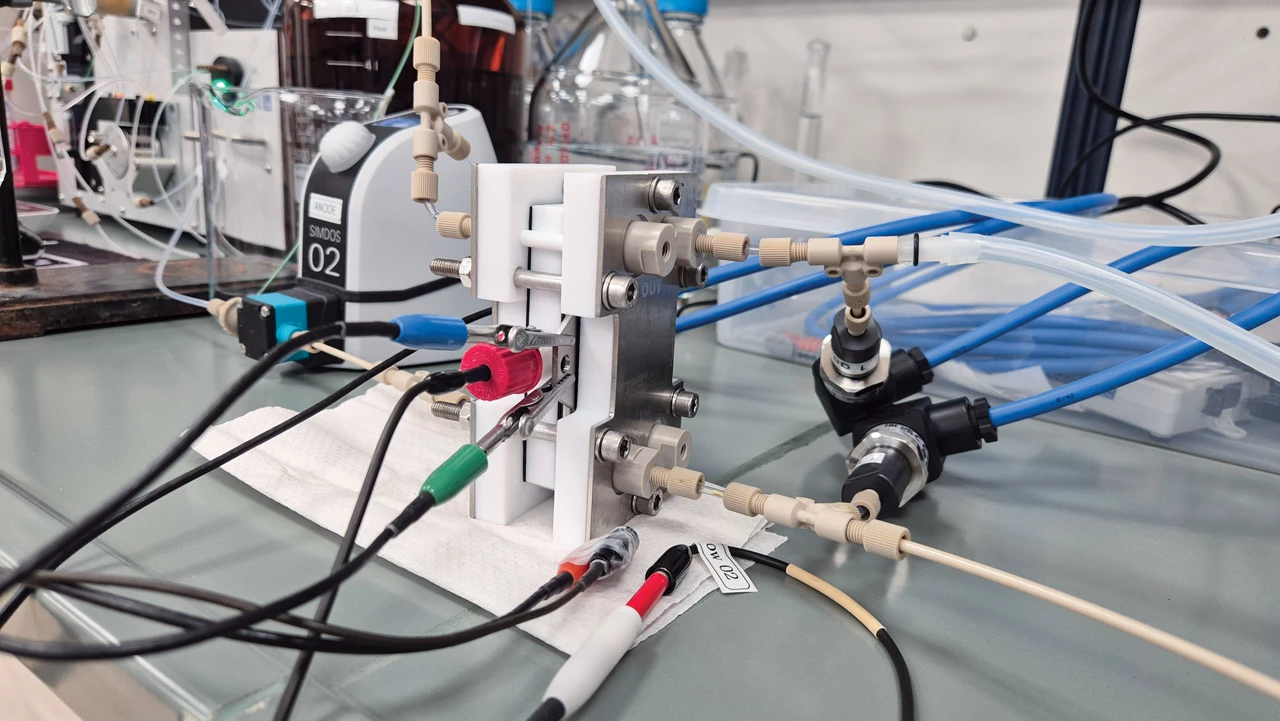
Wires and tubes emerge from a small tabletop device.
Atmonia is developing a reactor that uses a new catalyst and electricity to produce ammonia at low temperature and pressure.
Credit:
Atmonia
Atmonia uses a new catalyst and electricity to produce ammonia at low temperature and pressure. Unlike conventional ammonia plants, the company’s reactor can easily be turned on and off, making it possible to connect it to cheap, intermittent sources of electricity like solar panels.
In February, Atmonia won a grant from the European Innovation Council to start scaling up the process. The company hopes to develop shipping container-sized plants that farmers can operate on their own land. While the technology won’t provide an immediate solution—Atmonia’s reactor is years from commercialization—Dögg Flosadóttir hopes such systems will give farmers more control over their fertilizer and insulate them from future wars or disasters.
“They will be the producers of their own fertilizer, and they won’t be dependent on international value chains and geopolitics,” Dögg Flosadóttir says.
Other firms developing decentralized methods of making nitrogen fertilizers are also progressing. Nitricity, based in California, raised $50 million last September to commercialize a process that converts almond waste into organic fertilizer. PlasmaLeap Technologies recently raised $20 million for technology that uses plasma to convert air into nitrogen fertilizer, and TalusAg is planning a green ammonia plant that will serve local farmers in Iowa and Minnesota.
But producing fertilizer at local scale is more expensive than making it in massive manufacturing plants, says Lorenzo Rosa, a principal investigator at Carnegie Science who researches fertilizer production. Farmers operate on such tight margins that it’s tough for them to justify paying for protection from price spikes that might happen only once every few years, he says.
“It’s just a matter of finding someone willing to pay,” Rosa says. “Are companies, farmers . . . or countries willing to pay the green premium to offset reliance on imports and improve resilience?”
In an October report from the climate-focused think tank Agora Industry, Rosa and Agora analysts argue that small-scale fertilizer production will be an important complement to centralized manufacturing, even if it doesn’t completely fulfill local demand.
Phosphorus-containing fertilizers have also been affected by the war. More than 20% of the world’s phosphate fertilizers come from countries affected by the closure of the Strait of Hormuz, according to the Fertilizer Institute, an industry group. The region is also a major producer of sulfur, a raw material used to make phosphate fertilizers elsewhere.
The fertilizer price spikes in recent years have put a spotlight on new fertilizer technologies, says Hunter Swisher, CEO of Phospholutions, a start-up that makes an additive to increase the efficiency of phosphate fertilizers. But the momentum doesn’t last long enough to boost new technology all the way from concept to commercialization, he says.
“That shock maybe lasts a year,” Swisher says. “These innovations take many years to develop, many years to commercialize at a meaningful scale.”
Dögg Flosadóttir says the recent upheavals have sparked interest in fertilizer start-ups more for their potential to ensure a stable food supply than for their low carbon footprint—an argument that could have more staying power.
“Security is what people are thinking about now,” Dögg Flosadóttir says. “People have not forgotten it.”

Matt Blois is a food, ag, and cleantech reporter at C&EN.
Chemical & Engineering News
ISSN 0009-2347
Copyright ©
2026 American Chemical Society