


Global girl group GIRLSET under JYP Entertainment / Courtesy of JYPE
K-pop agencies are accelerating their push into overseas markets this month, unveiling new music from global acts positioned beyond the traditional K-pop idol framework.
March has seen fresh releases from JYP Entertainment’s global girl group GIRLSET and HYBE Labels’ Latin boy band SANTOS BRAVOS, underscoring how major labels are continuing to refine exportable versions of the K-pop production system.
GIRLSET, rebranded from VCHA, returned March 6 with the digital single “Tweak,” a track shaped by JYP’s founder and chief producer Park Jin-young alongside Grammy-winning hitmaker Diego Ave. Built on a sleek blend of late-1990s R&B textures, the song draws on vintage sonic references while maintaining K-pop’s polished performance focus.
The accompanying music video also quickly gained traction online, with the clip surpassing 10 million views on YouTube by Thursday and reaching No. 1 on the platform’s worldwide music video trending chart shortly after its release.

From left, GIRLSET members Lexi, Camila, Savanna and Kendall / Courtesy of JYPE
HYBE’s Latin boy band SANTOS BRAVOS followed with the release of its first mini album, “DUAL,” Friday. The six-track project presents a contrast between the group members’ brightness and intensity, framing its identity through a blend of Latin pop influences and the structured production approach within the K-pop system.
According to the label, the title track “MHM” unfolds as a melody-driven Latin pop number, layering warm vocals over synth textures and percussive rhythms to capture the excitement of a budding romance. It offers a tonal counterpoint to performance-forward tracks like “KAWASAKI” and “0%,” which foreground sharper choreography and high-energy staging.
Other songs broaden the album’s sonic palette, including the upbeat, rhythmically propulsive “WOW,” the speed-driven Brazilian funk-inspired track “VELOCIDADE” and the emotive Latin ballad “FE,” which spotlights the members’ vocal delivery.
The group is also set to release a five-part documentary series, “Behind DUAL,” on Spotify beginning Monday, chronicling the album’s creative process and the members’ development as performers.
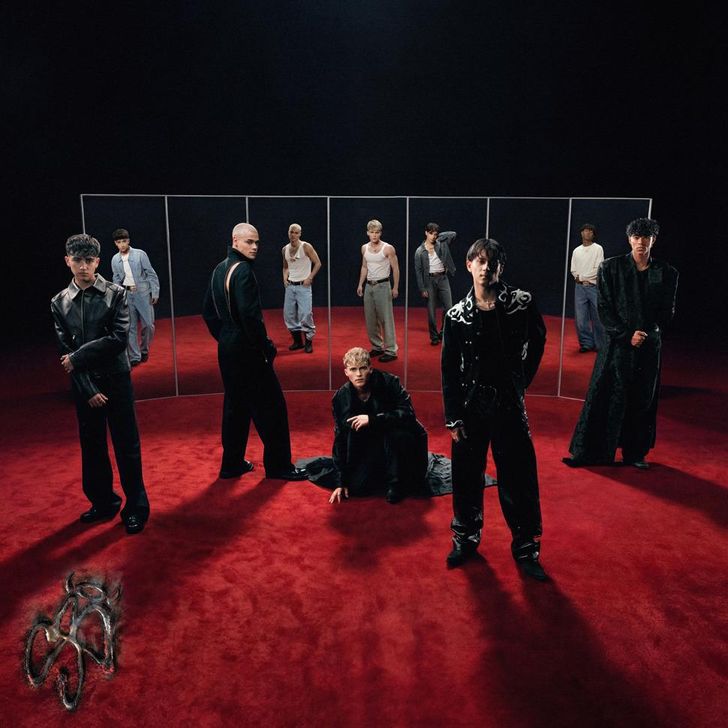
SANTOS BRAVOS, the Latin boy band under HYBE Latin America / Courtesy of HYBE Labels
Global model 2.0
The back-to-back releases arrive as the globalization of the K-pop production system faces renewed scrutiny.
Recent controversies surrounding global girl group KATSEYE have highlighted the operational challenges of managing artists across different cultural and linguistic environments.
In February, KATSEYE member Manon announced a temporary hiatus from group activities, with management citing a need to focus on her “health and well-being.” The decision triggered widespread speculation after the singer separately reassured fans she was in good condition, prompting online debate over transparency in communication between the label, the group and its global fan base.
The situation escalated further when social media comments attributed to a parent of another KATSEYE member circulated widely among fans, fueling criticism that the issue was being handled insensitively.

Girl group KATSEYE, a joint project under HYBE America and Geffen Records, performs its 2025 hit “Gnarly” during the 68th Annual Grammy Awards on Feb. 1, in Los Angeles. AP-Yonhap
The episode has since expanded into a broader conversation about representation, artistic positioning and the sustainability of multinational idol projects. Supporters noted that the KATSEYE controversy reflected deeper structural pressures faced by international artists operating within a system historically designed around a single national training pipeline.
March releases from GIRLSET — whose earlier activities under the VCHA name also exposed some of the growing pains faced by multinational idol projects — and SANTOS BRAVOS, the genre’s first-ever Latin American boy band, suggest major agencies are continuing to experiment with hybridized strategies rather than scaling back overseas expansion.
By foregrounding region-specific genres, from retro-inspired R&B to Latin pop and Brazilian funk, while preserving the tightly structured choreography, visual storytelling and serialized content rollouts associated with K-pop, labels appear to be testing how far the model can evolve as the industry enters a new phase of global competition.