
Feelings can seem messy and hard to pin down. One moment you might feel anxious, the next excited, and sometimes both at once.
A new study suggests that the mind arranges emotions on an internal map, grouping related feelings while keeping distinct ones farther apart.

That structure could help the brain navigate emotional experiences, turning rapidly changing feelings into an organized mental landscape.
Understanding that hidden map may reveal how people interpret emotions, regulate them, and move from one feeling to the next.
Brain activity tracks emotions
Across more than 2.5 hours of short films, viewers’ reported feelings rose and fell in patterns that brain activity mirrored.
Working from those patterns, researchers at Emory University found that hippocampal and prefrontal signals recorded where emotions belonged within this internal layout.
Anger and fear repeatedly appeared as near neighbors, while emotions such as happiness and excitement occupied more distant positions.
Such ordering points to a shared framework for organizing emotion, raising the question of how different brain regions divide the work of maintaining that map.
Brain regions share emotional roles
Deep in the brain, the hippocampus, a deep brain structure that helps build memory, carried the clearer signature of emotion categories.
Farther forward, the ventromedial prefrontal cortex (vmPFC), a frontal area that weighs meaning and value, tracked where those categories sat overall.
Within the hippocampus, posterior sections held finer distinctions, while more interior sections captured broader contrasts such as good versus bad.
This arrangement suggests that feelings are organized at several scales at once, from blunt emotional direction to narrower, more specific states.
Watching feelings change
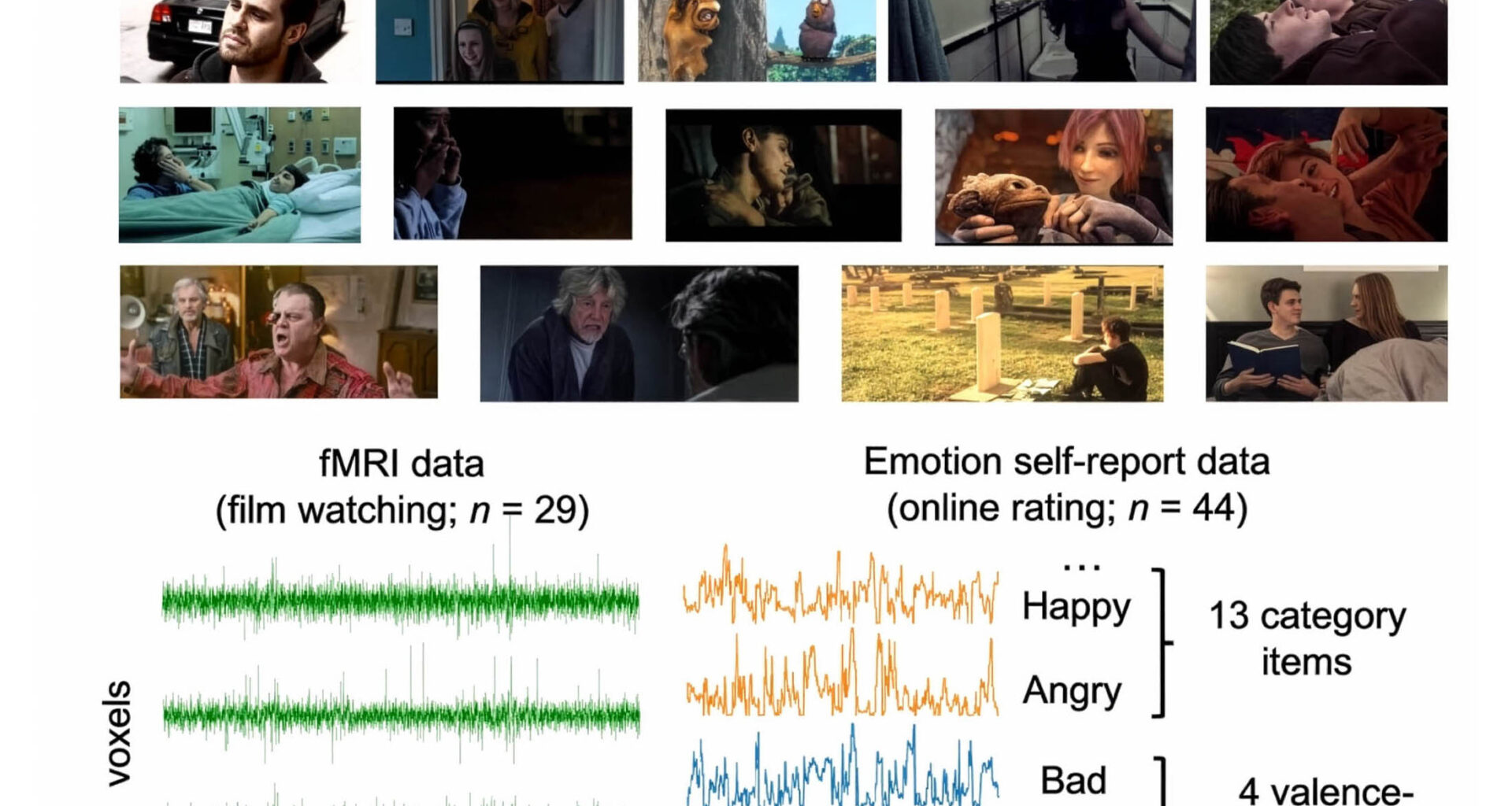
To capture emotions as they changed, 29 people watched 14 short movies while brain scans recorded activity over four sessions.
A separate group of 44 raters marked what each moment felt like, giving the researchers a moving emotional timeline for comparison.
Because the clips unfolded like real experiences, the team could test not just isolated flashes of feeling but also transitions between them.
Naturalistic clips made the evidence stronger for mapping emotional movement, which depends on sequence and context rather than single still moments.
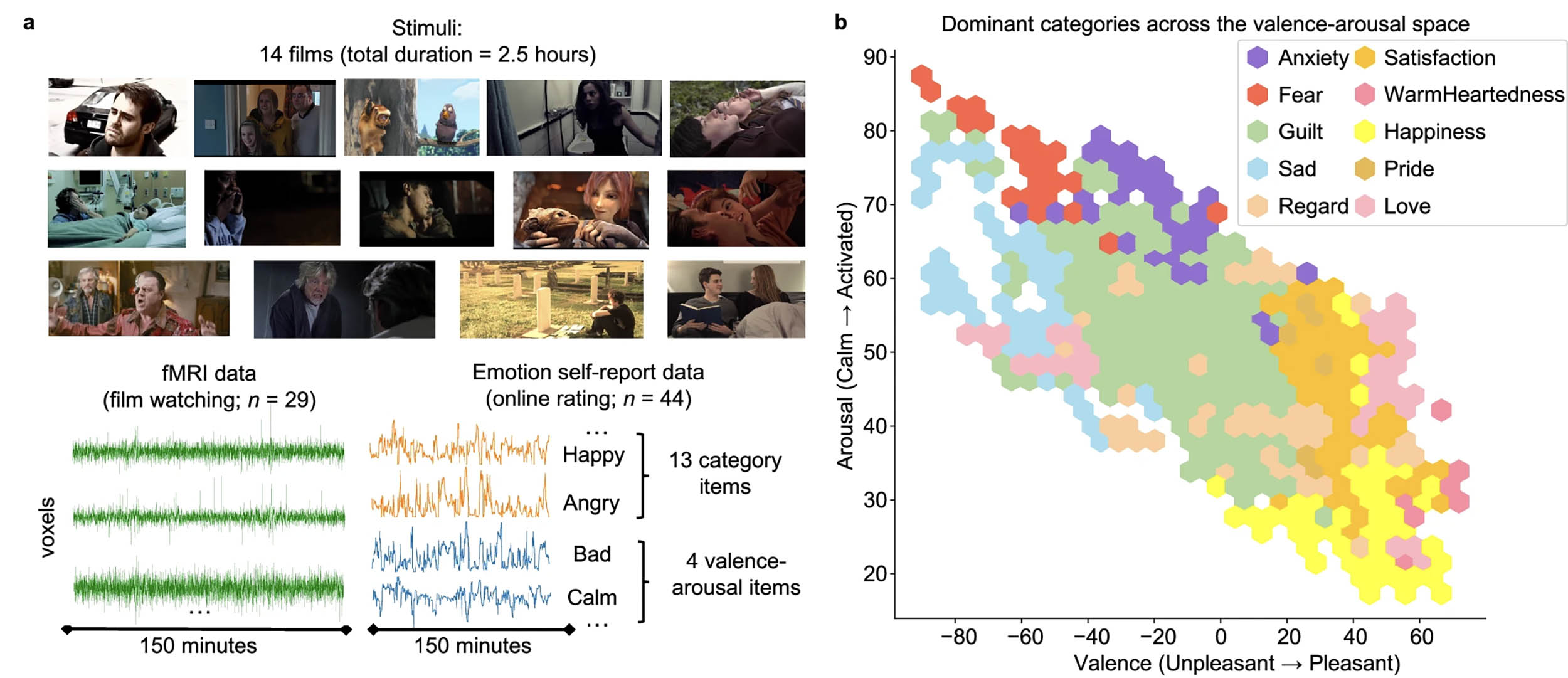 Map-like representations of emotion knowledge in hippocampal-prefrontal systems. Credit: Nature Communications. Click image to enlarge.Learning may build emotion maps
To test whether this emotional structure could emerge through learning, the researchers trained an artificial intelligence system on an abstract grid of emotions.
The model, called the Tolman-Eichenbaum Machine, is designed to learn relationships between experiences. In the simulation, virtual agents could move through the grid, stay in place, and predict what emotional state might come next.
“For the current paper, we wanted to probe how the human brain compresses emotion experiences,” said study co-author Philip Kragel, assistant professor of psychology at Emory University.
When the model began producing patterns similar to those seen in the brain scans, the results suggested that the brain may gradually build its emotional map through ordinary learning over time.
Emotions are more than mood
The emotional map was not simply a scale of good versus bad or calm versus energized.
Patterns in the hippocampus preserved richer emotional groupings, showing that the brain retains more detail than a simple two-number score.
That extra detail matters because emotions such as sadness, guilt, and fear may all feel unpleasant, yet they signal very different situations and responses.
An effective emotional map therefore needs both overall direction and finer distinctions, which is the division these brain systems appeared to maintain.
Brain organizes emotions like knowledge
Earlier reviews of brain imaging studies found little evidence that individual emotions occupy neat, isolated locations in the brain.
Instead, this study suggests the brain may rely on a shared system that organizes emotional knowledge in much the same way it organizes space, memory, and relationships.
A map-like system could help explain why people can shift from anxiety to fear or from delight to pride without starting from scratch.
Feelings may seem messy in the moment, but the system that stores and organizes them may be far more orderly than they appear.
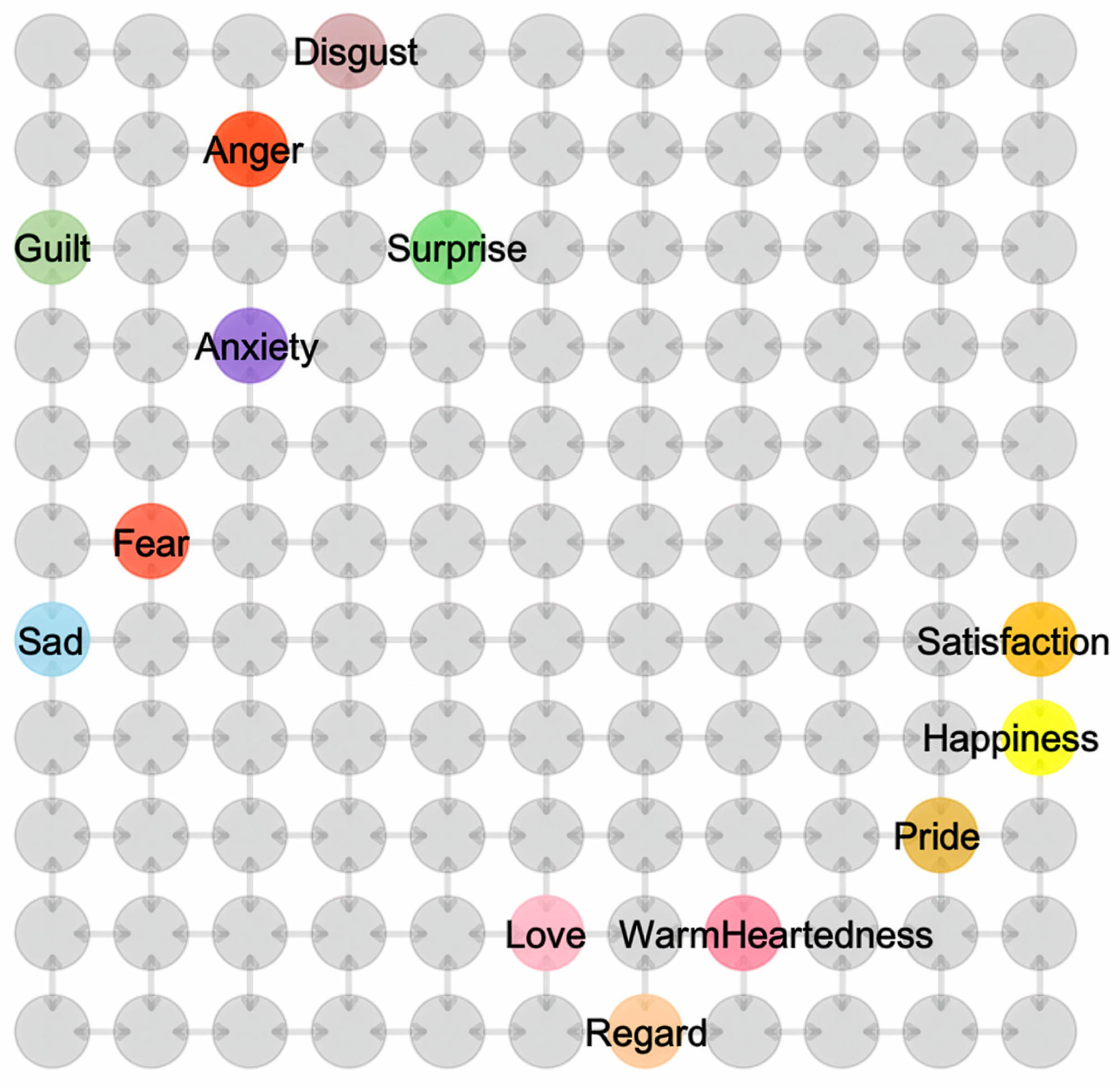 An illustration of the environment in which artificial agents were allowed to “walk” and make their own predictions about what they would experience depending on where they moved along the graph. Credit: ECCO Lab. Click image to enlarge.Blurred emotions linked to disorders
The ability to distinguish between similar emotions, known as emotion granularity, has been linked to mental health in earlier research.
One study found that people with major depression differentiate negative emotions less clearly, even after accounting for how intense those feelings are.
Among adults with social anxiety, another study reported weaker separation between negative emotions during everyday life.
These findings suggest that when emotional experiences blur together, it may become harder for people to understand and regulate what they are feeling.
Emotion maps remain incomplete
Even so, the emotional map described in this study is only a simplified representation. The researchers focused on two broad dimensions, pleasantness and bodily intensity, which cannot capture every part of emotional experience.
Emotions also vary with certainty, effort, control, memory, culture, and personal history, none of which fit neatly on just two axes.
Because brain scans blur rapid neural timing, they cannot show whether this map relies on the same fast signals seen in spatial navigation.
For now, the results point to a plausible structure for organizing emotions rather than a complete theory of how emotional experience works.
Where emotion research goes next
Next, researchers want to know whether this internal emotional layout changes across childhood, culture, or mental illness. They also need to test whether broad emotional categories appear first and finer distinctions emerge later through learning.
“These are open questions,” said Kragel, pointing to how much remains unsettled. Answering them will matter for education, therapy, and efforts to strengthen emotional skills before problems harden.
By tying films, brain activity, and artificial learning together, the study suggests that emotion may be less chaotic than it seems and more like an organized system.
The findings do not turn feelings into a simple grid, but they provide a concrete way to study how emotional knowledge forms and strengthens over time.
The study is published in the journal Nature Communications.
—–
Like what you read? Subscribe to our newsletter for engaging articles, exclusive content, and the latest updates.
Check us out on EarthSnap, a free app brought to you by Eric Ralls and Earth.com.
—–