
By: Sarit Zehavi and Tal Beeri
General
What will bring security to the residents of northern Israel? Is a security zone required, and what should its size be? If a security zone is established in Lebanon, how is it to be maintained in terms of the manpower of soldiers, given that the area of southern Lebanon is larger than the Gaza Strip? How do we avoid reaching a situation in which we are once again in a static defense posture, as we were in the security zone in Lebanon during the 1980s and 1990s—a situation from which we have very negative memories.
On the other hand, ideas that focus on the willingness or ability of the Lebanese Army to disarm Hezbollah have repeatedly proven irrelevant. Over the years the Lebanese Army has received billions of dollars in international aid; unfortunately it remains weak. It cannot, and does not want to, act systematically and actively to disarm Hezbollah. The answer will not be found in aid to the Lebanese Army at this stage.
It is time to abandon old solutions and think outside the box.
Below, we propose a combined set of moves that can bring about a profound change in the security of Israeli civilians in general and the residents of northern Israel in particular. The working assumption is that Hezbollah will not voluntarily disarm, and that the Lebanese government fears civil war and therefore will not do so itself in the immediate time frame. The second working assumption is that achieving a fundamental change requires coordinated action by several actors: the Lebanese government, Israel, and the international community, across multiple efforts, multiple fields, and multiple arenas.
The logic guiding agreements with the Lebanese government following conflicts with Israel must change. Until now, the underlying assumption has been that the Lebanese government would disarm Hezbollah, beginning with the implementation of UN Security Council Resolution 1701 south of the Litani River—along the border with Israel.
However, it has repeatedly become clear that the Lebanese government will never act to disarm Hezbollah. The period since the beginning of the ceasefire (November 2024), and Hezbollah’s subsequent entry into the war in March 2026, have demonstrated this clearly. Moreover, its ability to impose sovereignty in the area south of the Litani, populated by a Shiite base loyal to Hezbollah, while up to about 50 percent of its army is Shiite, is very limited to non-existent.
Therefore, Lebanese government activity as part of the effort to dismantle Hezbollah’s power in the state and impose sovereignty must begin from north to south and focus on Beirut—Beirut as a concept rather than a geographical area. Beirut as the sovereign capital of Lebanon where its governing institutions are located.
As part of this effort, the Lebanese government must focus first on the civilian level, the financial level, purging the ranks of the Lebanese Army, and coordination with Syria to prevent weapons smuggling. However, it must not be assumed that the Lebanese government will do this; but if and when it does, below is what it must do:
The Civilian Effort
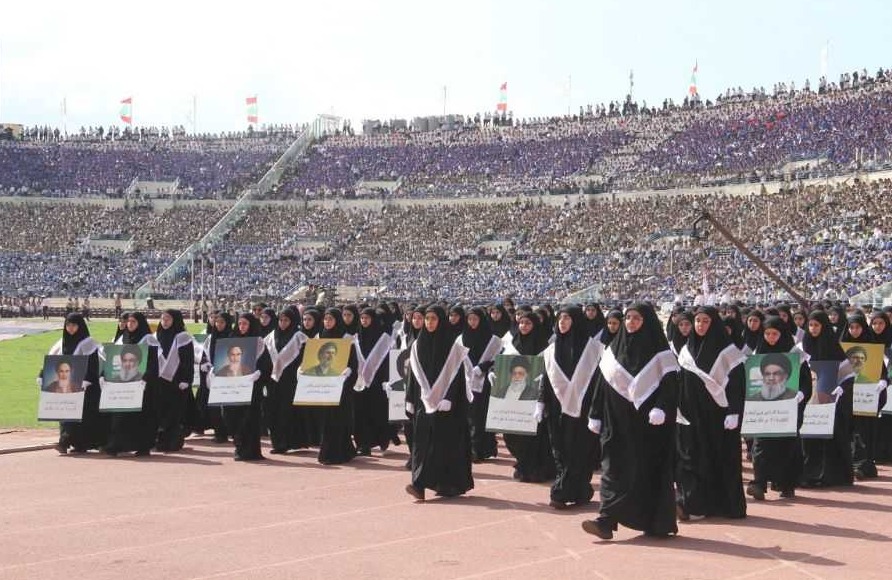
Accordingly, the Lebanese government should formally designate Hezbollah as a terrorist organization. Displays of power such as the memorial event for Hassan Nasrallah, where roughly 70,000 members of the Al-Mahdi Scouts gathered in a Beirut stadium under banners and images of Iran’s leaders, Khamenei and Khomeini, should not be permitted to take place.
Declaring Hezbollah illegal would lead, for example, to the dismissal of Ali Hamieh, the presidential adviser for reconstruction, who is a Hezbollah member; it would enable to improve efforts against terror financing; and it would outlaw all civilian enabling activity of Hezbollah: the Al-Amana gas stations, Hezbollah schools, Jihad al-Bina – responsible for building Hezbollah assets and using civilian properties for military purposes; and the various Hezbollah civil associations that take part in terrorist activity, such as “Green Without Borders” and “Help Each Other” and other associations that are part of Hezbollah’s social fabric and support the Shiite base. Many of these organizations operate under Hezbollah’s Executive Council.

For the Lebanese government to designate Hezbollah as a terrorist organization, substantial international pressure on Lebanon, along with support for enforcement, will be required. In addition, all countries seeking to play a role in shaping the future regional arrangement—particularly France—should designate Hezbollah in its entirety as a terrorist organization.
The international system must understand that all Hezbollah civilian systems serve the military arm, and as long as they are not shut down, there will be no sovereign state in Lebanon.
At the same time, international aid must be provided to create an immediate functioning alternative for every Hezbollah organization or association that is closed.
After the war, the international community should work with the Lebanese government to dismantle Hezbollah’s independent education system and replace it with schools operated by the Lebanese state under a national curriculum. A similar approach should be applied to Hezbollah’s health services (the Islamic Health Organization) and its welfare system.
Over the past year, despite significant economic hardship, Hezbollah has continued to invest in its civilian activities. Although it has struggled to rebuild damaged areas, it has maintained social events, food distribution, and the development of infrastructure for the benefit of its constituency, efforts that have been widely publicized for public relations purposes. These activities consistently convey familiar messages of loyalty to Iran, the concept of the “Resistance Society,” and a culture that glorifies death. This dynamic must come to an end.
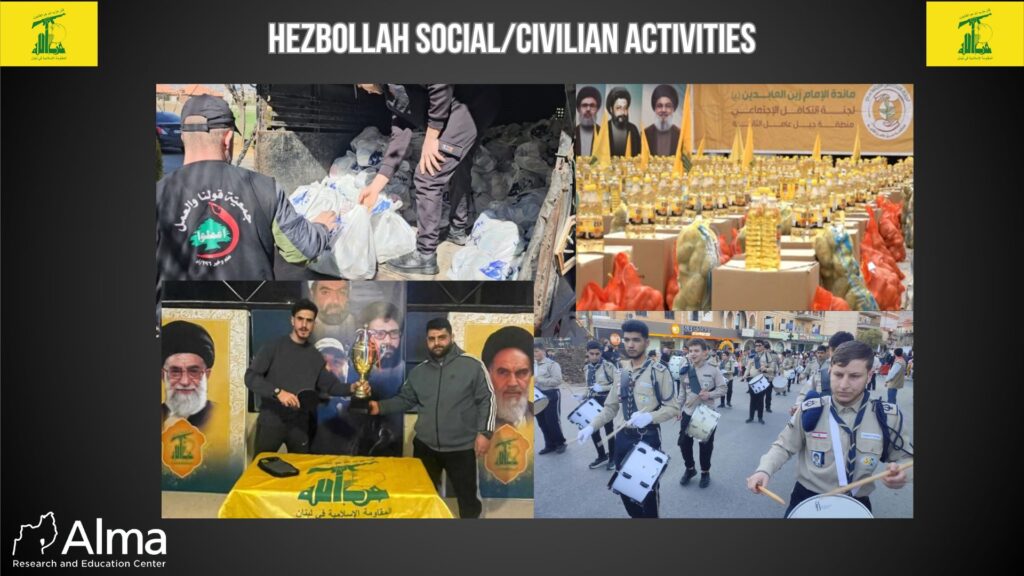
If the Lebanese government, rather than Hezbollah, provides these services to citizens through a sustained multi-year program, it could gradually produce meaningful social change. The current humanitarian crisis in Lebanon, marked by roughly one million people displaced by the war, also presents a window of opportunity. Much of the Shiite population is no longer in its home villages, having evacuated the conflict zones and now requiring extensive humanitarian assistance. It is therefore essential to ensure that this aid is not delivered by Hezbollah.
Unfortunately, at the time of writing, although aid is being delivered in the field by Saudi Arabia and Qatar, Hezbollah has a presence among the displaced and conducts extensive public relations efforts to demonstrate its presence among the evacuated base. In addition, despite their situation, the general mood among the base is support for the war that Hezbollah brought upon them.
However, we are at the beginning of the campaign and there is a major opportunity. Any humanitarian aid provided to the displaced by the Lebanese government must be clearly branded as such. The evacuees must understand that their government—not Hezbollah—is taking care of them.
In the civilian–diplomatic context, Lebanon should sever its diplomatic relations with the Islamic Republic of Iran. It is untenable for the embassy of a state that, through Hezbollah, seeks to undermine the Lebanese state and extend the influence of the Islamic Revolution within it to continue operating in Lebanon.
The Financial Level
The Lebanese government must ban all Hezbollah economic activity in Lebanon. This includes exchange offices that work with Hezbollah and Hezbollah’s central bank, Qard al-Hassan.
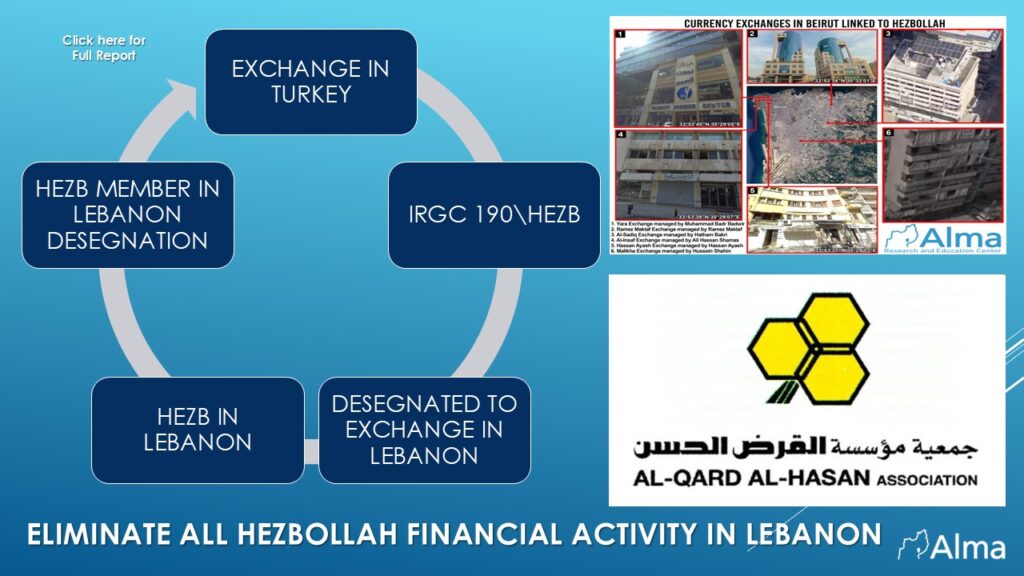
FOLLOW THE MONEY – The Lebanese government’s activity alone against Hezbollah’s economic empire will not suffice. Over the years Hezbollah has developed independent sources of income that will help it survive even after Iranian support stops. It is a global mafia organization, with criminal activity and revenue streams on every continent. Therefore, determined international action is required to pursue Hezbollah’s terror finances. This is an enormous effort requiring intelligence, investigation, and enforcement capabilities worldwide, but it is crucial not only for Lebanon’s future but also for stopping Iranian and Hezbollah terror activities worldwide.
Purging the ranks of the Lebanese Army
A purging of the ranks is required in the Lebanese Army—officers (and soldiers) who cooperate with Hezbollah must be immediately dismissed. Significant operational positions, especially those responsible for the southern sector, must be staffed by officers known for their opposition to Hezbollah over the years.
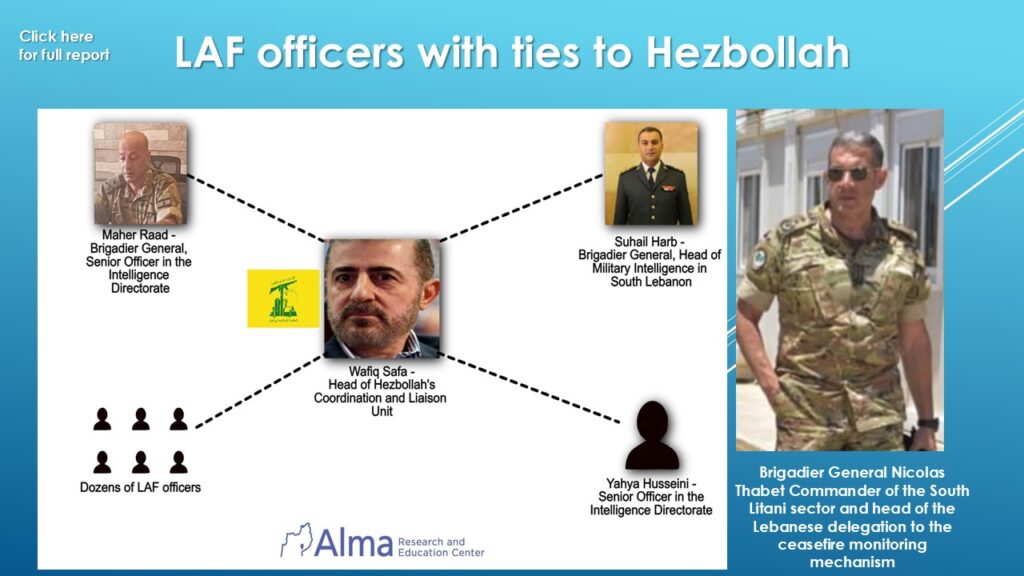
Beyond that, the problem is that the fish rots from the head—Rudolf Haykal, commander of the Lebanese Army, has ambitions. He wants to become the president of Lebanon in the future. Because of this he prefers not to confront Hezbollah. Therefore, he outlines a policy that first serves Hezbollah’s interests at the expense of Lebanon’s interests.
Under him, Nicolas Thabet, commander of the sector south of the Litani, consistently presents a hard line against Israel and constantly aligns himself with the “spirit of Hezbollah.” We recall that Thabet began his career in the Presidential Guard during the tenure of Emile Lahoud, known as “the president of the resistance,” and considered very close to Hezbollah. Later, Thabet served in the Intelligence Directorate, an organization we know well for its penetration by Hezbollah.
Only after “the right people” are appointed in the Lebanese Army, those who can truly lead it in fulfilling its mission, should the army be strengthened in intelligence, salaries, and equipment to assist it in acting against Hezbollah.
Such a purging of the ranks would send a clear message of support to Lebanese Army officers who oppose Hezbollah and wish to dismantle its weapons. They will understand that their efforts will not be in vain. Make no mistake: there are many professional and patriotic officers in the Lebanese Army whose highest priority is the Lebanese state.
Illegal Weapons Smuggling
The border with Syria stretches about 400 kilometres. The main area where weapons smuggling takes place is the eastern border with Syria, especially its central and northern parts. Weapons smuggling continues even under the al-Sharaa regime. The economic interests of smugglers from Syria drive these activities even under al-Sharaa’s rule. A cooperation mechanism must be created between the Lebanese Army and the al-Sharaa government to prevent smuggling. It should be noted that even now, possibly as part of such a move, Syrian forces have been deployed along the border with Lebanon and are threatening Hezbollah.
Will the Lebanese Government Really Do All This?
Part of the answer lies in Tehran—the weaker the Iranian regime becomes, the greater the chance that the Lebanese government will agree to stand up to Hezbollah. If the Islamic Republic survives—Hezbollah will survive as well and even draw strength from it. The fall of the regime in Iran would cut Hezbollah’s oxygen pipeline in terms of weapons, professional training, and money. Hezbollah would become far more isolated, and its ability to invest large sums in both military and civilian infrastructure would decline significantly. Nevertheless, it would not disappear entirely. As noted, it possesses independent sources of revenue and continues to benefit from strong ideological support within its large Shiite base in Lebanon.
In addition, the fall of the Iranian regime would test Hezbollah’s ideological compass. Would it be able to introduce Lebanese considerations into its decision-making processes while its loyalty was to an Islamic Republic that no longer exists? It is difficult to answer this question now.
In any case, as noted above, it must not be assumed that the Lebanese government will do all this, and certainly not immediately. The ideas proposed above require a long process, focused on Beirut and in the governance of the Lebanese government there.
Israel’s Military Move
Meanwhile in southern Lebanon—the responsibility lies with Israel to protect its citizens. It cannot be expected that the Lebanese government will simultaneously impose sovereignty in the south and in Beirut. Israel does not have time to wait until they reach the south—the residents of northern Israel deserve security.
It is important to understand the geography—the length of the Israel–Lebanon border is about 120 km, and in most areas the Litani River is 20–30 km away. This is except for the area known as the Litani Bend, which lies less than 5 km from the Israeli community of Metula, a community surrounded on three sides by Lebanon. Israel has more than 20 communities adjacent to the border fence, where residents’ homes are only meters from the fence.
In the 2024 war, Israel cleared the villages adjacent to the fence on the Lebanese side of all Hezbollah presence. This allowed it not to evacuate residents from Israeli communities in the current campaign, but it does not stop Hezbollah from firing at them around the clock.
We waited 20 years for the Lebanese government to disarm Hezbollah south of the Litani according to Resolution 1701, and it did not do so. Therefore, to bring security to the north, Israel must be allowed to disarm Hezbollah south of the Litani. This may take several weeks to months. Israel has already called on residents to leave these areas. Manoeuvrings without a civilian population (or hostages) will be faster than the experience in Gaza. Clearing the area south of the Litani will remove the threat of infiltration, invasion, mortars, and anti-tank missiles from northern Israeli communities and make it harder for Hezbollah to fire rockets at them.
After we clear the area, the most important question is how to maintain the achievement. What will prevent Hezbollah from returning south again and threatening northern Israeli communities?
First, implementing all the processes detailed above will eventually affect southern Lebanon as well and slow Hezbollah’s rebuilding of its military deployment there.
Second, Israel must retain the right to adopt a policy of permanent strategic weakening for years ahead against Hezbollah and continue to strike anything related to Hezbollah directly or indirectly in relation to its rebuilding and rearmament processes—especially military ones—anywhere in Lebanon. This policy will not harm Lebanon; on the contrary, it will help it impose its sovereignty and the principle of “one weapon.”
Third, because Hezbollah operates within the Resistance Society, a 10 km buffer zone from the border must be created. In this area there will be no civilian presence. Lebanese villages in this area will not be rebuilt, because it is clear that the day they are rebuilt, Hezbollah’s military infrastructure will be rebuilt within them according to the principle of the “Resistance Society” described above. Therefore, in post-war arrangements it will be clear that any attempt by Hezbollah to rebuild the villages will be interpreted as a violation. Israel will have the right to strike any Hezbollah violation. The focus must be on treating violations, not reporting violations, which has not proven effective in preventing Hezbollah’s buildup over the years.
In these areas, until the war, thousands of Lebanese lived, and the humanitarian questions arising from the need to create a civilian-free buffer zone cannot be ignored. However, the alternative—allowing the return of Lebanese civilians who support Hezbollah to areas adjacent to Israel—means continued wars and bloodshed. The return of Lebanese civilians to the buffer zone will only be possible if and when it becomes clear that the concept of the “Resistance Society” hosting Hezbollah and its weapons no longer exists, which is likely not realistic even in the more distant future.
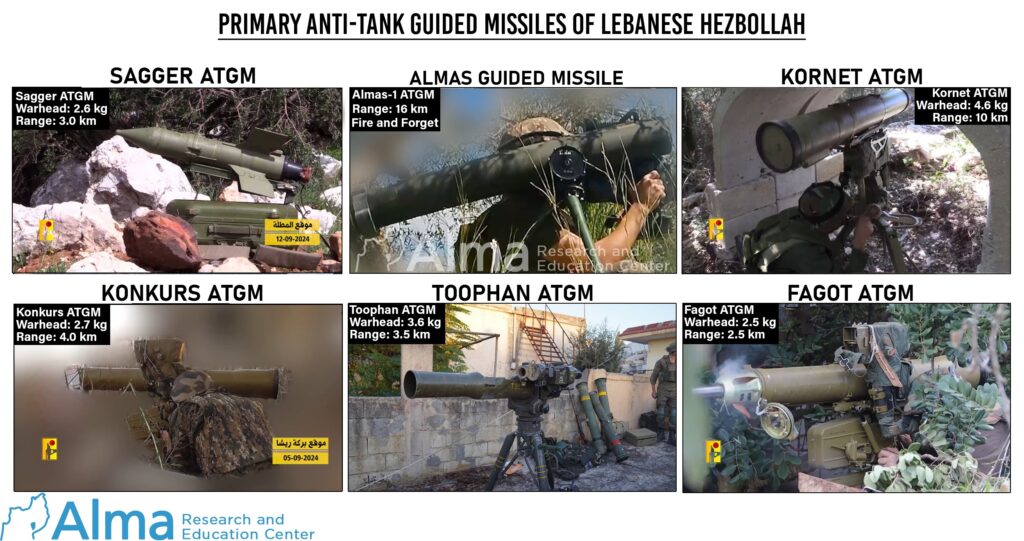
Why 10 km? During the 2024 war, Hezbollah used anti-tank missiles against Israeli border communities. These are highly precise weapons that provide no advance warning before launch, and Israel’s air-defense systems are not designed to intercept them. While Israeli tanks are equipped with active protection systems against anti-tank missiles, such systems cannot be installed on homes or used to protect civilians living along the border. The most advanced missiles of this type in Hezbollah’s arsenal may have a range of up to 16 km (such as the Almas missile), but our assessment is that the majority of Hezbollah’s anti-tank missiles have an effective range of up to roughly 10 km. The continued relevance of this threat is evident today, as Hezbollah has joined the current war.
In the Litani Bend, where the distance is only a few kilometres from Israel, a unique solution must be provided so that Israel can control fire and observation over the northern Litani area and protect Metula and surrounding communities.
So Is the Endgame a Security Zone in Lebanon?
In military language, every action is defined by an objective and a required achievement. The required achievement is security for the residents of the north. The objective is the strategic weakening of Hezbollah and distancing it from the border. A security zone is neither a required achievement nor an objective in itself—it is merely a tool. It also carries significant costs: the area in question is larger than the Gaza Strip, and maintaining long-term IDF control would require extensive reserve service, imposing considerable economic and social burdens on Israel. Moreover, past experience shows that once the IDF adopts a static posture and relies on fixed outposts, its ability to effectively control the area and prevent terrorists from infiltrating the security zone becomes severely limited.
Therefore, once the area south of the Litani has been cleared, it will be possible to discuss the conditions for establishing a buffer zone, including a potential IDF withdrawal to five designated positions that would enable enforcement from those locations. Such steps would depend on the outcome of the campaign in Iran, dialogue with the Lebanese government, and any actions it may take against Hezbollah, as outlined above. The very discussion of a buffer zone could serve as a form of leverage—both incentive and pressure—to encourage Lebanon to act against Hezbollah in Beirut.
Israel’s Military Move in Beirut – Here the working assumption is that Israel will not want to occupy Beirut or the Bekaa Valley. However, almost every house in the Dahiya serves Hezbollah, both for headquarters and for production and storage sites of precision missiles and UAVs. Israel has called on the Dahiya residents to evacuate; it must be allowed to destroy all Hezbollah infrastructure there—every last one.
Afterward, the Lebanese government must maintain an increased presence of Lebanese security organizations there to prevent Hezbollah from rebuilding warehouses and headquarters. It is important to ensure that the Lebanese government chooses a security organization in which Hezbollah’s influence and cooperation potential are the lowest.
In Lebanon, in addition to the army, three security organizations operate. Two of them, the General Directorate of General Security (GSGD) and the Internal Security Forces (IS-ISF), are subordinate to the Ministry of Interior.
The third organization, the State Security Directorate (SSD), operates directly under the Lebanese presidency and its main role is securing government institutions, sites, and officials. This is the organization we recommend for carrying out the above mission.
In addition, all Hezbollah civilian infrastructure must be attacked, such as:
The Al-Amana gas station network.
Hezbollah fuel depots.
The organization’s solar electricity infrastructure.
All assets of the Jihad al-Bina organization.
Israel’s Relations with the Lebanese State – Any negotiations with the Lebanese government prior to the completion of Israel’s military campaign should take place while military operations continue, in order to first secure the military achievements outlined above. At the same time, attacks on Lebanese state infrastructure should be avoided. Such actions do not contribute to the operational effort. Targeting Lebanese state infrastructure would not impact Hezbollah and would instead further weaken the Lebanese state, which is already in a fragile position vis-à-vis Hezbollah. (As noted, the focus should remain on Hezbollah’s civilian infrastructure as detailed above).
Israel has an interest that the Lebanese state “defeats” Hezbollah one day, because as we saw in the Iranian case, threats can evolve even from a distance from Israel’s borders.
In conclusion, direct negotiations between the Lebanese government and Israel, as currently proposed by President Aoun, could be very interesting—but they cannot ignore the elephant in the room: Hezbollah is armed and dangerous. At the time of writing, more than 1,000 Hezbollah targets have been struck by Israel—imagine how little the Lebanese government did between the two wars, in the period between November 2024 and March 2026.
The working assumption of all future arrangements is that the Lebanese do not want to fight Hezbollah for fear of civil war. This dynamic is likely to change only if Hezbollah becomes significantly weakened, if Lebanon’s Shiite community is offered viable political and social alternatives, and if the risk of a violent civil war diminishes as Hezbollah’s power declines.
For now, it appears we are very far from that point, and this is a long process lasting several years, with a low probability of success to say the least. Therefore, Israel’s military effort is of great importance, as are international pressure and the financial struggle against Hezbollah.
Hezbollah is not afraid of civil war, on the contrary. It is not afraid that Lebanon will be destroyed because it believes this would help it emerge from a civil war even stronger relative to other demographic groups in Lebanon. Its goal, to take over Lebanon, would then be within reach.
Hezbollah is here to stay. However, another military campaign in the near future must be avoided. Northern Israel requires a prolonged period of recovery and stability and cannot sustain repeated rounds of conflict at short intervals. Therefore, the damage inflicted on Hezbollah in the current campaign must be sufficiently significant, accompanied by arrangements that enable the continued disruption of its military buildup. The objective is to limit Hezbollah’s capabilities and ensure that the organization remains constrained and strategically weakened over time.
