

Listen to this article
Estimated 4 minutes
The audio version of this article is generated by AI-based technology. Mispronunciations can occur. We are working with our partners to continually review and improve the results.
New Brunswick Premier Susan Holt says health care won’t be exempt from her efforts to cut spending — even though her health minister says big spending increases will be unavoidable in coming years.
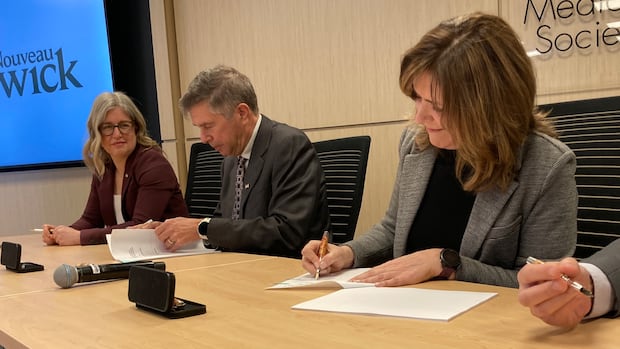
Holt and John Dornan were sitting side-by-side when they made the comments after the signing of a new four-year pay agreement with the province’s doctors.
The contract, with financial incentives for doctors who agree to work in collaborative care clinics, is costing taxpayers $176 million this year.
Overall, health-care spending is $432.5 million over budget this year, with the agreement responsible for 40 per cent of that increase.
Inflation will mean that on a regular basis there will be an increase in cost to our system.- Health Minister John Dornan
Holt has asked all government departments to look for how to reduce spending by 10 per cent to get a ballooning budget deficit under control.
She said health care is not exempt from that effort.
“No, every department was asked to save, to do things differently,” she said.
But she suggested the spending restraint in health may happen over time.
“There will be ongoing work happening between the team at the Department of Health and the Regional Health Authorities to make sure every service we provide is maximized for its efficiency and optimized. That’s work they’ll be continuing to do in the years ahead.”
Moments later, Dornan said future spending increases will be “unavoidable.”
Total spending on health care this year is on track to be 10.7 per cent higher than last year.
WATCH | ‘It’s unavoidable’: Health-care costs will continue to rise:
Holt Liberals sign pricey doctor deal, despite talk of cuts
Premier says health sector isn’t off-limits from restraint, but minister says spending will increase.
Dornan didn’t answer directly about whether that rate of increase is sustainable year after year.
“That’s called inflation. Every year there will be an increase in our costs, our physician incomes, our nurses’ incomes, our health care providers’ incomes,” he said.
“Inflation will mean that on a regular basis there will be an increase in cost to our system.”
In the province’s most recent fiscal update, Health Department spending represented one-third of all government expenses.
The four-year agreement with the New Brunswick Medical Society has a total cost of $270 million, with the largest share happening this year to allow doctor pay to catch up to other jurisdictions.
Family doctors had fallen more than 20 per cent behind the rest of Canada in their compensation and specialists were 10 to 16 per cent behind, the society said.
The new agreement includes money this year to close most of that gap.
Holt said it makes New Brunswick more competitive as a place for doctors to practise, noting there’s been a net gain of 66 doctors in the province since last April 1.
Medical Society president Dr. Lise Babin said the deal “represents a turning point for our province and will strengthen our health care system and provide much-needed support for physicians and their patients.”
The new agreement pays doctors extra for practising in collaborative care clinics, the Liberals’ preferred model for expanding primary care and reducing pressure on hospital emergency departments.
That includes funding to cover the cost of supporting a clinic, such as the hiring of other professionals, such as nurse practitioners and social workers, so doctors don’t have to pay them.
It also includes incentives for other doctors who adopt other ways to improve access, such as by taking on new patients or opening their offices after regular hours.
The Canadian Institute for Health Information estimated that New Brunswick spent $9,431 per person on health care in 2025 — the third-lowest per-capita amount in Canada.
While health spending is now forecast to be 10.7 per cent higher than budgeted last March, the institute says the province’s per-capita spending increased by only 3.6 per cent from 2024 to 2025.