
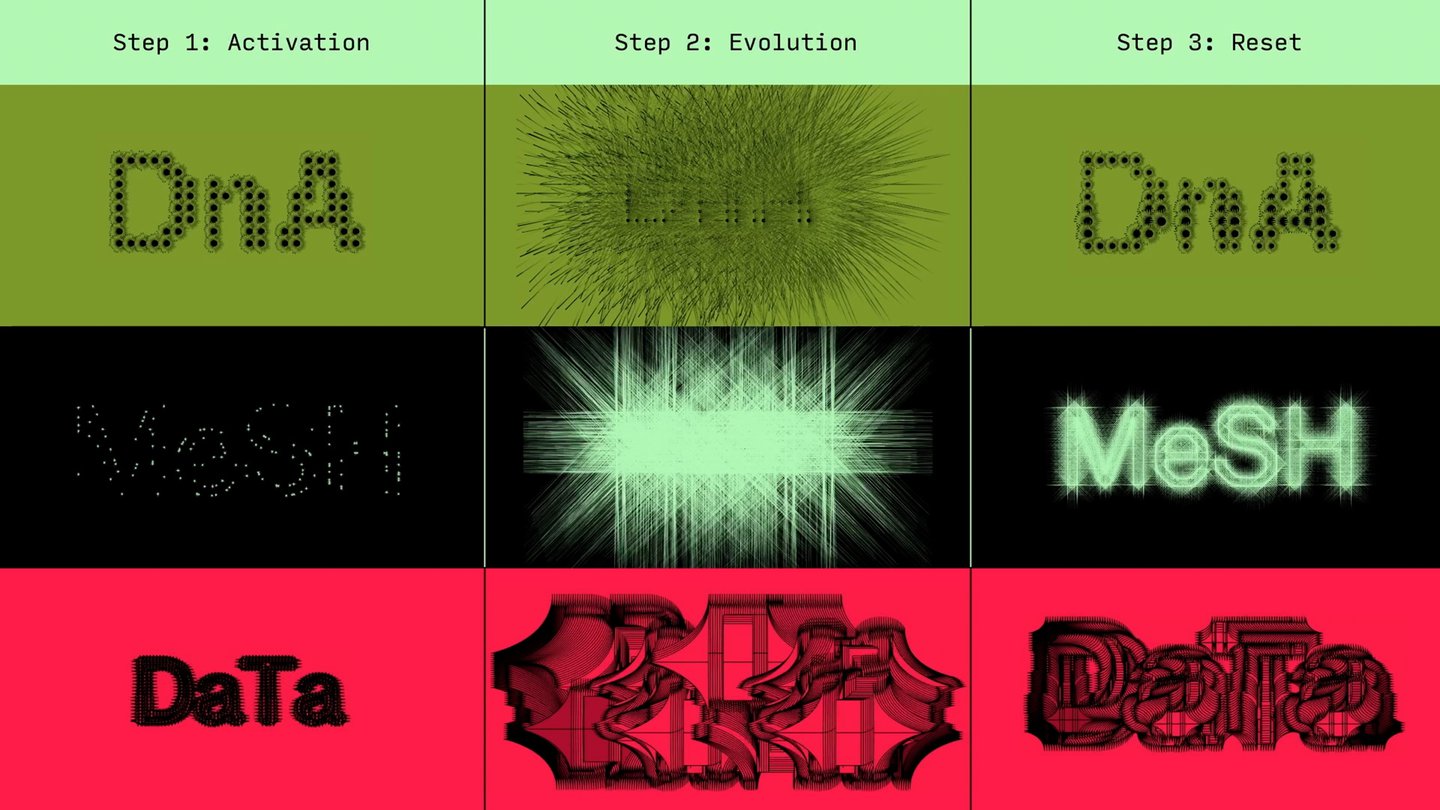
The typefaces in Synthetic Nature are a “trio of different creatures”. The DNA type is built from small, clustered units that repeat and branch like mutating, microscopic life forms, while the Mesh type is more porous and sponge-like, suggesting tiny networks and tissues. Finally, the Data type is made up of twisted wires, knots and cables like expansive circuit boards. “This family is about measurement and control: life as something tracked, optimised and routed through invisible channels,” says Eleanor. “These are three ways of thinking about what ‘life’ means when biology, computation and culture merge.”
Eleanor’s ribbony, glittery, microbial typeface design is mesmerising. Each installation was designed with the type system first, then each letter was built to behave like a small organism. From there, she structured the interactive elements around three stages: activation, evolution and reset. Activation is driven by webcam data; when someone appears, the system detects their face and depending on their proximity to the installation, the typeface slows and shrinks. In Evolution, a second camera focuses on touch materials. When a hand touches the installation’s materials, the type generator increases in line length or density. In Reset, the installation begins a soft shutdown when nobody is there to interact with it. It’s remarkable technology and one that should be implemented into type a lot more, especially when the barriers between digital and analogue seem to widen every day.
Everything about Synthetic Nature is rooted in a love for biology and type design. Eleanor is fascinated by how organisms are built, so she allows typography to feel alive like one. To Eleanor, this installation is about what certain life forms will look like in a century, and what will become of our technologies, which feel more like living things more than ever before.