

Refresh
2026-03-16T20:34:48.802Z
That’s a wrap, with country song that’s probably generated by AI
(Image credit: Tom’s Hardware)
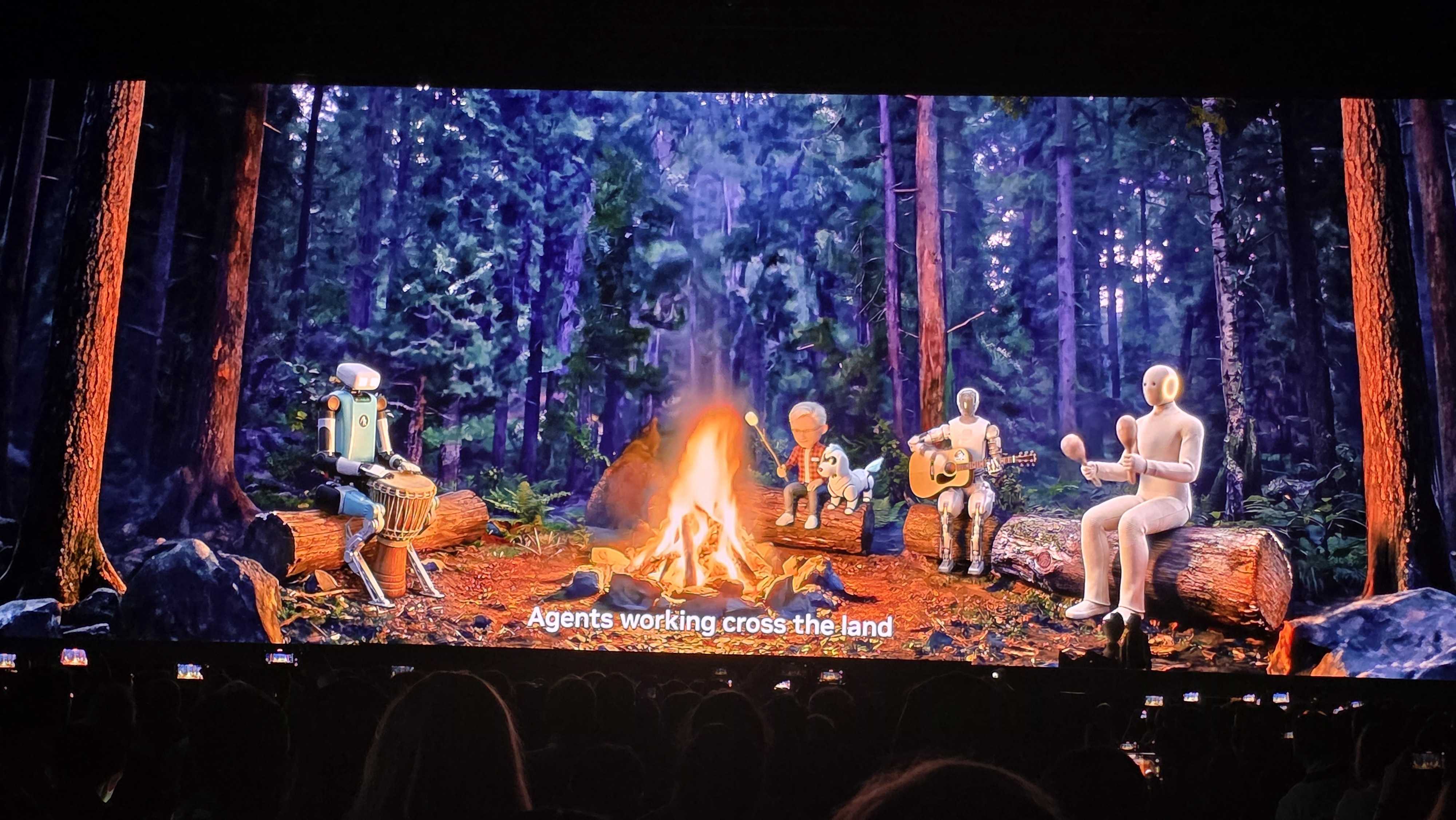
Well, we’re done now, I guess. Nvidia closed out its keynote with an animation of several robots (plus Jensen) sitting around a fire singing a song about the keynote. It’s a country song, and probably generated by AI? I don’t really know what to say about this one. A rough-talking robot singing about tokens and open-source software wasn’t on my bingo card.
2026-03-16T20:31:19.127Z
Olaf joins Jensen on stage
(Image credit: Nvidia)
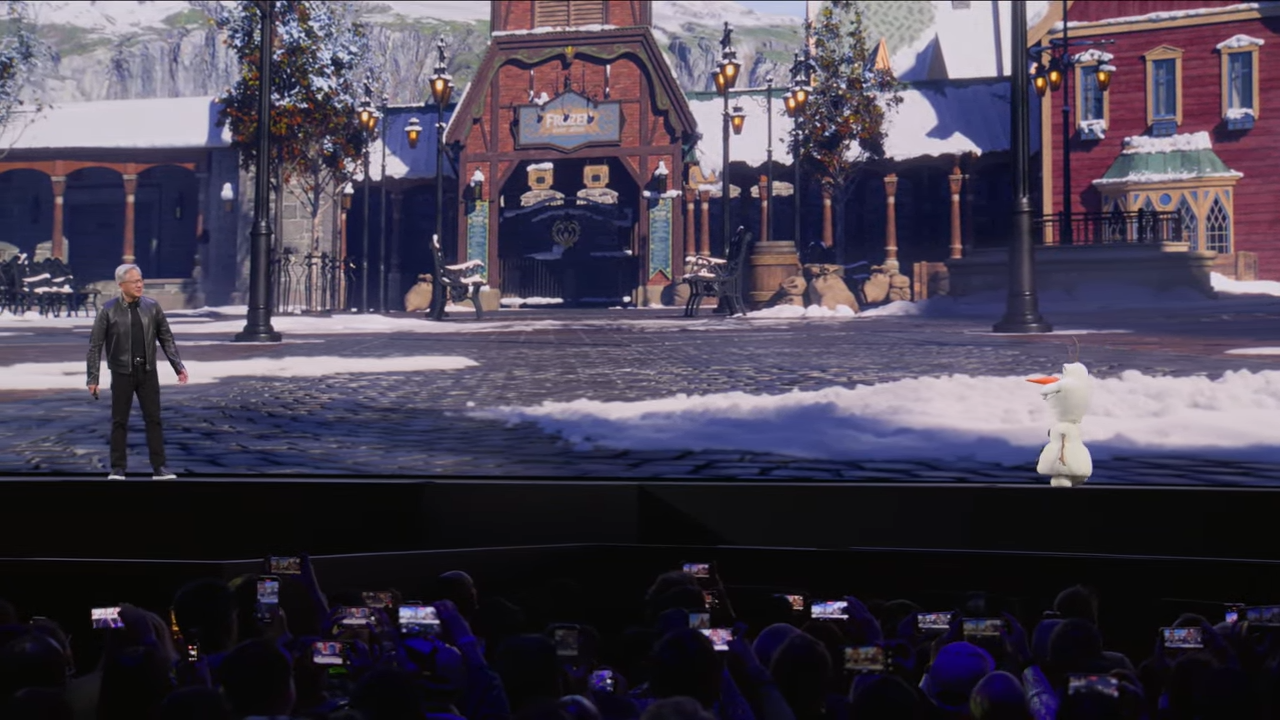
In a not-at-all-awkward meeting, Olaf from Frozen joins Jensen on stage. The executive is now describing the various AI models used to make Olaf, which is… something. Anyway, Olaf is helping close out the keynote.
2026-03-16T20:24:33.597Z
Bringing agents to the physical world
(Image credit: Tom’s Hardware)
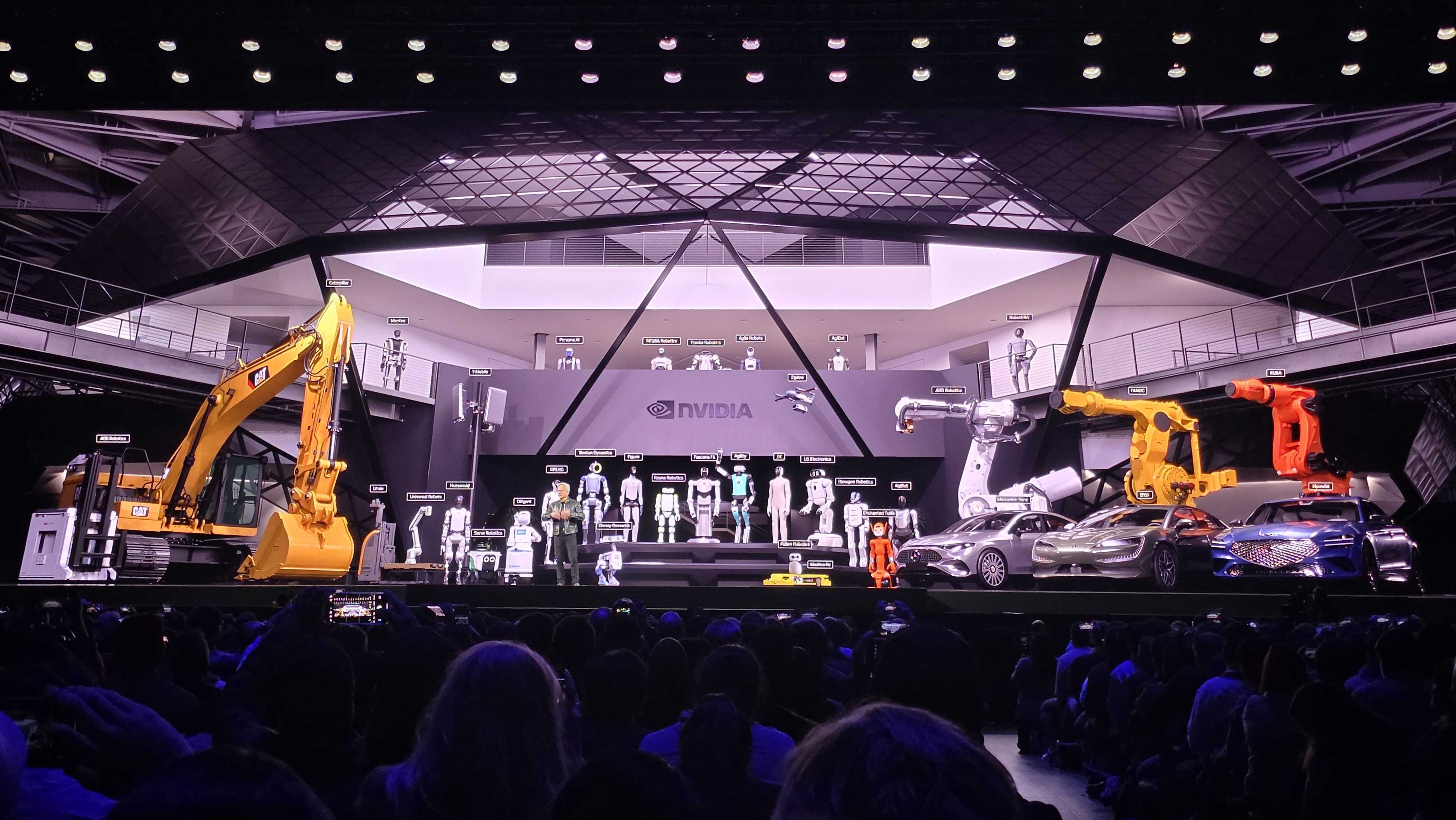
Nvidia is showing off 110 robots at GTC, showcasing its “physical AI.” Nvidia announced several new partners, including four new partners for robo-taxis, including BYD, Hyundai, and Nissian. Nvidia is also partnering with Uber, connecting robo-taxis into Uber’s network in select cities.
2026-03-16T20:19:14.699Z
Nvidia is building a Nemotron coalition
(Image credit: Tom’s Hardware)
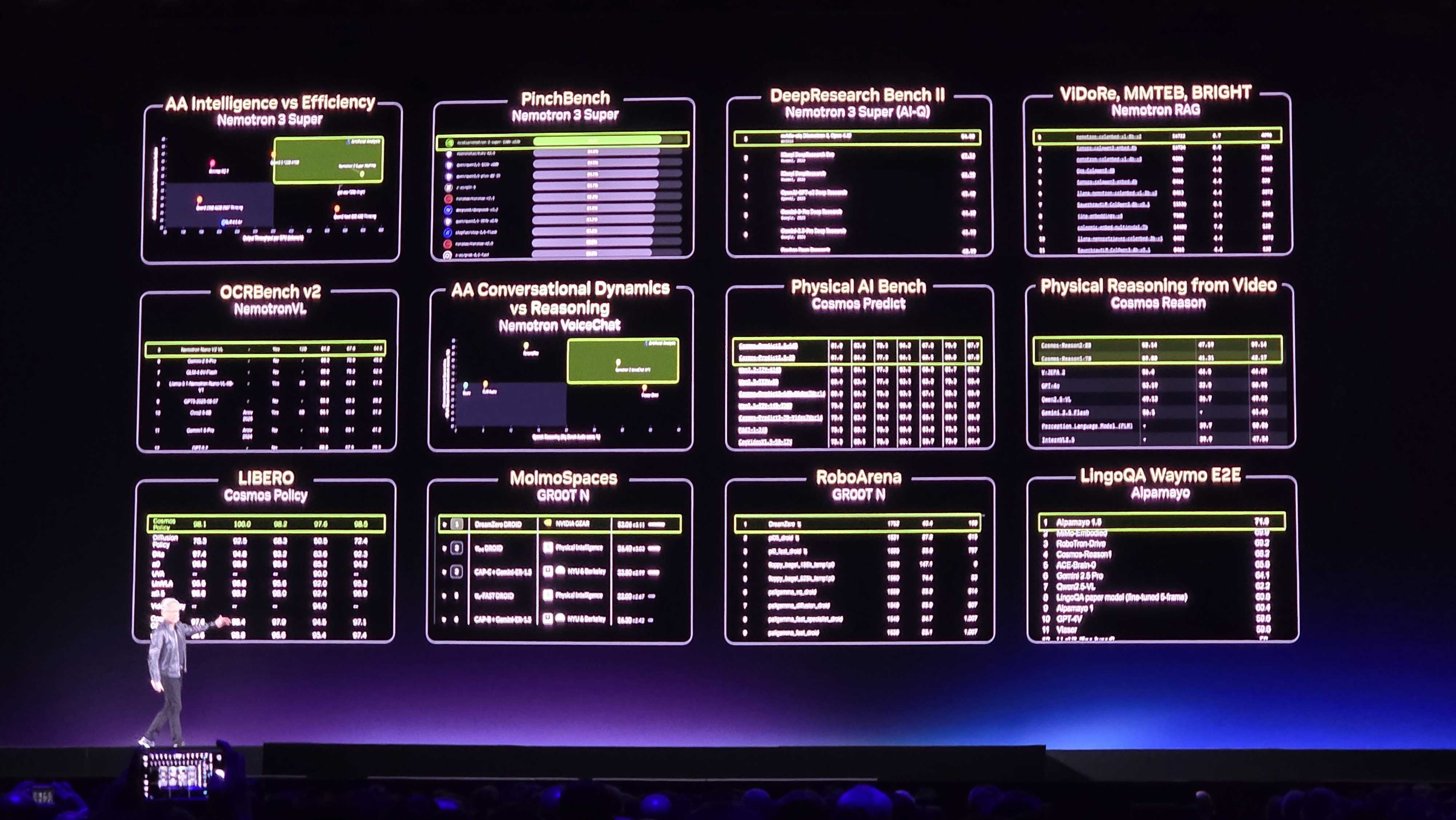
Nvidia says that Nemotron 3 Ultra will be the best base model in the world. In order to scale out Nemotron, Nvidia is creating a coalition for Nemotron 4, including companies like Black Forest Labs, Perplexity, Mistral, and Cursor.
2026-03-16T20:13:46.340Z
Nvidia worked with OpenClaw to make it enterprise-secure
2026-03-16T20:09:01.189Z
What is OpenClaw? Nvidia says it’s an OS
2026-03-16T20:06:39.703Z
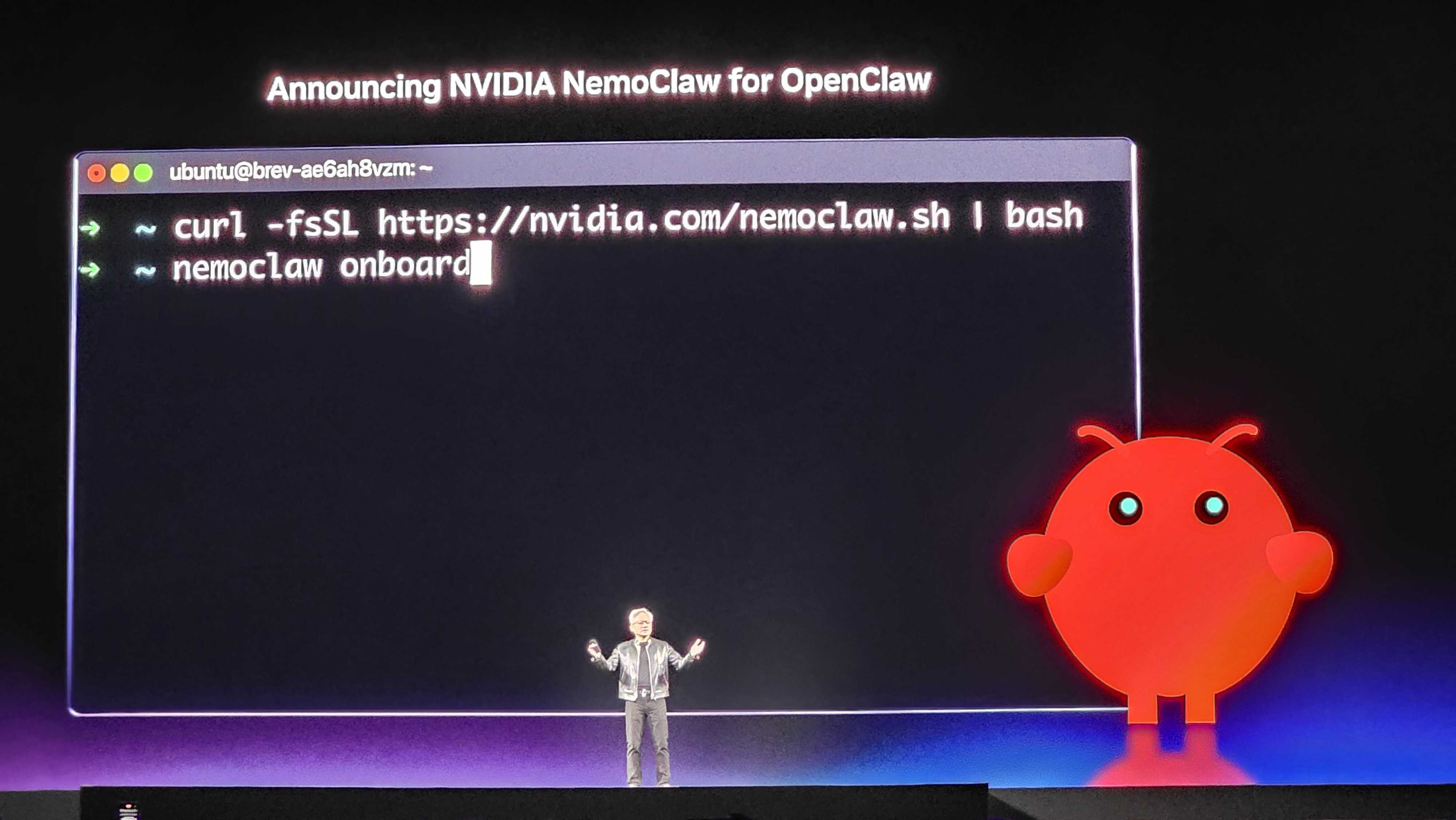
NemoClaw makes using OpenClaw easy
(Image credit: Tom’s Hardware)
Nvidia is streamlining the process of setting up an AI agent with OpenClaw. Type two lines of shell commands, and you’re off to the races with an AI agent. From there, Nvidia says you just need to give it a task and let the agent run its course.
2026-03-16T20:04:03.058Z
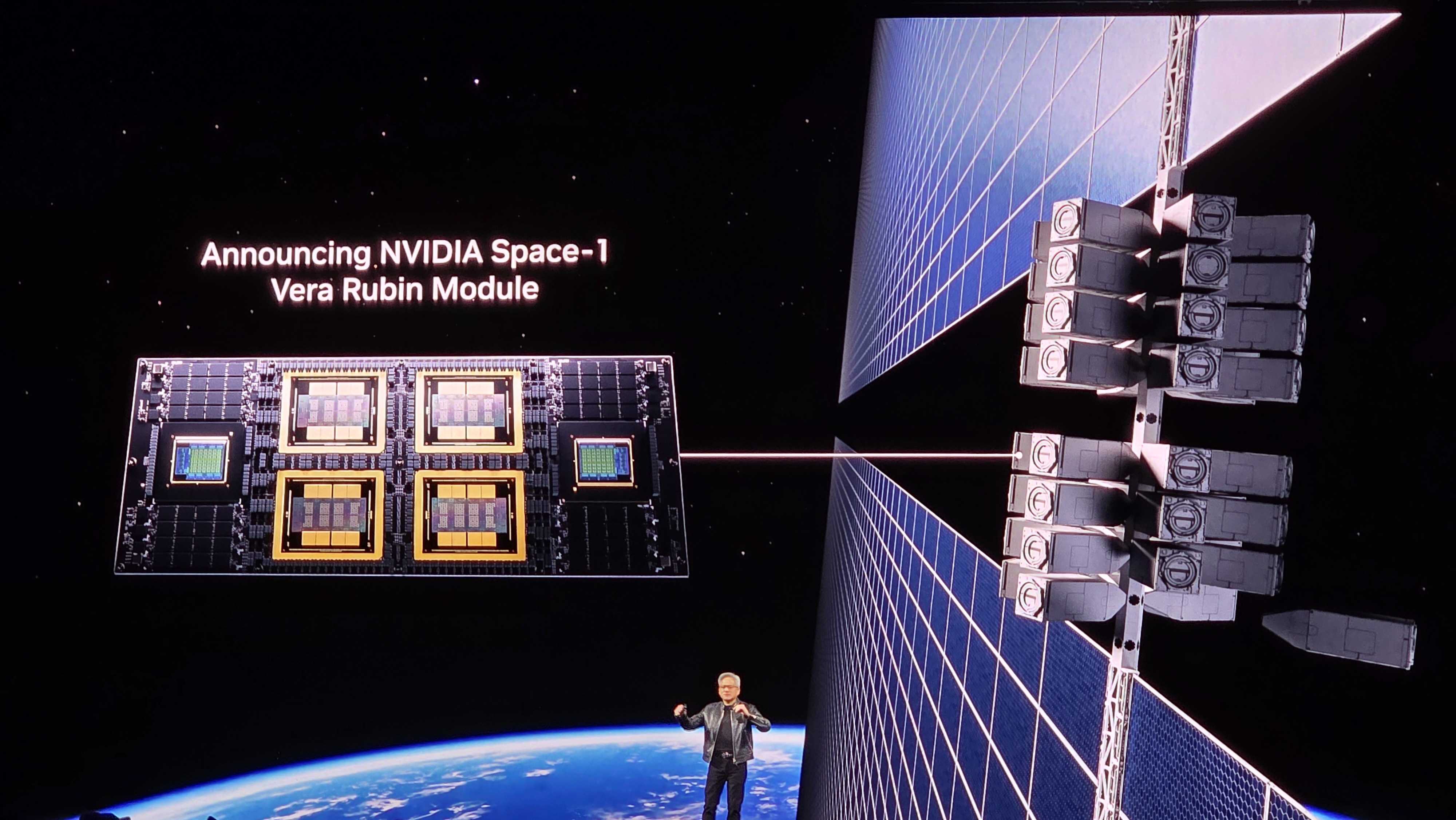
Data centers are going into space
(Image credit: Tom’s Hardware)
Nvidia is working on a system called Vera Rubin Space-1, which will be the first data center in space. Sounds like we’re in early stages, but Nvidia has “a lot of great engineers” working on it.
2026-03-16T19:59:53.138Z
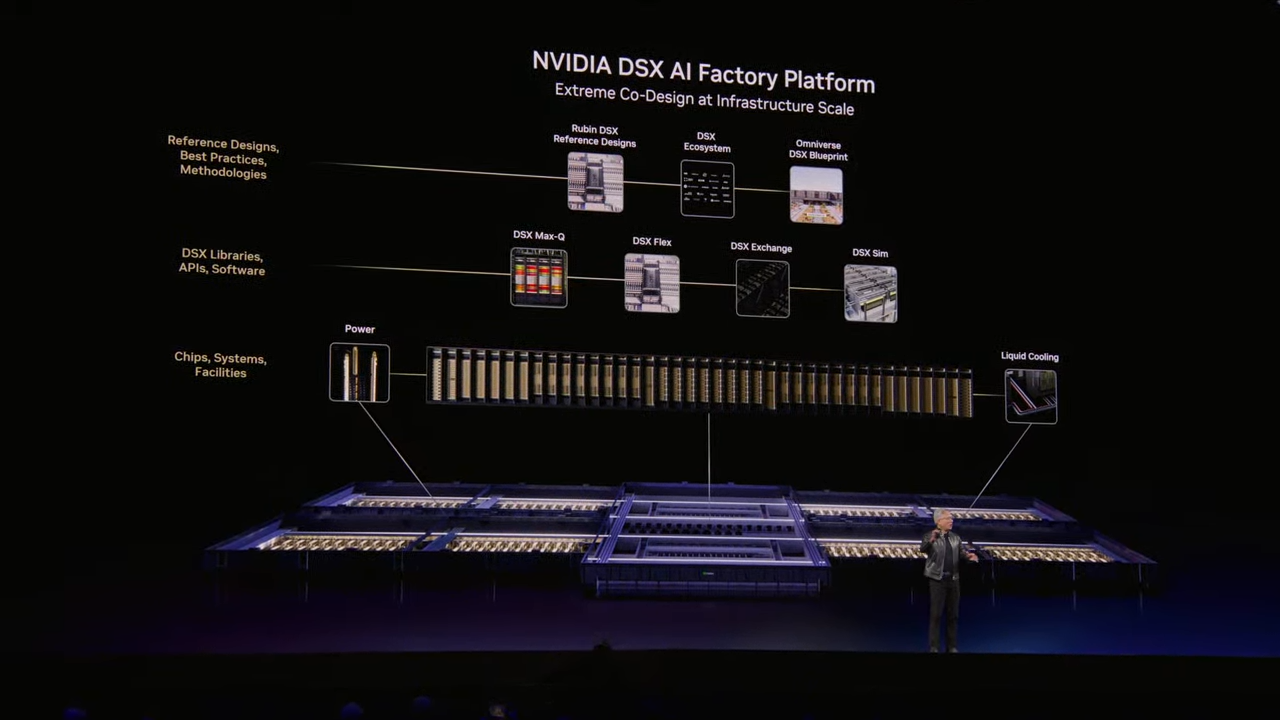
Meet me in the Omniverse
(Image credit: Nvidia)
Nvidia built Omniverse to meet suppliers virtually, allowing co-design in the data center at a much broader scale. The goal is to leave “no power squandered.” They’re blueprints for AI factories, which Nvidia calls its DSX platform.
2026-03-16T19:56:42.386Z
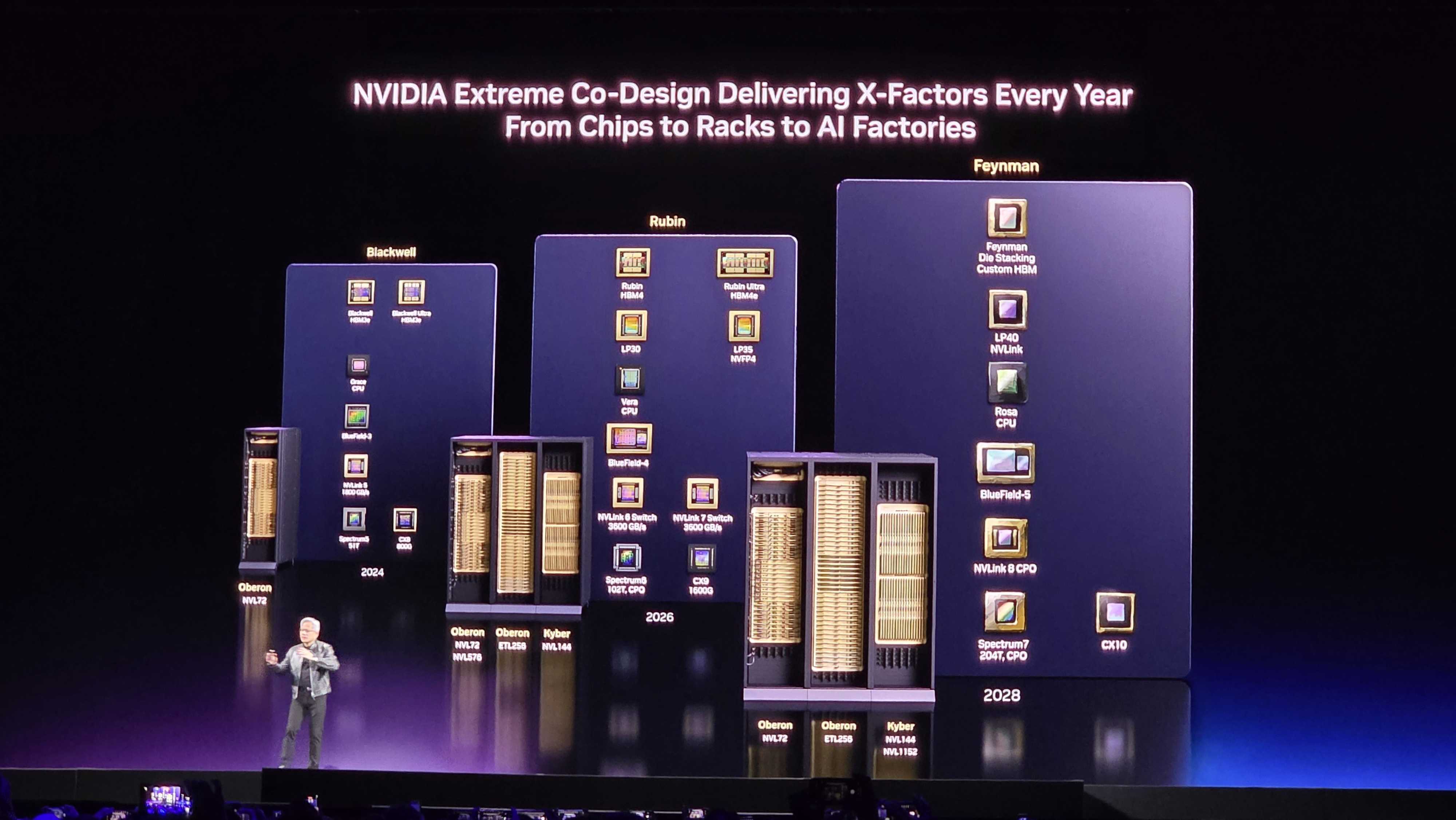
Here’s Nvidia roadmap
(Image credit: Tom’s Hardware)
Jensen is teasing next-gen Feynman systems. It has a new GPU, new LPU, new CPU called Rosa, Bluefield 5, and Kyber with copper and CPO scale up. Feynman systems are on-track for 2028, so we’ll hear a lot more about them throughout the year. At next year’s GTC, we’ll probably run back the same talking point with Feynman that we hard about with Vera Rubin this year.
2026-03-16T19:53:34.693Z
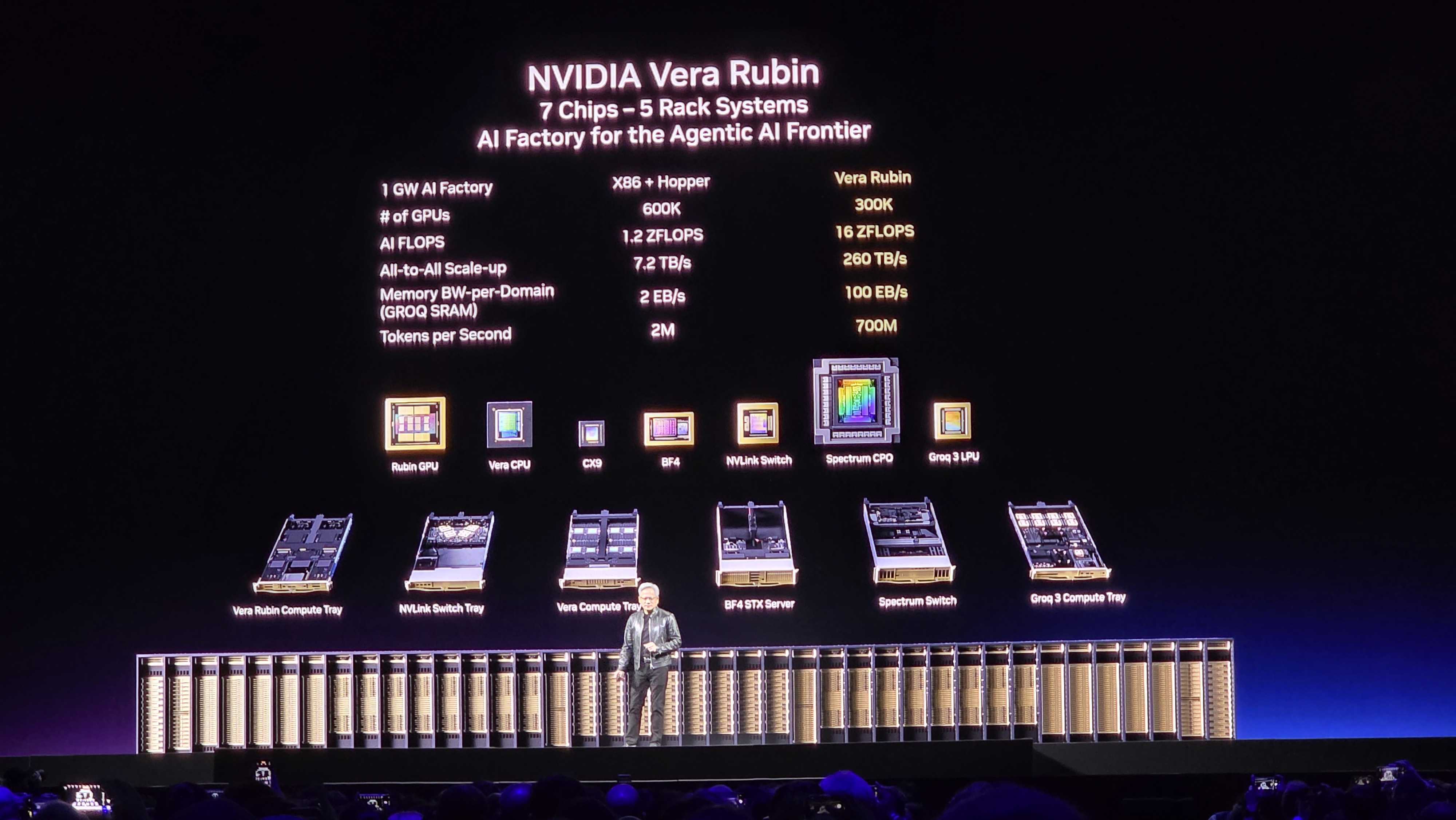
Vera Rubin is 7 chips across 5 rack systems
(Image credit: Tom’s Hardware)
Vera Rubin is undoubtedly Nvidia’s most ambitious system to date, featuring seven chips across five rack systems. Compared to x86 and Hopper, Nvidia says Vera Rubin is able to deliver 700 million tokens per second compared to just 2 million
2026-03-16T19:51:27.523Z
Vera Rubin sampling is going ‘incredibly well’
2026-03-16T19:47:18.072Z
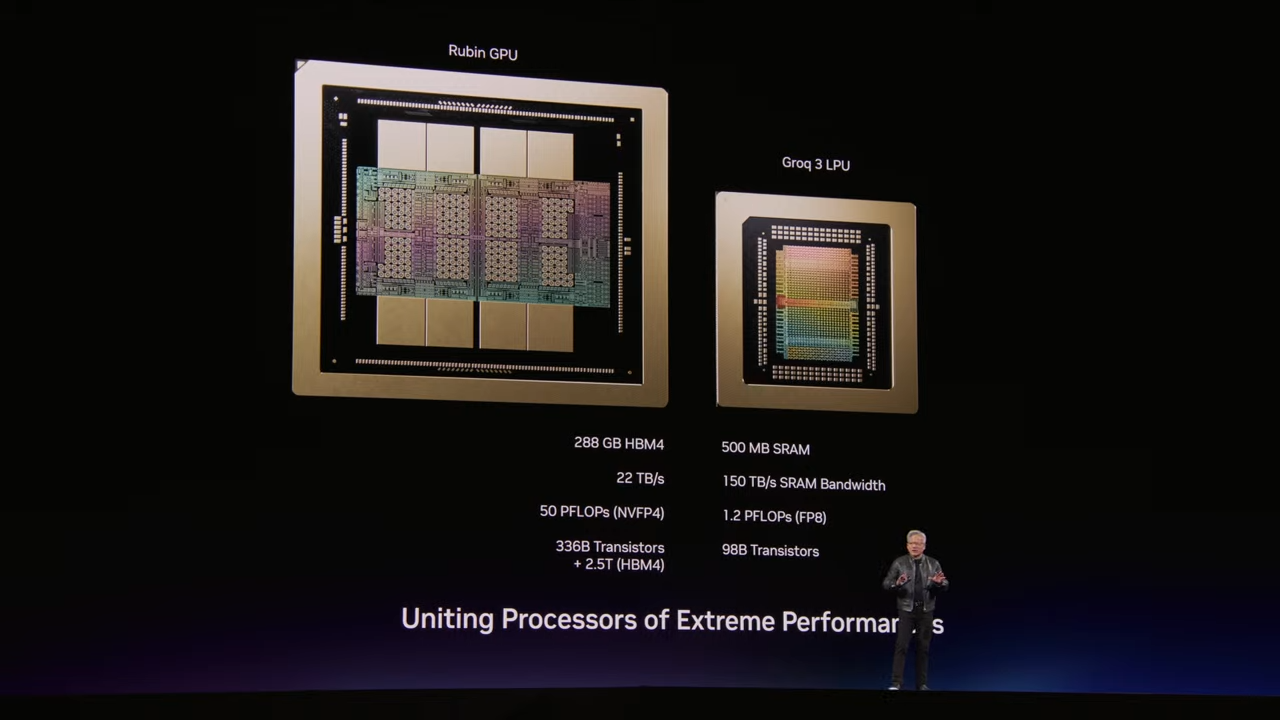
Low latency and high throughput are ‘enemies of each other’
(Image credit: Nvidia)
Groq is important for Nvidia because it pushes beyond the limits of NVL72. With Groq LPX, Nvidia says it’s able to deliver up to 10x in revenue to companies using Vera Rubin. It helps solve the problem of delivering low latency and high throughput, which Jensen described as “enemies of each other.”
Nvidia combined one chip for high throughput and one for low latency, which it achieved with disaggregated inference.
2026-03-16T19:42:46.416Z
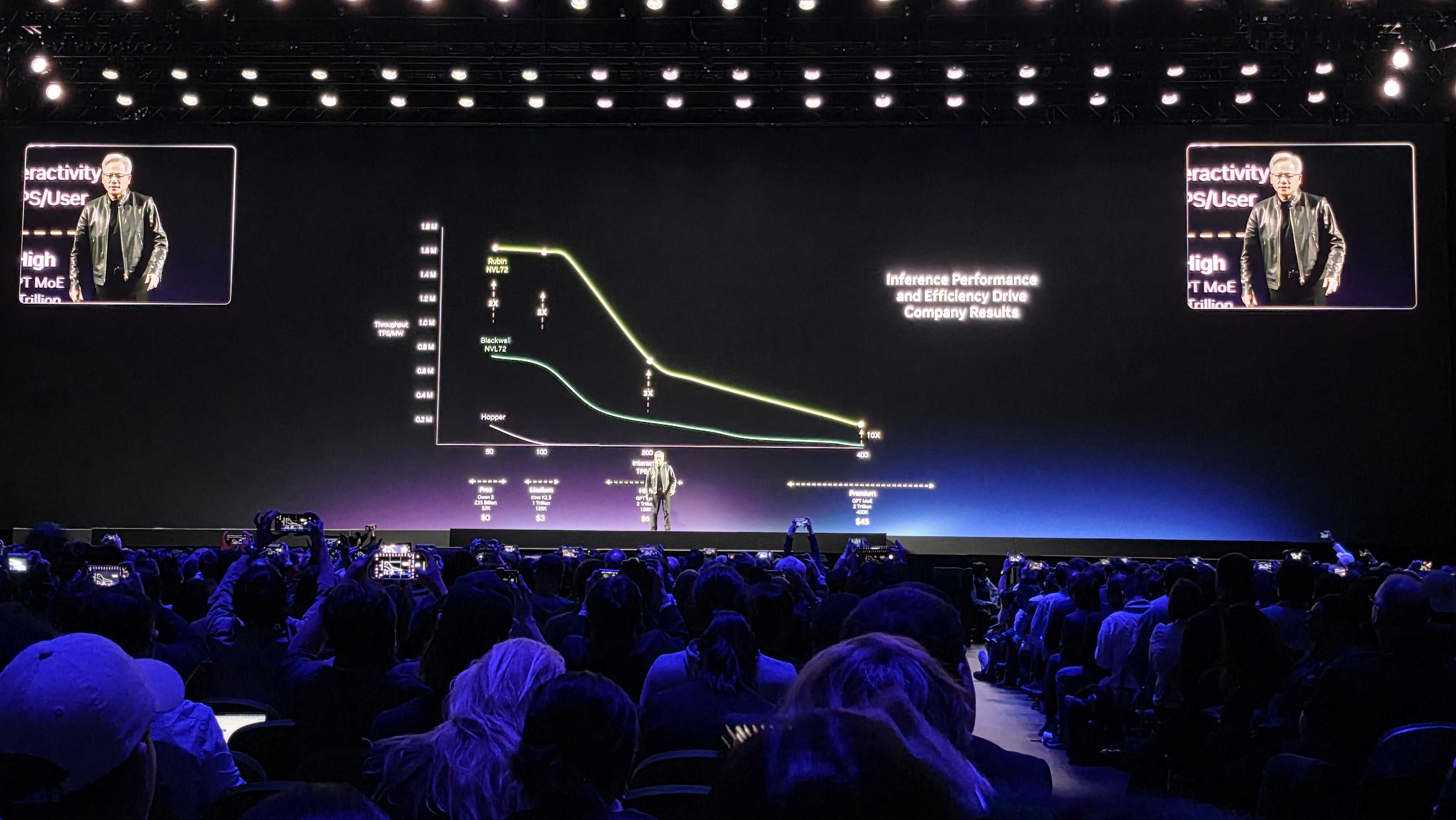
This is ‘the most important chart’ for companies, says Nvidia
(Image credit: Tom’s Hardware)
Tokens are “the new commodity,” according to Nvidia. For businesses, Nvidia says that the throughput of an AI factory at iso power is something that will be “studied for years.” More tokens means smarter models, and the smarter the models get, you need better token throughput. Nvidia says that, at every tier, Vera Rubin delivers much higher throughput.
2026-03-16T19:37:24.520Z
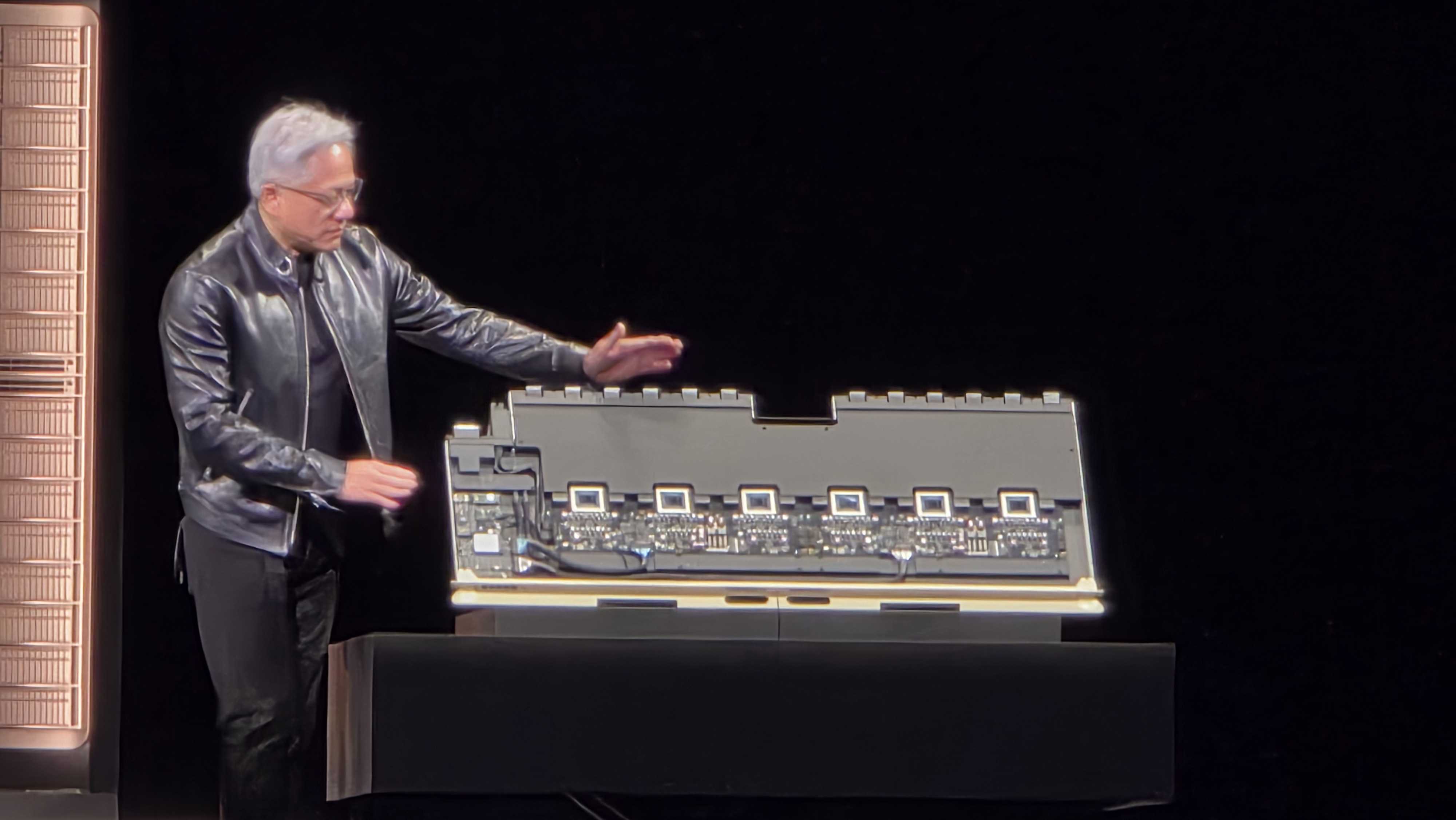
Jensen shows off NVLink for Rubin Ultra
(Image credit: Tom’s Hardware)
Jensen explains how NVLink for Rubin Ultra works, with compute sitting in the front and the scale-up fabric in the back.
2026-03-16T19:35:12.126Z
Groq 3 LPU and Groq LPX join the fray
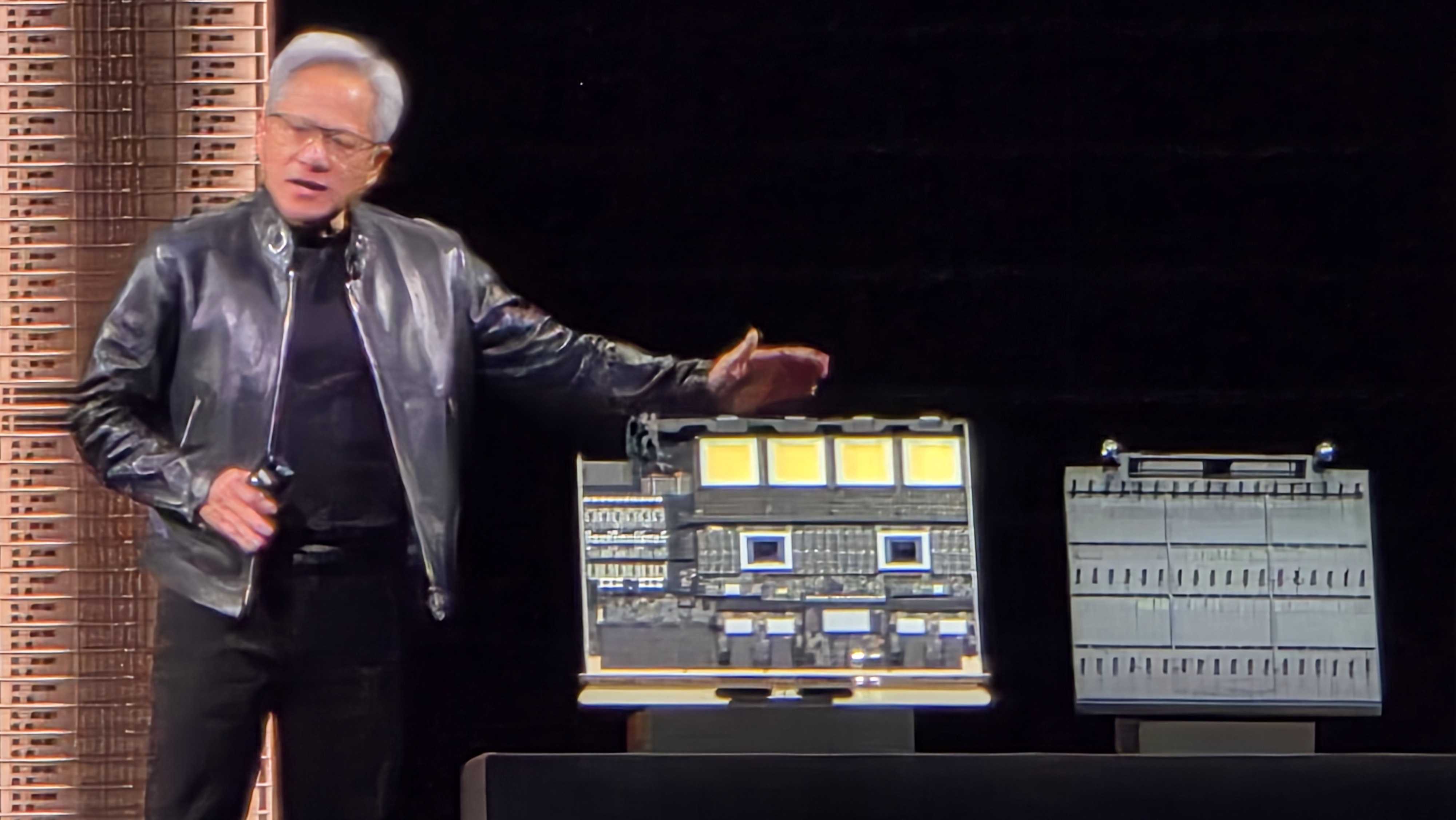
(Image credit: Tom’s Hardware)
A new addition to the system is a Groq LPX rack, which we learned about ahead of GTC. You can read Jeffrey Kampman’s breakdown of Groq 3 in Vera Rubin now.
2026-03-16T19:32:17.296Z
Learn more about Nvidia’s Vera CPU
2026-03-16T19:30:09.660Z
Vera Rubin joins Jensen on stage
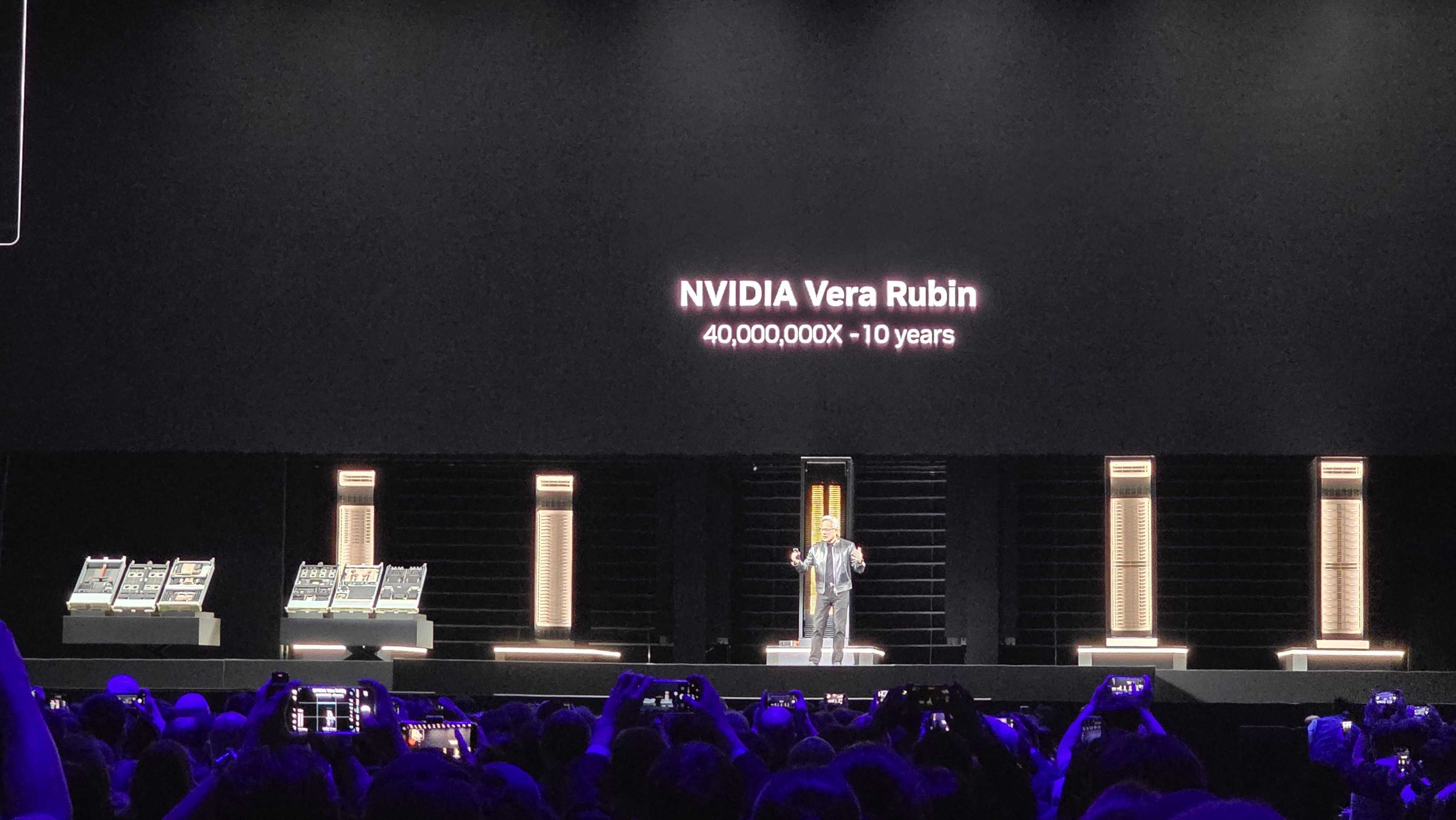
(Image credit: Tom’s Hardware)
Vera Rubin NVL72 is the “engine supercharging the era of agentic AI.” A new addition is the Groq 3 LPX tray, and as a whole, Nvidia says it’s delivered 40 million times more compute over the past decade. Jensen is showing off Vera Rubin on stage; the whole thing. It’s “one giant system.”
Jensen says the Vera CPU is designed for high single-threaded performance, and the company built it go along with its racks for agentic processing.
2026-03-16T19:24:58.979Z
‘It’s now a factory to generate tokens’
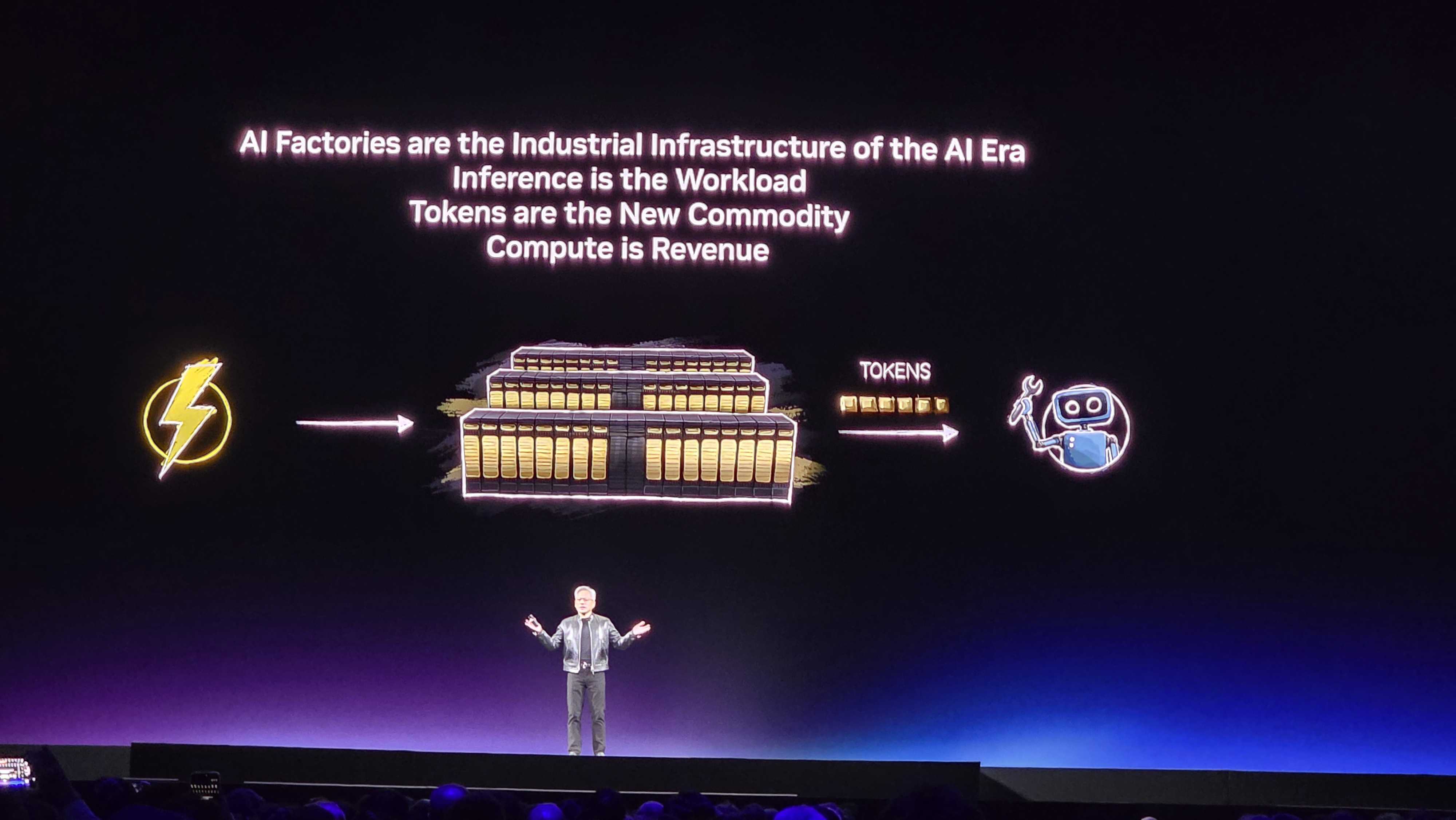
(Image credit: Tom’s Hardware)
Jensen says data centers used to be a place to store files, and they’re now a factory to generate tokens. Inference is the workload and tokens are the new commodity, says Nvidia. Now, onto a short video showing how we got here.
2026-03-16T19:21:09.596Z
50x performance per watt, 35x lower cost
2026-03-16T19:17:58.865Z
Nvidia says Grace Blackwell was ‘a giant bet’
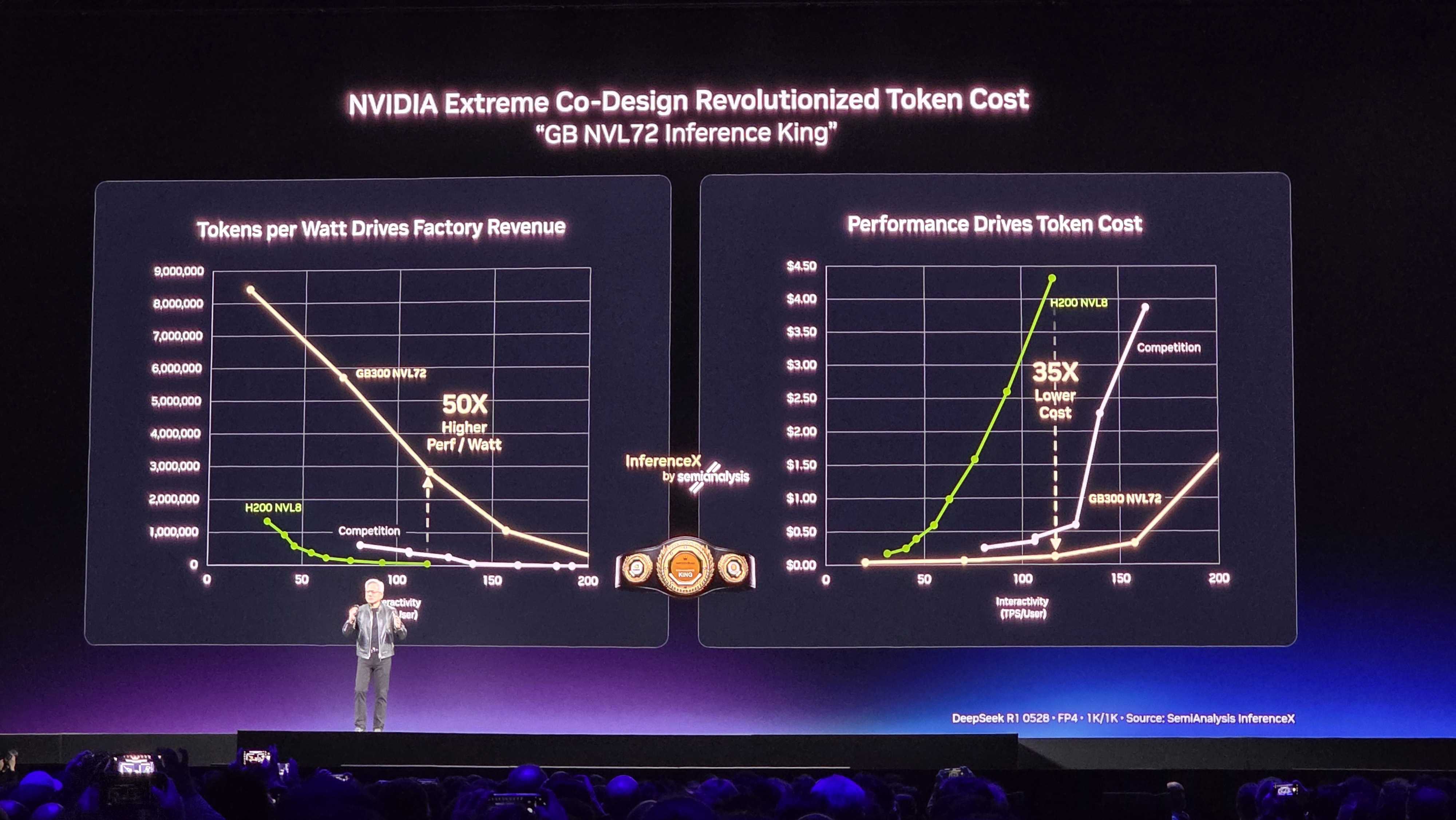
(Image credit: Tom’s Hardware)
Nvidia NVL72 was a “giant bet,” says Jensen, and he thanked Nvidia’s partners for sticking with the company. “It wasn’t easy for anybody… inference is the ultimate hard.” The bet paid off, according to Nvidia, which you can see in the slide above.
2026-03-16T19:13:13.204Z
Nvidia is the only company that runs every domain of AI across every domain of AI models
2026-03-16T19:10:50.589Z
Nvidia says it’s going to double demand through the next year
(Image credit: Tom’s Hardware)
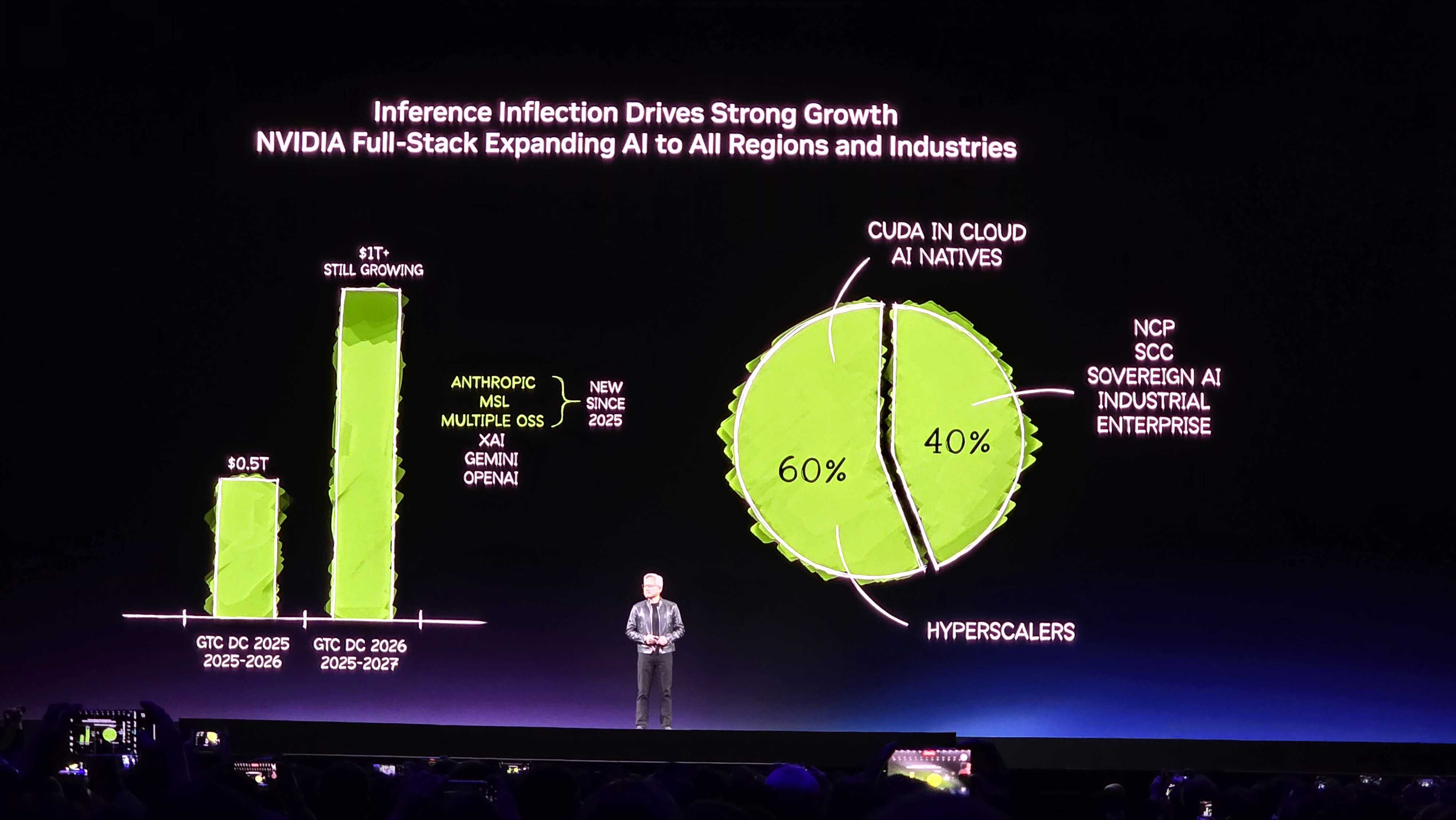
Last year, Nvidia said it saw about $500 billion of high confidence demand and purchase orders for Blackwell and Rubin through 2026. “I see through 2027 at least $1 trillion,” says Jensen. “Now, does it make any sense?” Jensen says that’s what he’s going to spend the rest of the keynote talking about.
2026-03-16T19:07:06.918Z
An accelerated timeline of AI
(Image credit: Tom’s Hardware)
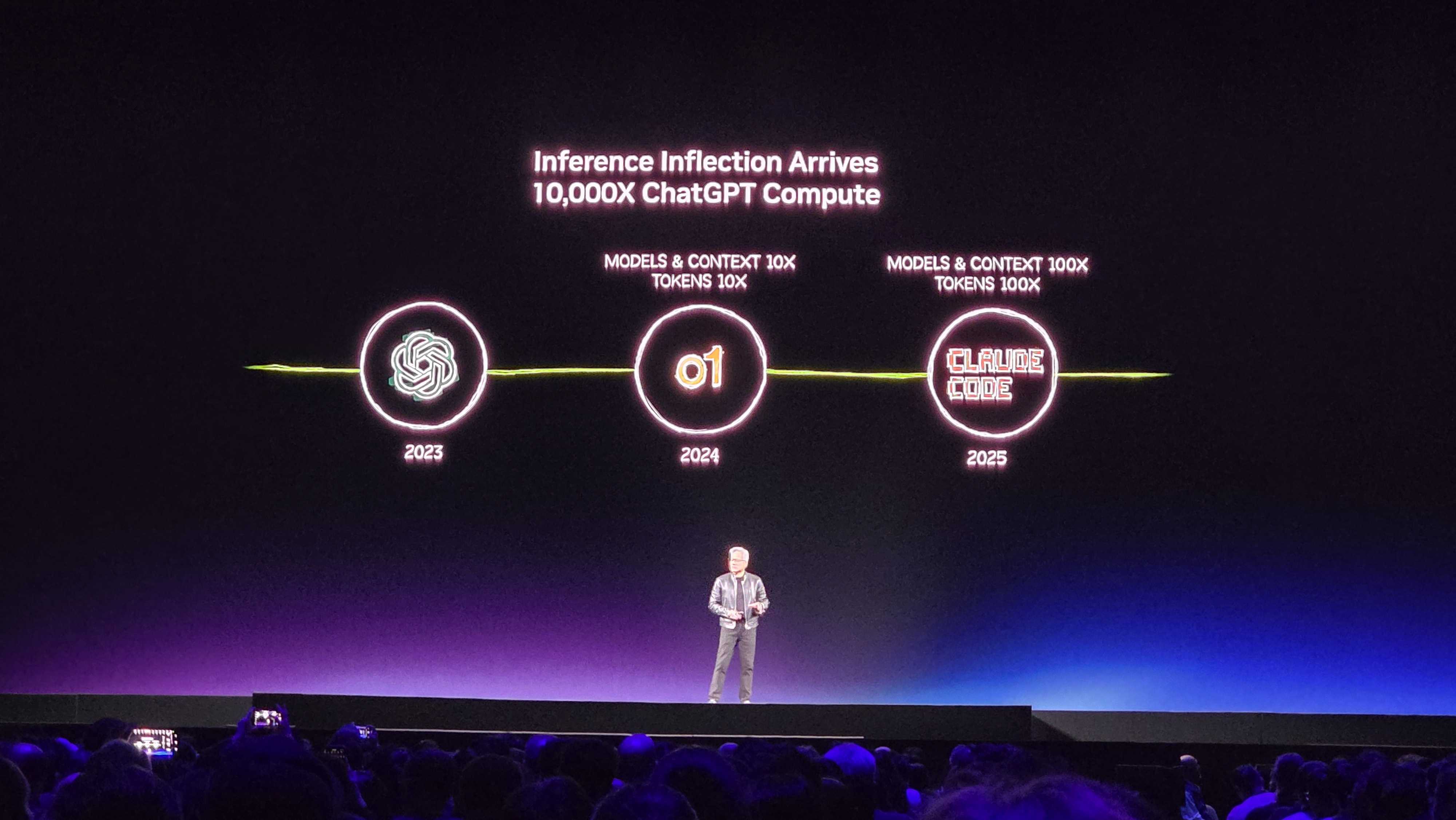
There’s been rapid AI development over the past few years. In 2023, it was ChatGPT. In 2024, it was reasoning models like o1, and in 2025, it was huge models with massive context windows like Claude Code. It’s the first “agentic model,” says Jensen. The executive says 100% of Nvidia is using Claude Code, along with other models. In 2026, Nvidia says we’ve reached an “inflection point for inference.”
2026-03-16T19:02:44.883Z
Nvidia ‘reinvented computing’
2026-03-16T18:56:30.679Z
cuDNN is what caused the ‘big bang’ of AI
(Image credit: Tom’s Hardware)
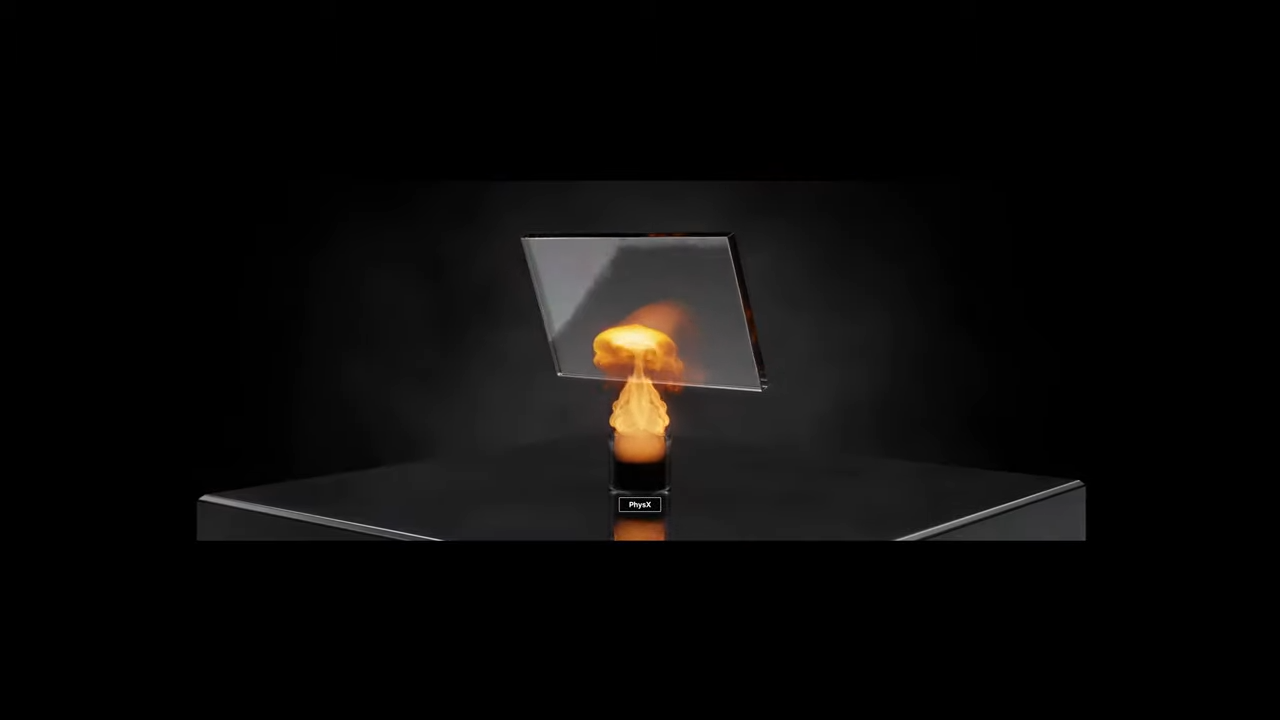
Nvidia says cuDNN, or CUDA Deep Neural Network, is one of the most important libraries the company has ever made, saying it caused the “big bang” of modern AI. Nvidia is showing a short video about its various CUDA-X libraries, including a life-like video that’s entirely simulated.
2026-03-16T18:54:28.786Z
Bringing it back to CUDA
2026-03-16T18:51:49.166Z
Nvidia says it needs domain-specific libraries to address the needs of different industries
(Image credit: Tom’s Hardware)
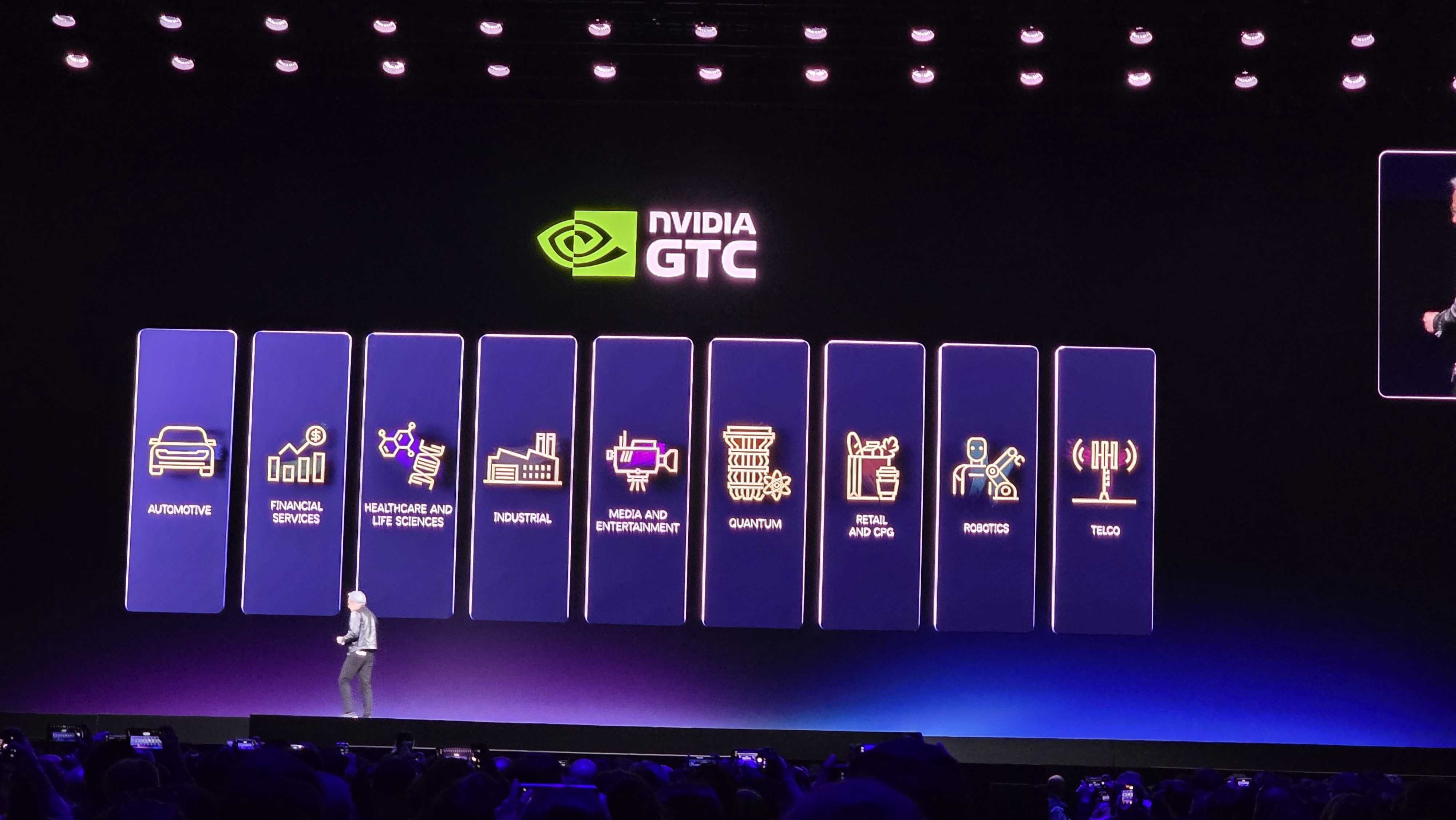
AI has a lot of applications, but Jensen says it isn’t as simple as throwing GenAI at the wall and hoping it sticks. “We have to have domain-specific libraries that solve problems in every one of these verticals,” he says.
2026-03-16T18:47:57.918Z
‘Vertically integrated but horizontally open’
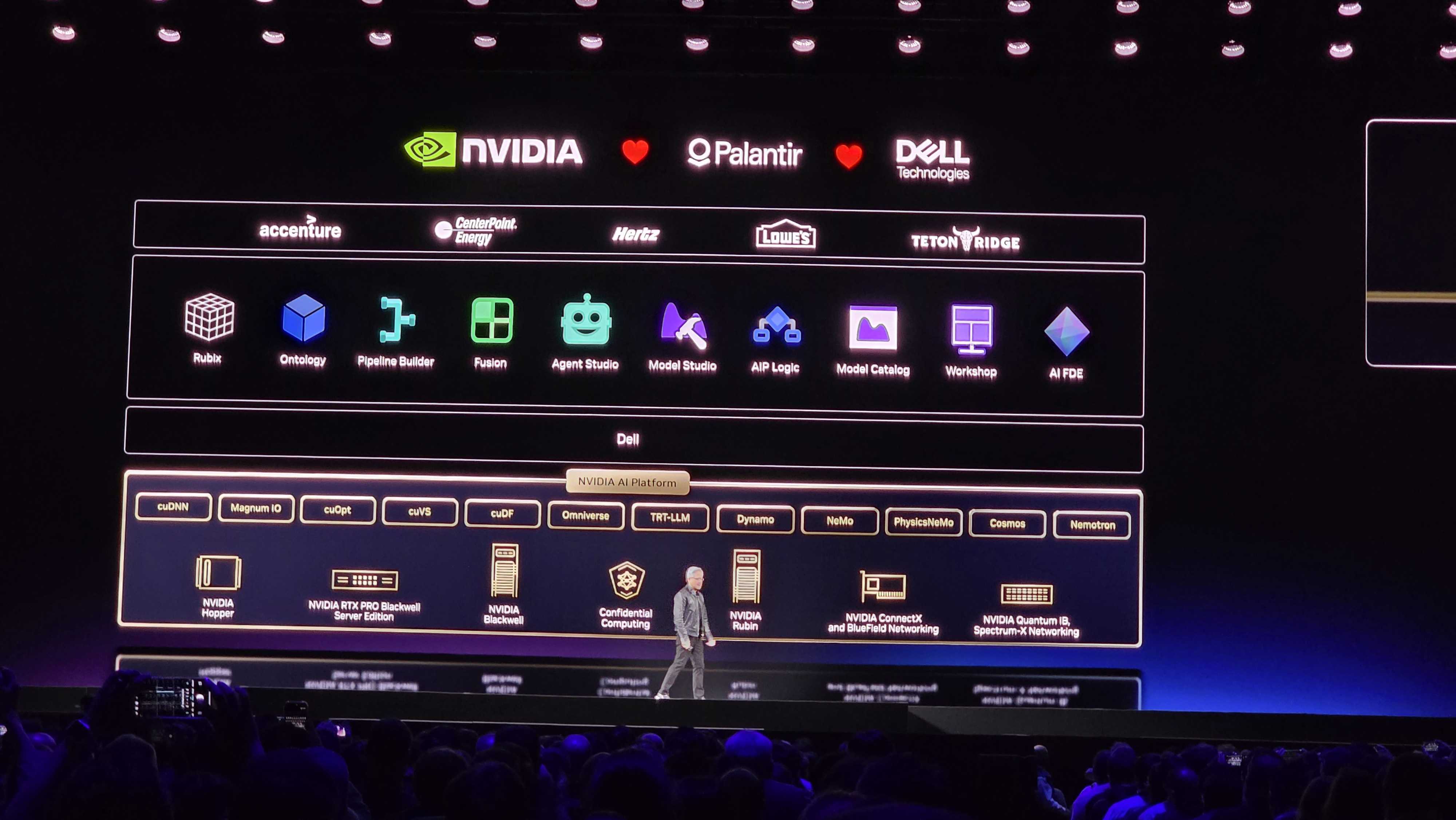
(Image credit: Tom’s Hardware)
Jensen describes Nvidia as “vertically integrated but horizontally open,” which may or may not raise some eyebrows at the FTC. Regardless, Nvidia says there’s “no other way” it can be given what it’s trying to do with accelerated computing, delivering the entire stack to customers.
2026-03-16T18:43:12.659Z
Nvidia is bringing OpenAI to AWS this year
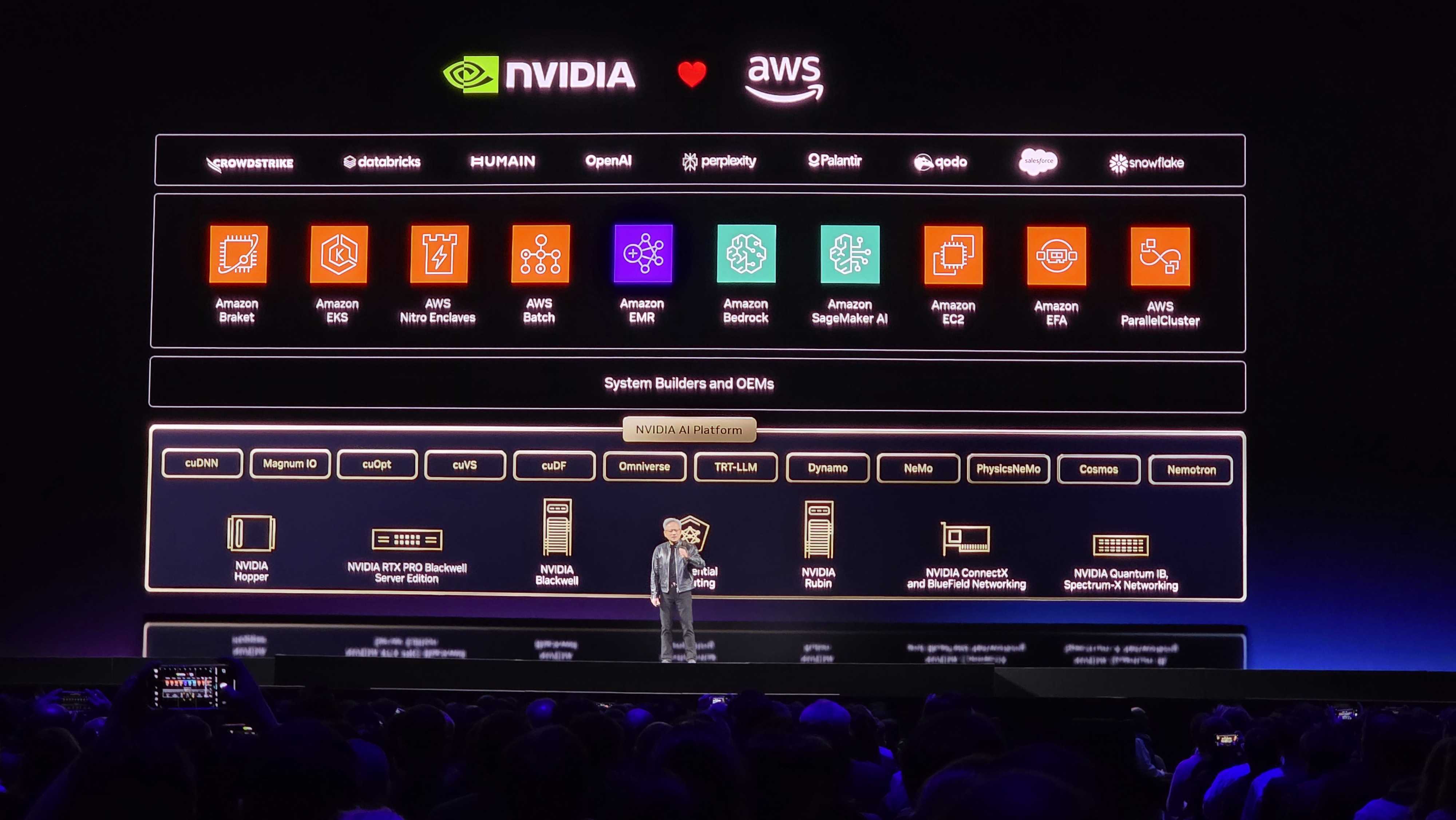
(Image credit: Tom’s Hardware)
“As you know, [OpenAI] is completely compute-constrained.” Jensen says that OpenAI will come to AWS this year, hopefully lightening the load on its massive infrastructure demand.
2026-03-16T18:41:06.320Z
More Moore’s Law talk
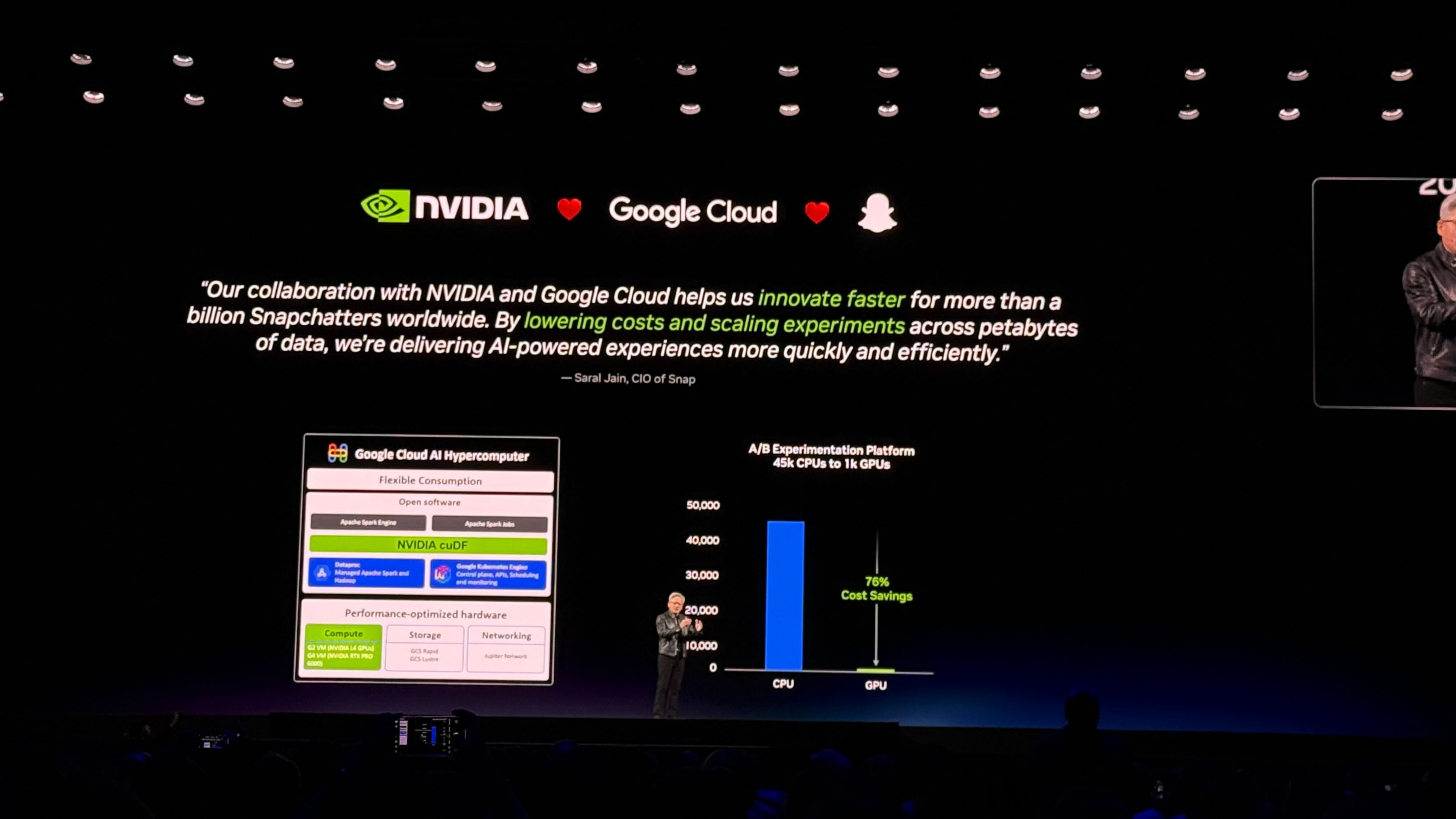
(Image credit: Tom’s Hardware)
Jensen likes to talk about the death of Moore’s Law, and he’s doing so once again. “Moore’s Law has run out of steam, accelerated computing allows us to take giant leaps forward.” Jensen is showing off an example with Google Cloud and showing how Nvidia’s acceleration can be repeated across companies and industries.
2026-03-16T18:36:53.349Z
AI can solve unstructured data, says Jensen
2026-03-16T18:34:24.711Z
‘This is my best slide’
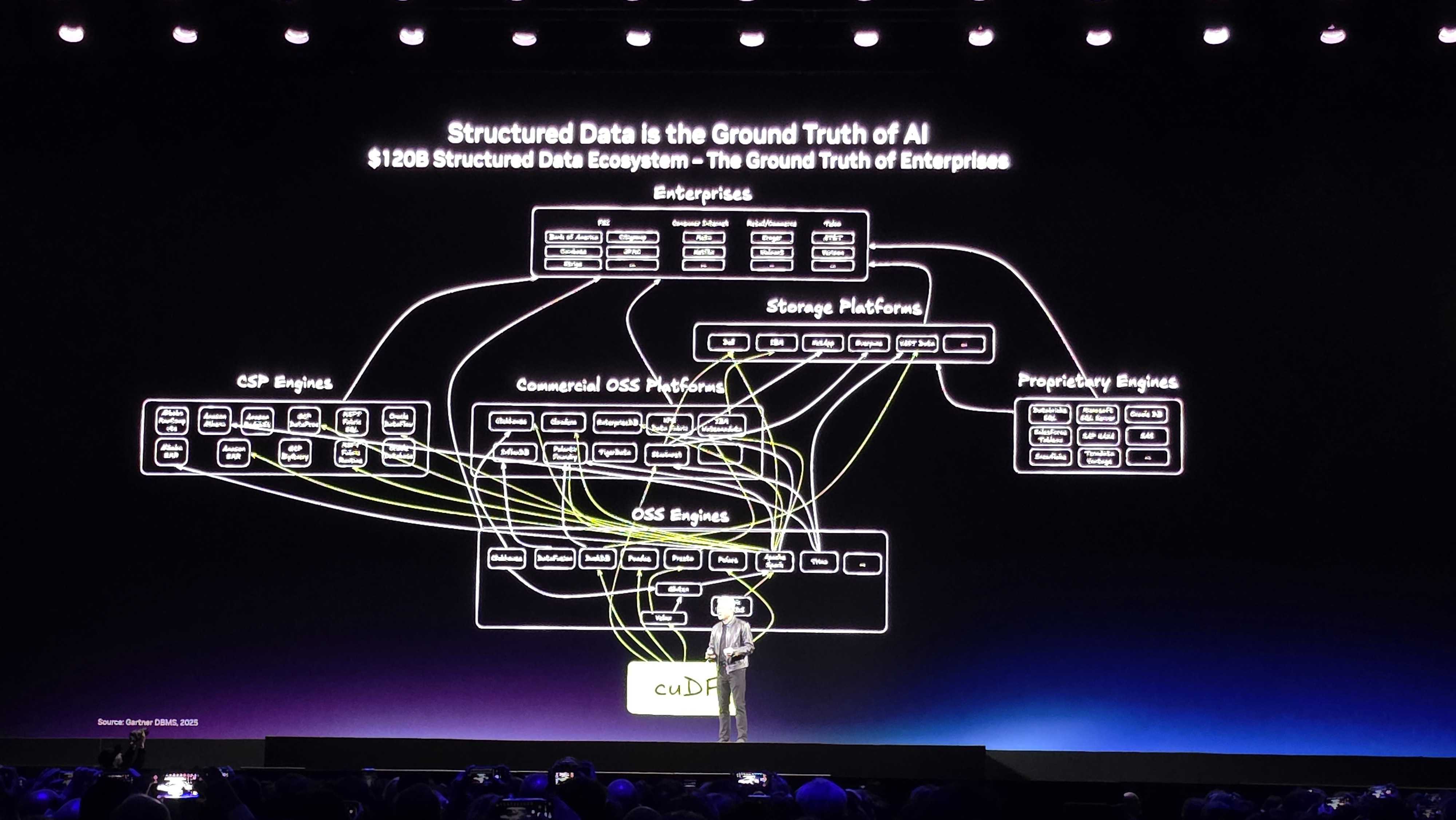
(Image credit: Future)
Jensen jokes that he’s going to spend the rest of the keynote going through the slide you can see above about structured data. This is “the ground truth” of enterprise computing.
2026-03-16T18:32:56.352Z
What is DLSS 5?

(Image credit: Tom’s Hardware)
Nvidia says it combined controllable 3D graphics and structured data with generative worlds. “This concept of fusing structured data with generative AI will repeat itself in one industry after another industry after another industry.”
2026-03-16T18:30:54.491Z
Nvidia is showing off the next generation of computer graphics: DLSS 5
2026-03-16T18:28:42.826Z
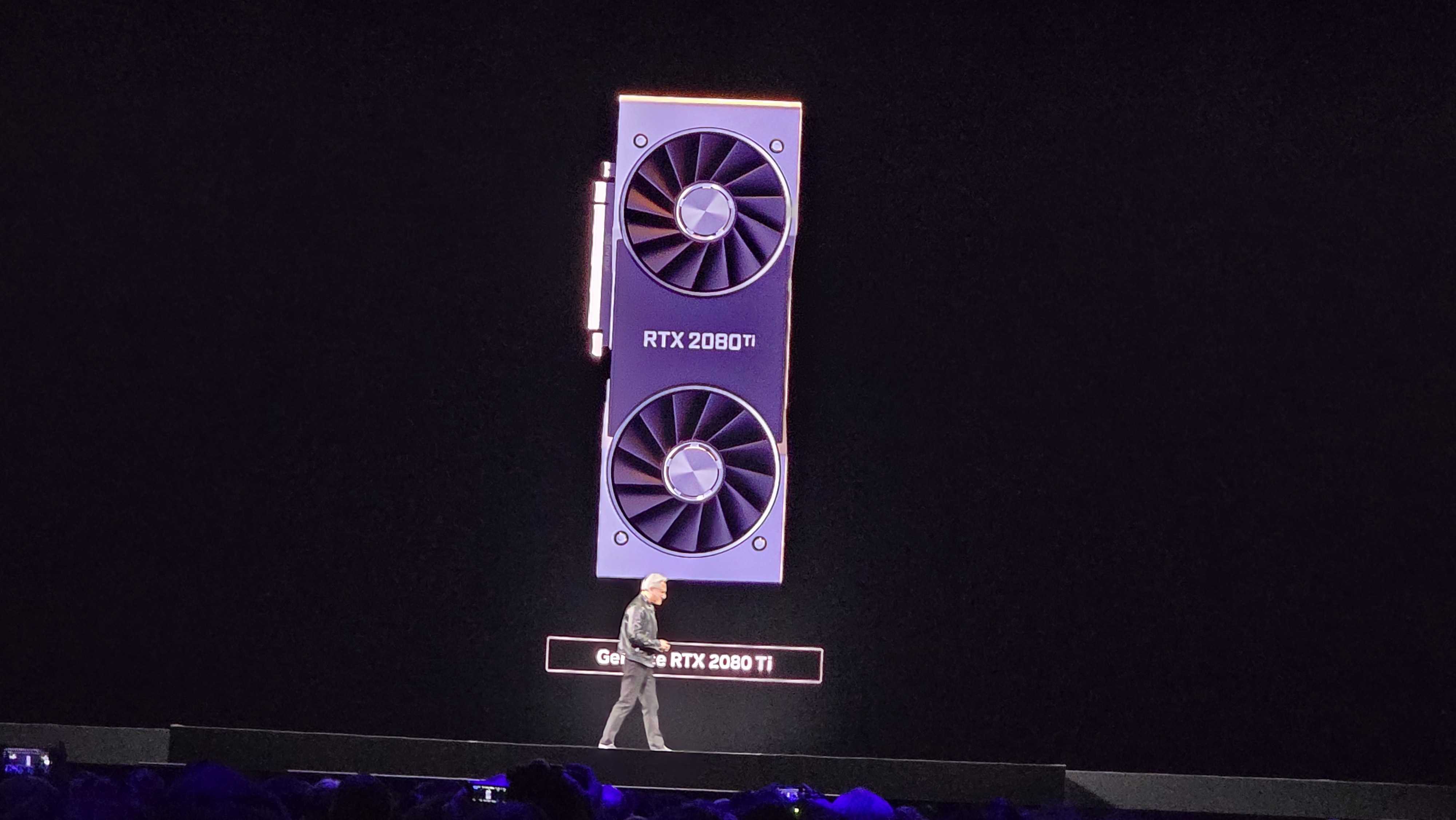
‘GeForce is Nvidia’s greatest marketing campaign’
(Image credit: Tom’s Hardware)
Jensen says that “GeForce is Nvidia’s greatest marketing campaign.” It’s an interesting way to frame the conversation, and one that Nvidia has been trying to crack for the past few years. Jensen paints a picture of Nvidia creating the first programmable shader 25 years ago, which eventually led to CUDA, and used GeForce as a vehicle to drive adoption.
2026-03-16T18:26:36.284Z
Pricing of Ampere in the cloud is going up
2026-03-16T18:24:25.290Z
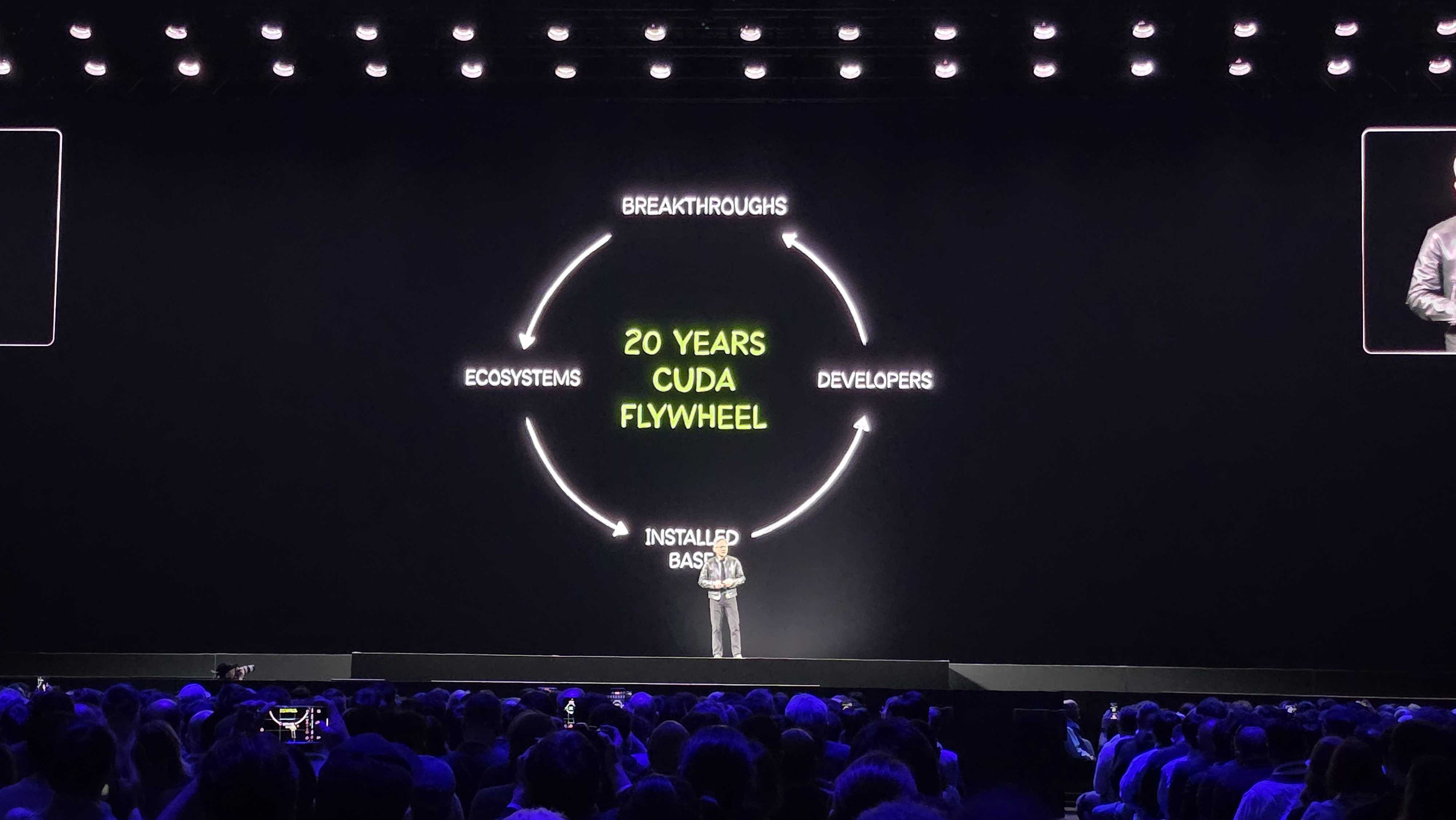
‘We’ve been working on CUDA for 20 years’
(Image credit: Tom’s Hardware)
CUDA is one of the major reasons Nvidia is in the position it’s in today, and this GTC marks the 20th anniversary of CUDA. “The single hardest thing is to have built up our install base, we’re in every cloud and computer company in every single industry,” says Jensen.
2026-03-16T18:21:07.420Z
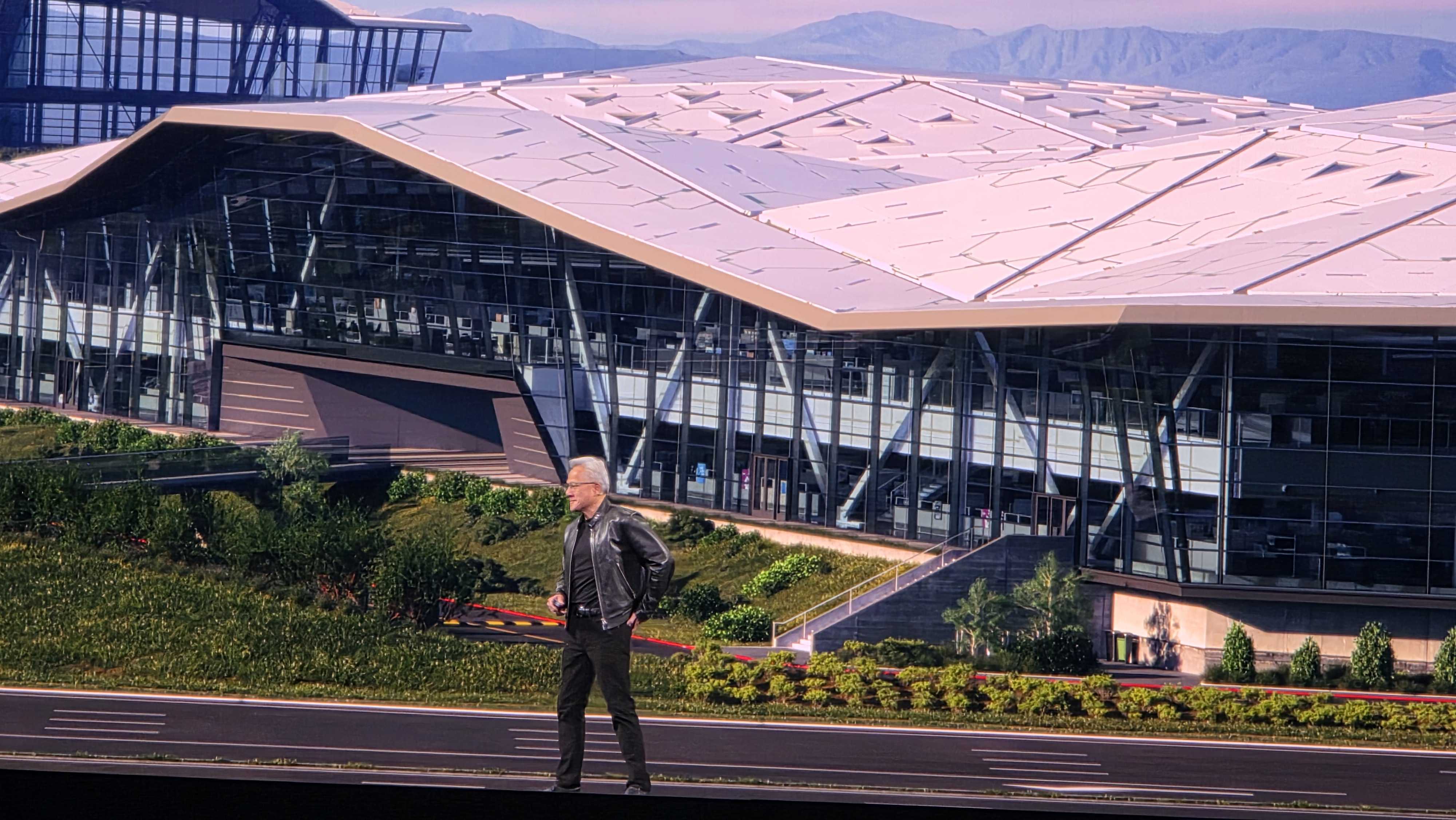
The man of the hour is here: CEO Jensen Huang
(Image credit: Tom’s Hardware)
Jensen Huang has taken the stage in a familiar leather jacket. Sorry folks, there’s no special jacket this time around. Jensen is starting off the show thanking some of the people that hosted the preshow leading up to the keynote.
2026-03-16T18:18:42.915Z
And we’re off!
2026-03-16T18:13:42.529Z
That’s… a lot of country music?
2026-03-16T18:04:38.117Z
Running a bit behind schedule
We’re a few minutes past the top of the hour, and we’re still waiting on the keynote to start. In the meantime, a quick reminder that you can watch along with us through the live stream above.
2026-03-16T17:55:12.129Z
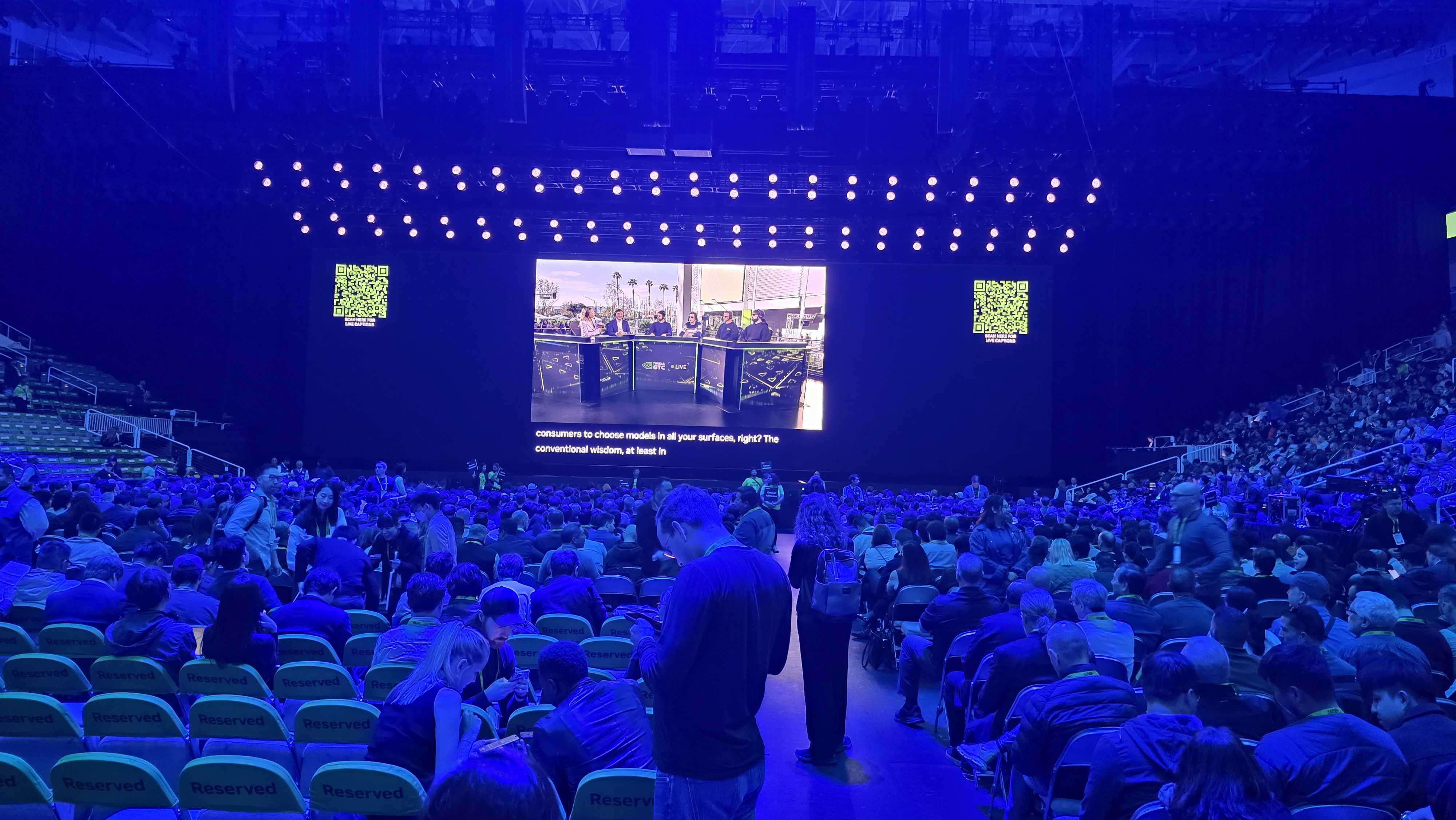
T-Minus 5 Minutes
(Image credit: Tom’s Hardware.)
Run to the bathroom, get your drink ready, and settle in. We’re just a few minutes away from the start of GTC 2026. Jensen will probably start with a short history of Nvidia’s role in AI, but we expect the announcements to rapid-fire out after that point. We’re sat down in the SAP Center in San Jose and ready to dig in.
2026-03-16T15:24:10.145Z
What to expect from GTC 2026
Intel x Nvidia partnership — Nvidia bought $5 billion in Intel stock last year, and at the time, announced that the two companies would be working together on custom x86 processors across both the data center and consumer PCs. The deal has apparently been decades in the making. It’s not clear if we’ll hear about consumer or enterprise chips, or both, but there’s a good chance we’ll hear something from the partnership.The ‘future of real-time rendering’ — Nvidia presented at GDC (not GTC) about neural rendering, but just a week later, the company is teasing that it will reveal the “future of real-time rendering” at GTC (not GDC). Maybe it’s a new DLSS feature, maybe it’s something completely new. We don’t know, but Nvidia has already confirmed something is coming for gamers during the keynote.More on Vera Rubin — Nvidia officially launched its Vera Rubin NVL72 in January, and it started shipping samples to customers just weeks ago. These next-gen AI data center boards are on-track for the second half of the year, so we expect to hear a lot about them during the keynote.AI agents — Since the release of OpenClaw, the tech industry has been washed in talk of AI agents. Nvidia will talk about AI agents during the keynote, that much is almost guaranteed. We could see an announcement of “NemoClaw,” which is an AI agent Nvidia is reportedly developing to compete with OpenClaw.Nvidia N1/N1X — Perhaps the biggest rumor around Nvidia over the past year has been the N1 and N1X, which are two SoCs reportedly being developed for the consumer market. Do we finally see a reveal at this year’s GTC? Perhaps, but this is the last item on this list for a reason.