
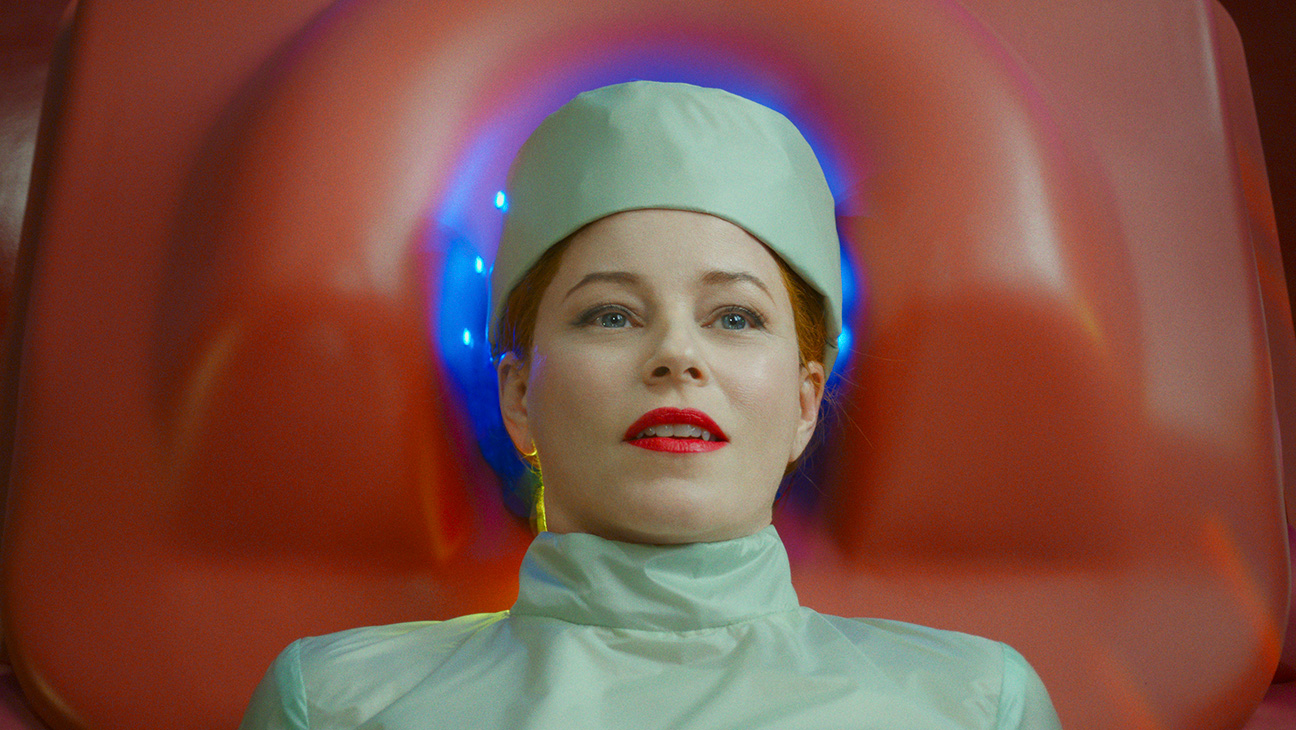
An alarmed glance at the near future, DreamQuil is set in a world where the air is unbreathable and most human interactions are virtual. It’s also steeped in a well-traveled sci-fi movie past, the one that revolves around the fear of robots — a connection the movie winkingly acknowledges when it name-checks The Stepford Wives, the most fitting and obvious of allusions for this domestic drama. With screen power to burn, Elizabeth Banks and John C. Reilly star as married parents who enlist state-of-the-art help with saving their marriage. But as the movie adds new technologies and AI anxiety to the rise-of-the-machines template, it lands somewhere that’s more pastiche than genre advancement.
The film’s director, Alex Prager, whose striking short films have featured Banks, Cate Blanchett and Bryce Dallas Howard, brings a bold, color-drenched visual language to her feature debut. Through that hyperreal lens, and working from an admirably succinct screenplay that she wrote with her sister, Vanessa Prager, the helmer zeroes in on a nuclear family whose cohesion is in serious peril, bringing a rise-of-the-androids scenario, à la Westworld, into a far more intimate realm.
DreamQuil
The Bottom Line
On the pulse and yet off the mark.
Venue: SXSW Film Festival (Narrative Spotlight)
Cast: Elizabeth Banks, John C. Reilly, Juliette Lewis, Sofia Boutella, Lamorne Morris, Toby Larsen, Anna Marie Dobbins, Kathryn Newton
Director: Alex Prager
Screenwriters: Alex Prager, Vanessa Prager
1 hour 23 minutes
Banks’ Carol is a hard-edged real estate agent who’s determined to make partner. Her husband, Gary (John C. Reilly), a mellow literature teacher who wants to leave the city for a quiet beach town, can’t take much more of her indifference toward him and their son, Quentin (Toby Larsen). The kid doesn’t particularly enjoy being around her, and who can blame him after she refuses to be called Mom because it’s so limiting.
In a corner of their enormous high-rise apartment, interrupting the deep jewel tones of the traditional decor, stands a pod that’s used mainly for virtual socializing, but also for other things. The production design by Annie Beauchamp (Top of the Lake, On Becoming a God in Central Florida) is both recognizably grounded and subtly weird, and the camerawork of Lol Crawley (The Brutalist) is attuned to the liminal disconnect as well as the saturated palette. As to the pod, it lands somewhere on the spectrum between the Orgasmatron in Sleeper and the teleportation closet in Bugonia. Carol has been spending a good deal of time there lately. As DreamQuil begins, Gary opens the pod door to find her “minxing” in a field of poppies with a strapping virtual fellow straight off a romance-novel cover.
Knowing she needs to change something in her life but not sure what, Carol finds herself bombarded with ads for DreamQuil, an immersive therapy that promises a personally tailored reset. The commercials, featuring the company’s young CEO, Margo Case (Kathryn Newton), fuse Big Pharma come-on with a vague feminist spiel, and Carol rolls her eyes at all the feel-good whatever. But then her good friend Rebecca (Sofia Boutella) swears by the “digital ayahuasca,” saying it saved her marriage to Eric (Lamorne Morris), and urging Carol to take the plunge. And so she does — and with a dial-spinning, needle-wielding, breathy-voiced Nurse Chapman (Juliette Lewis) overseeing the procedure, what could possibly go wrong?
For reasons that eventually make sense, the movie isn’t clear about how long Carol is away from home for her treatment. But it’s long enough for her temporary replacement robot (Anna Marie Dobbins) — an extra DreamQuil service — to have organized the household and endeared herself/itself to Gary and Quentin. Carol is understandably freaked out; the robot is straight from the uncanny valley, with Dobbins and the filmmakers delivering a thoroughly unsettling sleight-of-hand. She has the same strawberry blond hair as Banks’ character, the same electric-red lipstick, and also calls herself Carol — and, to further twist the virtual knife, Quentin calls her Mom.
As the setup cycles through cinematic tropes and makes its way to a predictable catfight over who’s the true domestic goddess, Banks is terrific at communicating Carol’s wordless rage, her workplace competitiveness having shifted to the home front. And Reilly is aces at playing aw-shucks-who-me innocence while Gary enjoys the best of both worlds, as his friend Eric slyly points out during a dinner party. That pivotal scene plays out with tremendous energy and sexual tension as the camera cuts between the two couples and the suddenly ultra-demonstrative robot Carol.
The story’s frictions and its premise could not be more evident, and the actors deliver the subtext with skill and a playful edge. But beneath the well-engineered surface of mannerisms, ambitions and frustrations, what’s missing is an emotional hook that truly catches. The story grows less compelling as the layers of reality purposely grow more jumbled. In narrative terms, the artifice begins to feel like sensory overload. Yet Prager is clearly a filmmaker with a distinct talent, and it will be interesting to see how she next applies it to the big screen.