
Gaps in the eldercare and retirement housing landscape can be addressed with regulatory changes
SINGAPORE will be a super-aged society by 2030, when one in four residents will be 65 or older. The demographic shift is unlikely to be reversed, and retirement adequacy and protection will become increasingly important social issues that require deliberate elaboration and policy interventions.
While several government programmes are in place that aid active ageing and retirement adequacy, there remain some gaps in regulation that are hobbling the development of better senior housing options for Singapore.
How do we make certain that senior citizens continue to age well? For peace of mind, seniors need to ensure independence in three areas – physical, social and financial.
Physical independence will mean being free of illness, remaining mobile, carrying out their usual routines, and participating in daily activities.
Social networks and connectivity are important in retirement. Pickleball, for instance, is one senior-friendly activity that has gained a strong following among both young and old.
Financial adequacy will be critical to ensure that retirees maintain independence when their regular employment income sources are terminated, and can stay debt-free.
Navigate Asia in
a new global order
Get the insights delivered to your inbox.
The Central Provident Fund Lifelong Income For the Elderly plan, a national longevity insurance annuity scheme, supports retirement adequacy with a line of lifetime income.
Still, seniors and caregivers increasingly cite challenges in navigating care support systems and finding clearer pathways and more predictable long-term support. The availability, quality and cost of care loom large for many as they age.
Public housing options for senior citizens
Care needs are intertwined with housing options. Many seniors want to ensure they have adequate housing throughout their lifetimes and, at the same time, remain connected to the community. Ageing in place is the preferred option.
Housing & Development Board (HDB) homeowners have two options to support retirement.
The first: They can sell their current flats and take up three-room or two-room flexi flats via the Silver Housing Bonus scheme, which offers up to S$40,000 in cash to support such a move. They can also choose to buy community care apartments (CCAs) that come with assisted living services.
The second: They can opt for the lease buyback scheme, allowing them to continue to stay in their current home and monetise the rest of their lease to supplement retirement incomes.
Retirement villages at Kampung Admiralty and CCAs are two public housing typologies currently available for those who choose to sell and move out of their flats.
Kampung Admiralty is a model for active ageing, which involves multiple agencies: the HDB, Ministry of Health, Yishun Health Campus, National Environment Agency, National Parks Board, Land Transport Authority and Early Childhood Development Agency.
The self-contained development comprises around 100 units of two-room flexi flats, integrated with medical care, senior care and other supplementary services and amenities – including a supermarket, food court and childcare – all under one roof. The project, however, could be costly to scale across different towns.
The CCA project is a more viable option that provides a range of assisted living and care services to senior residents’ homes. Assisted living services could be extended to other senior residents in nearby non-CCA housing estates to reap economies of scale.
Privately housing with care options
There are also seniors living in, or owning, private housing who prefer not to move.
Those unable to live independently are likely to seek non-home-based care services and support, such as nursing homes and hospice care, as well as home-based arrangements that combine home medical services with community rehabilitation and day care or day hospice care.
The government provides funding to support social programmes that ensure these care services are affordable and accessible. It has also extended a cost-sharing scheme, called Enhancement for Active Seniors, to subsidise the installation of safety and accessibility fittings in private homes.
There remains a sizeable gap in the private housing market in meeting the needs of aged people seeking to live independently and live well.
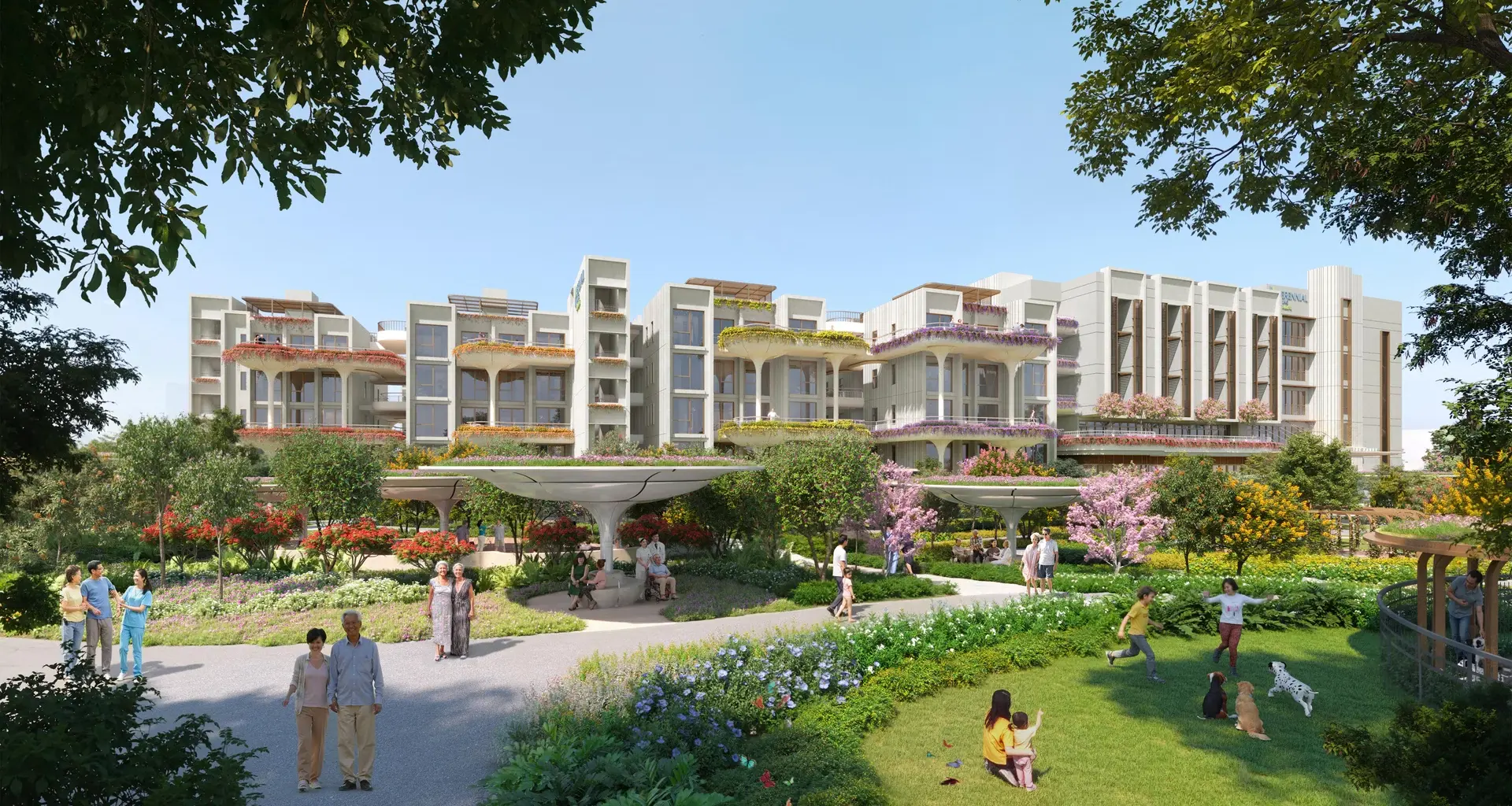
The recently opened Perennial Living Parry Avenue project is one development aimed at this niche.
Combining assisted living, nursing care and medical care, it consists of 200 assisted living apartments and a nursing home with 100 beds. The project also hosts a wellness clubhouse, geriatric care centre and community park.
The Perennial Living project is a relatively new concept in Singapore. Developers do not have past precedents to reference for such integrated developments, and they navigate multiple regulatory regimes for conventional residential use, healthcare facilities or social residential homes.
Clarity on the legal provisions and planning guidelines is thus helpful to encourage the private sector to create new and innovative housing and care services to support active and healthy ageing in Singapore.
Four issues need to be considered.
1. Lack of a clear legal definition
Australia and New Zealand have dedicated Retirement Villages Acts for integrated models that combine private residential accommodation with non‑institutional support services – such as healthcare – and lifestyle amenities.
However, current laws in Singapore, including the Healthcare Services Act and the Social Residential Homes Act (introduced in 2025), do not have a formal definition of “assisted living” as a distinct housing‑with‑care model that is neither a nursing home nor an acute healthcare facility.
Introducing a clear, non-medicalised, consumer-centred definition with standard disclosure requirements for assisted living would thus reduce confusion and give seniors greater confidence when evaluating private housing-with-care options.
2. Land use and zoning constraints
Assisted living is not recognised as a distinct zoning class in the Urban Redevelopment Authority’s Master Plan.
Therefore, establishing an assisted living zoning category with permissible development parameters would reduce uncertainty for developers when applying for a “change of use” to develop land for residential use integrated with medical and nursing care, as well as other assisted living services.
3. Ownership models and stamp duty barriers
The additional buyer’s stamp duty rate of 65 per cent for entities and trusts, together with the buyer’s stamp duty, adds immense financial risk for developers undertaking innovative housing models.
Australia and New Zealand apply deferred management fees or buyback clauses to senior living assets with a recurring fee tenure, which is treated as an investment product.
Issuing specific guidance under Monetary Authority of Singapore oversight on how stamp duty rules apply to these products could allay concerns and enhance consumer protection.
4. Licensing complexity
Integrated residential facilities with assisted living, nursing care and wellness services require multiple licenses under the Healthcare Services Act and other regulations, as well as the appointment of clinical governance officers.
A coordinated single regulatory mechanism, instead of multi-agency licensing pathways, could significantly reduce compliance friction for integrated senior living developments.
Shortages of trained workers in medical and nursing care services are also barriers to ensuring operational sustainability and care quality in the assisted living model.
The adoption of technologies such as telehealth, wearable devices and smart home systems could ease – though not substitute – workforce pressure.
Supporting job redesign, strengthening training pipelines and developing clear guidance on safe technology adoption would improve workforce resilience across the sector.
From the regulators’ perspective, data privacy, cybersecurity and compliance with medical device regulations must be maintained throughout.
Fee structures for different levels of eldercare and assisted living services should be fully and clearly disclosed to protect consumers, maintain trust and avoid disputes.
Developers of senior living housing options will not just build physical spaces and buildings – they will also need to integrate assisted living services and, in some cases, medical and nursing care programmes.
The pilot project at Parry Avenue would not have been possible without close collaboration and bespoke arrangements with various government agencies and ministries.
The project offers valuable lessons for replicating similar retirement homes with assisted living and care services in the future.
Together with HDB’s CCA and retirement village projects, other privately driven experimental concepts and ideas – for example, intergenerational co-living at the St John’s-St Margaret’s Church Village – could offer more and diverse options for living well and ageing well in Singapore.
Sing Tien Foo is the provost’s chair professor at the Department of Real Estate of the National University of Singapore Business School. Norman Ho is a senior partner at Rajah & Tann Singapore. The views in this article are the authors’ and do not represent the views of their university, company or affiliations.
Decoding Asia newsletter: your guide to navigating Asia in a new global order. Sign up here to get Decoding Asia newsletter. Delivered to your inbox. Free.