
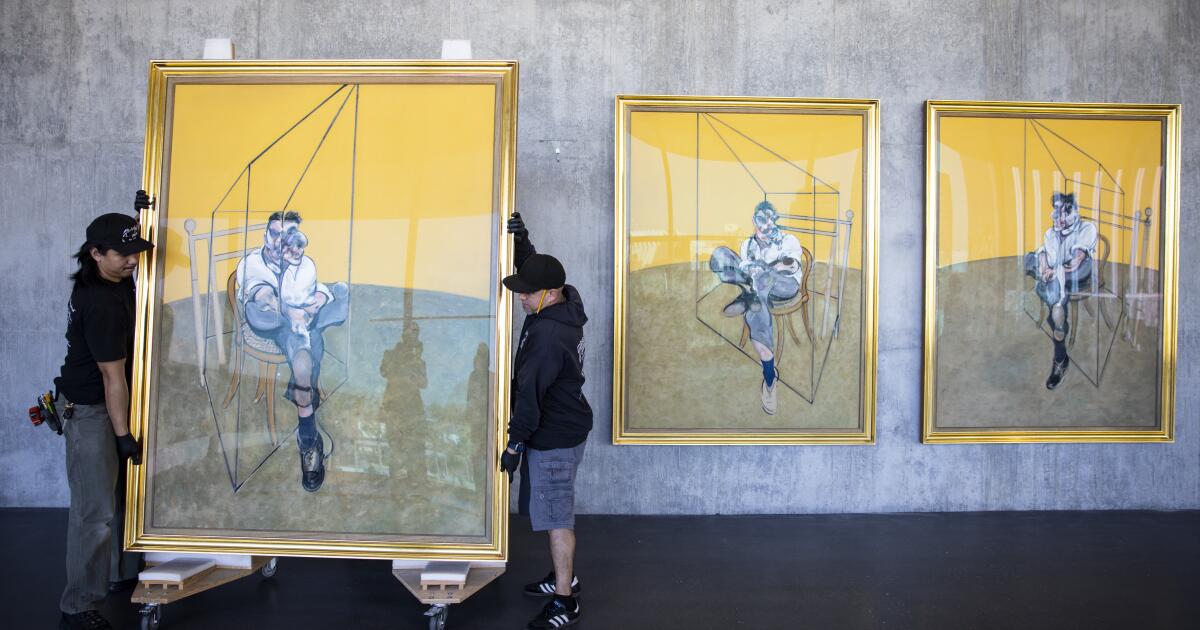
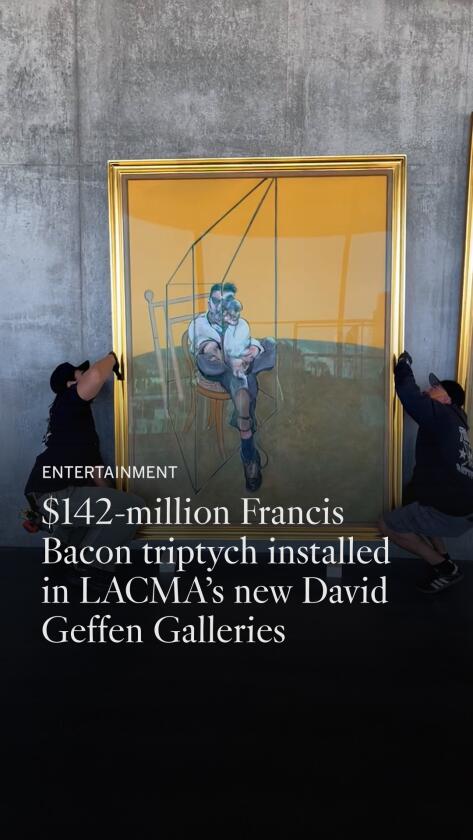
“She’s supposed to be here instead of the paintings,” said Los Angeles County Museum of Art Director and Chief Executive Michael Govan of the late LACMA trustee and philanthropist Elaine Wynn, while watching the installation of a $142.4 million triptych by Francis Bacon. Wynn gifted the 1969 paintings to the museum upon her death.
When Wynn acquired Bacon’s “Three Studies of Lucian Freud” in 2013, it broke the record for the most expensive artwork to ever sell at auction. It’s also among the most valuable works in LACMA’s collection, alongside other iconic paintings, including Vincent van Gogh’s 1888 “Tarascon Stagecoach,” which was donated to the museum as part of the Pearlman Collection.
Share via Close extra sharing options
Wynn became LACMA’s board co-chair in 2015, and the following year pledged $50 million toward the museum’s new Peter Zumthor-designed David Geffen Galleries. The north wing where the Bacon triptych has been installed is named after her. It wasn’t public knowledge at the time, Govan said, but part of Wynn’s interest in supporting LACMA was to find a home for the Bacon paintings, which she had pledged to donate to the public.
“So really, the story of this building and her gift, part of the energy for it was, where do you leave these legacies?” said Govan, looking at the paintings on the mottled gray concrete walls. The golden compositions are housed in bright gold frames, and the glass that shields them reflects the world beyond. Both the frames and the glass were specified by the artist, Govan said. The triptych is along the wall in a main thoroughfare of the museum facing the floor-to-ceiling windows that form part of the building’s bridge over Wilshire Boulevard.
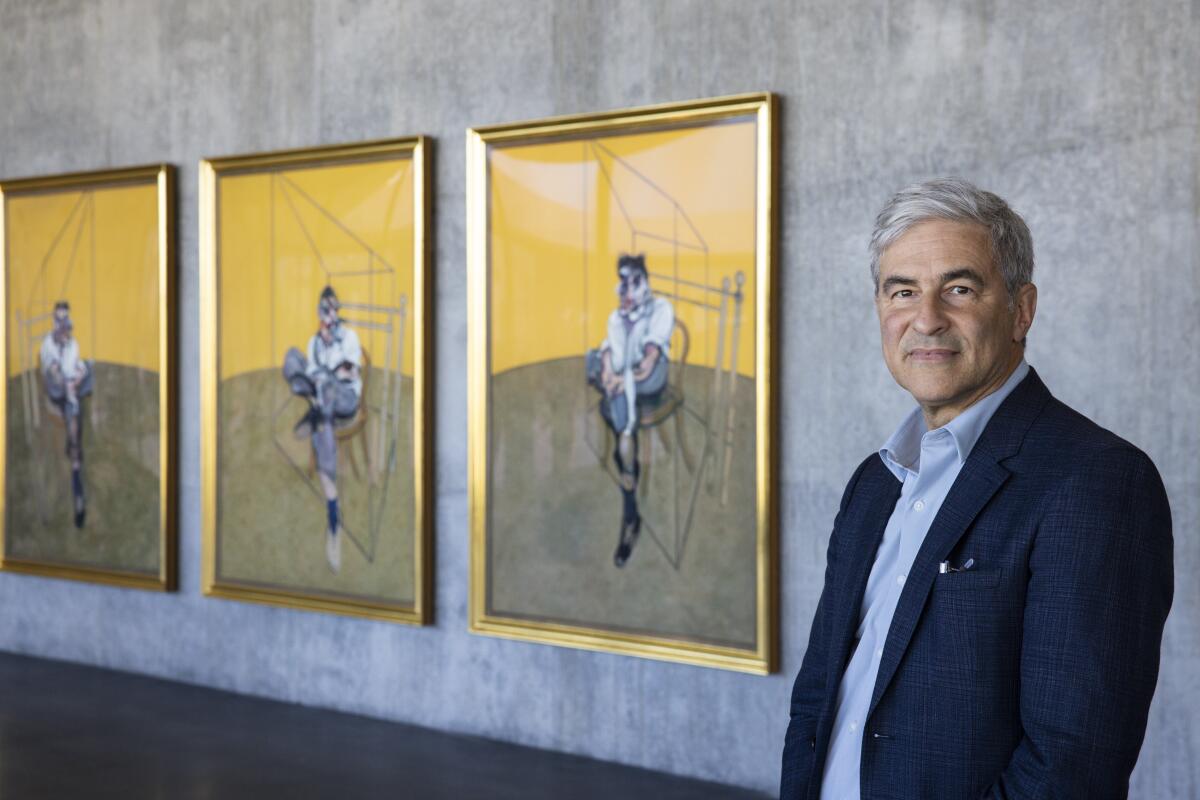
Los Angeles County Museum of Art Director and Chief Executive Michael Govan stands beside a newly installed triptych by Francis Bacon, which was gifted by late museum trustee Elaine Wynn, who paid $142.4 million for work at auction in 2013.
(Kayla Bartkowski / Los Angeles Times)
Visitors will be able to turn their heads from the Bacon paintings to see traffic rushing beneath the building and Chris Burden’s iconic “Urban Light” installation in the distance. Passengers in vehicles below may be able to catch a glimpse of the golden treasures above, which was always part of the plan for the museum’s design, Govan said.
“I am sitting here somewhat sad,” Govan said. “Museum directors are never sad to see a masterpiece on the wall for the opening of their brand new museum. However, it was a life interest gift. At the end of her time she would make this gift, and she told me that. And so I was assuming we would just have a cocktail party at her home after the opening of the building. … I never imagined [the paintings] would be here, because, of course, I thought Elaine would be here.”
Museums are not just civic spaces meant for public gatherings, concerts and conviviality, Govan said, they are “vessels to hold people’s legacies, hopes and dreams. Almost everything in our museum belonged to somebody, and it was a gift or somebody acquired it for us.”
He hopes that feeling of generosity and public commitment resonates with museumgoers as they explore the new galleries this spring. Govan also says he thinks visitors will appreciate another significant aspect of the triptych: It puts an artist’s portrait of another artist at the heart of the museum.
The psychological energy of two artists in dialogue is meaningful to Govan, a self-described “artist person.”
“Three Studies of Lucian Freud” finds Bacon portraying his fellow artist in a way that has a frenetic film strip quality — he observes Freud from three different angles. Freud is depicted on a chair and enclosed with an abstract black-lined box that could be interpreted as a mental cage of sorts.
“It’s very powerful,” Govan says, nodding his head in appreciation.
With the Bacon triptych up, the new David Geffen Galleries continue the countdown to their grand public opening on May 4. Until then, drills buzz into concrete, construction lifts beep loudly, workers iron curtains and more art comes out of storage waiting for a moment in the sun.