
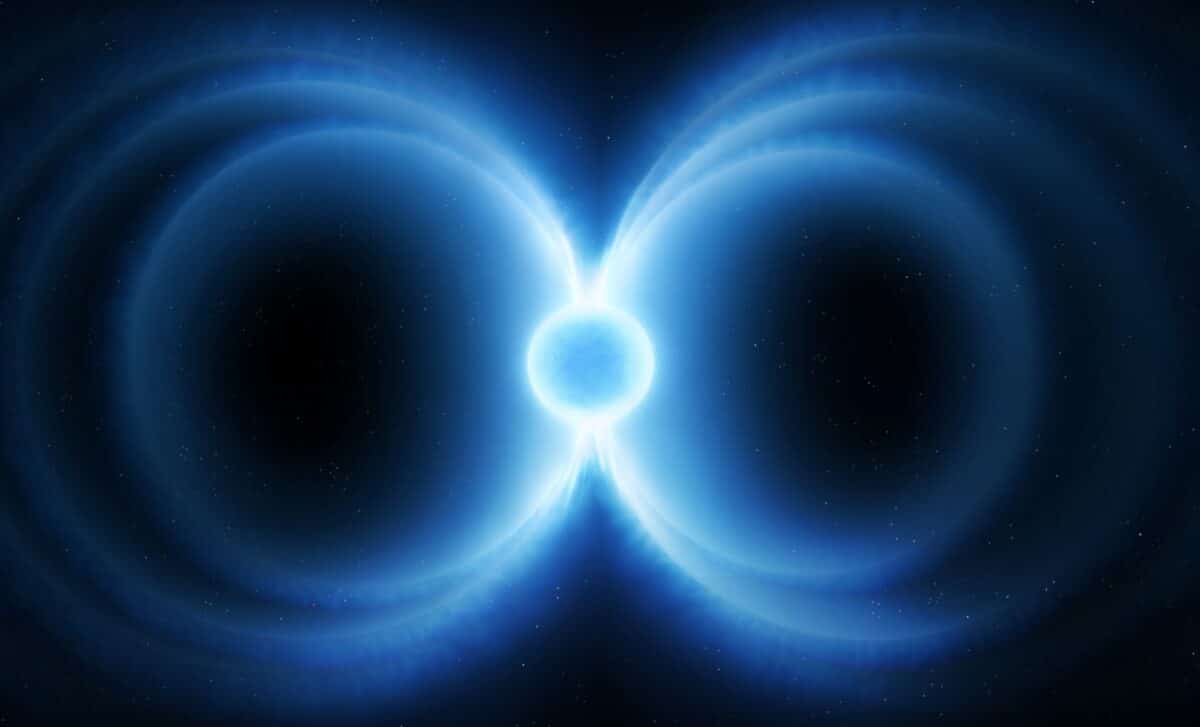
After seven decades of failed attempts, researchers have finally identified how the universe generates its vast, orderly magnetic fields from chaotic turbulence. The breakthrough, published in Nature, could reshape our understanding of everything from solar storms to neutron star mergers.
Magnetic fields are among the most universal forces in the cosmos, threading through planets, stars, and entire galaxies. Yet despite decades of study, explaining how turbulent plasma produces large-scale, organized magnetic structures has remained one of plasma astrophysics’ most stubborn unsolved problems.
The answer, it turns out, may lie in something deceptively simple: a steady push. Researchers at the University of Wisconsin-Madison, led by physicist Bindesh Tripathi, ran some of the most computationally intensive plasma simulations ever attempted and found that a persistently replenishedvelocity gradient within plasma flows is the missing ingredient scientists have been searching for.
The Problem That Stumped Physicists for Generations
The puzzle dates back to 1955, when physicist E. N. Parker proposed what became known as mean-field dynamo theory, an attempt to explain how turbulent motion inside stars and galaxies could give rise to organized magnetic fields. The theory became widely used, but it carried a nagging flaw. According to the study’s senior author Paul Terry, a physics professor at UW-Madison,
“Magnetic field generation via dynamos has been extensively studied for 70 years, with the frustrating result that the generated fields almost always end up at small scales and highly disordered, unlike observations.“
In other words, every serious simulation kept producing the wrong answer, tangled, fragmented fields where the universe clearly shows something sweeping and structured. The gap between theory and observation was real, and it was embarrassing. What made this especially difficult is a dimensional one. Fluid flow problems can often be solved in two dimensions, but magnetic field generation requires full three-dimensional modeling, dramatically more complex and computationally demanding.
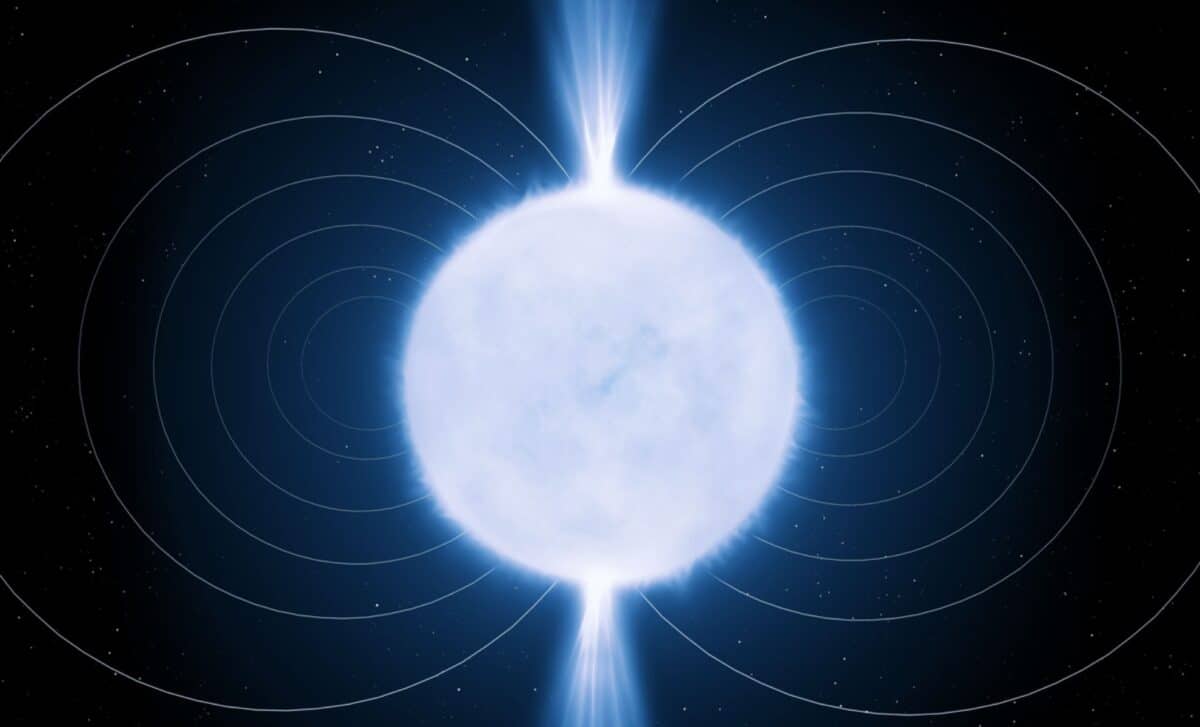 The 3D Problem That Stumped a Generation of Physicists ©Shutterstock
A Bicycle Crash and 137 Billion Grid Points
Tripathi and his colleagues made two decisive changes to break the deadlock. The first was conceptual: they introduced a constantly replenished velocity gradient into their simulations. The team uses a vivid analogy to describe it, imagine a cyclist riding straight into a curb. The wheels stop, but the rider’s momentum carries them over the handlebars. That abrupt change in speed is a velocity gradient, and such gradients occur naturally throughout the universe, between layers inside the sun or during neutron star mergers.
The second change was sheer computational firepower. The team ran simulations using up to 4,096 × 4,096 × 8,192 grid points (137 billion in total) across three-dimensional space, consuming nearly 100 million CPU hours on the Anvil supercomputer at Purdue University and generating roughly 0.25 petabytes of data across approximately 90 individual simulations.
As Tripathi describes it, the process begins small: “Initially, these perturbations lead to turbulent flows and magnetic fields in small-scale structures, then, over time, they emerge into larger, ordered structures.” When the team ran the same simulations but allowed the initial velocity gradient to decay, the large-scale patterns vanished entirely, replaced by small-scale chaos. The conclusion was unambiguous, a sustained, large-scale velocity gradient is the key driver.
From Lab Experiments to Neutron Star Mergers
The new findings don’t just resolve a theoretical headache, they also explain a real experimental mystery. In 2012, researchers at the Wisconsin Plasma Physics Laboratory conducted experiments studying magnetic field formation, and the results didn’t match any existing model. The mechanism identified by Tripathi’s team aligns far more closely with those decade-old measurements, giving the new theory an important experimental anchor.
The implications stretch across some of the most extreme environments in the universe. According to Tripathi, the work “has the potential to explain the magnetic dynamics relevant in, for example, neutron star mergers and black hole formation, with direct applications to multimessenger astronomy.”
In binary neutron star mergers specifically, the identified dynamo process likely operates on microsecond timescales, producing within milliseconds some of the strongest magnetic fields known to exist anywhere in the universe, fields that generate detectable signals across multiple astronomical messengers, from gravitational waves to light.
Closer to home, the research, published in Nature, may also improve scientists’ ability to model stellar magnetic activity and predict solar ejections heading toward Earth, with tangible consequences for space weather forecasting and the satellite infrastructure that modern life depends on.