
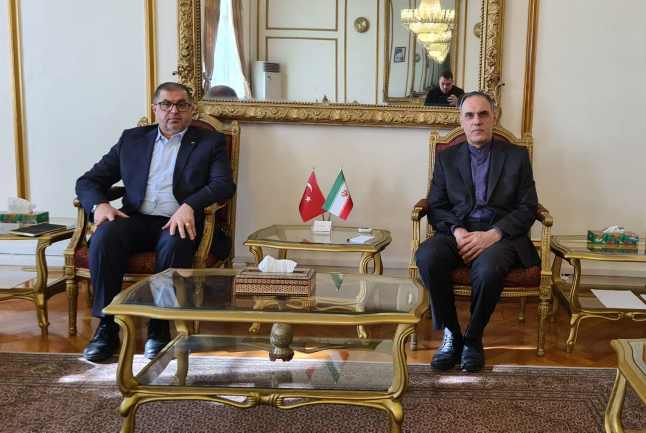
 Bassem Na’im at the Iranian embassy (Hamas Telegram channel, March 16, 2026)
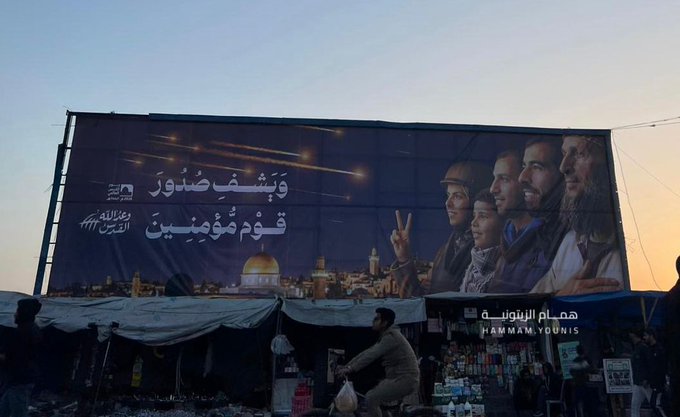 Billboard at the al-Saraya junction in Gaza (X account of journalist Muhammad Abd al-Aziz, March 12, 2026)
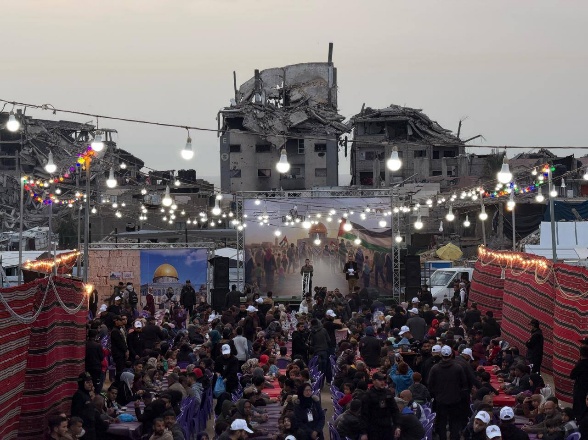 The World Jerusalem Day fast-breaking meal (Facebook page of journalist Osama al-Kahlout, March 14, 2026).
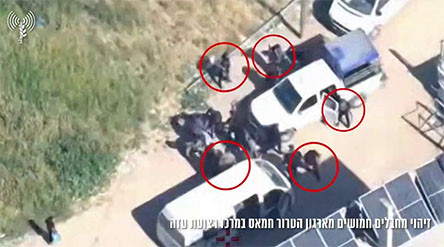
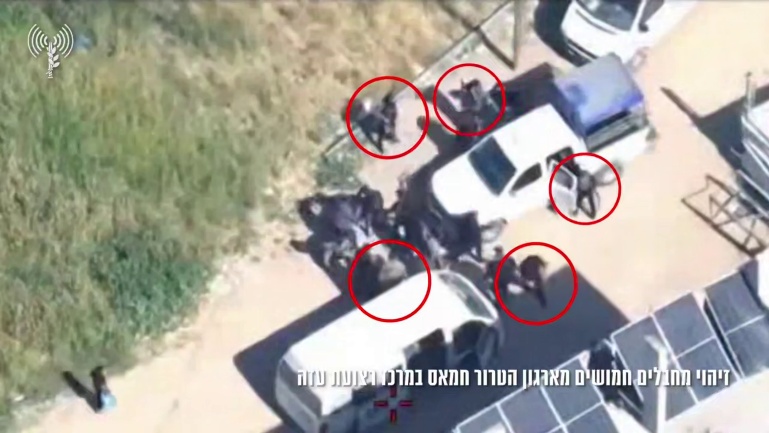 Armed terrorists (circled in red) prepare to attack IDF forces (IDF spokesperson, March 16, 2026)
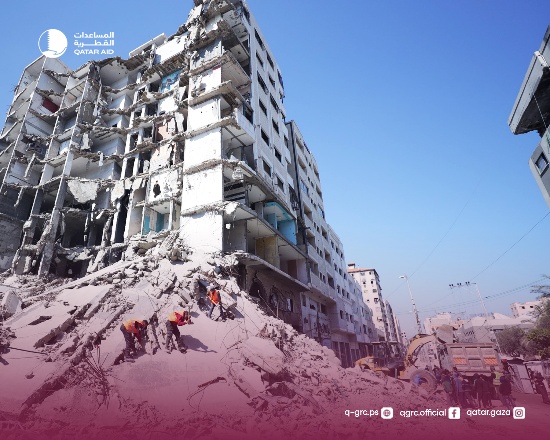 Removing dangerous concrete blocks (Facebook page of the Qatari committee, March 12, 2026)
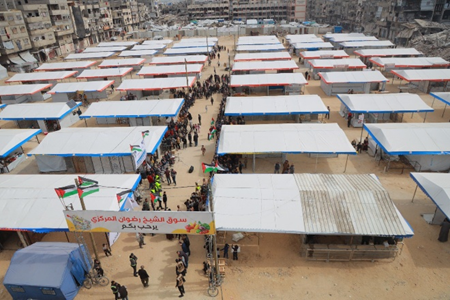 Inauguration of the new market (Facebook page of the Gaza municipality, March 13, 2026)
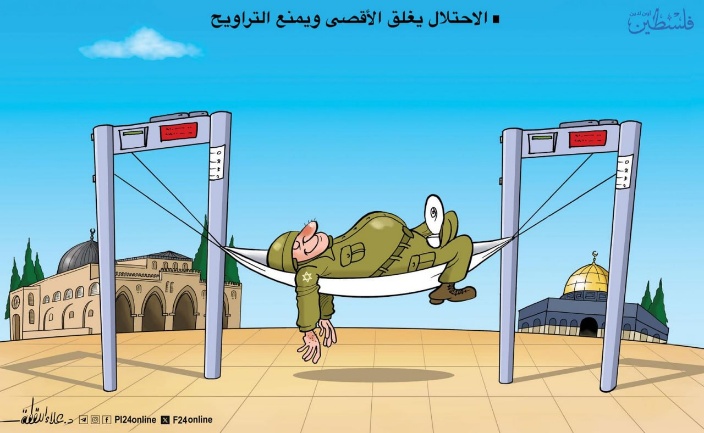 A cartoon by Alaa al-Laqta, Hamas’ in-house cartoonist. The Arabic reads, “The occupation closes al-Aqsa and prevents [the Taraweeh] prayer” (Palestine Online, March 12, 2026)
Hamas condemned the “American-Zionist aggression” against Iran and noted Iran’s “right” to respond, but not against its neighbors. Hamas also reportedly sent a secret letter to Iran’s leader for all fronts to be activated against Israel.
IDF forces continued operations within the Yellow Line area in the Gaza Strip and eliminated Hamas terrorists who posed a threat, including those involved in the October 7, 2023 terrorist attack and massacre.
Hamas is tightening its security governance in the areas under its control in Gaza with public appearances of armed police and operatives from the military wing.
The Turkish IHH continues to increase its activity in the Gaza Strip.
A Hamas delegation visited Cairo and held talks with Egyptian officials and with representatives of the Board of Peace regarding implementation of the ceasefire agreement.
The United States imposed sanctions on four associations that helped fund Hamas’ military wing under the guise of humanitarian activity. A suspect involved in a Hamas plot to attack Israeli and/or Jewish targets in Europe was arrested in Cyprus.
Shots were fired at IDF forces in Samaria; there were no casualties. An Israeli civilian was stabbed and seriously wounded in Ramat Gan, suspected as a terrorist attack, and an Arab-Israeli was detained.
The chairman of the Palestinian Authority, Mahmoud Abbas, spoke to the Pope. Abbas said that once the war in Iran ended, an international peace conference should be convened to end the “Israeli occupation of Palestinian territories and Arab territories in Lebanon and Syria.”
Hamas expressed “concern” over the war and condemned the “American-Zionist aggression” against Iran, which it claimed “violated” international law and international humanitarian law, and endangered regional and global security and stability. Hamas said Iran had the “right” to respond to the attacks “by all available means” in accordance with international norms and laws, but called on Iran not to attack neighboring countries (Hamas Telegram channel, March 14, 2026).
Hamas also reportedly sent two letters to the new leader of Iran, Mojtaba Khamenei, one of them public and diplomatic, and the other a secret letter stating that Hamas would not compromise on the issue of disarmament, called for the activation of all fronts against Israel, in cooperation with elements of the “resistance axis”[2] in Lebanon, Yemen and Iraq. The letter reportedly criticized the Gulf States promoting normalization with Israel, portraying them as weak and not defending those who were sheltering in their bases (Israeli Kan News, March 15, 2026).
A Hamas delegation headed by political bureau member Bassem Na’im visited the Iranian embassy in Turkey and offered condolences for the death of the supreme leader, Ali Khamenei, and other Iranian officials killed in the Israeli and American attacks. The delegation congratulated Mojtaba Khamenei on his selection as the new leader and condemned the attack on Iran. Na’im briefed the Iranian ambassador on political, humanitarian and military developments in the Gaza Strip, east Jerusalem and Judea and Samaria, as well as on the [alleged] “risks” facing al-Aqsa Mosque and the continued “violations” of the ceasefire. The Iranian ambassador said his country would continue to support the Palestinian people (Hamas Telegram channel, March 16, 2026).
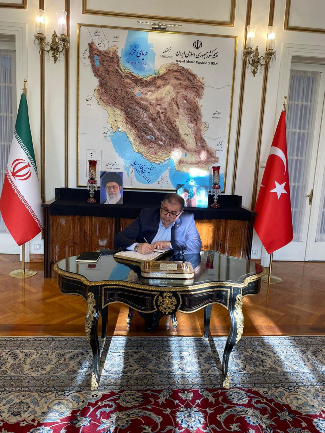
Bassem Na’im at the Iranian embassy (Hamas Telegram channel, March 16, 2026)
Marking World Jerusalem Day in the Gaza Strip
On March 13, 2026, events marking World Jerusalem Day[3] were held, however for the third consecutive year no large events were held in Gaza. According to sources in the terrorist organizations, the “security” and political situation in the Strip prevented such events from being funded and organized, and there were concerns that Israel would exploit public gatherings to identify operatives and later target them. Other sources said the severe financial crisis affecting the terrorist organizations, especially those supported by Iran, including the Palestinian Islamic Jihad (PIJ) and smaller organizations, made it difficult for them to finance ceremonies, fast-breaking meals and public activities (al-Sharq al-Awsat, March 13, 2026).
The main event marking World Jerusalem Day was reportedly held in a displaced persons camp in western Gaza City. The event included a speech by Assid al-Kahlout, brother of the former spokesperson of the military wing Abu Obeida, on behalf of the families of the shaheeds, in which he related to the choice of “steadfastness and adherence to Jerusalem.” A billboard was erected at the al-Saraya junction in central Gaza City, extolling the Iranian missile attacks on Israel (al-Mayadeen.net, March 15, 2026).
Right: The World Jerusalem Day fast-breaking meal (Facebook page of journalist Osama al-Kahlout, March 14, 2026). Left: Billboard at the al-Saraya junction in Gaza (X account of journalist Muhammad Abd al-Aziz, March 12, 2026)
The IDF continued operations within the Yellow Line areas in the Gaza Strip to locate terrorists and destroy weapons and terrorist infrastructure. The forces eliminated terrorists who crossed the Yellow Line or posed a threat and planned to attack IDF soldiers, including Hamas nukhba operatives who participated in the October 7, 2023 attack and massacre. In response to shots fired at IDF forces, a commander in Hamas’ anti-tank missile unit was eliminated. In addition, a Hamas rocket launcher in Gaza City aimed at Israel was destroyed (IDF spokesperson, March 10-17, 2026).
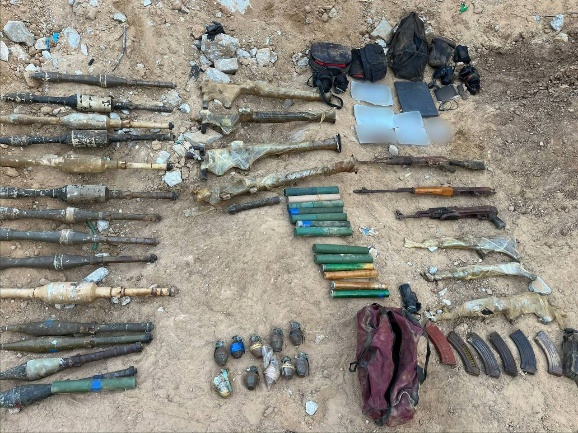
Right: Weapons found underground in the Rafah area (IDF spokesperson, March 11, 2026). Left: Armed terrorists (circled in red) prepare to attack IDF forces (IDF spokesperson, March 16, 2026)
Palestinian media reported IDF attacks targeting Hamas police forces in the Strip: according to reports, on the night of March 13, 2026, an Israeli aircraft struck a police checkpoint in Khan Yunis and two policemen were killed (Agence France-Presse and Telegram channel of activist Hamza al-Masri, March 14, 2026). A day later an Israeli aircraft attacked a police vehicle near the entrance to the town of al-Zawayda in the central Gaza Strip and nine officers and policemen were killed, including the commander of the Central District’s intervention police, and 14 others were wounded (Quds Agency and the Palestinian Media Center, March 15, 2026).
Local sources reported that the IDF had increased its aerial attacks, especially in western Gaza City, claiming the attacks often caused full or partial burning of displaced persons’ tents near the bombed sites and caused injuries and burns (al-Ayyam, March 13, 2026).
Security Governance
This past week, pictures were published of armed Hamas terrorists moving openly in areas under the movement’s control, ostensibly to ensure order and assist residents:
A video circulated on social media in the Strip showing a convoy of Toyotas with Hamas gunmen. The caption said it was a “military display” of the security forces in the Khan Yunis district, part of efforts “to strengthen security, impose control on the ground and deal with any violation or cases of chaos” (al-Sayyad Telegram channel, March 12, 2026).
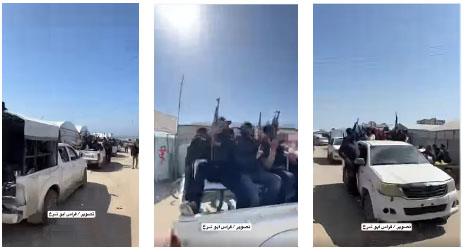 P
P
ictures of armed operatives (al-Sayyad Telegram channel, March 12, 2026)
The Hamas ministry of interior and national security published photographs of armed policemen inspecting prices in the markets (Hamas police Telegram channel, March 12, 2026).
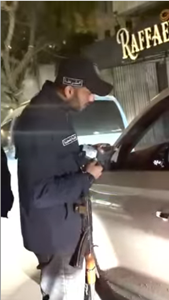
An armed policeman deployed at night in Gaza City during Ramadan
(Hamas police Telegram channel, March 12, 2026)
Hamas’ Shehab news agency issued a video of Hamas military wing operatives distributing water and dates ahead of the fast-breaking meal (Shehab Telegram channel, March 15, 2026).
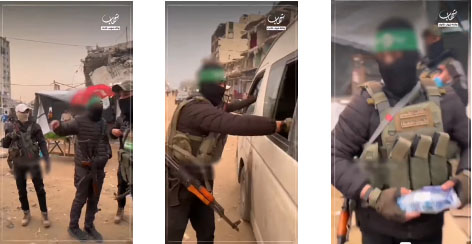
Pictures from the video (Shehab Telegram channel, March 15, 2026)
The Hamas’ “resistance security” Rada Force announced that its operatives had ambushed a militia operating under Israeli patronage in southern Khan Yunis, outside the Yellow Line area. According to the announcement, the house where the militia members had barricaded themselves was attacked with a shell. The operatives then attacked them with gunfire, killing and wounding several. According to claims, the militia members had looted civilians’ tents and stolen property, and when they fled food and drink were found during the Ramadan fast hours, which was presented as proof of their “detachment from the values of society and religion” (Rada Telegram channel, March 16, 2026).
Sources in Hamas “security” and intelligence forces claimed that the interrogation of a detainee captured during a pursuit of a cell of armed groups loyal to Israel in western Gaza City revealed that Israel trained members of such groups to operate UAVs carrying explosives and firearms, and used them to attack Palestinians in areas under Hamas control. It was further claimed that three times a week, at Israeli military sites established east of the Yellow Line, members of the groups were trained to operate new weapons and communication devices, and to infiltrate and conceal themselves in areas controlled by Hamas, mainly in eastern Rafah, Khan Yunis and Deir al-Balah. According to the sources, the UAVs were used for attacks and to transfer weapons to sleeper cells. Meanwhile, according to the sources, Hamas is conducting internal investigations, suspecting that its operatives could be involved in assisting the groups, but so far without conclusive findings (al-Sharq al-Awsat, March 16, 2026).
Operatives in the Hamas “security” forces were accused of employing draconian measures, including the arrest of social media “activists” or those classified as Hamas “opponents.” Sources in the Hamas “security” forces denied the allegations and claimed they were attempting “to preserve security and stability” because of attempts to spread false information about certain events or “distort reality.” They also denied any physical assault or other forms of abuse during the interrogation of civilians, who they claim “receive the utmost respectful treatment” (al-Sharq al-Awsat, March 11, 2026).
The Situation in the Gaza Strip
The director of the Hamas government media information office, Isma’il al-Thawabta, claimed that since the beginning of the war against Iran, the operation of the Crossings has been limited, with only 640 trucks entering the Gaza Strip of the 6,000 trucks that were supposed to enter according to existing understandings, not more than 10% of the “actual needs” (Anatolia Agency, March 10, 2026). In response, the Israeli Coordinator of Government Activities in the Territories (COGAT) stated that hundreds of trucks with humanitarian aid had entered the Strip in recent days and despite the complex security situation, they were working to coordinate the entry of aid. He also emphasized the statement of the acting director of the Gaza Chamber of Commerce, Hossam al-Huwaiti, who told Hamas’ al-Risalah on March 2, 2026 that there was an available supply of food and clothing for the next six months (al-Munasaq Facebook page, Coordinator of Government Activities in the Territories in Arabic, March 12 and 14, 2026).
Sixteen commercial trucks entered the Gaza Strip through the Kissufim Crossing, carrying products such as chocolate, semolina, cakes, household goods, biscuits, soft drinks, cornstarch and cooking oil. It was further reported that Israel informed authorized merchants in the Strip of an increase in the quota of coordinated trucks from four per day per merchant to eight in the coming days (Akhbar al-Musa’adat, aid news Telegram channel, March 15, 2026).
Given the sharp price hikes of basic goods, especially vegetables, fruits and frozen meat, Muhammad Barbakh, head of the policy and planning department in the Hamas ministry of national economy, claimed that the quantities currently entering did not meet the minimal needs of the market. He noted that the ministry tried to regulate marketing through designated sales points to maintain reasonable prices, but some merchants bypassed the system, smuggled goods to other markets, hoarded products and sometimes stored them in hard-to-access places, while supervision was limited. Gazans also said they displayed supervised prices only in the presence of representatives of the Hamas ministry of economy, and afterward returned to charging higher prices (al-Araby al-Jadeed, March 14, 2026; al-Sharq al-Awsat, March 14, 2026).
The ministry of health in Gaza continued to complain about the condition of the healthcare system in the Strip, blaming closure of the Crossings since the beginning of the campaign against Iran, despite the reopening of some of them: the director of the al-Shifa medical center, Muhammad Abu Salmiya, claimed that the closure made it difficult to bring medical equipment and disposable medical supplies into the Strip, and the shortage had reached “unprecedented levels.” He added that diesel fuel, required for the hospital generators, was again entering in limited quantities (Palestine Online, March 11, 2026). The assistant deputy minister of health of Hamas for engineering, construction and medical equipment, Bassam al-Hamadin, claimed hospitals were sometimes forced to operate on small generators, reducing the medical services provided to patients in some departments and the complete shutdown of others (Palestine Online, March 13, 2026).
The Qatari committee for the reconstruction of Gaza began a project to remove dangerous and unstable concrete blocks from damaged structures in various areas of the Gaza Strip. The project targets more than 200 structures, including about 750 housing units. It also includes paving main roads and essential passages near the structures to facilitate movement and improve safe access to essential services (Facebook page of the Qatari committee for the reconstruction of the Strip, March 12, 2026). The committee also began constructing and repairing 30 water wells within the jurisdiction of 11 local authorities in the Gaza Strip, which is planned to be completed within three months at a cost of more than $1 million (Facebook page of the Qatari committee, March 13, 2026).
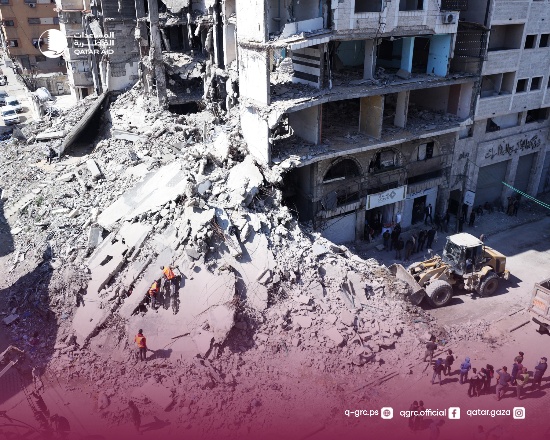
Removing dangerous concrete blocks (Facebook page of the Qatari committee, March 12, 2026)
The Turkish IHH,[4] which has been outlawed in Israel and other countries, continues to extend its activity in the Gaza Strip: the municipality of the al-Bureij refugee camp published photographs from the launching of the Zamzam water well in Block 4 of the camp, which was repaired with IHH funding (Facebook page of the al-Bureij refugee camp municipality, March 11, 2026). The IHH also announced that it planned to establish another clinic, a wooden school [sic] which will accommodate about 1,400 students and a prayer hall (IHH Facebook page, March 15, 2026).
The Gaza municipality inaugurated the reconstructed central market in the al-Sheikh Radwan neighborhood in Gaza City after it was destroyed during the Gaza Strip War. The deputy mayor of Gaza, Tamer al-Ris, said the al-Sheikh Radwan neighborhood was in the eye of the storm during the war, when residential buildings, infrastructure and the market itself were destroyed, and that reopening the market was the beginning of economic recovery in the neighborhood, and a message of hope affirming the ability of Gazans to rise again despite the destruction. The reconstruction work included building the necessary infrastructure, providing security services 24 hours a day and establishing a cleaning team to ensure the market’s continued operation, as well as supplying electricity and internet services in an attempt to create a suitable working environment for merchants despite limited resources (Palestine Online, March 14, 2026).
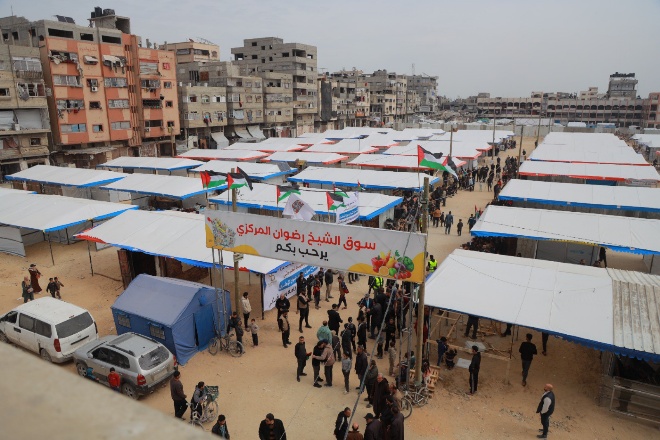
Inauguration of the new market (Facebook page of the Gaza municipality, March 13, 2026)
A Hamas delegation headed by Nizar Awadallah, a member of the Hamas political bureau and of its leadership council, visited Cairo and met with senior officials in Egyptian general intelligence and with the commissioner of the Board of Peace, Nikolay Mladenov. Hamas stated that the members of the delegation had submitted a report containing more than 800 [alleged] Israeli “violations.” According to informed sources, the discussions focused on ways to consolidate the ceasefire agreement and to ensure its continuation in light of the ongoing Israeli “violations.” The Hamas delegation noted the need to ensure Israel’s full adherence to the ceasefire and cessation of all “violations,” stressing that continued acts of “aggression” would damage efforts. They also discussed the need to accelerate the entry of aid and ease the restrictions imposed on the Strip to improve living conditions, and the practical steps required for the national committee for managing the Strip to arrive in the Strip and begin its work (aljazeera.net, March 15, 2026; al-Sharq channel website, March 15, 2026).
Three sources reported that envoys from the Board of Peace met with Hamas representatives in Cairo in an attempt to preserve the ceasefire in the Gaza Strip. According to one of the sources, Aryeh Lightstone, an assistant to the American special envoy, Steve Witkoff, represented the Board. Reportedly, after the meeting Israel announced it would soon reopen the Rafah Crossing. The sources added that Hamas representatives warned the Board of Peace of the possibility that the movement would retract its previous commitments under the ceasefire agreement if Israel continued to impose the new restrictions on the Strip introduced during the war with Iran. A United States official confirmed that Lightstone had participated in recent meetings on Gaza in Cairo, but did not confirm that he met with Hamas representatives (Reuters in Arabic, March 16, 2026).
The federal prosecution in Germany reported that authorities at Larnaca airport in Cyprus had arrested a Palestinian born in Lebanon, who was wanted in Germany on suspicion of membership in Hamas and involvement in acquiring weapons and ammunition for the purpose of attacking Israeli and/or Jewish institutions in Germany and other European countries. He is expected to be extradited to Germany for further proceedings (Reuters, March 10, 2026).[5]
The United States Treasury Department imposed sanctions on four associations operating in Turkey and Indonesia which serve as front organizations for funding Hamas’ military wing under the guise of humanitarian activity. The four are reportedly part of an international financing network which transfers resources, equipment and funds to projects in the Gaza Strip from which Hamas directly benefits, and assists Hamas terrorist operatives and Hamas military forces. The Treasury reported it was a continuation of previous sanctions measures against fake Hamas charity networks (United States Treasury Department, March 12, 2026).
Terrorist Attacks
A shooting in Samaria: On March 12, 2026, two Palestinian terrorists in a vehicle shot at an IDF position near Ariel Junction. They then drove to the Tapuah Junction, where they fired their guns and tried to ram into Israeli security forces at the site. They were shot and killed; there were no IDF casualties (IDF spokesperson and Israeli media, March 12, 2026). The two terrorists were reportedly from the village of Einabus (Shehab Agency, March 12, 2026).
Stabbing in Ramat Gan: On March 12, 2026, an Arab-Israeli from the northern village of Jatt stabbed an Israeli civilian in central Ramat Gan, seriously wounding him. He was detained and the attack is under investigation to determine its motivation (Israeli media, March 12, 2026).
Israeli security forces detained a young man from east Jerusalem suspected of planning an attack in the immediate future. He was detained in a mosque in the city of Lod (Israel Police spokesperson and Israeli media, March 16, 2026).
Counterterrorism
Israeli security forces continued counterterrorism activity in Judea and Samaria. They demolished a weapons manufacturing workshop and confiscated four lathes, and demolished the home of a terrorist who was involved in shooting an Israeli youth to death at the al-Khader Junction in December 2024. Two Palestinians throwing rocks at vehicles on a main road were eliminated. An attempt to use a drone to smuggle nine pistols across the Jordan border was foiled (IDF spokesperson, March 10-17, 2026).
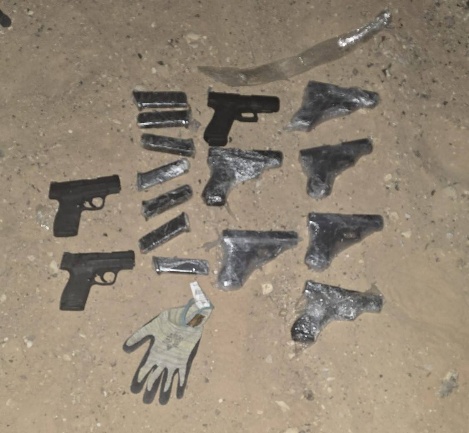
Weapons found on the drone (IDF spokesperson, March 11, 2026)
The ministry of health in Ramallah reported that four members of one family from the village of Tammun, parents and their two children, were killed by IDF fire (Wafa, March 15, 2026). The IDF reported that during operational activity by security forces to detain wanted suspects in the village of Tammun, a vehicle sped toward the forces. In the assessment of the fighters their lives were in danger and they responded with gun fire, as a result of which four Palestinians were killed. The circumstances of the incident are being investigated (Israeli media, March 15, 2026).
Friction between Settlers and Palestinians
The Israel Police began an investigation, suspecting that Jewish settlers vandalized and set fire to a mosque in the village of Duma near Nablus (Israeli media, March 12, 2026). Hamas condemned the burning of the Muhammad Fayyad Mosque in Duma and the spraying of racist graffiti on it. Hamas called it a “serious crime and part of Israeli escalation against Palestinian identity and holy sites, especially during Ramadan.” Hamas called on the Palestinian public in Judea and Samaria to mobilize, establish popular defense committees and protect mosques, homes and property (Hamas Telegram channel, March 12, 2026).
The ministry of health in Ramallah reported that a 28 year-old Palestinian from the village of Qusra south of Nablus was shot and killed by Jewish settlers who raided the western area of the village. Two Palestinians were wounded by the gunfire, and the father of the deceased was [allegedly] beaten (Wafa, March 14, 2026). The Israel Police stated that three suspects, aged 17 to 21, were detained on suspicion of involvement in the incident. They were released under restrictive conditions (Israel Police Spokesperson Telegram channel, March 15, 2026).
International Activity
The chairman of the PA, Mahmoud Abbas, spoke with Pope Leo XIV to discuss the latest developments in the Palestinian territories and in the region. He thanked the Pope for his position to end the war in the Gaza Strip, establish peace based on the two-state solution and reject unilateral measures that harmed the chances of achieving peace. Mahmoud Abbas reviewed the “serious situation” in Jerusalem because of the closure of al-Aqsa Mosque during the month of Ramadan. He related to the “escalation” in Judea and Samaria in light of “annexation plans, the expansion of settlements, settler terrorism and the continued delay in transferring tax revenues,” along with the “difficult” situation in the Gaza Strip. Mahmoud Abbas condemned the launching of Iranian missiles at Gulf States and the region, and the activity of IDF forces in Lebanon. He said that once the fighting in the region ended, an international peace conference should be convened and the Arab Peace Initiative should be implemented, which would end the “Israeli occupation of Palestinian territories and Arab territories in Lebanon and Syria” and pave the way for a just and comprehensive regional peace (Wafa, March 16, 2026).
The PA deputy chairman, Hussein al-Sheikh, spoke with the Egyptian foreign minister, Badr Abdelatty, about the latest developments in the Palestinian arena and regional developments in light of the “current military escalation.” Abdelatty said his country supported the Palestinian issue, and condemned recent Israeli decisions regarding “annexation” of parts of Judea and Samaria for the purpose of expanding settlement activity, warning that they harmed the chances of achieving a two-state solution. Abdelatty also condemned the continued closure of al-Aqsa Mosque, claiming it affected the historical and legal status quo of the holy sites in east Jerusalem. He said it was important to accelerate the activity of the committee for managing the Gaza Strip until it became possible for the PA to assume responsibility for managing the Strip, Judea and Samaria (Wafa, March 16, 2026).
The PA foreign minister, Varsen Shaheen, received three letters from the Chinese foreign minister through the acting representative of China in Ramallah. According to reports, the letters stated that Judea, Samaria and the Gaza Strip were an integral part of the Palestinian territories and that Israel’s “annexation attempts” harmed the two-state solution. Shaheen thanked China for its political support and assistance it provided to the Palestinians (Facebook page of the PA foreign ministry, March 11, 2026).
A cartoon by Alaa al-Laqta, Hamas’ in-house cartoonist. The Arabic reads, “The occupation closes al-Aqsa and prevents [the Taraweeh] prayer”[6] (Palestine Online, March 12, 2026)
The Sale of PA Lands
The PA ministry of local government in the Jenin district circulated a document instructing heads of local authorities to take steps to restrict land sales if the sales served Israel. According to the instructions, anyone seeking to sell land to an Arab citizen of Israel had to receive prior approval from the security forces and the local council, and anyone who had already carried out such a transaction was required to submit the sale agreement and the buyer’s details to the relevant authorities. Selling land to another person from the same city would also requires prior contact with local or security authorities. Any transaction carried out without complying with the instructions would expose those involved to legal proceedings (Facebook page of the al-Yamoun municipality, March 10, 2026).
[1] Click https://www.terrorism-info.org.il/en to subscribe and receive the ITIC’s daily updates as well as its other publications.
[2] Iran, Hezbollah, the Palestinian terrorist organizations, the Houthis in Yemen and the Shi’ite militias in Iraq.
[3] World Jerusalem Day has been marked since 1979 on the last Friday of the month of Ramadan, according to a decision by Ruhollah Khomeini, founder of the Islamic Revolution in Iran. The event is intended to express Iran’s and the Muslim world’s support for the Palestinian issue and the “liberation of Jerusalem.” The events are used to vilify Israel, call for its destruction, and for incitement and propaganda against the United States.
[4] See the October 2025 ITIC report, The Turkish IHH, which led the Mavi Marmara flotilla, operates in the Gaza Strip and is involved in its reconstruction
[5] See the October 2025 ITIC report, Arrest of Hamas Terrorist Cells in Europe: Hamas May Carry Out Attacks Abroad
[6] Taraweeh is a highly recommended, voluntary Sunnah night prayer performed exclusively during Ramadan after Isha, usually in congregation. ↑
Related Articles