
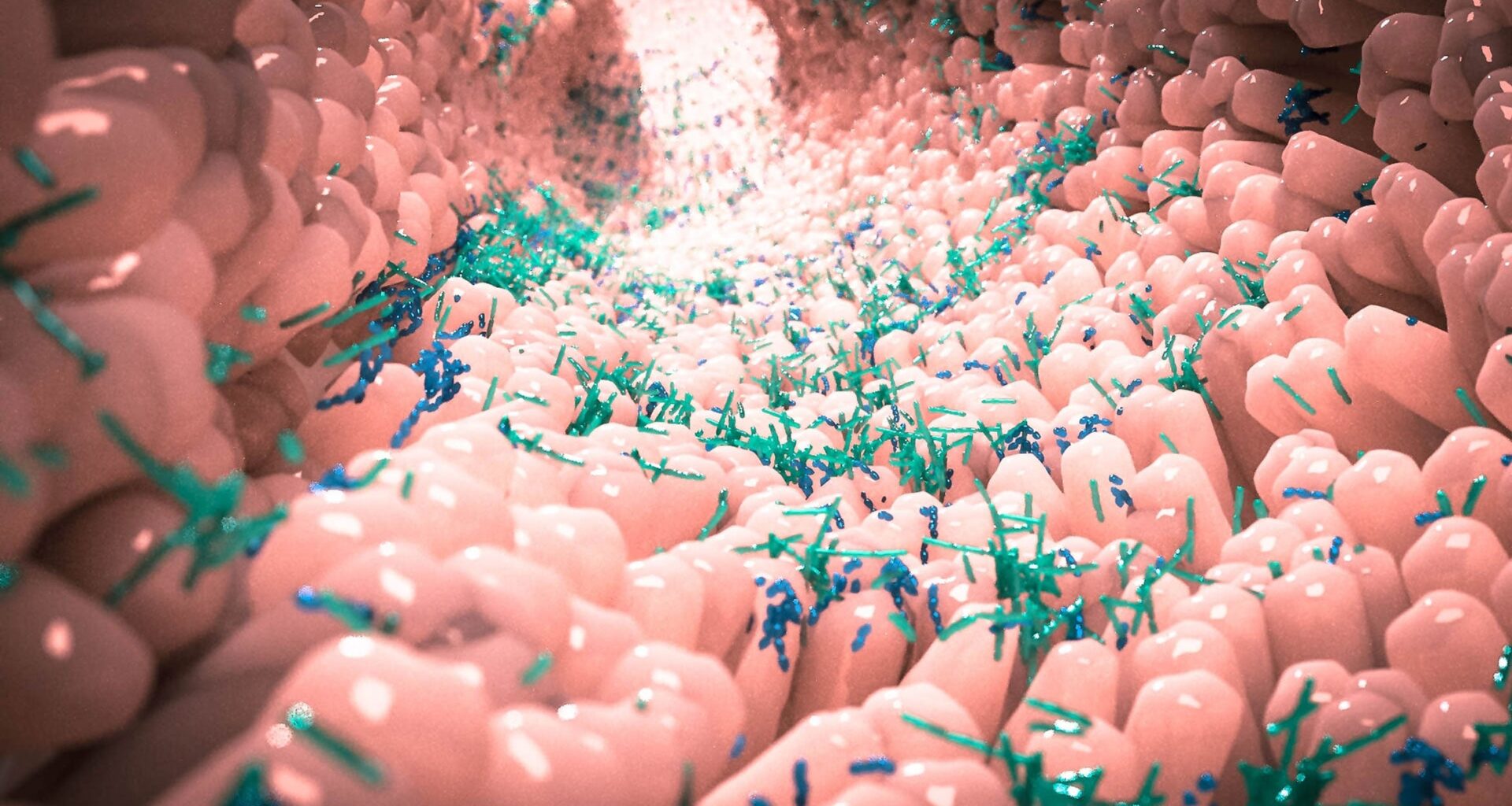
“We’re essentially creating miniature, highly controlled versions of the gut so we can challenge them with different early-life environments — such as components of breast milk or antibiotic exposure — and observe how these communities evolve,” O’Malley said. “The scale of Ex-FAB means we can run experiments that would take years by hand and instead generate rich, dynamic datasets that reveal how microbial systems behave.”
Analyzing that volume of data requires new ways of thinking about the microbiome as a dynamic, evolving system. That effort is led by two UCSB faculty members and co-principal investigators, Jean Carlson, a professor of physics, and Holly Moeller, an assistant professor of ecology, evolution, and marine biology, who bring complementary expertise in complex systems and biological interactions. Rather than focusing only on which microbes are present, their modeling work asks what microbial communities are doing over time — how they interact, respond to stress, recover, or shift into new states during early development.
“When you can observe how a system evolves, you can start to see which early changes actually matter, and which ones don’t,” Carlson explained. “That’s what allows us to connect biological mechanisms to developmental outcomes.”
By combining high-throughput experimental data with modeling approaches drawn from physics, mathematics, ecology, systems biology, machine learning and AI, the team aims to move beyond correlation toward causal understanding.
“Bringing together mechanistic modeling with the statistical power of machine learning and AI is a powerful combination and gives us a way to transform thousands of experiments into insight,” Carlson added. “That has real potential to benefit the neurodivergent community.”
The work is further strengthened through close collaboration with co-principal investigators Ty Vernon and Fernanda Castellón at UCSB’s Koegel Autism Center, within the Gevirtz Graduate School of Education, ensuring that experimental insights are grounded in community engagement and informed by clinical perspectives. Vernon, director of the UCSB Koegel Autism Center, emphasized the importance of grounding the work in practical relevance.
“This research offers the opportunity to move beyond speculation and toward data-driven understanding of how early biological systems interact with neurodevelopment,” said Vernon, who is also an associate professor of clinical psychology at UCSB. “The knowledge provides a critical missing link that can help families, clinicians and educators make more informed decisions that support the neurodivergent community’s well-being and quality of life.”
For campus leaders, the FORM award underscores how UCSB’s interdisciplinary model — where engineers, physicists, ecologists, clinicians and educators work side by side — accelerates discovery and expands its real-world impact.
“We are honored to have the partnership and transformative support of Wellcome Leap. This important new work will advance our understanding of how the microbiome of babies is linked to neurological disorders. It is a shining example of the interdisciplinary collaborative research that is a hallmark of our campus,” said UCSB Chancellor Dennis Assanis. “Congratulations to the lead PI, Professor O’Malley, director of Ex-FAB, a premier facility on our campus, and to our colleagues, Professors Jean Carlson, Holly Moeller, Ty Vernon, and Fernanda Castellon, for their leading-edge efforts.”
“This award demonstrates the power of pairing visionary science with world-class infrastructure,” said Umesh Mishra, dean of The Robert Mehrabian College of Engineering. “Ex-FAB gives our faculty the ability to generate and analyze complex biological systems at unprecedented scale. We commend Professor O’Malley and the co-principal investigators for advancing such an ambitious, collaborative effort that will shape the future of microbiome science and human health.”
“This collaboration exemplifies our school’s commitment to research that is not only scientifically rigorous but also deeply rooted in the well-being of the communities we serve,” said Jill Sharkey, the interim dean of the Gevirtz School. “The inclusion of professors Vernon and Castellon ensures that groundbreaking biological research is directly informed by clinical expertise and a person-centered, neuro-affirming philosophy that will translate into practical, life-enhancing resources for educators, clinicians and families.”
“What is exciting about this investigation into the early-life microbiome is how naturally it draws on the full range of what the science division does — from physics and ecology to molecular biology and psychological brain sciences,” said Dean of Science Shelly Gable. “These researchers are asking a genuinely important question about the roots of neurodevelopment, and they are bringing exactly the right mix of perspectives to answer it.”
O’Malley emphasized that the goal is not to “cure” autism, but to deepen scientific understanding and improve support.
“We’re trying to understand the biological mechanisms of neurodivergence so we can better support individuals and families,” she said. “That includes recognizing the strengths of neurodivergent people, while also asking whether early biological insights could expand options for promoting health and well-being.”
Ultimately, the research is intended to help build a clearer scientific foundation for understanding early neurodevelopment. By identifying which biological signals matter — and when — the team hopes that the findings can guide future conversations about how families, clinicians, and educators support neurodivergent individuals, grounded in data rather than assumption.