
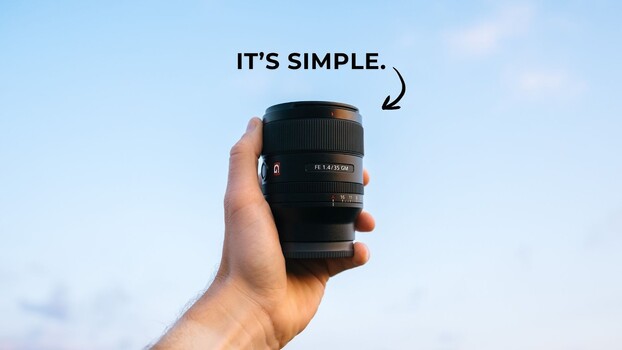
The 35mm focal length sits in a unique position: wide enough to show a scene, tight enough to keep it clean. Most people who struggle with it are treating it like a 50mm or 85mm, and that’s exactly where things go wrong.
Coming to you from Sean Dalton, this practical video breaks down six specific techniques for getting the most out of a 35mm lens. Dalton has shot hundreds of thousands of frames on 35mm over eight years, and the tips here aren’t theoretical. He walks through real images he’s made in Bali, Zurich, New York City, Bangkok, and Morro Bay, showing exactly how each technique played out in an actual shot. The first tip is to use the focal length for what it actually does well: including context. A 35mm lens shows the world around your subject, and that context is what makes a portrait feel like a story instead of a headshot. Dalton shows a portrait from Bali where you can see the subject’s house, a Balinese temple, a television, artwork on the wall, and light rays spilling into the frame. That’s the kind of image a 50mm or 85mm would have cropped out entirely.
The second tip tackles the biggest complaint about 35mm: compositions get busy fast. Dalton’s answer is negative space and framing. Negative space gives your subject room to breathe and tells the viewer exactly where to look. Framing uses elements already in the scene, trees, buildings, light, even other people, to isolate your subject without needing shallow depth of field to do the work. His third tip follows directly from this: use foreground elements to add depth. One of the most common issues when switching to 35mm is that images look flat. Shooting at f/1.8 or f/1.4 through something in the foreground puts soft, out-of-focus texture in front of your subject and immediately adds a sense of dimension. He shows a ferry shot in New York where a life ring and part of a passenger in the foreground completely transform what would have been an ordinary scene.
The video also covers a technique Dalton calls “unfocusing your eyes,” which sounds strange but is genuinely useful for reading a composition before you shoot it. By going slightly cross-eyed, you reduce the scene in front of you to shapes, light, and color, which makes it easier to spot what’s visually dominant and compose around it. This is particularly helpful at wider focal lengths where there’s simply more information competing for attention. Two more tips round out the video, both tied to the physical act of shooting: getting closer than feels comfortable, and moving your feet in ways that go beyond the standard “zoom with your feet” advice. Dalton’s Bangkok sequence, a set of images of boys fishing in a river, demonstrates how working a single scene from multiple distances, angles, and heights can produce a genuinely diverse and cohesive body of work from one location. He also touches on the Fujifilm X100VI as his go-to camera for documenting everyday life at 35mm, and why the focal length’s lack of dramatic compression or distortion makes it the most honest way to record the world around you. Check out the video above for the full rundown from Dalton.