
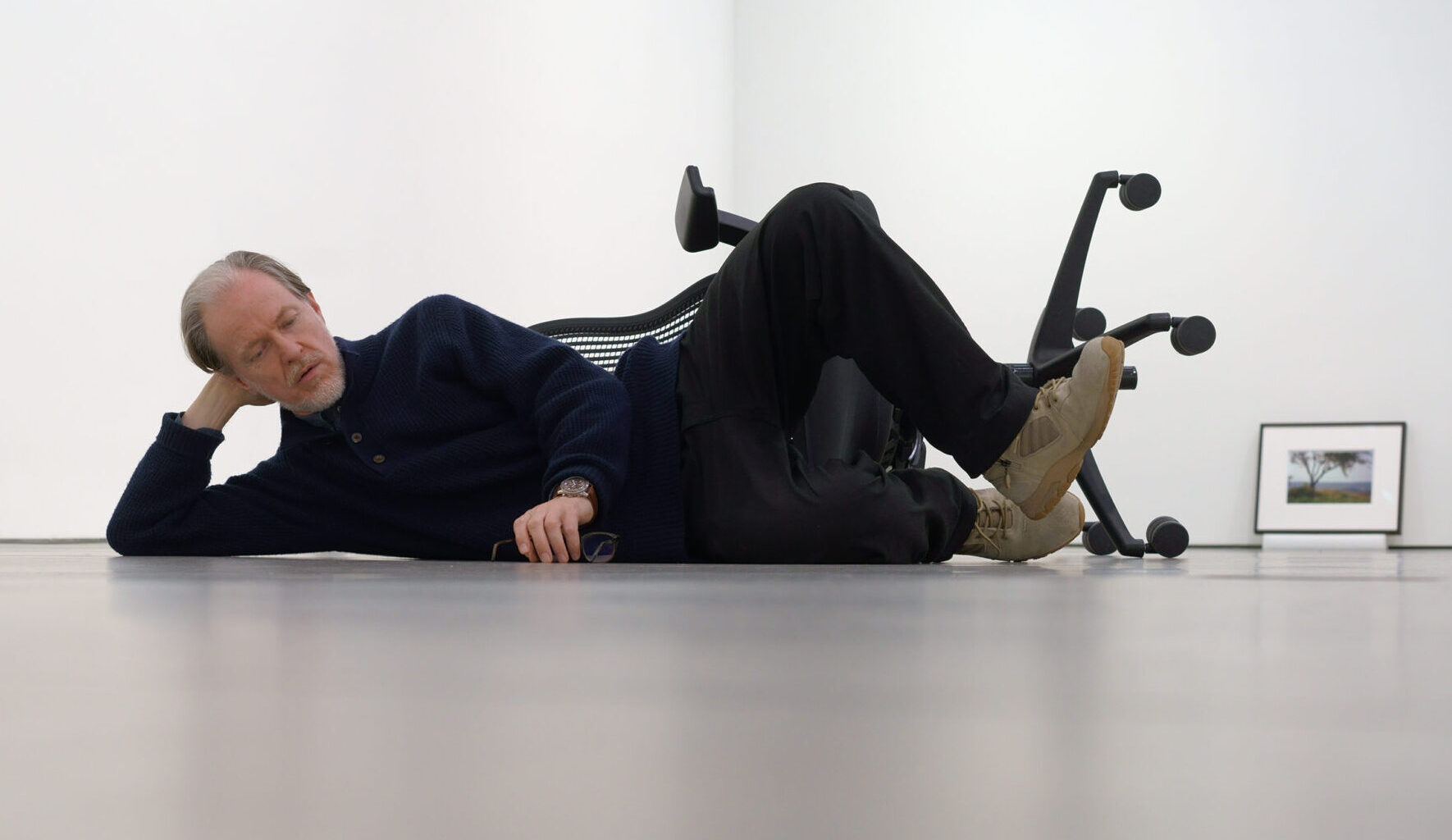
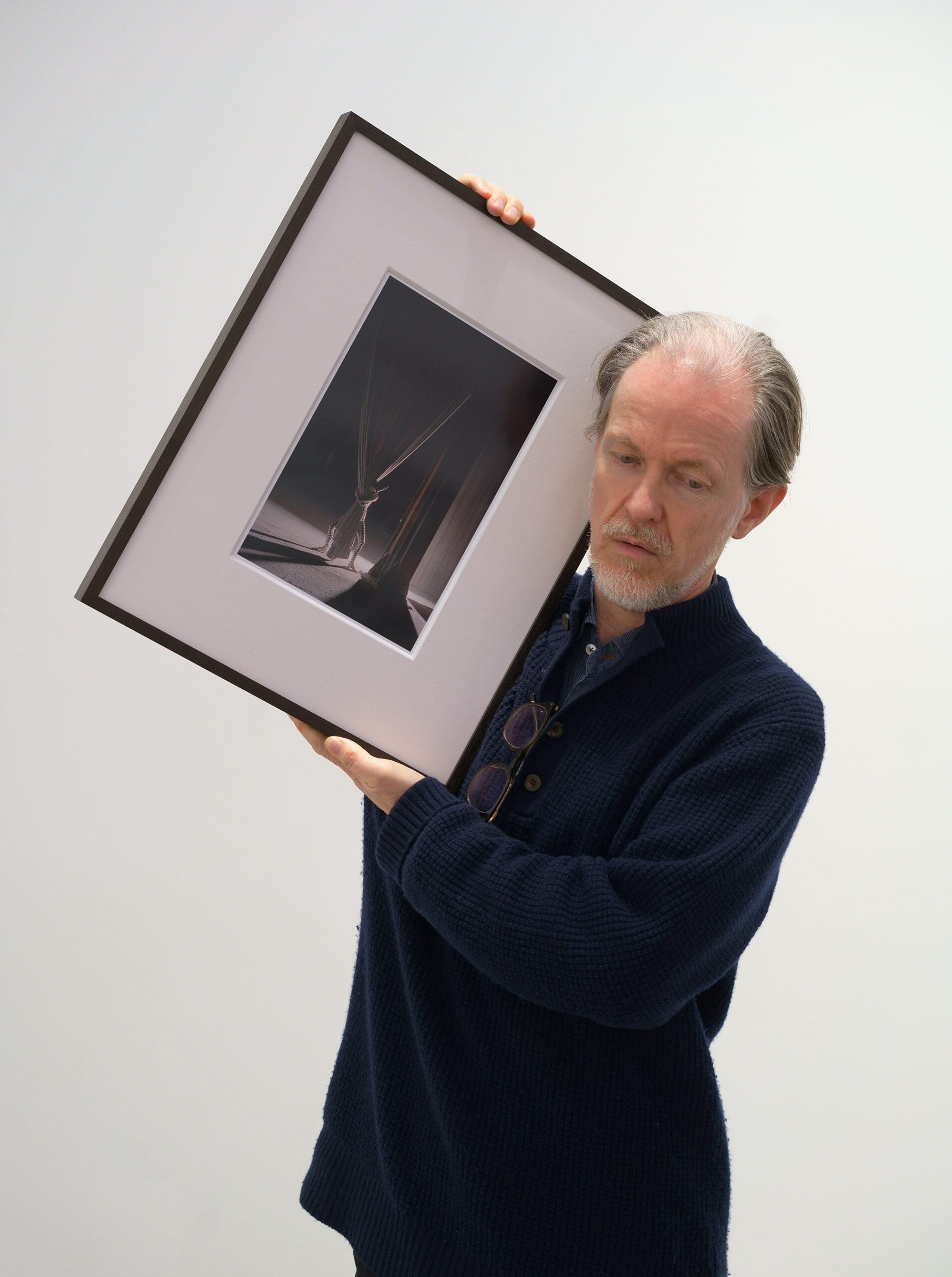
Torbjørn Rødland, photographed Reyna Colt-Lacayo.
For three decades Norwegian artist Torbjørn Rødland has constructed images that at first glance seem controlled: glossy skin, wholesome setups, meticulous lighting. But if you stick with them, reality starts to crack, and an unsettling, uncanny presence emerges. His latest show, Bones in the Canal and Other Photographs, which opened last week at David Kordansky, marks a return to the calculated perversions he’s spent years perfecting, only this time with a much smaller camera, and a different view. As he told his friend and collaborator Lily McMenamy (who also appears in the exhibition), over Zoom, it’s all about composition, Enneagram types, and his inexhaustible inner world.
———
TORBJØRN RØDLAND: Hey.
LILY MCMENAMY: Hi. I’m just wondering how to have you on my big screen–oh, wow. I got it. Yay.
TORBJØRN RØDLAND: You’ve got the visuals?
MCMENAMY: Yeah. I’m so grateful to have this power over you finally.
RØDLAND: You feel the balance has been off?
MCMENAMY: No, I’ve just been engaging with the idea of photography and the power dynamics at play.
RØDLAND: You’ve been around photographers pretty much all your life, no?
MCMENAMY: Yes. Is that why you chose me to interview you?
RØDLAND: I thought you would be qualified. But also this upcoming show has two photographs from our Arles session included.
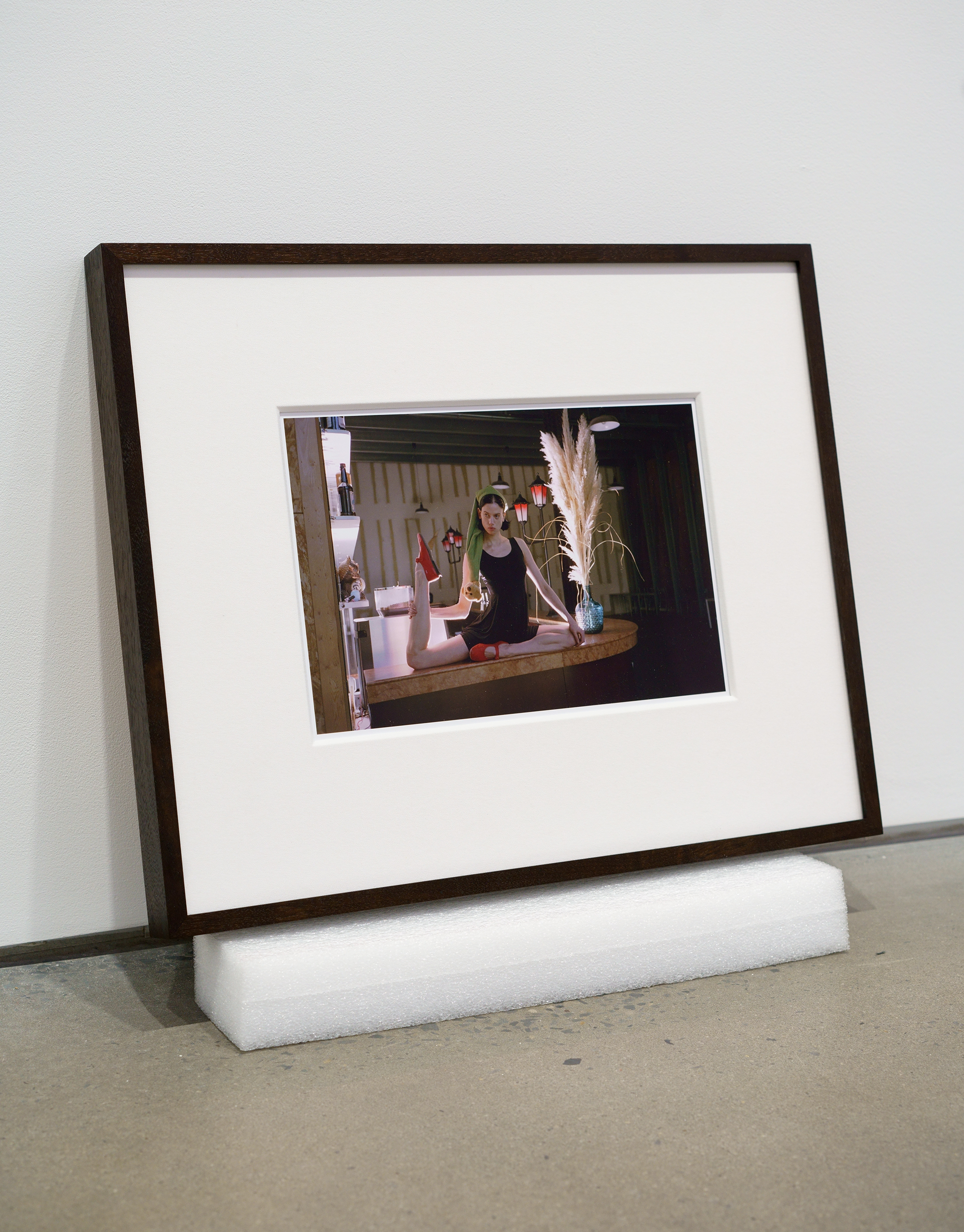
Another Bricolage, 2024-2026. Chromogenic print. 7 7/8 x 12 inches. Courtesy David Kordansky Gallery.
MCMENAMY: No way. [Laughs] You kept that one quiet.
RØDLAND: I might have. It’s the one that you know from the cover of the Mimes zine, and the one with the red shoes from the top of the bar. Remember that one? With the strange teddy bear head night hat?
MCMENAMY: Oh, wow. Yeah. What is the show called?
RØDLAND: It’s called Bones in the Canal and Other Photographs. I made so many titles for all 30 pictures, and I didn’t really have another title in me for the show, so I just reused one.
MCMENAMY: How do you think of a title? You go deep into your poetic soul?
RØDLAND: Sometimes, but for some of them I do the opposite. Some are sort of dry and descriptive, like how an art historian would title something they found from the past.
MCMENAMY: Right. I think the interview should start now, with the day that we were born.
RØDLAND: I think it has already started, but maybe that’s the reason why you were chosen to do this.
MCMENAMY: Because we were born on the same day?
RØDLAND: Mm-hmm. Probably a couple of years apart, but same day. Is that significant to you? The position of the stars?
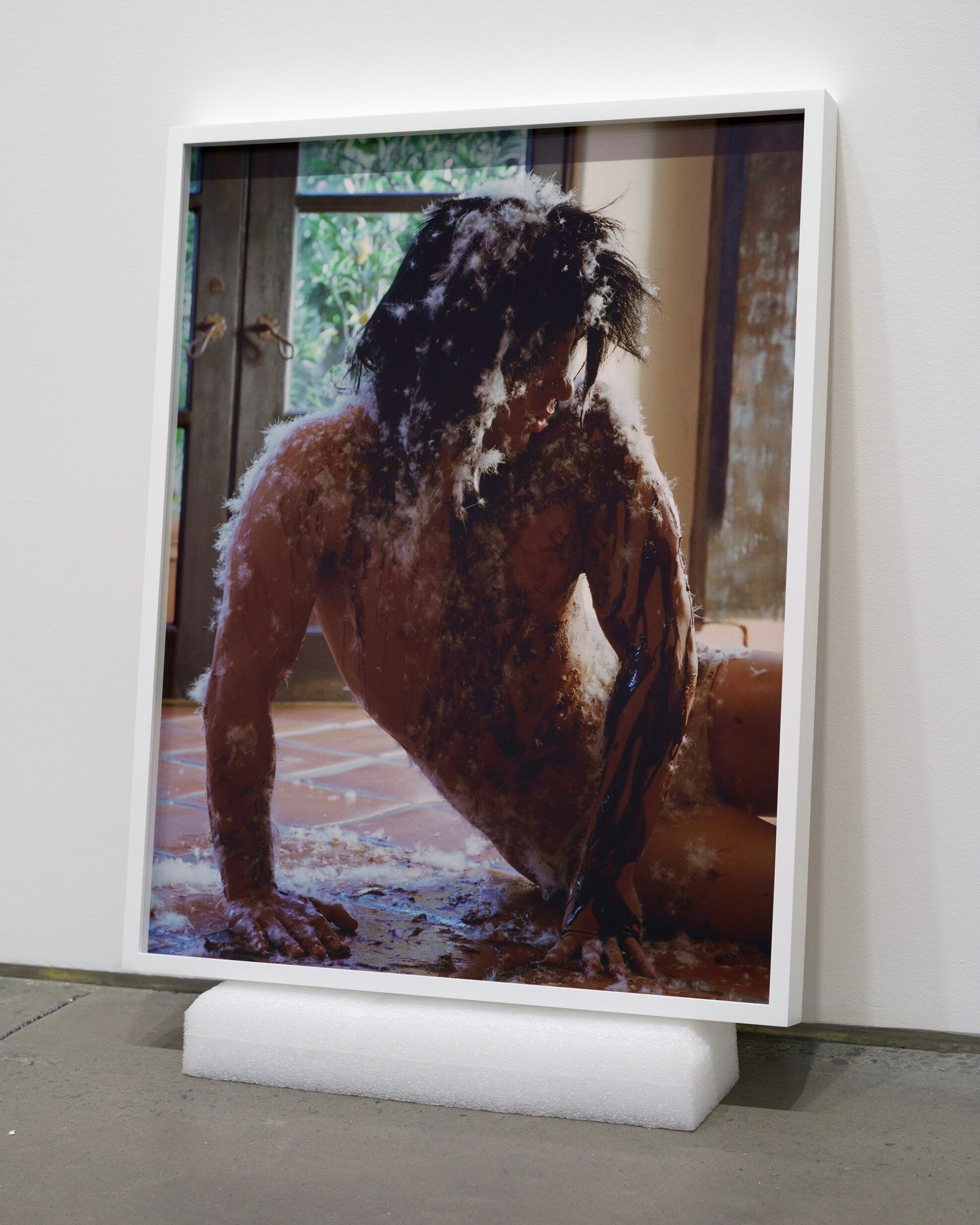
Tar and Feather no. 2, 2008-2026. Chromogenic print. 22 1/2 x 17 3/4 inches. Courtesy David Kordansky Gallery.
MCMENAMY: I just think being born on the same day means a lot. Anyway, who is conducting this interview? [Laughs]
RØDLAND: I think it’s you, if you’re up to it? If not, I’m going to step in.
MCMENAMY: Okay. So, you were born in Norway?
RØDLAND: Yeah. In Stavanger on the southwest coast. Just across the sea from Scotland.
MCMENAMY: You come from a very wholesome town. I looked it up.
RØDLAND: Mm-hmm. At least it used to be.
MCMENAMY: Do your photos try to subvert the wholesomeness of your upbringing?
RØDLAND: I don’t think so. I mean, these days contemporary art has become so respectable, but the contemporary art that I was raised on in the early 1990s was much more critical, and on the perverted side. So, I was looking for something more provocative within the wholesome, and trying to play the wholesome as straight as I could. In this exhibition there’s a bit of a return to that, to what the pictures looked like in the ’90s. But only with a different camera and therefore a different view on it all.
MCMENAMY: You did a series, which was your first claim to fame, called In a Norwegian Landscape.
RØDLAND: That was the title, yeah.
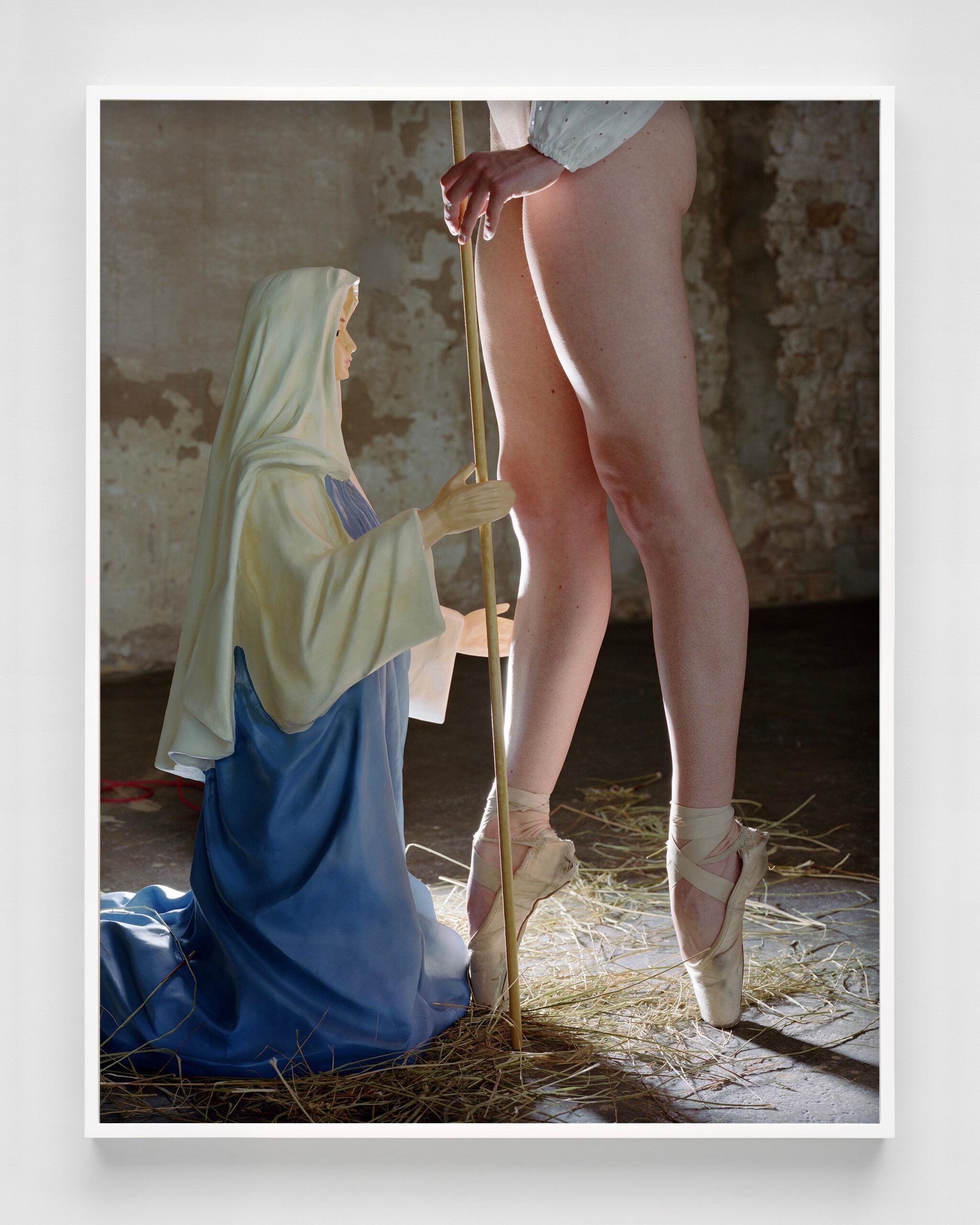
Cause of Our Joy, 2023-2026. Chromogenic print. 41 3/8 x 31 1/2 inches. Courtesy David Kordansky Gallery.
MCMENAMY: Torbjørn in a Norwegian landscape with a plastic bag. Was the plastic bag a perversion in the Norwegian landscape?
RØDLAND: That’s one take on it. That’s not how I saw it. I saw the plastic bag as necessary to be able to return to the woods, as a sign of a the problematic nature of trying to be romantic in the forest and so on. To me, it wasn’t standing in the way of romanticism, but it was a necessary component of it in a contemporary way.
MCMENAMY: So, are you returning to that vibe now?
RØDLAND: I think so. For this, I picked up a 35 millimeter camera, the tiny one that I used in Arles. So the main part of this show is all photographed with that.
MCMENAMY: Wow. You’re breaking up with your signature style?
RØDLAND: Yes. It’s pretty counterintuitive to give up a lot of that highly tactile surface focus with different textures that I’ve been looking at for a while. Because of the camera, it doesn’t tell you when things are in focus, so I don’t go that close to anything. The figures tend to be sort of in the middle of a space, so it feels more like folk art. It has more of a vernacular feel to it. Compositionally it’s closer to what I did in the ’90s, but it’s more wide angled because of the lens that comes with these tiny cameras.
MCMENAMY: I feel like how I relate to your work is this kind of dichotomy of smoothness versus leaking. I think that’s what I try to do in my performances. Present this facade, but then it’s spewing out. I wonder how you are playing with the texture with this far away film stuff?
RØDLAND: I guess the interest is still there, but I rarely try to make it extra messy. There is a part of the exhibition that has more skin and more wall-to-wall nakedness than anything I have exhibited before.
MCMENAMY: Wall-to-wall nakedness?
RØDLAND: There’s exposed body parts in all of those photographs, and they are older negatives that are printed for the first time. Some of them have just been waiting around for a context where they could be seen. And some of them have that tactility, especially in one called Tar and Feather. The weird thing about the show is that it’s doing the new thing, but it’s also doing the old thing at the same time.
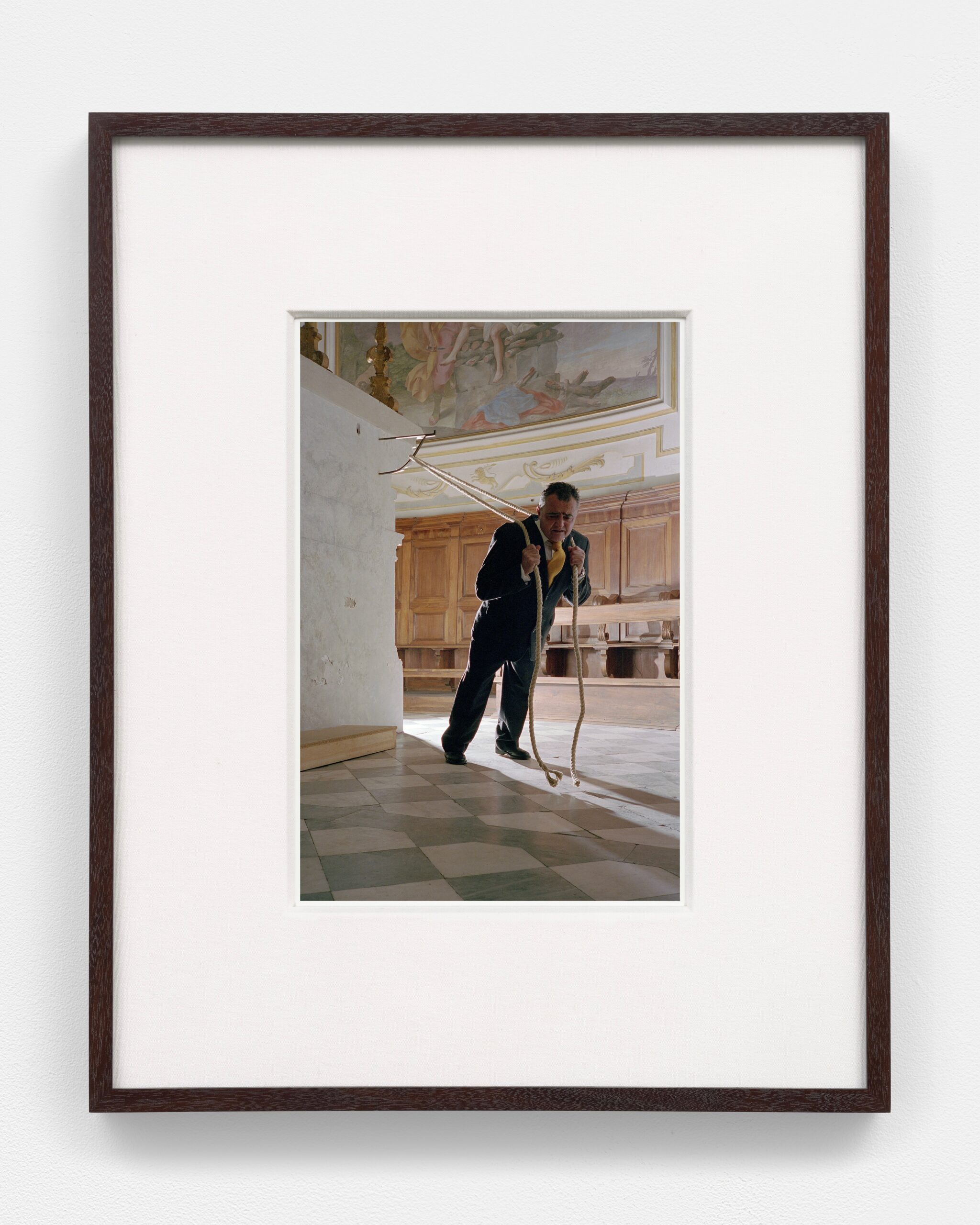
Church Rope, 2024-2026. Chromogenic print. 12 x 7 7/8 inches. Courtesy David Kordansky Gallery.
MCMENAMY: Did your parents inspire you with art stuff?
RØDLAND: I’m not one of those middle-class kids who was raised with an understanding of contemporary art. That wasn’t something that I got from home. When I started, or rather when I stopped doing editorial cartoons for local newspapers–
MCMENAMY: Editorial cartoons? What? Like drawings?
RØDLAND: Yeah.
MCMENAMY: I didn’t know you used to do that.
RØDLAND: Oh yeah. When I was five or six, I started drawing politicians that I saw on TV, and 10 years later, I started doing this for local newspapers. When I stopped doing that, my parents were a little disappointed, because they saw that as a higher form of art compared to photography.
MCMENAMY: But you seem to have elevated photography into a certain art. I also see that you’re doing a bit of fashion now. I’m thinking about these different ways you present your work and how you protect it, I suppose.
RØDLAND: Protecting is the central part. Any framework that you can realize your project within is to be applauded. I think the problem is when you start changing what you want to do to please someone else.
MCMENAMY: Like insidiously warped, yeah.
RØDLAND: Right, either because you do it for money or someone else has the final say.
MCMENAMY: Even your language changes too.
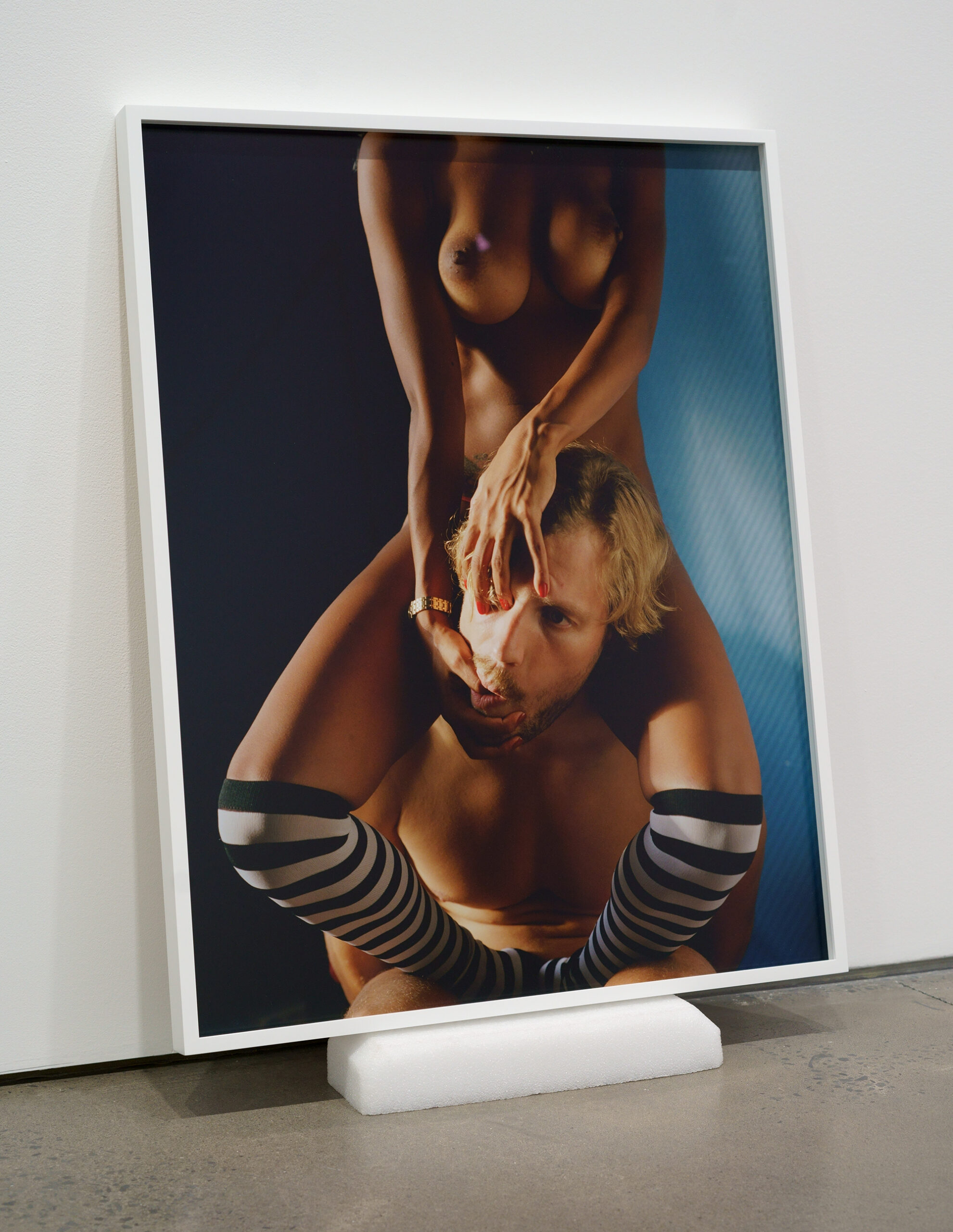
Strings Attached, 2008 – 2026. Chromogenic print. 30 x 23 5/8 inches. Courtesy David Kordansky Gallery.
RØDLAND: Exactly. Because everything you do matters. As long as it’s with your tools, you can’t really put it aside and say, “What I do here over here is not relevant to my main project.”
MCMENAMY: You employ the language of commercial imagery, so maybe it’s important to not make commercials.
RØDLAND: Since my starting point was critical appropriation from The Pictures Generation and so on, that’s the art that I learned to appreciate. But if you were to use a Richard Prince piece to sell Marlboros, then the work disappears completely. It doesn’t keep its power. I think that’s been a very important distinction for me. It’s a balance.
MCMENAMY: That’s so haunting and real. I got this fucking book called To Photograph Is to Learn How to Die. I would say being photographed is a bit to learn to die, but taking a photo is like taking life.
RØDLAND: I did start making pictures as a teenager because I was miserable and lonely. To point the camera at myself in those situations and make something gave me meaning.
MCMENAMY: And it’s such a contemporary thing to take a selfie to remind yourself you exist. And being in the spotlight is nice for when you’re born, on April 3rd.
RØDLAND: I’m honestly so into the Enneagram, so I haven’t really had much use for this focus on the day you’re born.
MCMENAMY: What’s an Enneagram?
RØDLAND: It’s a model for mapping out and understanding differences in personality types. But it’s not at all linked to when you’re born. You just have to figure it out by being honest with yourself.
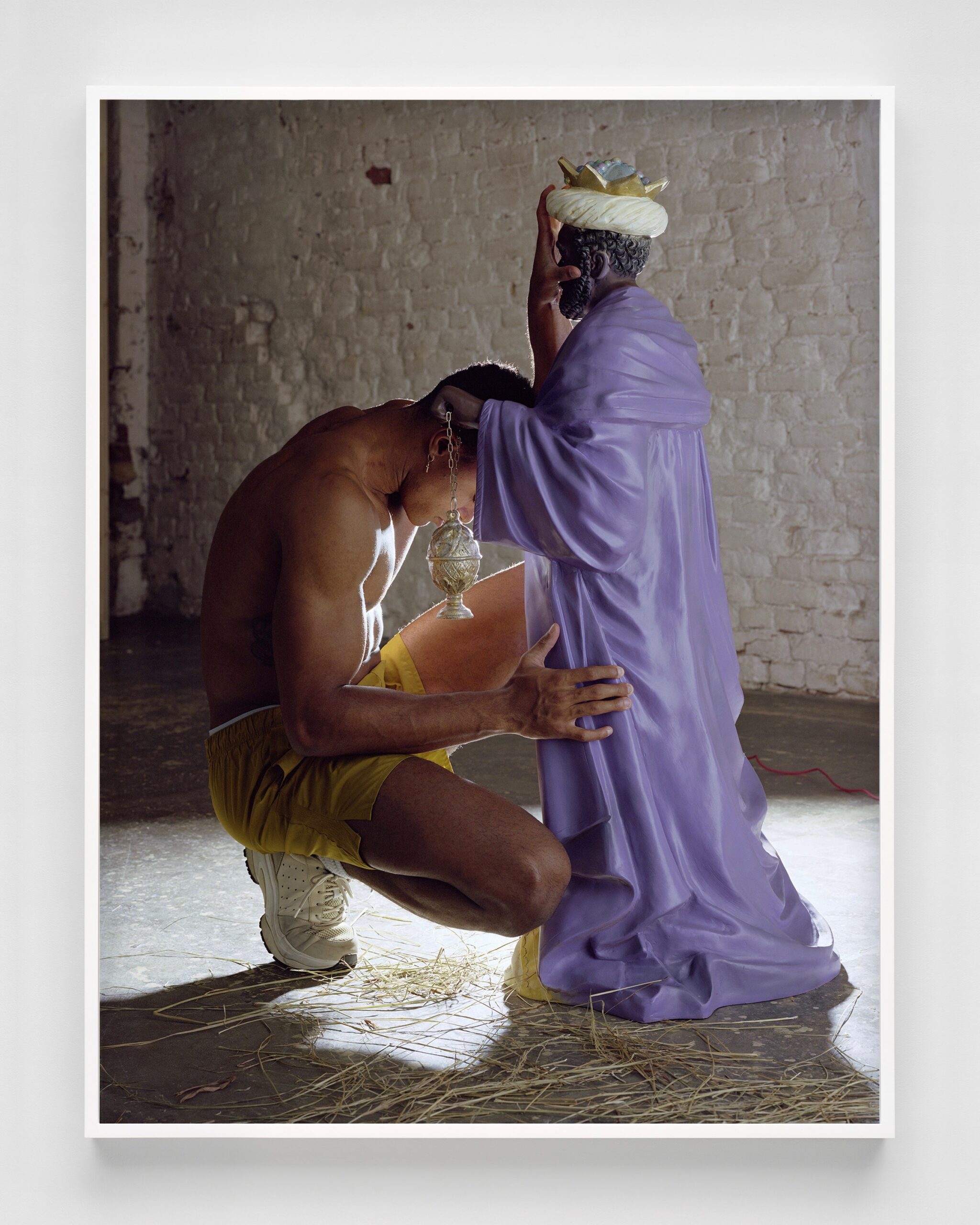
Balthazar, 2023 -2026. Chromogenic print. 41 3/8 x 31 1/2 inches. Courtesy David Kordansky Gallery.
MCMENAMY: I wanted to talk about Norse mythology, because I found out that Odin lost his eye. Did you know that?
RØDLAND: What happened to it?
MCMENAMY: Odin went to the fountain of knowledge, but he had to sacrifice his eye to go in. It’s like taking a photo, right?
RØDLAND: He becomes the camer, yeah. I guess I’m named after the other guy, the thunder god.
MCMENAMY: Really?
RØDLAND: Well, the first half of my name is Tor.
MCMENAMY: That’s so true.
RØDLAND: And the other half Bjørn means bear, the animal. So it’s kind of an overdose of strength.
MCMENAMY: Whoa. How do you channel all that power, Torbjørn?
RØDLAND: I guess you just become really chill. It’s like a really large dog that has to become really chill.
MCMENAMY: What are you looking for in a subject? I found it hard to meet the gaze of your camera, because with some photographers it’s just like you can’t give something that’s not real.
RØDLAND: Yeah, but that was fine with me though. I don’t think you look in the camera in any of these photographs in the upcoming show. I thought it was good, because you have so much movement in you. That’s a very generous way to be in front of the camera.
MCMENAMY: Is it harder to photograph a model you don’t know versus someone you love?
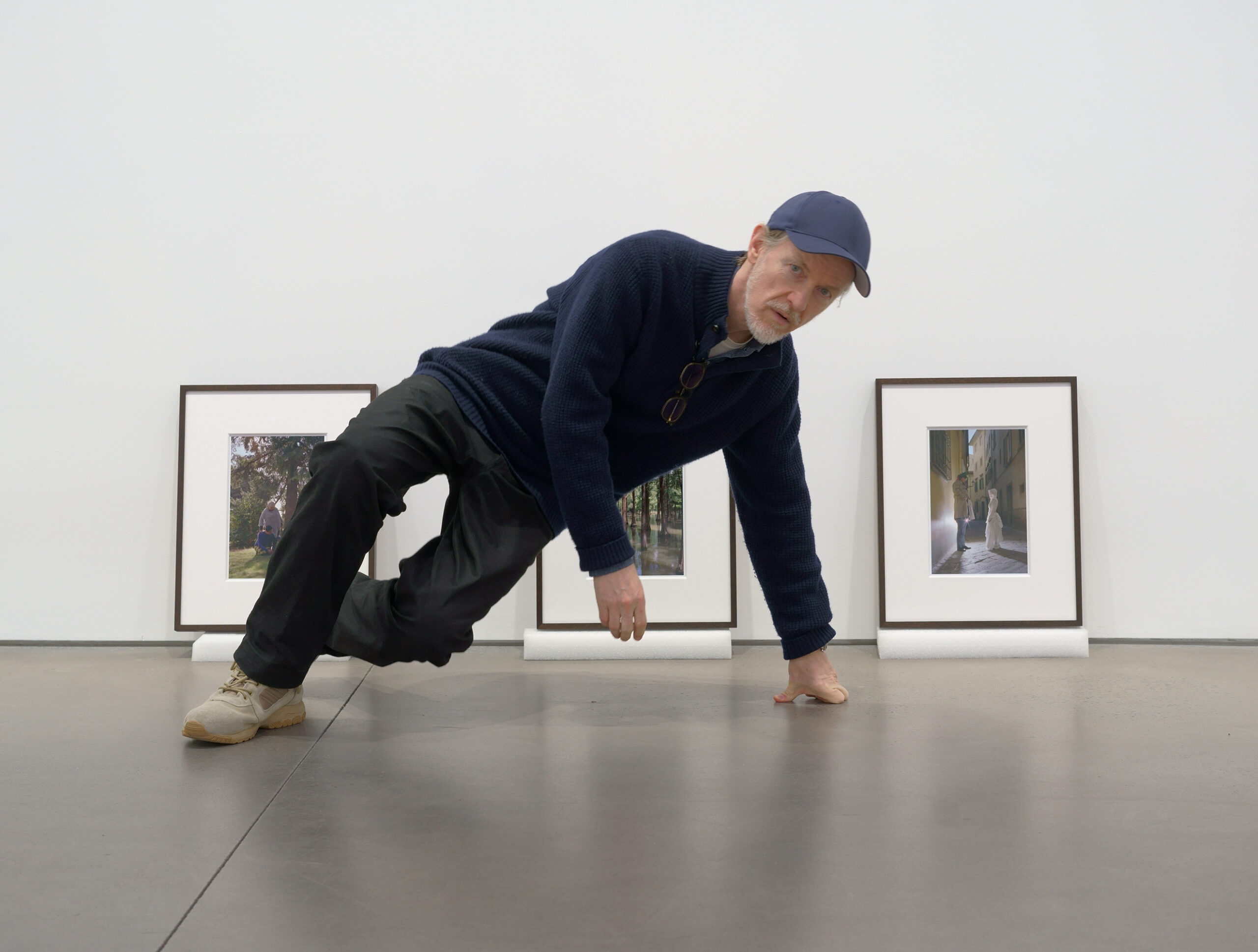
Portrait by Reyna Colt-Lacayo.
RØDLAND: I think photographers who have more of a documentary approach at heart can find that that’s harder. But for me, I feel more of an opposite problem. If I photograph someone that I have a close relationship to, then it’s hard for me to see the photograph the way everyone else will see it. I’m not so sure that I’m able to know what I’m presenting. I don’t want the viewer to have to go through me to see the picture thinking, “Oh, this is the photographer’s father, so it must mean this and that.” I want you to be able to connect to it directly.
MCMENAMY: That’s nice of you to think of your viewer. What’s your relationship to humor, but also sincerity?
RØDLAND: I’m building on this very flattened out 80s art where everything had become ridiculous and you couldn’t really deal with any big questions or subjects. I do is start with something that has become funny, because it’s turned into a joke and then try to see, “If the joke isn’t funny anymore, what’s there? Is there anything of value still for us today?” But I guess I’m still keeping the flavor of the joke. But the goal is movement is away from the joke, not toward it.
MCMENAMY: Same. But do you compose your images, or are you struck by a moment of intuition? Or is it both?
RØDLAND: Those go hand in hand, because composition is intuitive.
MCMENAMY: Slay. Do you ever take photos that are completely banal and not art photography?
RØDLAND: Those are the ones that I exhibit as art.
MCMENAMY: That’s a good place for us to end.