
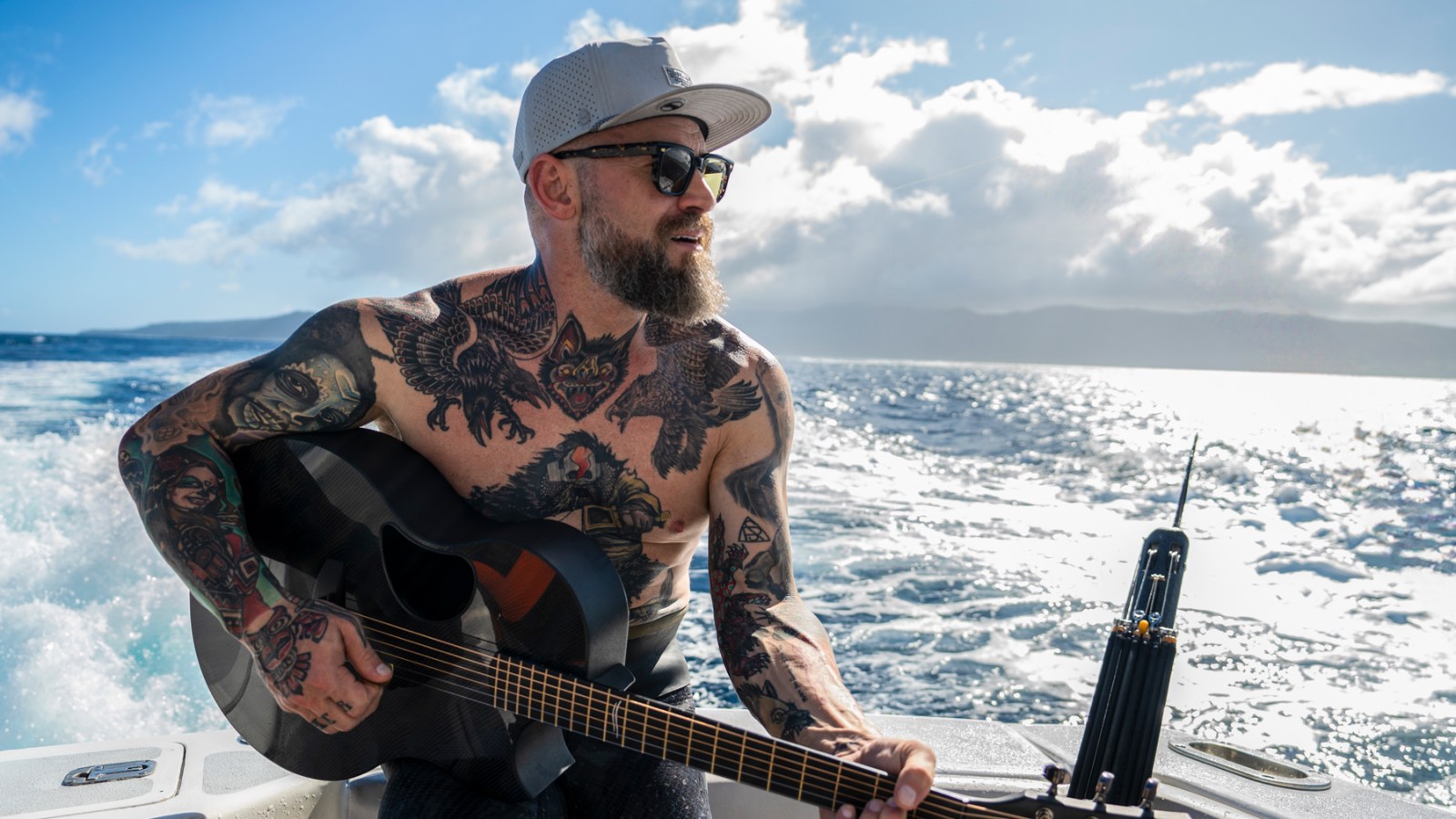
The boat is small and gray, cutting a lonely wake through the turquoise water off Fiji’s Mana Island. At the helm is a man who looks more like a local fisherman who hasn’t seen a razor or a hotel shower in a week than the multi-platinum country-music stadium act that he is: Zac Brown.
Tattooed on his right shoulder: Bob Marley. On his left, improbably: Teddy Roosevelt. He’s drawn to Roosevelt’s idea of the man in the arena, the one who acts while others watch. “There are people who are going to hate on whatever you do,” Brown tells me later. On the floor behind him are two four-foot dogtooth tuna, silver bellies catching the sun above neat slits, speared by his hand about an hour ago.
To get those fish, Brown, gripping a custom-built Alemanni speargun, plunged 80 feet into some of the sharkiest waters on earth. He had 90 seconds to take aim, fire, and ascend with the bleeding carcass, one at a time, back up through the water column before a shark could swipe it. It has happened to him before. “Sharks are a good thing,” he’ll say later, in the flat manner you might order a coffee. “They’re a sign of a lot of life.” He’s spent more than decade training his mind and body to function in darkness on a single breath. It requires, above all else, learning not to panic.
Brown steps off the boat onto the hot sand holding the fish by its jaw with both hands — it runs the full length of his torso, its crescent tail bobbing at his waist —and flashes the kind of wide, unhinged grin of a man who has just done something most people wouldn’t attempt on a dare.
Then five people come running down the sandbank. A camera operator adjusts his strap. Two tripod stands are planted in the sand.
And you remember: This is the set of Survivor.
It started, as so many things do, at a barbecue at Dave Grohl’s house in Hawaii. Jeff Probst was there. “A girl said to me, ‘Oh, Zac Brown’s coming — he’s a Survivor fan,’” Probst recalls. “We started talking for like three hours about life and Survivor, and then on his way out, Zac turned to me and said, ‘Hey, I would love to play this game, but I’ll never have a month that I can leave with my schedule and my family. But if you ever do a shortened version, or you need me for a day or two, let me know.’”
Probst filed it away. When he texted Brown about the concept for the show’s landmark 50th season, called “In the Hands of the Fans” — which is drawing its highest ratings since 2021 — Brown responded immediately. “I’m in. And here’s what I’ll do. I’ll come out there and I will catch you fish and I’ll cook it up. I’ll bring everything I need. Fillet knives, a Demerbox, get some music going.” Probst pauses. “And then he said, ‘Do you want me to bring my guitar?’ I said, ‘Zac, if you want to play music, that is literally the cherry on top of the greatest reward of all time.’”
I MEET THE LEADER OF THE ZAC BROWN BAND AROUND 9 on the morning of the reward challenge, nine days into shooting the season, in a cramped production office in the jungle, mere feet from the beach set. He is completely alone — no handlers, no label rep, no publicist, no one coming over to dab concealer or offer him water. He is 46 years old, newly svelte, and in a black t-shirt, fitted camo shorts, and flip-flops. He looks like a kid on Christmas morning.
The 11th of 12 children, Brown grew up in northern Georgia, at the foot of the Appalachian mountains. His early jobs were always as a line cook. When he became famous with the Zac Brown Band for hits like “Chicken Fried,” “Free,” and “Homegrown,” he did his best to minimize it. In fact, Brown has spent years building one of the most deliberately private careers in American music. “I’ve been almost PTSD about being a celebrity,” he says, with something that might be irony and might not, given that he is standing on the set of the most-watched reality competition in television history.
At the time of our interview, Brown has been deep in preparation for his band’s residency at the Sphere in Las Vegas. “I want to make something that elevates us into the legacy act,” he says. “We want to be a Grateful Dead or Rolling Stones. We want to be in that air.” He self-funded the entire run. “I love that we’re kind of the underdogs.”
Related Content
In the world of Survivor, the Sanctuary is an open shack decorated like a fantasy beach bungalow. It’s a set on Mana where winning tribes go to eat, relax, and drink — maybe find a clue. “Usually they’re quick, you’re in and out,” says Benjamin “Coach” Wade, 54, who has played four seasons including this one. “This was something else.”
Editor’s picks
Wade is the first castaway to greet Brown as his inflatable boat arrives with the day’s catch. “I’ve seen all of you before,” Zac says, taking in the assembled tribe — a maestro, an actuary, a corporate lawyer, an artist, a marketer, a firefighter, and a cattle rancher — and preparing to clean the fish. “I feel like I know a lot of you. I’m tripping out as much as y’all are right now.”
“I’m sorry that we all smell real bad,” says Colby Donaldson, a Season 2 alumni and one of the show’s first stars.
Scott Duncan, Survivor‘s director of photography since Season 1, was one of four people on the boat with Brown that morning. The assignment, as it had been explained to him, was simple: “Zac’s going to go get lunch.” Duncan laughs. “Where the big stuff is, you’re going deep. Light doesn’t travel the same way down there. It’s like outer space,” he says. “He just disappears.”
Brown plunges his knife in thin strokes down the spine of the tuna and gets to work. Once he’s done filleting, he whips up a tropical salsa with jalapeño, red onion, and cilantro, and grills the fish. (He accommodates the tribe’s vegan with wood-fired tofu and veggie skewers.) On other game shows, a celebrity guest is the reward. Here, Brown is basically their butler. He just can’t help himself.

Zac Brown went free-diving on the set of ‘Survivor’ to spear tuna and make the cast lunch.
Scott Duncan/CBS
“He didn’t let us do anything,” Probst recalls. “He said over and over, ‘Whatever you need. I’m here to grind.’ At one point he said, ‘Do you know if there will be access to fresh mangos?’”
While cooking, Brown runs three conversations simultaneously: “I’ve got a pretty healthy dose of ADD, so I can actually listen better when I’m doing something.” He talks about his love of Jimmy Buffett, about playing Fenway Park, about the time he met Beyoncé and Jay-Z at the Grammys after having downed an In-N-Out Burger in the van outside. “I shake their hand with an onion hand. I was just ashamed.”
Brown spies Joe Hunter, a Sacramento fire captain who made it to the end of Season 48, and says, “I think you should have won,” as if he traveled all the way to Fiji just to deliver this verdict.
“I saw his hands shaking,” Wade tells me later. “That’s when I knew he wasn’t here to be a star. He was here to be one of us.”
The late-afternoon light has changed its angle but not its intensity when production moves down to the beach and the castaways settle into the cool sand. Brown looks out at them and picks up his guitar, a sleek black carbon-fiber instrument built to resist humidity, and starts singing a cover of Jason Isbell’s “Cover Me Up.” When talking about writing his own music, he describes it less like entertainment and more like surgery. “I want something where the message and the melody and the harmony all come together to where it just pierces you,” he says. “I know if I get choked up writing it, it’s gonna do that for other people.”
“The Man Who Loves You the Most,” which Brown performs later, has that effect on Hunter. “They’re going to give me so much shit at the station,” he whispers to Donaldson next to him, wiping his eyes.
Later that night, before Tribal Council, Brown sits across from me and says something that takes a moment to land — “I’ve never told my story. I’ve never told anyone.” Then he begins recounting his early years in a steady and low voice. He talks about growing up in Georgia in a house that, he says, wasn’t a safe place, and how he had to be the guardian of the person who was supposed to be protecting him.
According to Brown, his mother was bipolar and manic-depressive, undiagnosed until she was 63. One of the symptoms was compulsive lying. “She was functional enough to where she could be normal to people for a few months,” he says, “and then people would realize that that whole reality wasn’t real.” She married a man who was abusive. There were battered women’s shelters and a horse farm they’d escape to when things got bad.
“There was not a safe place,” he says. “I saw my dad every other weekend, so I knew kind of how it should be. I knew that it was wrong. I knew it was weird. But I had to protect my mom.”
At 14, he moved in with his father, but the situation was strained. His stepmother let him stay for a year and a half, and then they moved away to Atlanta. At 16, he had no adult supervision — just a bed above a friend’s garage, his father covering the rent, and a drive to Chattanooga every weekend to play with a band. “I had to grow up so fast that I was already an adult in a lot of ways,” Brown says. “Those were all the things that were supposed to happen, however fucked up they may be.”
It wasn’t until he took an abnormal-psychology class in college that he encountered clinical language for what his mom had been living with. “That was when all of the anger turned into compassion,” he says. “Because it wasn’t her choice to be that way.”
Brown eventually helped his mother get diagnosed after he says she had forged his signature on a life insurance policy. “I was like, ‘You are going to get help,’” he recalls, before praising the change he witnessed. “After 60 days, she was normal. I call and check on her, they’re like, ‘Your mom’s amazing — she’s helping everybody with their art.’”
His roller-coaster upbringing left Brown with a nervous system finely tuned to other people’s pain. “Usually empathy comes from trauma,” he says. “If I know you, I can tell if there’s something wrong — you don’t have to say anything. I can sense it. I not only notice it, but I actually feel it.” He pauses, aware of how this sounds. “I know this is weird, but I can see with my hands. If I close my eyes, I can actually see what I’m touching. If I put my hands on someone, I could feel exactly where the knots are, where the pain or the suffering is.”
The dark side of that gift is that he carried it everywhere. “Dating people, being in a partnership with somebody — if that person is constantly suffering from something, then I would suffer,” he says. Brown worked for years to find the ability to hold space for someone else’s pain without it flooding through him. He eventually got there. “I carried a bowling ball inside my chest, and five hours later it was gone,” he says. “And it’s been gone since.”
Inspired, Brown went on to build Camp Southern Ground when his country-music career afforded him the means. The singer founded the facility, outside Atlanta, with at-risk youth and veterans in mind, in part because of what happened to himself at camp, and in part because of what he sees now in the kids who pass through.
“There’s a poverty of spirit with a lot of American kids,” he says. “When you don’t know how to appreciate anything you have, when you haven’t had to work for it or struggle or wait — it just creates entitlement. Some of the most affluent kids are some of the saddest ones.” He’s seen enough of that to be afraid of it. He has children of his own.
“Going to camp gives kids the ability to be courageous for the first time, in an environment that supports it. You get up in sixth grade and start singing or dancing, you’re gonna get murdered by the kids there,” he says, setting his jaw. “Those mean kids at that age are just old enough to know how to say the worst things without knowing what any of it means. And you spend the rest of your life trying to get over the things that happen to you when you’re young.
“But there’s a redemption from all those things,” he continues. “You live in whatever prison you believe is there. And it’s a facade. It’s all a facade.”
A lot of people aren’t happy, according to Brown, because they’re too busy protecting themselves to give anything away. “A lot of people miss out on the real joy in life, which comes from serving other people. That’s what really makes you happy at your core,” he says, unaware that he’s putting his whole Survivor experience into focus.
That sentiment explains the free diving, where you either surrender to the moment or you die. It explains the inspirational tattoos, the hardcore cooking, and Camp Southern Ground. And, most of all, it highlights why Brown is here, barefoot on a beach in Fiji, playing songs for people until some of them cry.
“Every day on Survivor you’re counting down the days. You’re marking them in the trees. But that was the night we just wanted to stretch out for eternity,” Wade says. “Twenty years from now, we won’t talk about who got voted out or who won immunity. We’re gonna talk about the night we spent with each other and Zac.”
Probst, who has spent 26 years watching people disintegrate and transcend themselves under impossible conditions, has one more point he wants to voice about Brown’s trip to the set. “He flew out here to fucking Fiji,” he says. “I can’t imagine asking someone to do everything he did and then sit for an interview. This only happened because he wanted it to happen.”
Trending Stories
On the boat that morning, that rang true. Before the cameras, before the castaways, before the songs and the tears and the fillet knife and the jalapeños, Brown, breathless and grinning, was right where he wanted to be.
“What you get spiritually from being where no one ever goes,” he says. “You feel small in the best way ever.”