
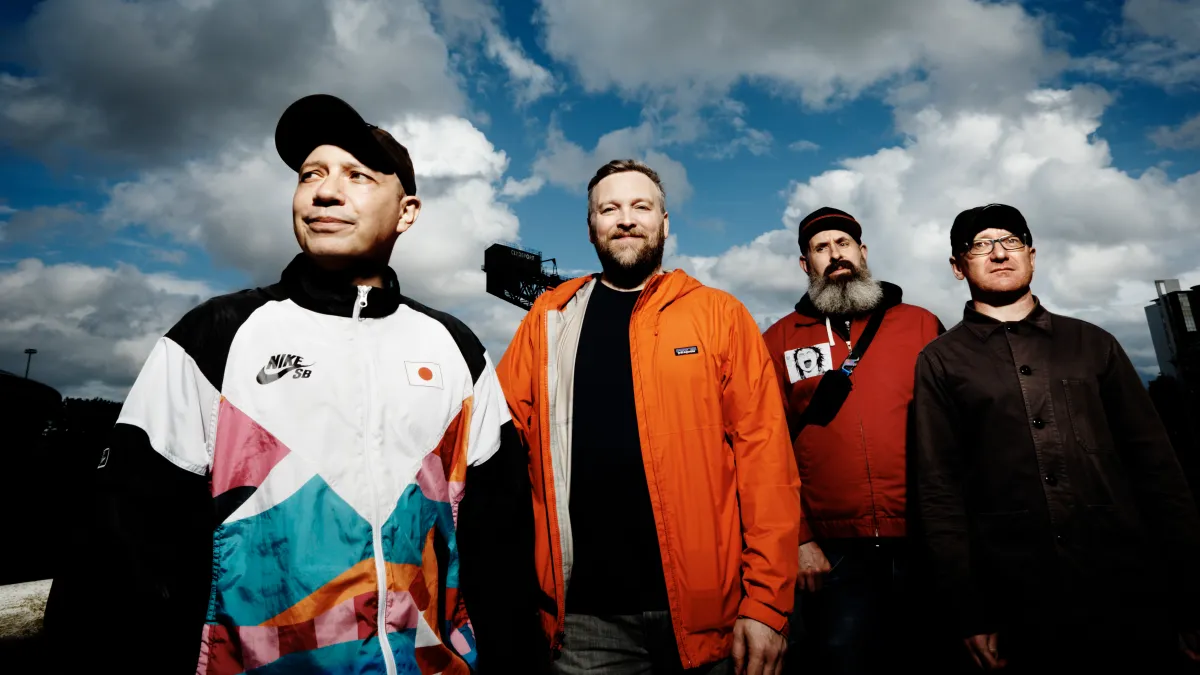
Thirty years is a long time to be doing anything — especially maintaining a career of full-on, heavily distorted post-rock music that sounds as big as the sky. All hail Mogwai, then, the great survivors of the 1990s, a gang of Scots whose debut single came out in 1996 and who are the least likely group to have a No 1 album (in 2021), score a mesmeric movie about an elite footballer in Zidane: A 21st-Century Portrait (2006), and headline the Royal Albert Hall (on Wednesday).
Still, many years ago, Mogwai’s one-time manager Alan McGee (the man who discovered Oasis) knew the future of the band was secure. “Alan said that nobody is going to care when we look old and shite, because we already look shite,” Mogwai’s chief songwriter and guitarist, Stuart Braithwaite, says. “It’s a very backhanded compliment. His point was that our youthfulness and attractiveness were never a factor.”
He laughs, a contented 49-year-old man in a cap, settled backstage at the University of Exeter before his band’s gig that night as part of a jaunt round the UK. Next to him is the multi-instrumentalist and co-songwriter Barry Burns, and their rapport remains strong, despite decades spent crammed together.
 The band in 1997 Stuart Mostyn/Getty Images
“At the end of the day, though,” Braithwaite says about touring, “you’re just on a silly holiday with your friends. And, also, it helps. My mum was really ill over Christmas. She’s doing better now, but I spent a lot of time round her house doing nothing. It drove my sister nuts, but I’m absolutely built to sit around. So you can get life skills from touring — I’ve done nothing in airports all over the world.”
The Mogwai/30 tour continues throughout the year — from the Royal Albert Hall to two nights in their native Glasgow at the Royal Concert Hall. Their appeal is unique. Think big, swelling, melodic symphonies of electric guitar and synth, music creating emotions, given a frequent absence of words. When I saw them in Exeter, two teenagers who can’t have been more than 15 stood transfixed in the front because, while Mogwai’s influences include My Bloody Valentine, and they have led to artists such as Sigur Ros, there are few better to zone out to live, while wearing earplugs.
They formed in Glasgow in 1995, the band completed by Dominic Aitchison on bass and Martin Bulloch — who watches Celtic in the Europa League on his phone during the gig I see — on drums. Their debut album was Mogwai Young Team — the band are named after the creatures in Gremlins — with Rock Action and, my favourite, Happy Songs for Happy People following, plus the soaring soundtrack for the spooky French TV show The Returned, which cemented them as a sizeable cult.
Mogwai are family men now. Braithwaite has a wife and a stepson; Burns’s daughter was diagnosed with aplastic anaemia, which meant she needed a bone-marrow transplant and chemotherapy, but will be OK. “It’s traumatising when I think about it,” he says, “but when she started to get better the studio was an escape.” Their latest album, The Bad Fire, came out last year.
“Still, it doesn’t seem long ago that we were just throwing guitars around our bedrooms,” Braithwaite says of their early ambitions. “But I remember that we wanted to make something with permanence — we began at the height of Britpop, so it was like music was a joke. It was a disposable culture, where people were so fixated on the next thing that bands would be discarded. Ones we loved like Sonic Youth had fallen by the wayside, but we wanted to make a lot of noise and I can’t believe that we wrote those songs of ours when we were teenagers. All the teenagers I know can barely order an Uber Eats.”
Back to Britpop. “I’m not going to castigate an entire era of music,” Braithwaite says with a smile.
“You should,” Burns says. “People say British but what they mean is English. Scotland didn’t really feel part of Britpop, it always felt culturally closer to America. We were listening to more Television than the Kinks.”
Which is why, I assume, in 1999 Mogwai put out T-shirts saying “Blur: Are Shite” — when both bands were playing the T in the Park festival. “Their anti-American English nationalism grated,” Braithwaite said once but, I ask, was it Blur in particular or any big band of the time? “It was a silly idea we thought would be funny but it had more attention than anticipated,” Braithwaite says. “And, safe to say, we’re not big fans, but I wouldn’t tar all commercial guitar music.” “Didn’t you just get into Pink Floyd?” Burns asks. Braithwaite nods. “But never Queen.”
Times have changed. Indeed, Braithwaite cannot think of an industry that has altered as much as the music business in such a short amount of time. “It’s totally unrecognisable,” he says. “And I cannot claim to understand how it works. Before, you would send a single to John Peel, an indie label would sign you, then someone would sign you in America. We lived through that, but it’s gone now.”
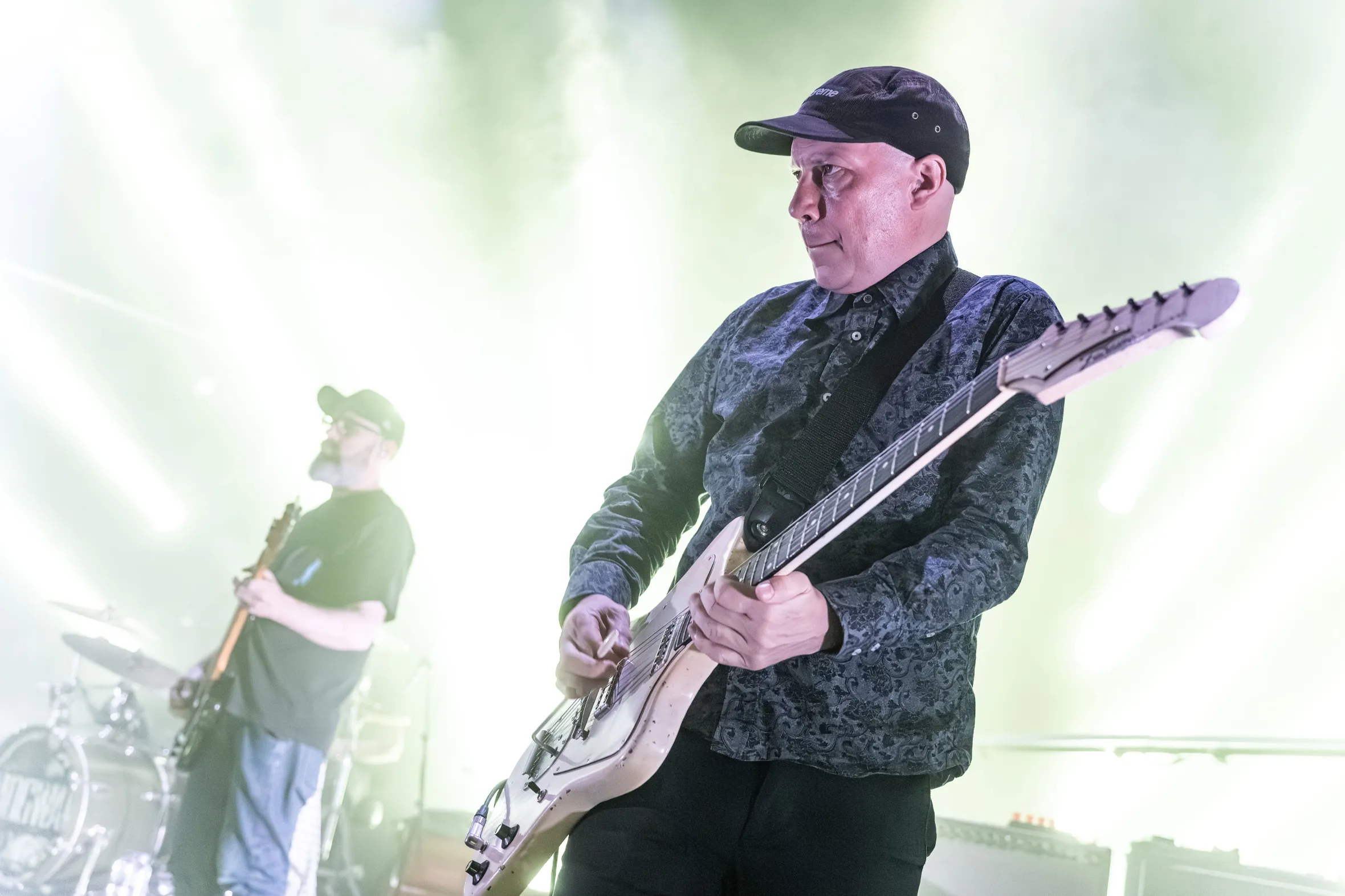 Mogwai on stage in Cambridge last FebruaryValerio Berdini
So the cash was not just reserved for Oasis, Blur et al — it trickled down? “In comparison to now? Unbelievably so,” Braithwaite says. “But a downside was that there were so many idiots in the music industry because there was so much money. But I guess those people attracted to the music industry’s money are tech bros now.”
Mogwai run their own label, Rock Action, which has released records by the Scottish groups the Twilight Sad and Arab Strap. And while they are keen to point out that, as a band, they are doing OK, the coffers have rather emptied for many others.
“The availability of music is really good,” Braithwaite explains, referring to services such as Spotify. “But the downside is the economics, because labels make so much from old music that they don’t invest in new stuff. No one wines and dines young musicians and pays for them to go around the world now. That is never coming back.”
As such, many Rock Action acts need arts grants, or to work second jobs. “I’d never encourage someone to not make music,” Braithwaite says. “It’s still the funnest thing you can do and makes the world better, but it’s harder. In the UK, the cultural sector makes so much money for the government, but it is taken for granted, and small venues are also struggling because young people are not as into drinking. That is probably good for their lives, but not to keep small venues open.”
“So,” Burns says, “what you are saying is that people should drink more?”
Braithwaite laughs. “I’m saying that we should nationalise music.”
He is not entirely joking. Money in music is scarce. The future needs proofing and Braithwaite is long enough in the tooth to recognise that contradictions might be necessary. “There are people who don’t think you should play Live Nation venues or have music on Spotify,” Braithwaite says. “So we do things some people think we shouldn’t, but we’re not in a utopia and so you have to accept the world you’re living in.” He laughs. “Though we did once let one of our songs be used in a Lance Armstrong advert, before he was outed as a bastard. And I don’t think we even got much money for it.”
There is a dry-witted bloody-mindedness to Mogwai — precisely the sort of attitude you need to survive in this business. Braithwaite does not love the 30th-anniversary chat, because he wants to believe that their best is to come, and I do not get the impression his band ever bowed down to external pressure or marketing ideas. Is that fair?
“We’ve always done exactly what we want,” he says, smiling. “I’m not saying it was the right thing, but it was always for the right reasons. Once, we did two nights in Iceland and ended with five minutes of noise. We cleared the room.”
Mogwai play the Royal Albert Hall, London, on Mar 25, royalalberthall.com