
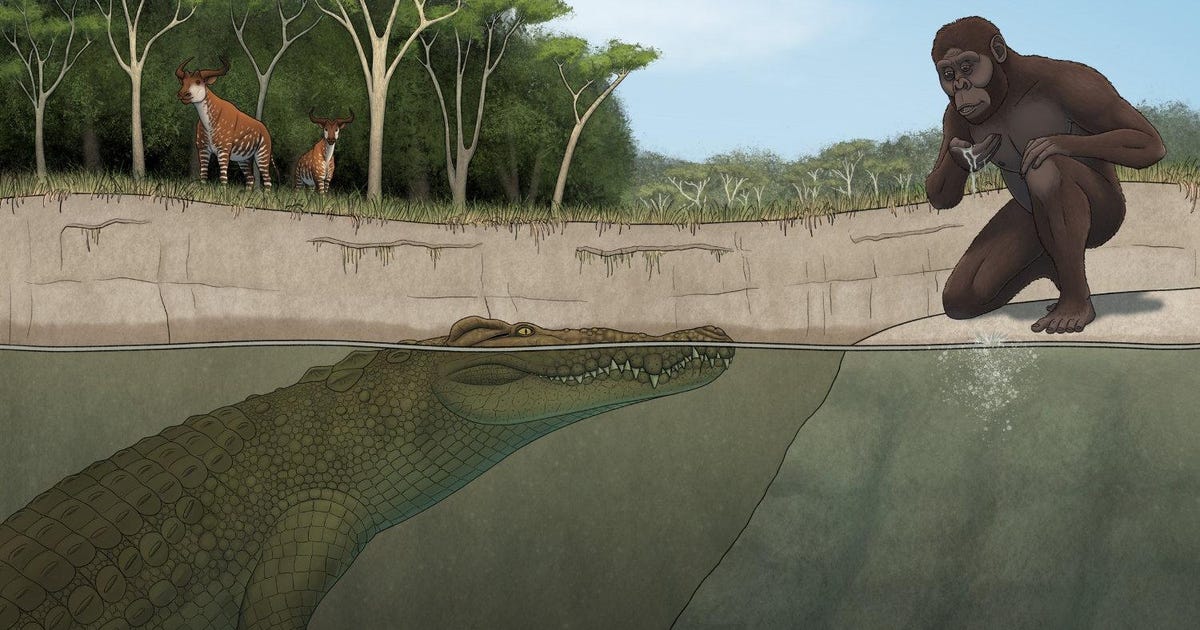
Africa was the cradle of humanity, the continent where We came into being and lo, we were not alone. Multiple branches on the hominin tree coexisted cheek by jowl, and they were not alone either. They lived amid giant animals, some of which wished to eat them.
One was a hitherto unknown large crocodile now classified as Crocodylus lucivenator, or “Lucy’s hunter.” It lived in the Hadar formation in the Afar region of Ethiopia 3.4 to 3 million years ago, in exactly the right time and place to ambush Lucy the lady australopithecine and her ilk when they came to drink, as they would have to do, Nathan Platt, Daniel Leaphart and colleagues report in the Journal of Systematic Palaeontology.
Crocodiles are ambush hunters. The hominins living in the Hadar, then a lovely green area with rivers and lakes, would have lived in fear of the giant reptilian lurking below the water, only its nostrils and eyes proud of the water. Hence the evocative name of their paper – “Lucy’s Peril: A Pliocene crocodile from the Hadar Formation, north-eastern Ethiopia.”
Related Articles
Not having found one with hominin bones in its abdomen, we can’t know that the lucivenator ate our ancestors but can assume it would if one was available. The hominins had to come to water sources to drink. They had no choice, the authors point out. This crocodile could have played a role in their daily life.
The dearly departed reptile ranged from four to five meters long (12 to 15 feet) in adulthood and weighed around 275 to 550 kilos (600 to 1,212 pounds).
 Close
Close
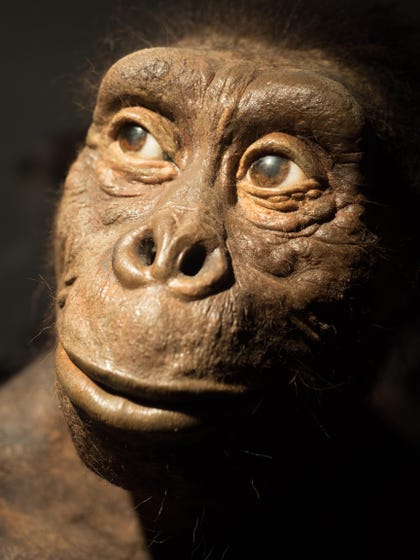
A reconstruction of Lucy, potential croc fodder and once considered the earliest human ancestor, Museum of Evolution, Warsaw Credit: GregGrabowski/Shutterstock
A reconstruction of Lucy, potential croc fodder and once considered the earliest human ancestor, Museum of Evolution, Warsaw Credit: GregGrabowski/Shutterstock
The biggest crocodiles today are the salties in Australia and Southeast Asia. The longest known to date was a capture named Lolong who was 6.17 meters or 20 feet, 3 inches long when he died in 2013, of unsuitable conditions in captivity.
Unlike Lucy, who coexisted in the Afar with other australopithecine species and apparently other hominins too, the lucivenator may have existed in glorious speciesist isolation. There were at least three other crocodile species in the Eastern Rift Valley at the time, but it was the dominant – or only – crocodile in its neck of the woods, the researchers suggest.
“The Hadar Formation [of fossils] preserves only one crocodile species. But at least three crocodylian species, possibly four, are known from the Turkana Basin during the Pliocene and early Pleistocene,” the team writes: Palaeoafrican Crocodylus, Euthecodon, and something related to Mecistops.
They don’t think the results are an artifact of sampling bias, where one only finds a tiny fraction of fossils – they think that for some reason, where lucivenator reigned, it did so supreme. They cannot explain why.
The crocodile’s peril
What was the lucievenator like? The paper goes into great length to explain why it is a distinct species and its probable relationships within paleo-crocodilia.
The lucivenator featured an elongated snout with a protuberance that is oddly reminiscent of modern American crocodiles but not African ones. That probably evolved for the same reason as tail in the peacock and the relatively large penis in the human – for display purposes. In other words, Lucy’s hunter had a bulbous nose to attract the ladies.
“You see this in some modern crocodiles,” said coauthor Christopher Brochu, an expert on ancient Crocodilia. “The male will lower his head down a little bit to a female to show it off.”
Could the crocodile and the hominin of the Hadar have existed in a state of mutual suspicion? Did the hunting go both ways?
Ancient Egyptians and aboriginal Australians hunted and ate crocodiles, but those were modern Homo sapiens and there isn’t a thing people today won’t eat. Looking earlier, evidence from Kenya’s Kanjera and Koobi Fara sites suggests members of the Homo genus were preying on crocodiles (among other animals) almost 2 million years ago.
But those were advanced hominins with a yen for meat (like we are), while the australopithecines were earlier, smaller, archaic and are thought to have subsisted mostly on plant matter augmented by opportunistically obtained protein. Wee small-brained Lucy would hardly have obtained her protein by hunting crocodiles, even baby ones, and the crocodile would have posed the biggest threat to her and her friends in the region, more so even than lions or hyenas, says Brochu.
 Close
Close
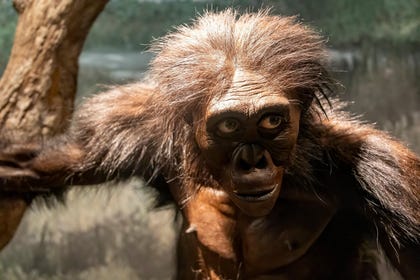
The early human species Australopithecus afarensis, likely known as “lunch” to the crocodiles of the Pliocene era. Credit: Jrtwynam/Shutterstock
The early human species Australopithecus afarensis, likely known as “lunch” to the crocodiles of the Pliocene era. Credit: Jrtwynam/Shutterstock
“It’s a near certainty this crocodile would have hunted Lucy’s species,” he says. “Whether a particular crocodile tried to grab Lucy, we’ll never know, but it would have seen Lucy’s kind and thought, ‘Dinner.'”
As do we. Monkeys and apes are not absent from modern human menus.
Brochu describes first seeing Crocodylus lucivenator specimens at a museum in Addis Ababa in 2016. “I was just blown away, because it had this really weird combination of character states,” he says, including the large bump on its snout, which distinguishes it from other crocs at the time.
So, the crocodile had little to fear from Lucy but may have had what to fear from itself.
The report characterizing the lucivenator is based on bone fragments, including one jawbone that bears toothmarks from another crocodile, says coauthor Stephanie Drumheller of the University of Tennessee. “This kind of face-biting behavior can be found throughout the crocodile family tree,” she says.
And now it is gone. Crocodylus lucivenator and its closest known relatives were a branch off the crocodilian tree that went extinct. They were not the ancestors of the modern Nile and West African crocodiles (Crocodylus niloticus Laurenti and C. suchus Geoffroy) currently living in Africa. If they threatened us, they do so no more.