
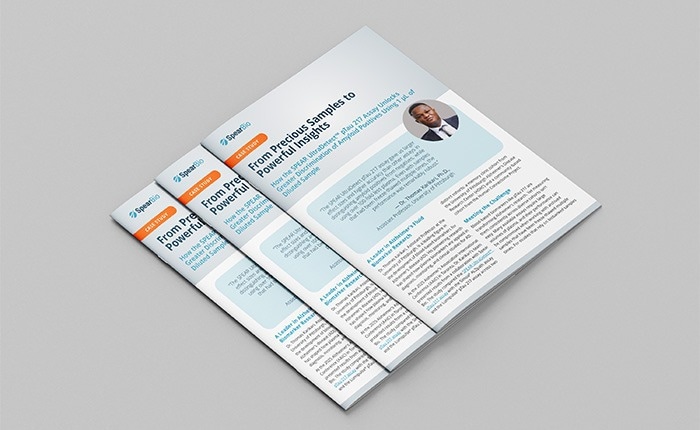
Dr. Thomas Karikari, an Assistant Professor at the University of Pittsburgh, plays a key role in the creation of blood-based biomarkers for Alzheimer’s disease. His pioneering study has influenced the use of plasma biomarkers in Alzheimer’s disease diagnosis, monitoring, and clinical trials.
At the 2025 Alzheimer’s Association International Conference (AAIC) in Toronto, Dr. Karikari’s team presented findings from a collaboration with SpearBio.
The study compared the SPEAR UltraDetect™ pTau 217 assay with the Simoa® ALZpath and Lumipulse® pTau 217 assays in two cohorts: a memory clinic cohort from the University of Pittsburgh Alzheimer’s Disease Research Center (ADRC) and a community-based cohort from the Human Connectome Project.
The SPEAR UltraDetect pTau 217 assay gave us larger effect sizes and higher accuracy than other assays in distinguishing amyloid positives from negatives, while using over 100-fold less plasma. Even with samples that had been freeze-thawed multiple times, the performance was remarkably robust.”
Dr. Thomas Karikari, Ph.D., Assistant Professor, University of Pittsburgh
Meeting the challenge
Blood-based biomarkers, such as pTau 217, are changing Alzheimer’s research. However, it is difficult to measure them reliably across different cohorts.
Many accessible tests require substantial amounts of plasma, and their performance can suffer when working with archived samples that have been freeze-thawed several times. These constraints are especially important in research that relies on biobanked samples accumulated over decades.
Dr. Karikari’s group used the SPEAR UltraDetect™ pTau 217 assay in two settings: a memory clinic cohort at the University of Pittsburgh ADRC and a community-based cohort from the Human Connectome Project. Participants were mostly cognitively normal.
A story of performance
In a memory clinic sample of 119 patients, the SPEAR assay consistently surpassed the Simoa® ALZpath assay. It produced a 4.7-fold difference between amyloid-positive and amyloid-negative groups, resulting in an AUC of 0.95, as opposed to a 3.0-fold difference and an AUC of 0.90 for ALZpath.
The SPEAR assay also showed 93% agreement with amyloid PET imaging, even though many of the plasma samples were collected years before the PET scans.
Notably, the SPEAR assay performed well for samples that had completed four to five freeze-thaw cycles, with a mean CV of 5.2 %, indicating outstanding precision.
In the community-based sample, in which most patients were cognitively normal, the SPEAR assay was compared with the Lumipulse® pTau 217 assay. It once again produced better results.
The UltraDetect assay had an AUC of 0.90, compared with 0.82 for Lumipulse, and a 3.0-fold difference between amyloid-positive and amyloid-negative groups, compared with 2.1-fold with Lumipulse.
The SPEAR assay requires only 1 µL of diluted plasma, which is over 100 times less than the Lumipulse assay, and maintains higher accuracy even after six freeze-thaw cycles.
Want to read the full piece? Click here
About Spear Bio
Spear Bio is an innovative leader in providing scalable solutions for ultra-sensitive protein biomarker measurements. Spear Bio’s proprietary technology, Successive Proximity Extension Amplification Reaction (SPEAR), employs a unique 2-factor authentication mechanism to precisely measure protein biomarkers at attomolar level from sub-microliter sample volume. Spear Bio is focused on leveraging its technology’s unprecedented sensitivity to transform protein research and early disease diagnosis.
Sponsored Content Policy: News-Medical.net publishes articles and related content that may be derived from sources where we have existing commercial relationships, provided such content adds value to the core editorial ethos of News-Medical.net, which is to educate and inform site visitors interested in medical research, science, medical devices and treatments.