
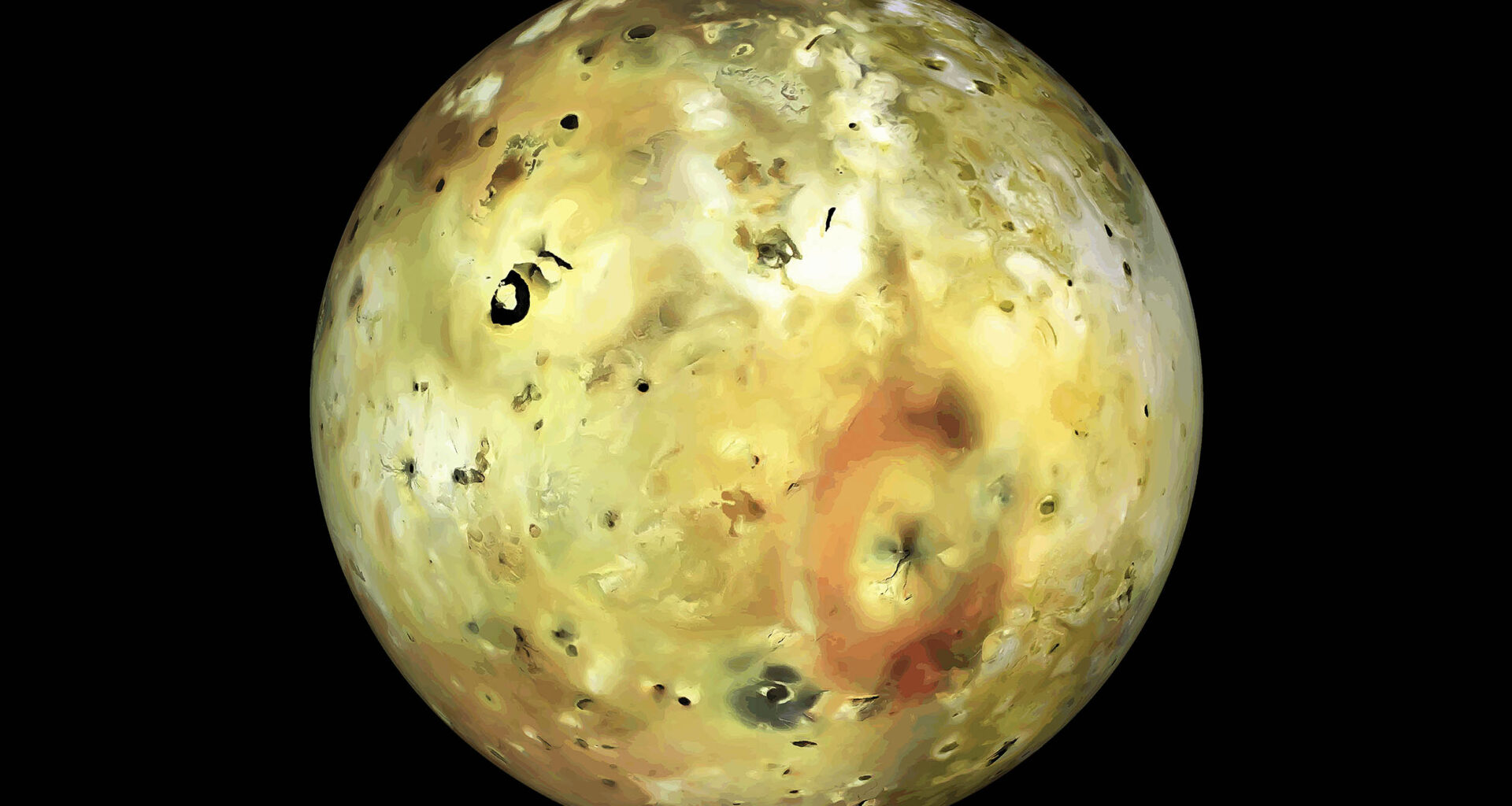
Researchers using the James Webb Space Telescope have identified seven active volcanoes erupting on Io, a moon that orbits the planet Jupiter. One dominant eruption shines brighter than the others at infrared wavelengths.
The finding turns Io from a blurred glow into a mapped volcanic landscape where separate eruptions can be tracked across its rapidly changing surface.
Signals of volcanoes on Io

The Webb telescope‘s infrared view from August 1, 2022, bright patches sit across Io’s disk instead of blending into a single glow.
Working from those patterns, Joel Sánchez Bermúdez at Mexico’s National Autonomous University (UNAM) rebuilt the surface into separate volcanic sources.
From that rebuild, the team separated one dominant eruption from several fainter volcanoes, while preserving surface glow that simpler methods pull apart.
Because Io changes so quickly, that cleaner view mattered only if the team could explain why the moon is constantly being remade.
Why Io erupts
Jupiter pulls Io hard enough to flex its interior, and the planet’s nearby moons, Europa and Ganymede, keep that strain locked in rhythm.
That squeezing creates tidal heating – heat made by repeated flexing – which melts rock below the crust of Io and feeds persistent volcanic eruptions.
Fresh lava and sulfur-rich deposits cover old scars so fast that big impact craters rarely last on the surface.
For astronomers, that constant repainting makes Io perfect for sharp observation, because small changes carry the story of what moves underground.
The masked mirror
Instead of using Webb’s full mirror, the team covered it with a metal plate pierced by seven holes that acted as light collectors.
That setup created aperture masking interferometry – a way of reading patterned light – as beams from each opening met on the detector.
By blocking most incoming light, the mask kept Webb’s detector from saturating on a bright target.
“However, with this mask, we are able to double the resolution of the JWST and can better recover the morphology of the object,” said Dr. Bermúdez.
Teaching the images
Standard reconstruction failed because Io was about as large as the interferometer’s field, so usual math could not separate structures cleanly.
The team turned to deconvolution, a way of undoing blur, using neural networks as an artificial eye.
One network learned from thousands of simulated scenes, while another rebuilt images from noise and preserved broader glowing regions.
That second approach mattered because eruptions are not just points of light, and surrounding haze can reveal fresh material.
Io’s seven erupting volcanoes
Across five Webb exposures taken on August 1, 2022, the same bright regions kept returning at consistent places on the disk.
The brightest source flared just northeast of Seth Patera, while six weaker sites lined up with known volcanic centers.
Measurements put that leading eruption near 33 gigawatts per micron, with several others clustering between 11 and 30.
Those numbers did not describe the entire heat release, but they pinned down which sites dominated the scene that day.
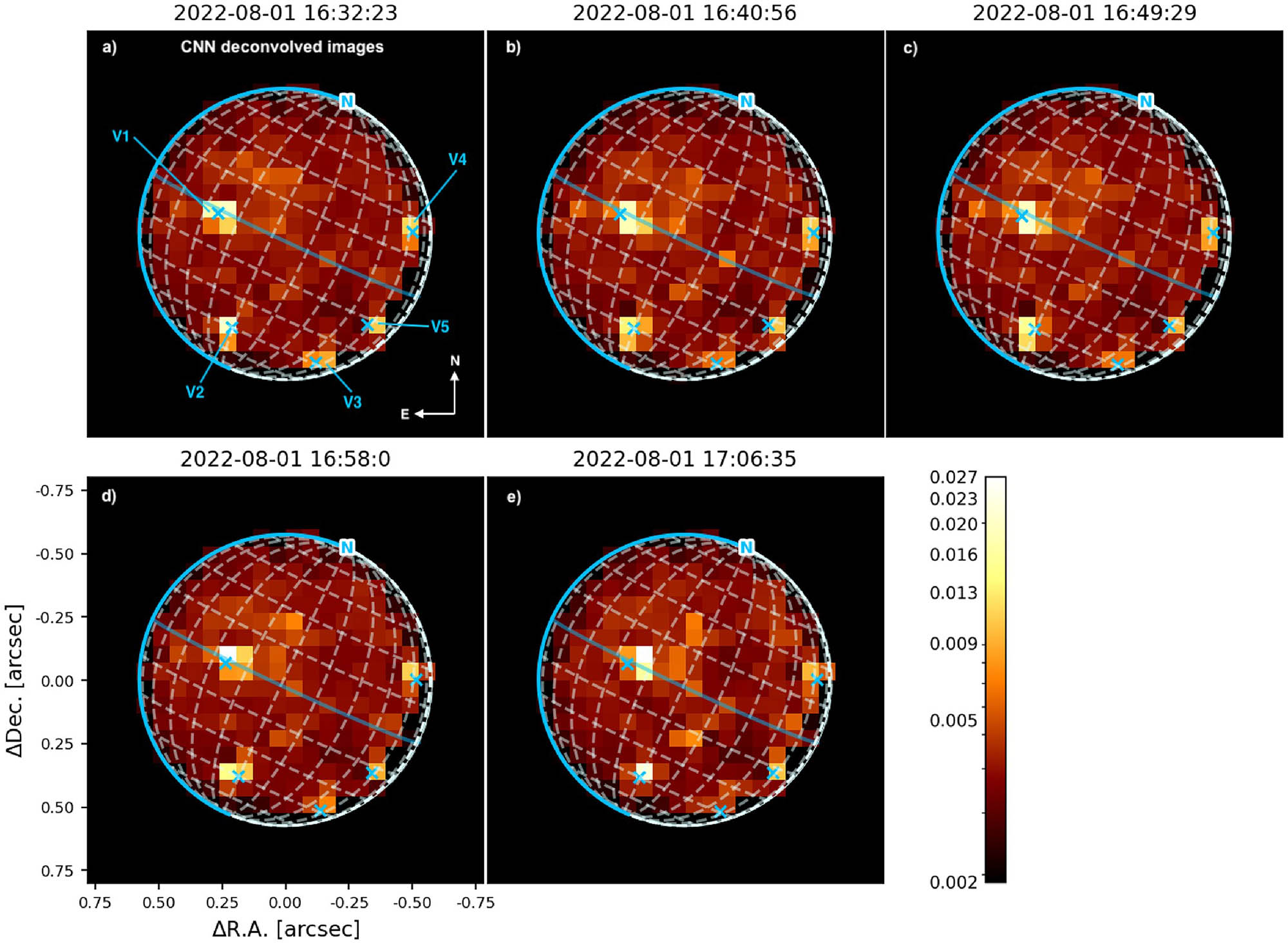 Median Io images per data cube of the JWST NIRISS-AMI observations, with superposed projected moon’s disc. The position of five volcanoes in the moon’s surface are identified with crosses and labels are displayed in panel (a). The total emission observed is normalized to unity. The emission’s scale is shown in the image and it is common to all the panels. Credit: Monthly Notices. Click image to enlarge.Check from Earth
A month before and a month after Webb observed volcanoes on Io, the Keck II telescope in Hawaii caught the moon at similar viewing angles.
Those ground images matched the major hot spots from space, giving the new reconstructions an external test instead of working from guesswork.
That cross-check was unusually strong because the same volcanoes appeared in both views, despite Io’s changing surface.
Agreement across space and ground instruments gave the team confidence to treat the new maps as physical structures, not artifacts.
More than hotspots
The new images did not stop at the brightest vents, because they also traced broader glowing regions around several eruptions. Broader glow may also mark sulfur dioxide, a gas that can freeze, near the surface.
Size checks suggested that the dominant structures were hundreds of miles wide, larger than single point sources and consistent with spread-out emissions.
That broader view turns Io from a list of volcanoes into a changing landscape with heat, frost, and fallout mixed together.
Watching motion from Io’s volcanoes
Because the five Webb observations ran over less than an hour, the team could watch the brightest eruption creep across the disk.
Its measured motion came out near 190 miles (305 kilometers) per hour, close to the speed expected from Io’s own rotation. That match did not prove every detail of the map, but it served as a useful reality check.
Longer campaigns will still be needed, because the study sampled only about one percent of Io’s rotation.
Beyond this moon
The method matters beyond Io because space telescopes usually trade brightness, field, and resolution against one another.
Here, the mask and neural cleanup recovered finer structure on a bright target without the need to build a larger telescope.
“This is quite novel; performing interferometry in space gives us advantages that we don’t have when making observations from Earth,” said Bermúdez.
That prospect reaches from erupting moons to forming stars and exoplanets, where tiny details often decide what astronomers can infer.
What Webb changed
By pairing a space telescope, a seven-hole mask, and machine-trained image recovery, the team turned Io’s surface into readable evidence of volcanic eruptions.
The gain is real but unfinished, because only repeated observations will show how fast those volcanic patterns appear, spread, and fade.
The study is published in Monthly Notices of the Royal Astronomical Society.
—–
Like what you read? Subscribe to our newsletter for engaging articles, exclusive content, and the latest updates.
Check us out on EarthSnap, a free app brought to you by Eric Ralls and Earth.com.
—–