
The Iranian Arena
Over the past 24 hours, widespread waves of strikes have been reported across Iran. According to the IDF Spokesperson, dozens of Israeli Air Force fighter jets operated in the western and central parts of the country, striking more than 200 targets belonging to the Iranian regime. Among the targets attacked were sites used for the storage and launch of ballistic missiles, facilities related to unmanned aerial vehicles, air defense systems, ballistic missile launchers, and weapons production sites.
At the same time, the Air Force also carried out strikes in the maritime arena. In Bandar Anzali, on the Caspian Sea coast, five missile boats of the Iranian Navy, along with a headquarters and a shipyard, were targeted. This marks the first strike in this area since the beginning of the war. In addition, a vessel of the Iranian Navy was attacked in the port of Bandar Abbas.
During the night, the airport in the city of Yazd in central Iran was struck, along with fuel depots located within its grounds. Additional strikes were also reported in the areas of Amikhbir and Shiraz.
According to data from the United States Central Command (CENTCOM), the U.S. military has carried out more than 7,800 strikes against targets in Iran, alongside over 8,000 aerial sorties. It was also reported that more than 120 Iranian vessels have been destroyed or damaged. In this context, the U.S. administration is considering the deployment of thousands of American troops in the Middle East, with one of their missions expected to be securing the Strait of Hormuz.
Eliminations
It was reported that Mohammad Khasravani, Deputy Judge and a security investigator in the Shiraz Prosecutor’s Office, was eliminated in a strike attributed to the IDF. In addition, according to opposition sources in Iran, Bahman Parsani, a senior figure in the Basij forces, was also eliminated. It was further reported that General Afshin Naqshbandi, who served as a representative of the Iranian Army within the Islamic Revolutionary Guard Corps, was eliminated.
Iran Targets Sites Across the Middle East
Over the past 24 hours, Iran carried out a series of attacks against energy facilities and strategic infrastructure in Qatar, Saudi Arabia, the United Arab Emirates, and Kuwait.
In Qatar, the Ras Laffan gas export facility, considered the largest of its kind in the world, was targeted, with reports indicating heavy damage to the site.
In Saudi Arabia, oil facilities at the port of Yanbu, which serves as the country’s main oil export terminal, were attacked. Following the strikes and launches toward the port, oil exports from the facility were halted. At the same time, it was reported that an unmanned aerial vehicle attempting to approach a gas facility in the eastern part of the country was intercepted, as well as another UAV en route to the diplomatic quarter in the capital, Riyadh.
In Kuwait, attacks were carried out against two oil refineries located at the ports of Al-Ahmadi and Abdullah.
Additionally, following reports earlier this week, the Kuwaiti Ministry of Interior announced the arrest of a Hezbollah cell consisting of ten operatives. According to the statement, members of the cell were in contact with actors outside the country, took part in planning attacks on critical infrastructure, and attempted to provide coordinates for future strikes. The investigation revealed that the operatives had undergone training in Hezbollah camps outside Kuwait, where they acquired knowledge in the use of weapons and unmanned aerial vehicles.
In the United Arab Emirates, a strike was reported against Dubai International Airport, as well as damage to a French base in the city. Additional damage was reported at the UAE Air Force base in Al Dhafra. In Abu Dhabi, debris from interceptions fell in two gas fields—Jebshan and Bab—causing damage on site.
It was also reported that the port of Salalah in Oman was targeted.
The Israeli Arena
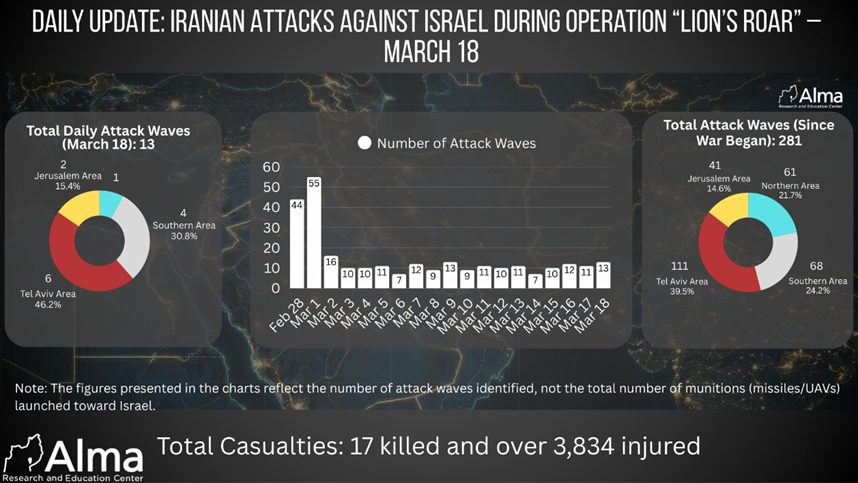
On March 18, 13 waves of Iranian attacks against Israel were identified, carried out using ballistic missiles. Geographically, most of the attacks were directed toward the Tel Aviv area, which sustained 6 waves of attacks (46.2%). In addition, 4 waves of attacks were recorded in the south (30.8%), 2 waves in the Jerusalem area (15.4%), and one wave in the north (7.7%).
Since the beginning of the campaign, a total of 281 Iranian attack waves against Israel have been identified. In cumulative geographic distribution, the central region—particularly the Tel Aviv metropolitan area—remains the primary target, with 111 attack waves (39.5%). It is followed by the southern region with 68 waves (24.2%), the northern region with 61 waves (21.7%), and the Jerusalem area with 41 waves (14.6%).
In one of the attack incidents targeting central Israel in the early hours of March 18, a missile carrying a cluster warhead was launched and struck a residential apartment in Ramat Gan. As a result of the impact, two civilians in their 70s were killed. The use of a cluster warhead indicates an attempt to increase the impact area by dispersing submunitions across multiple points, thereby increasing the potential damage, especially in a dense urban environment.
It should be noted that, according to current assessments, approximately 50% of the ballistic missiles launched by Iran toward Israel so far have carried cluster warheads. In addition, most of the Iranian fire is directed toward the central region—an area characterized by high population density—using means designed to expand the scope of impact over a wider area. This combination underscores an intent to cause significant harm to the civilian rear.
An examination of the daily trend indicates relative stability in the pace of attacks since March 2, when a decrease in the intensity of attack waves was observed compared to the opening phase of the campaign. Since then, a consistent level of activity has been maintained, averaging around 10 attack waves per day.
This pattern reinforces the assessment that Iran is operating within a strategy of attrition, based on sustained attacks over time, alongside a focus on central Israel and complementary geographic distribution across other regions.
Since the beginning of the war, 17 civilians in Israel have been killed, and more than 3,834 people have been injured to varying degrees as a result of direct hits, falling interception debris, and secondary damage. In addition, extensive damage has been caused to residential buildings and civilian infrastructure.
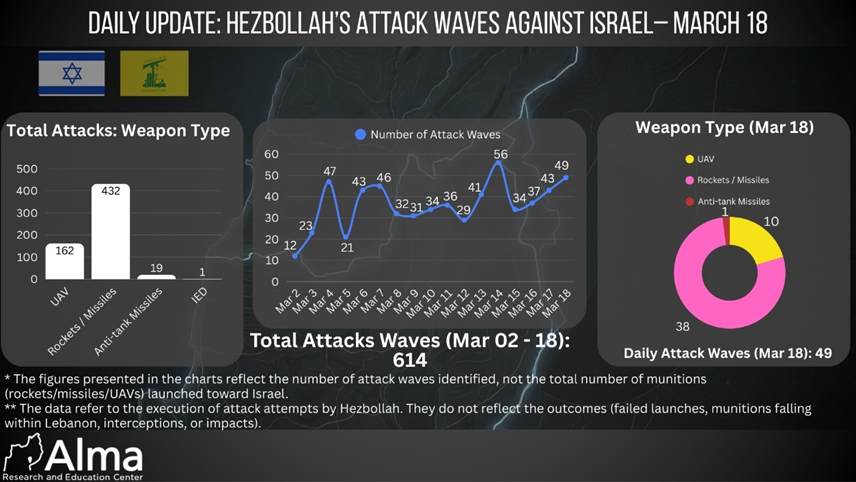
On March 18, 49 waves of Hezbollah attacks against Israel were identified. In terms of weapon types, 38 attack waves (approximately 77.6%) were carried out using rockets and missiles, 10 attack waves (approximately 20.4%) using unmanned aerial vehicles, and one attack (approximately 2%) using an anti-tank missile.
The data refer to the number of identified attack waves, not to the total number of munitions actually launched.
Geographically, most of the attacks were directed toward border communities, the Galilee, the Golan Heights, and the Haifa area. In addition, an unusual launch toward the Ashkelon area in southern Israel was recorded, in which a single missile was fired from Lebanon.
It was also reported that 15 of the attacks during the day were claimed by Hezbollah as targeting IDF forces operating in southern Lebanon.
Since Hezbollah joined the fighting on March 2, a total of 614 attack waves against Israel have been identified. An examination of weapon types shows that rockets and missiles continue to constitute the primary means of attack, with 432 attack waves, alongside 162 attack waves using unmanned aerial vehicles, 19 attacks using anti-tank missiles, and one IED attack.
An examination of the daily trend indicates a fluctuating dynamic in the scope of attacks: following a significant increase recorded on Saturday (March 14), there was a decline on Sunday (March 15), but in recent days a gradual and continuous increase in the number of attack waves has been observed. The current average stands at 36 attack waves per day from Lebanon.
Note – The data refer to the execution of attack attempts by Hezbollah. They do not reflect the outcomes (failed launches, munitions falling within Lebanese territory, interceptions, or impacts).
Lebanon and Hezbollah
The camp opposing Hezbollah is promoting a framework for opening negotiations with Israel. According to the proposal, direct negotiations would take place between Lebanon and Israel, constituting recognition that Israel is not an enemy of Lebanon—contrary to Hezbollah’s narrative. At the same time, the framework emphasizes the need to continue Israeli military operations against Hezbollah alone and not against the Lebanese state, based on the understanding that halting the fighting at this stage would allow the organization to rebuild. In addition, there is a call to implement decisions of the Lebanese government against Hezbollah, to the extent possible.
In contrast, according to reports, Hezbollah continues to oppose President Aoun’s initiative to open direct negotiations with Israel. The organization stresses that any future negotiations must be derived from the reality on the ground and not from political dictates. Reports further indicate that at this stage, Hezbollah is not interested in an internal confrontation within Lebanon and prefers to continue operating within the governmental framework. According to political assessments, Speaker of Parliament Nabih Berri continues to serve as a central channel for political mediation on behalf of Hezbollah.
At the same time, the IDF continues extensive strikes in Lebanon. The Air Force struck a bridge over the Litani River in the village of Qa’qaiyat al-Jisr. So far, several key bridges have been targeted, including the al-Khardali bridge, the Tir Falsiya bridge, the Qa’qaiyat al-Jisr bridge, the al-Qasmiya bridge, and the Burj Rahhal bridge. According to assessments, Hezbollah uses these routes to transfer weapons, rockets, and rocket launchers, which are used to carry out terrorist activities from the South Litani area.
In addition, the IDF eliminated Hassan Ali Marwan, the new commander of the “Imam Hussein” Division, after his predecessor was eliminated a week earlier. According to the IDF Spokesperson, Division 36 forces and the Air Force eliminated more than 20 militants in southern Lebanon over the past 24 hours. In addition, dozens of Hezbollah military structures were destroyed, and many weapons were located and confiscated.
Syria
In the Syrian arena, reports indicate continued monitoring of Hezbollah movements in the border area, alongside the deployment of reinforced forces.
The International Arena
Over the past 24 hours, strong political reactions have been recorded from regional states and the international community following the wave of attacks on energy infrastructure.
The UAE Ministry of Foreign Affairs condemned the attacks on gas facilities and oil fields on its territory, describing them as a dangerous escalation and a violation of international law. At the same time, the UAE also condemned the Israeli strike on a gas field in southern Iran.
The Saudi Foreign Minister also addressed the Iranian attacks on his country, stating that Saudi Arabia reserves the right to respond militarily. In addition, a member of the royal family noted that if Iran expands its targeting of critical infrastructure, the response will no longer be merely declarative.
According to a senior advisor to the President of the UAE, Anwar Gargash, Iran made a serious mistake by attacking his country and the Gulf states. He stated that this move could bring regional countries closer to Israel and the United States, and highlights the dangers inherent in Iran’s nuclear and missile programs and the impossibility of accepting them.
Qatar condemned the Israeli strike on the gas field in Iran, describing it as an irresponsible step by Israel. At the same time, Qatar announced that the military attaché and the security attaché at the Iranian embassy, as well as their staff, were declared “persona non grata.”
French President Emmanuel Macron called on all parties to refrain from deliberate attacks against civilian infrastructure, particularly water and energy facilities, and emphasized the need to curb the escalation.
The European Union called on Israel to halt its operations in Lebanon due to the “severe humanitarian consequences” and stressed the need for direct dialogue between the parties. At the same time, the EU condemned Hezbollah for dragging Lebanon into war, refusing to disarm, and carrying out attacks against Israel.
