

Astronomers using the Australian SKA Pathfinder (ASKAP) have detected a long-period radio transient with a period of 36 minutes, a finding that could reshape our understanding of stellar systems. The transient, known as ASKAP J1424, was reported in a study published on March 9, 2026, on the arXiv preprint server. Its enigmatic nature leaves scientists speculating whether it might be a white dwarf binary system or an entirely new class of cosmic object.
The Evolutionary Map of the Universe Project: A New Frontier in Radio Astronomy
ASKAP J1424 was discovered as part of the larger Evolutionary Map of the Universe (EMU) project, a significant initiative that uses ASKAP’s wide-field capabilities to conduct large-scale radio surveys. These surveys allow scientists to probe vast swaths of the sky, detecting transient radio sources that were previously impossible to observe in such detail. The project’s ability to sample the sky with high cadence and long dwell times makes it an invaluable tool for tracking down elusive cosmic phenomena like long-period radio transients (LPTs).
The discovery of ASKAP J1424 adds to a growing list of such mysterious objects, which are characterized by their long rotational periods and intense magnetic fields.
“We discovered ASKAP J1424 in a circular polarization search of a 10 h ASKAP observation, conducted on 2025-01-09 (scheduling block SB70271) as part of the Evolutionary Map of the Universe survey,” the researchers wrote in their paper.
This search, pulished in on the arXiv preprint, represents one of the latest steps in a larger effort to uncover more about the universe’s transient radio sources, a category of objects that remains poorly understood.
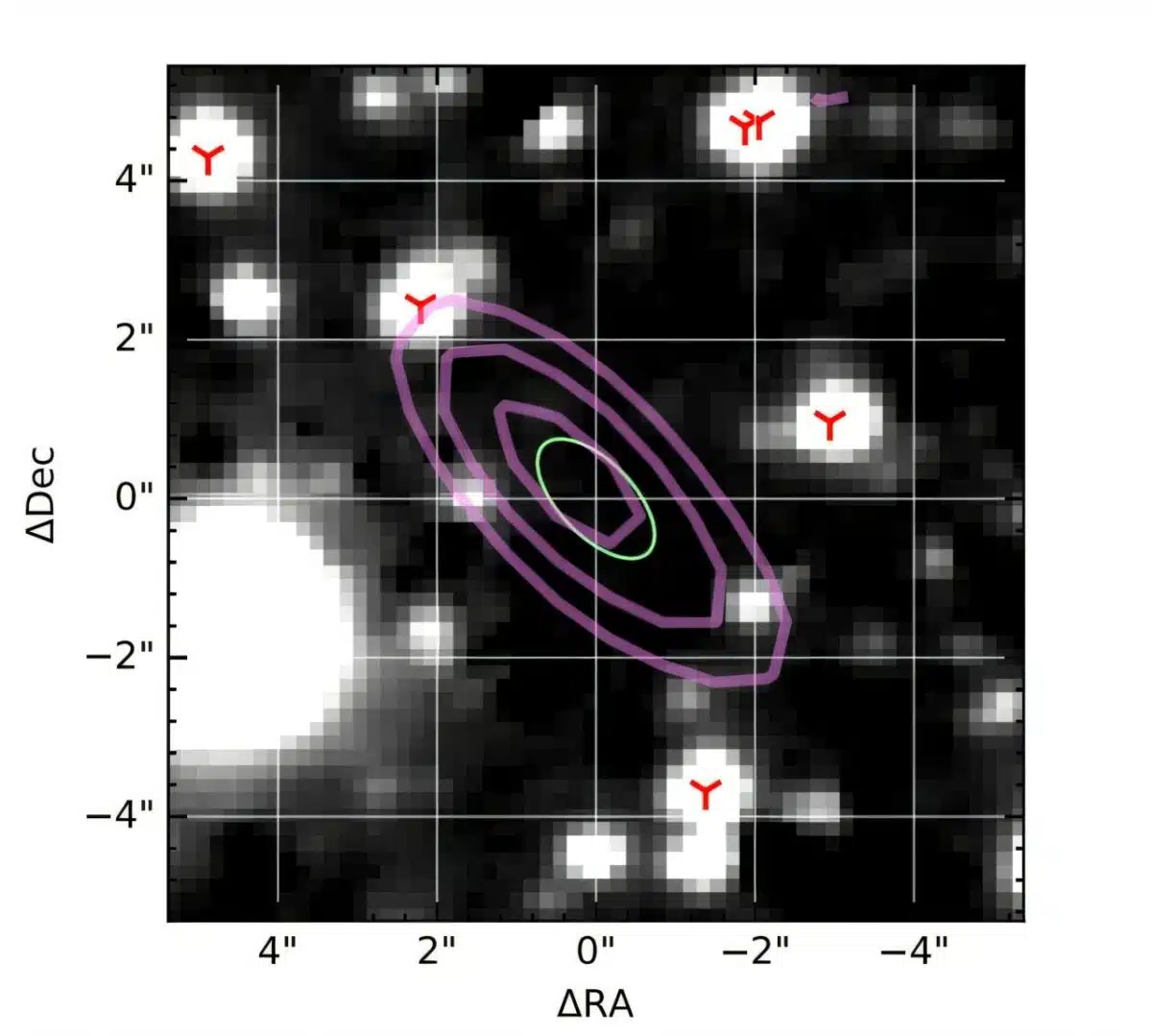 Ks-band Gemini observation of ASKAP J1424 with Stokes I radio contours from ATCA C3363 observation overlaid. Credit: arXiv (2026). DOI: 10.48550/arxiv.2603.07857
The Unsolved Mystery of ASKAP J1424: A 36-Minute Pulse that Defies Explanation
ASKAP J1424 stands out not just for its long period of 36 minutes (2,147.27 seconds), but for its extremely stable pulse profile, which lasted for eight consecutive days. Such stable emissions are rare among long-period radio transients and have intrigued astronomers. What sets ASKAP J1424 apart from other similar sources is the unusual polarization observed during its activity window. The emission from the source was 100% polarized across the entire pulse, transitioning from an elliptical to a fully linear polarized state. This unique behavior suggests that ASKAP J1424 could be related to a previously unknown class of stellar objects.
However, despite an extensive search, no optical or infrared counterpart to ASKAP J1424 has been found. This lack of additional signals makes it even more challenging to determine the source’s nature, leaving the astronomers with more questions than answers. The study’s authors have proposed that ASKAP J1424 could be a white dwarf binary system. In such systems, the activity is believed to be driven by magnetic interactions, where the white dwarf’s magnetic field interacts with a companion star’s magnetized wind.
“Further monitoring (e.g. as part of the planned second phase of the VAST [Variables And Slow Transients] Galactic survey) will allow us to determine whether the observed emission follows an intermittent activity pattern, or was powered by a one-off or stochastic event such as accretion of plasma from a companion,” the researchers concluded.
The Future of ASKAP J1424: A New Frontier in the Search for Cosmic Oddities
The discovery of ASKAP J1424 marks a new frontier in the study of long-period radio transients, a field that has gained increasing attention as astronomers seek to understand the complex behaviors of stellar systems with extreme magnetic fields. The researchers’ call for further monitoring is crucial to unraveling the true nature of ASKAP J1424. By extending the observation window and utilizing other tools, scientists hope to uncover whether this transient exhibits an intermittent activity pattern or is driven by an unpredictable event, such as plasma accretion from a companion star.
One of the most promising next steps is the second phase of the Variables And Slow Transients (VAST) Galactic survey, which aims to provide more detailed data about transient sources in the Milky Way. This phase, scheduled to take place in the near future, will focus on regions of the sky that are particularly rich in transient activity, offering a chance to study ASKAP J1424 in greater depth. The results could offer new insights into the physics of stellar systems with extreme magnetic fields, potentially transforming our understanding of the universe.