
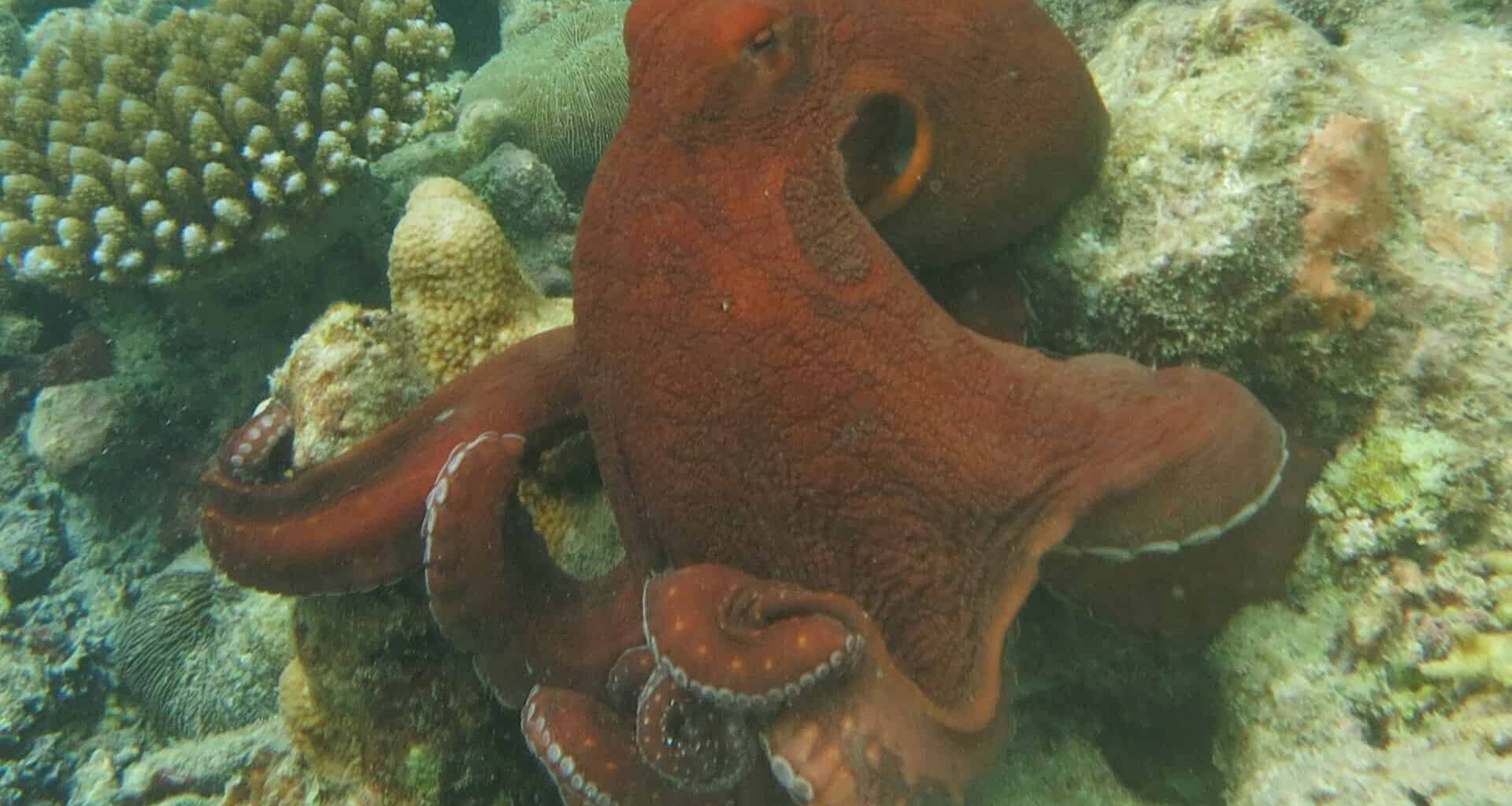
Scientists surveying marine life near Rotuma in the South Pacific caught something unexpected on camera: a day octopus appeared to punch a grouper fish on the seafloor.
As strange as it sounds, this is not the first time scientists have seen it. Octopuses have repeatedly been observed striking fish during mixed-species hunts, possibly to shove competitors aside or punish unhelpful partners. The new footage suggests the behavior may be more widespread than researchers once thought.
The Octopus Management Style
Researchers were conducting a fish survey near Morton Bank off Rotuma when one of the reef’s strangest regulars stole the show. Their camera captured a day octopus (Octopus cyanea) abruptly lashing out at a highfin grouper (Epinephelus maculatus), then taking another swing at a spotcheek emperor (Lethrinus rubrioperculatus) and missing. The footage was later shared by National Geographic Pristine Seas on Instagram.
“We never really know what we’re going to see until we watch the footage back later,” says Chris Thompson, a marine ecologist at National Geographic Pristine Seas.
Thompson suggested a few possible explanations. The octopus may have been pushing a fish out of the way to get at prey. It may have been policing a freeloading hunting partner. Or, as he put it, it may have happened “just because.” For now, the first two ideas seem to be the most likely.
Similar behavior has been documented elsewhere, especially in the Red Sea near Israel and Egypt, where day octopuses have been seen hunting alongside fish and occasionally striking them.
But Why?
 A day octopus in its natural environment. Image via Wiki Commons.
The weird part isn’t even that an octopus punches. The weird part is that it may punch during teamwork.
Day octopuses are active diurnal predators. They roam the coral reefs during the day, using exceptional camouflage to mimic their surroundings, and looking for crabs, clams, or fish. But they also seem to engage in a remarkably rare practice: mixed-species hunting.
×
Thank you! One more thing…
Please check your inbox and confirm your subscription.
In this type of group, different animals seem to do different jobs. In the Red Sea observations, octopuses searched crevices and reef structures, while fish partners worked the seafloor or watched the water column. The arrangement makes sense because each species brings a different skill, and together they can flush out prey that would be harder to catch alone.
Still, cooperation in nature is rarely smooth. Some partners get in the way. Some try to steal more than they contribute. That tension may explain the octopus’s aggressive jabs. A 2020 study in Ecology argued that punching can act as a “partner control mechanism,” helping the octopus manage other hunters in a crowded and unstable alliance. For the fish, the cost may be lost position or lost access to prey. For the octopus, the cost is smaller: a burst of energy and a brief distraction.

Cooperation in nature is rarely clean. Someone often steals or gets in the way. Animals have an incentive to try and cheat, and that friction could be what’s making octopuses punchy. A 2020 study in Ecology argues that punching may be a “partner control mechanism,” a way for the octopus to manage other hunters in a crowded, shifting alliance. The fish pays a price by losing position, losing access to prey, or, in some cases, being pushed out entirely. The octopus pays a smaller price: a burst of energy, a risky movement, a moment of distraction.
Researchers are not saying octopuses are angry in the way humans are angry. What they’re saying is this behavior can be regarded through the lens of game theory: when multiple species hunt together, conflict over effort and payoff can produce enforcement. A punch is a way to enforce cooperation, not a way to lash out.
There’s another, simpler explanation: ordinary competition. Not every fish in one of these hunting groups is a true collaborator. Some may just lurk nearby, hoping to benefit from the octopus’s work without contributing much. In those cases, a punch may be less about discipline than simple displacement. Move, and I get the food.
Octopuses Are Constantly Surprising Us
Octopuses keep complicating our ideas about animal intelligence. Despite being invertebrates, they solve problems, use tools, recognize patterns, and now seem capable of navigating the messy politics of a multi-species hunt. They’re not social in the way wolves or dolphins are, but they are clearly not simple loners either.
That is why researchers are so excited about this behavior: it fits a growing picture of an animal whose intelligence is flexible, opportunistic, and still full of surprises. The ambiguity is part of what makes the behavior so fascinating. We’re still not sure why octopuses do this.
That opens larger questions. Do individual fish learn to stay in line? Do octopuses remember reliable partners, or maybe even build lasting relationships? The more we observe this behavior, the more researchers can finesse their theories.