
WASHINGTON — The space manufacturing supply chain faces a number of interlocking challenges, ranging from greatly increased demand to inconsistent US government budgets to outdated specification requirements, according to a new study by the Aerospace Industries Association (AIA) and accounting firm PricewaterhouseCoopers (PwC).
But perhaps the biggest immediate hurdle is a serious lack of production capacity for nine highly specialized components, including rocket motor nozzles, actuators and optical intersatellite links (OISLs), the study, titled “Strengthening America’s Space Supply Chain: Built for yesterday, igniting momentum for tomorrow,” found.
“The rapid expansion of the U.S. space industry has driven demand to historic highs, placing significant pressure on the supply chain that underpins U.S. leadership in space,” Eric Fanning, AIA president and CEO, said Tuesday in a press release announcing the study’s findings.
“Without deliberate steps to strengthen suppliers and modernize regulations, we risk turning today’s momentum into tomorrow’s bottlenecks. A resilient space supply chain is not optional — it’s a national imperative,” he added.
The AIA-PwC study was based on numerous conversations with companies along the space manufacturing supply chain to flesh out the growing concern in the community, as reported by Breaking Defense late last month.
In particular, the authors asked companies to drill down into what specific problems with supplies they were finding most difficult to deal with, AIA’s Steve Jordan Tomaszewski, one of the study’s co-authors, said in an online briefing Tuesday.
“We went out to talk to some of the leading space manufacturers across the industry, and we asked them: What are you having difficulty getting your hands on? What might have long lead times? Where are prices really high, and, in some cases, [where is it] you just might not ever be able to get your hands on quality components that are ready to go for spacecraft?” he said.
The study found five major issues roiling the supply chain:
Demand is outpacing industry capacity across critical aspects of the space industrial base
Critical component shortages are delaying major programs as space companies compete with larger sectors for the same limited supplies
Legacy regulations and qualification requirements are driving up costs and slowing innovation, with limited access to certified testing facilities adding further delays
The supplier base remains fragile, with many essential components supported by three or fewer qualified domestic suppliers and smaller firms struggling to meet regulatory and cybersecurity demands.
Budget instability and inconsistent demand signals are discouraging private investment, limiting suppliers’ ability to expand capacity or modernize infrastructure.
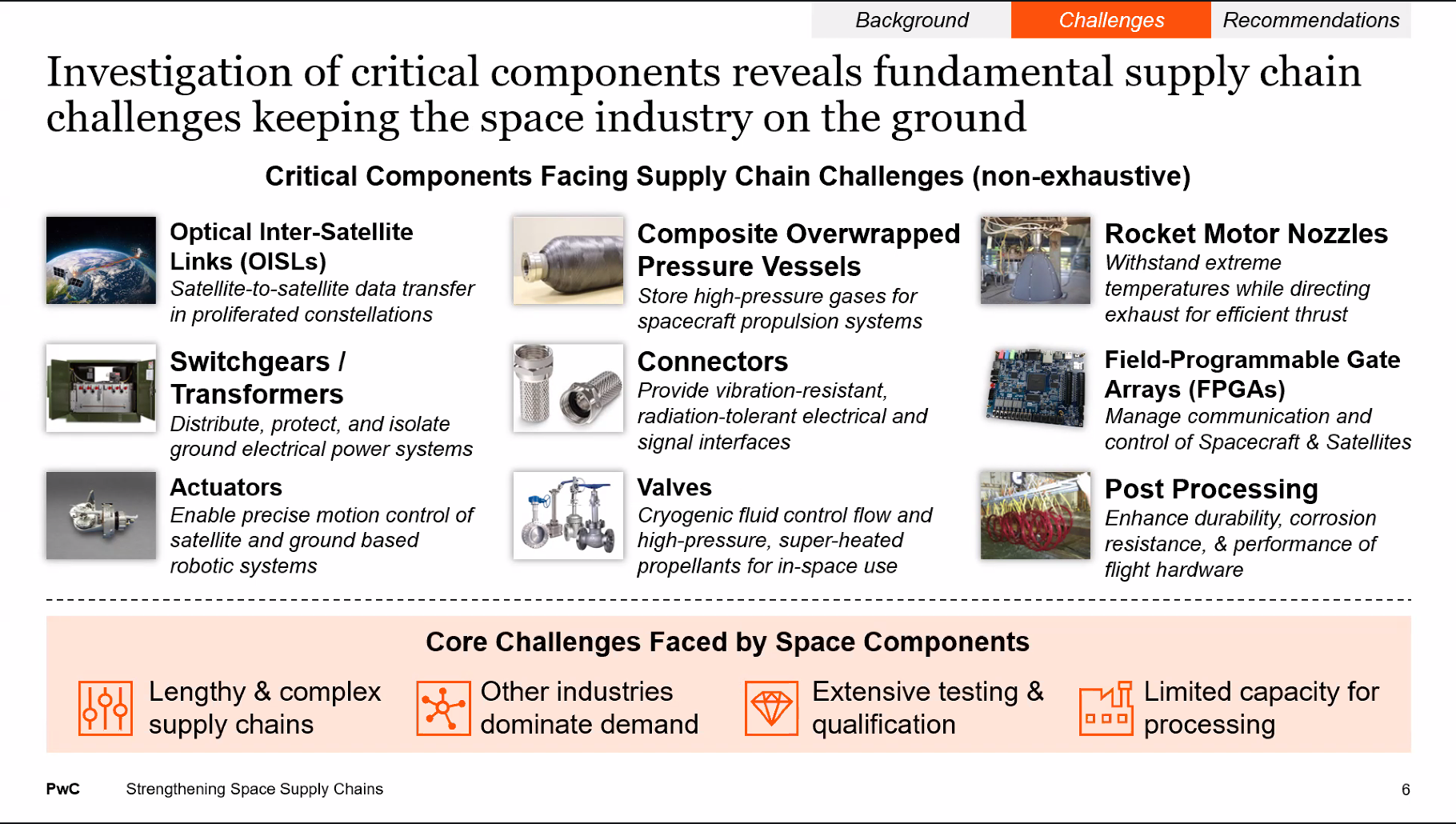 The AIA-PwC study found supply gaps for nine critical components currently are creating the biggest roadblocks for space manufacturers. (Credit: AIA-PwC)
While by no means an “exhaustive” list, the study said, it pinpointed nine critical components presenting the biggest obstacles for manufacturers of satellites and rockets. These are:
OISLs (i.e., laser links) used to pass data from one satellite to another to create a mesh network, such as that being developed by the Pentagon’s Space Development Agency.
actuators, which convert electrical energy needed to control a satellite’s position, deploy structures such as antennas, and operate on-board instruments;
rocket motor nozzles that must withstand extremely high temperatures;
“composite overwrapped pressure vessels” that store high-pressure gases for spacecraft propulsion systems;
connectors, which provide vibration-resistant, radiation-tolerant electrical and signal interfaces;
switchgears/transformers, which distribute, protect, and isolate ground electrical power systems;
valves, which provide cryogenic fluid control flow and high-pressure, super-heated propellants for on-orbit maneuvers;
field-programmable gate arrays, which manage communication and control of spacecraft; and
post processing used to enhance durability, corrosion resistance, & performance of flight hardware.
Connectors are a particularly problematic area, with production capacity extremely low, explained study co-author Doug Anderson, partner at PwC’s Operations and Supply Chain Services practice.
“One thing that comes to mind here is, like the fasteners that are used in both commercial aerospace as well as in launch vehicles. There’s simply a small number of manufacturers that produce these type of aerospace grade fasteners,” he said. “You might know there was a fire at one of these suppliers not too long ago, and it caused a big disruption. And so again, … we need more investment in these types of suppliers; we need to build more capacity.”
Another problem is finding certain types of electrical equipment that are used widely outside of the space domain as well, including by the ever-growing number of data centers popping up to support the development of artificial intelligence software, he said.
“Those types of electrical equipment, like switch gears and transformers, are needed to provide electricity to things on the ground,” he said, “[a] manufacturing facility, maybe it’s a launch pad, maybe it’s a telemetry tracking and control station for a satellite. But it’s really difficult for the space industry to get their hands on those electrical components right now … space can totally go to the back of the line, sometimes with extremely long lead times with certain types of these items.”
The AIA-PwC study proposed a handful of recommendations designed to at least kick start efforts to address the supply chain woes.
These include better cooperation between government and companies all along the chain to improve visibility about customer demand and budgets and planning by both sides to enable necessary investment, and a review of legislative and regulatory requirements to weed out outdated compliance burdens.
Further, the study recommends that government and industry work together to “expand testing, qualification, and post‑processing capacity through in‑house investment, shared facilities, and sustained federal support for critical infrastructure.”