
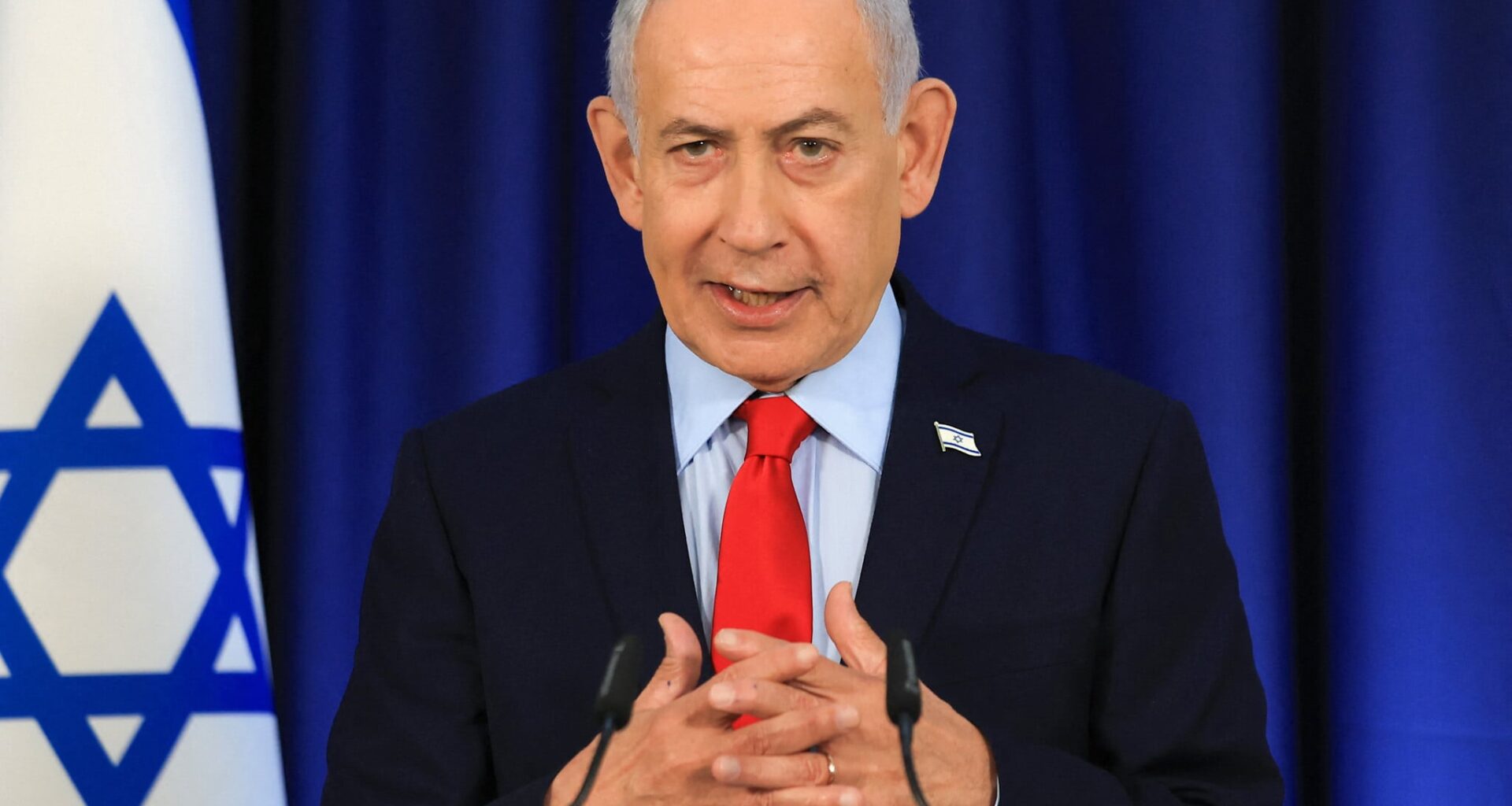
Iran can no longer enrich uranium or manufacture ballistic missiles, said Prime Minister Benjamin Netanyahu on Thursday.
“After 20 days, I can tell you — Iran today has no ability to enrich uranium, and no ability to produce ballistic missiles,” said Netanyahu in Jerusalem, speaking at his first in-person press conference since the launch of the US-Israel campaign against Iran on February 28.
“We are continuing to crush these capabilities. We will crush them to dust, to ashes,” he said in a Hebrew statement to open the bilingual press conference. Iran “is weaker than ever” while Israel is a regional power “and some would say a world power,” he says.
Hours after Netanyahu spoke in Jerusalem, Iran fired a series of missiles at Israel, causing sirens to go off repeatedly in the capital and elsewhere in the country.
Iran has launched missile and drone attacks across the region in response to the ongoing bombing campaign that the US and Israel launched last month in a bid to destabilize its leadership and destroy its nuclear and ballistic missile programs.
Get The Times of Israel’s Daily Edition
by email and never miss our top stories
By signing up, you agree to the terms
In his English-language remarks, Netanyahu said that “In [Operation] Rising Lion [in June], we destroyed missiles and we destroyed a lot of the nuclear infrastructure. But what we’re destroying now are the factories that produce the components to make these missiles and to make the nuclear weapons that they’re trying to produce.”
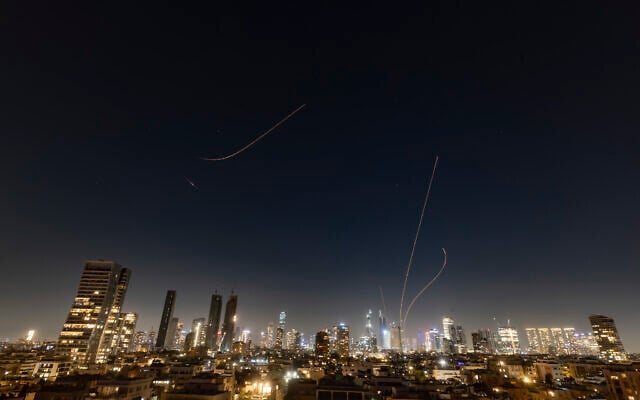
Anti-missile batteries fire interception missiles toward incoming ballistic missiles launched from Iran, as seen over Tel Aviv, March 16, 2026. (Chaim Goldberg/Flash90)
“We’re wiping out their industrial base in a way that we didn’t do before.”
After killing Iran’s supreme leader Ali Khamenei and dozens of top officials, Netanyahu said he is “not sure who is running Iran right now.”
“Mojtaba [Khamenei], the replacement ayatollah, [has] not shown his face,” he continued, adding that there is “a lot of tension” among officials at the top of the regime.
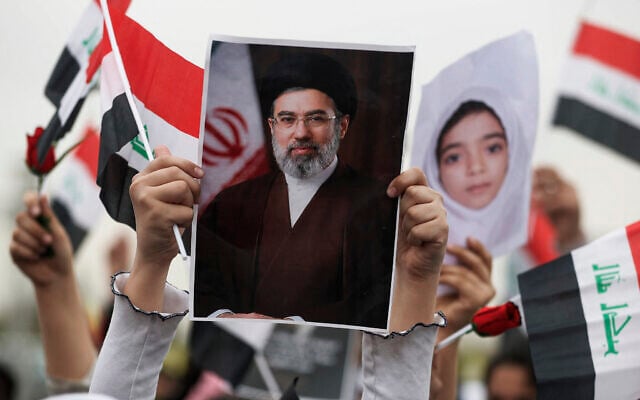
A schoolgirl holds up a poster of Iran’s new supreme leader Mojtaba Khamenei during an anti-US and Israel demonstration in Baghdad, Iraq, on March 12, 2026. (AHMAD AL-RUBAYE / AFP)
Mojtaba Khamenei has not been seen in public since he was chosen to replace his father, who was killed in the initial wave of US-Israeli airstrikes on Iran on February 28. Last week, a statement was issued in his name, carried by state media, vowing to “avenge the blood” of Iranians killed in the strikes, and another followed on Monday.
US President Donald Trump suggested Monday that it is unclear if the new Iranian leader is alive. Iranian state media have said that the younger Khamenei was wounded in the Israeli strike that killed his father, wife, son, and brother-in-law.
Netanyahu indicated that Israel would continue to target Iranian leaders: “It does not matter who replaces them — we are making sure that the shifts in the Revolutionary Guards will be very short.”
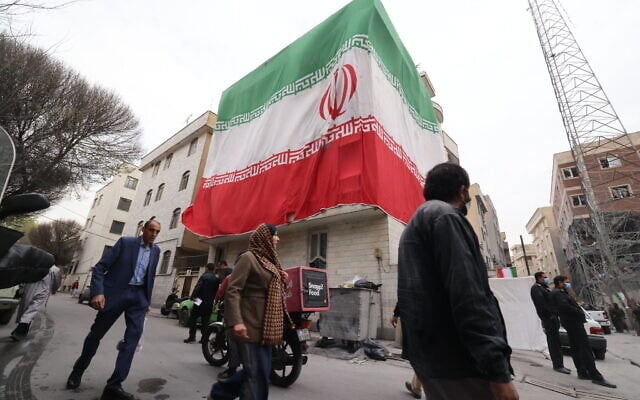
A huge Iranian flag adorns a building as Iranians walk past damaged structures following an earlier military strike in the Iranian capital, Tehran, on March 15, 2026 (Atta KENARE / AFP) /
Netanyahu reiterated that Israel is working to create the conditions for Iranians to topple the regime, but that ultimately it is up to the Iranian people to overthrow the Islamic Republic.
“Yes, the regime could change,” he said. “Is it guaranteed? No. And it is up to the Iranian people in the final accounting to make use of the conditions that we’re [creating], weakening the regime.”
At the same time, he left the door open for Israeli involvement in some sort of ground operation to bring the regime down.
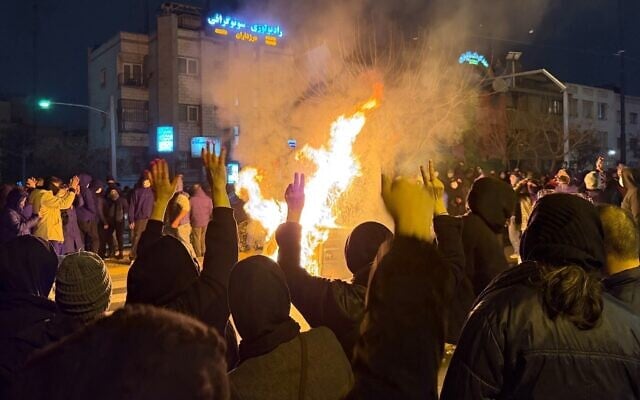
In this photo obtained by The Associated Press, Iranians attend an anti-government protest in Tehran, Iran, January 9, 2026. (UGC via AP)
“You can do a lot of things from the air, and we are doing, but there has to be a ground component as well,” he said. “There are many possibilities for this ground component, and I take the liberty of not sharing with you all those possibilities.”
There have yet to be large-scale protests against the regime during the war. Thousands of Iranians were killed in anti-government demonstrations in January, as the regime used live fire on its own citizens.
There are many possibilities for this ground component, and I take the liberty of not sharing with you all those possibilities.
Still said Netanyahu, “we’re seeing cracks” in the regime,” both at the leadership level and in field units. “It’s sort of like a hollowed-out, rotten piece of wood that’s holding on the outside, but there’s a lot of rot inside. We’re seeing some defections.”
Netanyahu did not give any indication as to how long the campaign will continue. It will go on, he said, for “as long as is necessary.”
‘Israel acted alone’
After conflicting versions emerged over the coordination — or lack thereof — between Netanyahu and Trump on an Israeli strike on a major Iranian gas field the previous day, the prime minister said he would not continue to target gas infrastructure.
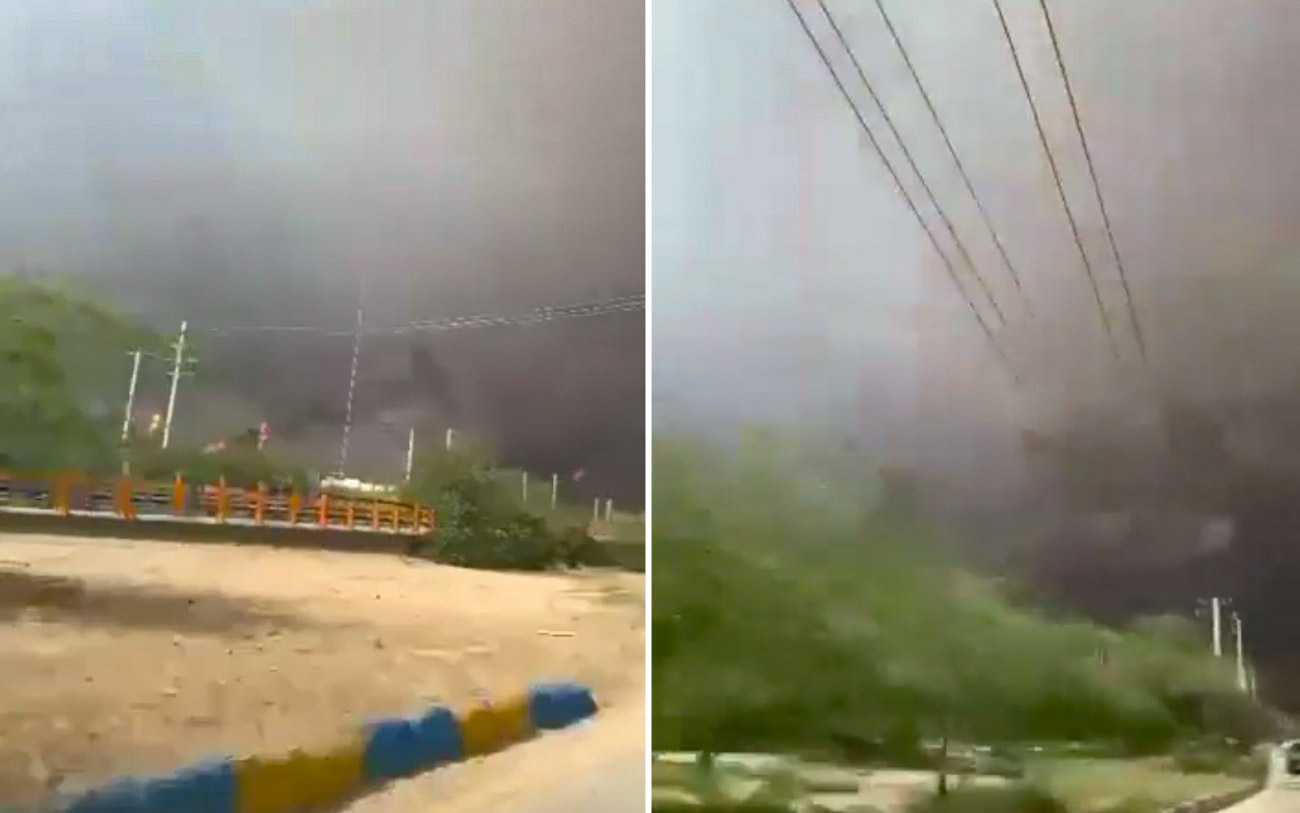
Footage shows the aftermath of an IDF strike on the South Pars gas field on the northern coast of the Persian Gulf, in Asaluyeh, Iran, on March 18, 2026. (Social media, used in accordance with Clause 27a of the Copyright Law)
“Fact number one, Israel acted alone against the Asaluyeh [South Pars] gas compound,” he said. “Fact number two, President Trump asked us to hold off on future attacks, and we’re holding off.”
Trump said early on Thursday that Wednesday’s gas field strike was uncoordinated with the US, and that Israel would not hit Iran’s gas sites again, but that the US would if Iran kept up attacks on Gulf gas fields.
Later Thursday, Trump added that he has told Netanyahu not to strike any more Iranian oil and gas fields: “I told him, ‘Don’t do that,’ and he won’t do that.”
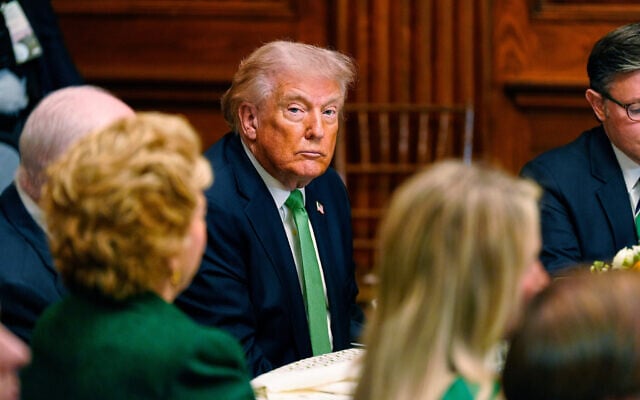
US President Donald Trump attends a Friends of Ireland luncheon for Irish Prime Minister Micheál Martin in the US Capitol, on St. Patrick’s Day, on March 17, 2026, in Washington. (AP Photo/Alex Brandon)
However, US sources told The Times of Israel and other media outlets that Washington had approved the strike, that it was coordinated, and that the president knew about it ahead of time.
Speaking at the Pentagon on Thursday, US Defense Secretary Pete Hegseth called the strike on South Pars “a warning” and urged Iran to stop its retaliatory strikes on energy sites across the Gulf, which have sent oil prices soaring.
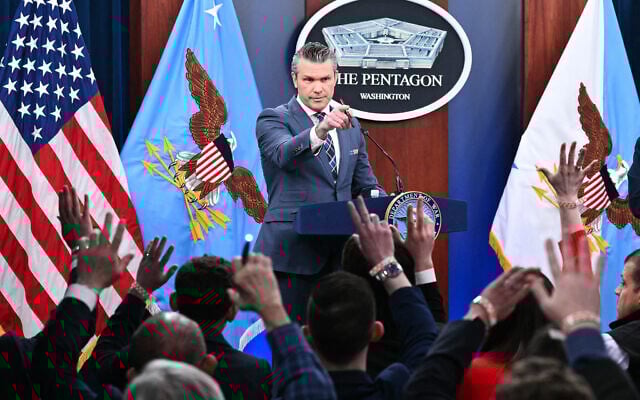
US Secretary of Defense Pete Hegseth takes questions during a news conference at the Pentagon in Washington, DC, on March 19, 2026. Oil and gas prices soared Thursday after Iran hit the world’s largest liquefied natural gas (LNG) facility in Qatar and threatened to destroy the region’s energy infrastructure, and US President Donald Trump warned of a furious US response if such attacks continued. (Photo by Mandel NGAN / AFP)
Asked repeatedly at his press conference about claims from anti-Israel voices in the US that he dragged Trump into war against Iran against American interests, Netanyahu scoffed at the notion.
“Does anyone really think that someone can tell President Trump what to do? Come on,” he said, adding that the US president “always makes his decisions on what he thinks is good for America.”
“I misled no one,” he stressed, “and I didn’t have to convince President Trump about the need to prevent Iran from developing its nuclear program, putting it underground, and being able to launch nuclear-tipped missiles at the United States. He understood that. He explained it to me. I didn’t explain it to him. And I think that our partnership is the only way to avoid this catastrophic development.”
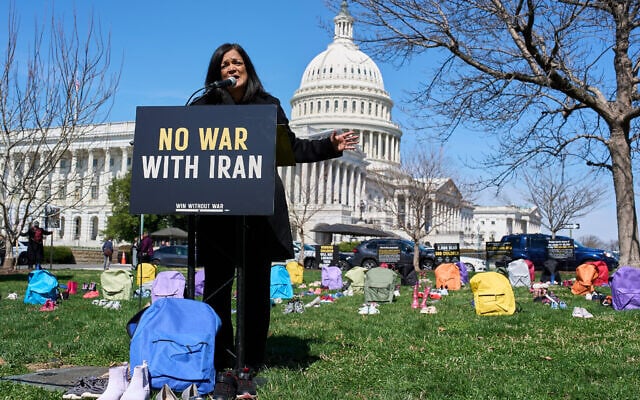
Rep. Pramila Jayapal, Democrat-Washington, speaks during an event and memorial display calling for an end of the war in Iran, on Capitol Hill in Washington, March 18, 2026. (Jacquelyn Martin/AP)
“The loss of servicemen is painful,” he acknowledged, recalling his brother Yoni, who in 1976 was killed leading “the historic Entebbe rescue. The cost to bereaved families is enormous, and I sympathize and send the condolences of the people of Israel to these families and to the American people.”
Netanyahu also hailed the depiction, in a recent US national security memorandum, of Israel as a “model ally” of America, and set this against “all the vilifications that are leveled at Israel — ‘Israel is sponging off America’ and all that. No, it’s not. It’s not. Israel is a brave country, a resolute country, with an incredible army, incredible soldiers, incredible courage, and we’re fighting alongside the United States when the chips are down… We’re fighting for a common goal.”
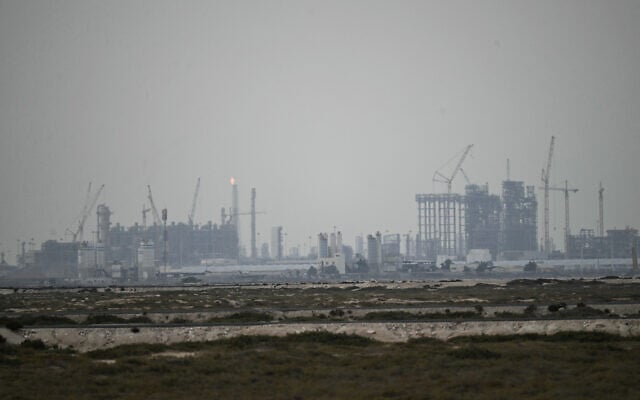
QatarEnergy’s operating facilities in Ras Laffan Industrial City on March 2, 2026, prior to the Iranian missile attack that damaged them some two weeks later. (AFP)
In the wake of Israel’s attack on the South Pars oil field, Iran launched fresh salvos of drones and missiles toward the Gulf states Wednesday evening and into Thursday, including at key energy infrastructure.
Missile strikes on Ras Laffan caused damage to a gas-to-liquids facility and early on Thursday sparked “sizeable fires and extensive further damage” to several liquified natural gas facilities, QatarEnergy said in a statement.
Multiple drones were also intercepted and destroyed as they headed toward Saudi gas facilities in the kingdom’s Eastern Province.
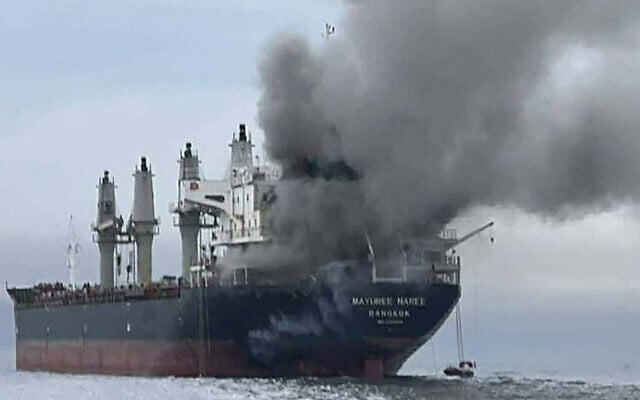
This handout photo taken on March 11, 2026, and released by the Royal Thai Navy, shows smoke rising from the Thai bulk carrier ‘Mayuree Naree’ near the Strait of Hormuz after an attack. (Handout / ROYAL THAI NAVY / AFP)
Iran has effectively shut the Strait of Hormuz, the narrow waterway it shares with Oman, through which a fifth of the world’s oil supply normally flows.
Netanyahu, in his Thursday press conference, said it was vital to have “alternative routes instead of going through the chokepoints of the Hormuz Strait and the Bab-al-Mandab Strait in order to have the flow of oil.”
What is needed are “oil pipelines, gas pipelines going west through the Arabian Peninsula right up to Israel, right up to our Mediterranean ports, and you’ve just done away with the chokepoints for forever.”
This vision “is definitely possible,” he said. “I see that as a real change that will follow this war, but I also see this war ending a lot faster than people think.”