
The US/Israel-Iran war is largely being directed by Israel. As retired director of the US Counterterrorism Center Joe Kent put it, Trump entered the war on behalf of Netanyahu. There was talk that the US President would head for an exit ramp after some time. But he can’t make that move. The reason is that Iran has blocked the Strait of Hormuz. With this move, Iran set the agenda for the war. It created serious pressure on the US and the Gulf states. Trump was forced to ask even China for support. While Israel tries to collect the spoils of war, Trump is the one taking a beating. The US President cannot head for an exit ramp without resolving the Hormuz crisis. He is not in a position to declare victory as he did in the early days of the war.
THE WAR HAS ENTERED A DANGEROUS PHASE
So, how will he resolve the Hormuz crisis? Does he have any option left other than deploying US troops on the ground? Trump is likely planning to seize control of Hormuz. It’s a wild idea. But signs of it are appearing on the ground. In recent days, the US military has started striking Iranian positions in the Strait of Hormuz with bunker-buster bombs. It is targeting Iran’s deterrent capability around the strait. There is a risk that US troops traveling from Japan could become easy targets in Hormuz.
The war has entered a dangerous phase. Iran had set the war’s agenda using the Hormuz card and had put Trump in a desperate position. It had gained the psychological upper hand. The killing of Laricani turned this around. The Revolutionary Guards can still strike various targets, especially in the Gulf states, with significant force. How the war will end is impossible to predict from here. But those in Iran seeking regime change may be approaching an outcome they did not calculate: what could remain of Iran after this war is a military regime hostile to the US and Israel.
ISRAEL’S SPOILS
For Israel, the spoils would be the conflict turning into an Arab-Iranian war. Iran’s attacks on neighboring Gulf countries since the start of the war was a wrong choice. It was an effort to increase the cost by widening the war and influence US decisions through the Gulf. It viewed the Gulf as a “tool for blackmail.” The killing of Laricani, followed by Israel’s strike on gas facilities in the South Pars field, led Iran to respond harshly. It targeted reciprocal points in Gulf countries, especially Qatar and Saudi Arabia. Qatar declaring Iranian attachés persona non grata is a dangerous sign.
The attacks on Riyadh occurred while an important meeting was taking place in the capital. In our previous articles, we emphasized that a “coordination” had been established in the region against Israel’s aggressive policies, that this coordination, with Turkey, Saudi Arabia, Egypt, and Qatar playing leading roles, was effective in Gaza, Syria, and even the Horn of Africa, and that this partnership would again be the actor to resolve this crisis. What needed to be done was to free Trump from Netanyahu’s influence.
STRONG LANGUAGE IN THE GULF STATEMENT
At the Riyadh meeting, which also included countries neighboring Iran such as Azerbaijan and Pakistan, the agenda was not so much stopping the war but rather Iran’s attacks targeting the Gulf. The joint statement issued after the summit is entirely about Iran (criticism of Israel’s expansionist policies was added to the text through Ankara’s initiatives). The joint statement, which also bears the signature of Foreign Minister Fidan, contains clear language: Iran’s attacks on regional countries, including Turkey, were condemned. The right to self-defense was affirmed. Iran was called on to “stop its attacks.” A condition was set: “the first step for a diplomatic solution is to establish good neighborly relations.” Iran was asked to end its support for proxy forces.
The Gulf countries, caught up in the immediacy of the situation, are focusing on Iran, but the post-war order is also very important. Because Israel is focusing on new spoils. Netanyahu will be a problem that all countries in the region need to contend with after the war. In fact, there are analysts suggesting that Israel also has its eye on Egypt and Jordan. That is a distant threat for now. But the same cannot be said for what is happening in Lebanon and Syria.
THE GRAND PLAN ON THE MAP
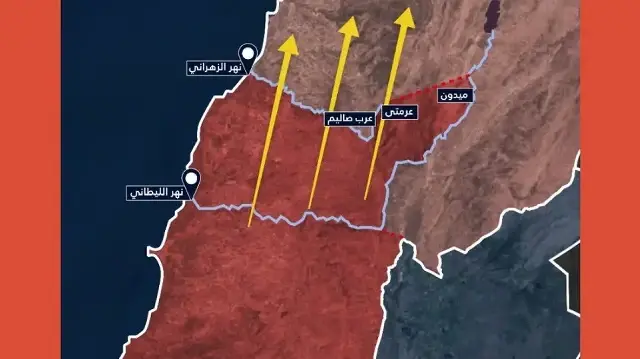
The scope of the simultaneous ground operation Israel launched in Lebanon, under the pretext of eliminating the Hezbollah threat, goes beyond Lebanon. Maps tell us that a larger plan is being put into motion. Let me explain: In discussions on disarming Hezbollah, Israel viewed the Litani River as a line. It wanted Hezbollah to move north of this river. However, in previous discussions, there was no mention of “depopulation.” The other day, the Israeli army ordered civilians living south of the Zahrani River in Lebanon to urgently evacuate the area. This is a new development. The Zahrani River is located 20 kilometers north of the Litani River. Israel is both expanding the area it wants to control and pushing the population there northward.
The Zahrani River has a strategic feature. If you draw a straight line eastward from the river, you reach Mount Hermon in Syria. Remember… After Assad was overthrown, Israel expanded its occupation in the Golan and seized Mount Hermon, establishing a base there. In other words, it linked the Golan with Mount Hermon. In Syria-Israel talks held under US auspices, it did everything it could to avoid withdrawing from this mountain.
If Israel reaches the Zahrani River, the territories it occupies in Syria (Golan, Hermon) will be back-to-back with the new areas it will occupy in Lebanon. Israel will likely seek to annex southern Lebanon and southern Syria by connecting them (an area of 4,000 square kilometers). If it finds the opportunity, it won’t stop there either. Let our friends in the Gulf be aware.