
Pensions and Isas are the twin foundation stones of most people’s personal wealth.
Each has its own tax rules and benefits but if you know how to use them together in the perfect combination, they can help slash your tax bill and increase your wealth through every life stage.
The picture will get more complicated from April 2027, as pensions will be included as part of inheritance tax calculations.
This will diminish the value of pensions as a clever vehicle to pass on wealth tax-free – although they will retain many other important benefits.
So, how do Isas and pensions work and which should you prioritise if you have some spare cash ahead of the tax year end on April 5? And should inheritance tax tip the balance on your decisions in future?
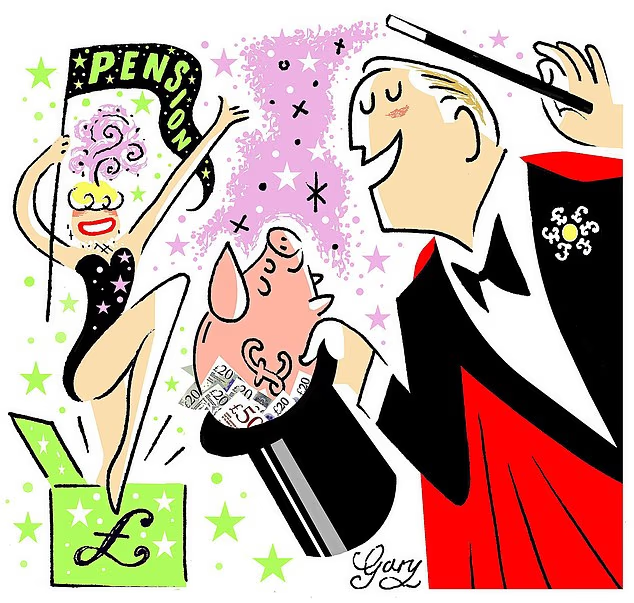
Should you save into a pension or an Isa if you want to benefit from the magic of compounding
The basics on how pensions and Isas work
When you open or add to an Isa, any money you put in will have already been taxed – likely in the form of income tax. However, withdrawals will be free of tax.
Crucially, you can withdraw money from an adult Isa at any age. That makes them very flexible and a useful way of saving separately from pensions, which they complement.
Any money you put into a pension up to 100 per cent of your earnings or £60,000 a year, whichever is lower, is tax-free (unless you are a very high earner), because pension tax relief compensates you at your usual income tax rate as it goes into your pot.
However, once it is in your pension it’s locked up until your late-50s. Once you do get access to it, you can take a 25 per cent lump sum tax-free, but all further withdrawals are subject to income tax.
Jon Greer, head of retirement policy at Quilter, says the way in which you use pensions and Isas relies on a few components. ‘The real question is what mix gives you retirement certainty, day to day flexibility and sensible legacy planning,’ he says.
He suggests different strategies (see below) depending on your age and wealth.
What about inheritance tax?
Rachel Reeves’ decision to make pensions liable for inheritance tax will now come into play when some people make savings decisions.
It is going to start being levied on unspent pensions – just like it is on other assets such as property, savings and investments – from April 2027. It is charged at 40 per cent on assets above the inheritance tax thresholds.
Do not forget you might start retirement with a large pension pot but spend most of it, so your estate might never be affected by inheritance tax. You can also leave it to your spouse free of inheritance tax and they might well run down the fund further.
You need to be worth £325,000 if you are single, or £650,000 jointly if you are married, for your loved ones to have to pay death duties.
There is a further £175,000 allowance, which increases the threshold to £500,000 or a joint £1 million if you have a partner, own a property and intend to leave money to your direct descendants.
Once an estate reaches £2 million this own home allowance starts being removed by £1 for every £2 above this threshold. It vanishes completely by £2.3 million.
There has been widespread criticism that some families will face a ‘double tax’ hit under the plans to levy inheritance tax on pensions.
Those who die after the age of 75 will see their pots hit by both inheritance tax and the income tax already levied on beneficiaries, who have to pay their normal rates of 20 per cent, 40 per cent or 45 per cent on pension withdrawals.
An Isa can provide you with a tax-free income in retirement
How to decide on a pension or Isa based on your age
Here’s how pension guru Jon Greer, of Quilter, suggests combining Isa and pension saving at every age.
Early career, 20s and 30s
GOAL: Financial flexibility and building a good retirement fund
Let’s assume you are a basic-rate taxpayer, and your employer will match your pension contributions up to 5 per cent for every 5 per cent you put into your pot.
WHAT TO DO: You should contribute at least 5 per cent to get a full match of your pension contributions – that’s an instant 100 per cent return, points out Greer. You can then split any surplus between an Isa, for the flexibility and perhaps to build a house deposit, and your pension to take advantage of the long-term growth of your savings.
‘Why not Isa instead of pension? You’d forgo the employer match contribution and upfront relief,’ says Greer. ‘The 2027 inheritance tax change is largely irrelevant here because the chance of dying with substantial unused pension is remote at this stage.’
Mid career, 40 to 55
GOAL: Building your pension, assessing if you can retire early
Here, we are assuming you are a higher-rate taxpayer wanting to stop work in your early-60s and intend to take some tax free cash.
WHAT TO DO: Maximise any matched pension contributions to gain the extra cash from your employer, and consider topping up your pension further for more higher rate pension tax relief, suggests Greer.
He also favours building an Isa to fund any gap between retirement and the minimum private pension age, which is going to rise from 55 to 57 from April 2028.
But Greer reckons you are still unlikely to be planning for a potential inheritance tax bill at this stage. He advises focusing on saving enough and working out the best order in which to access your funds – perhaps a mix of Isas first in the early years, then pensions later.
Approaching retirement, late 50s to 67
GOAL: Keeping your tax bill down when you access your pension
There are different scenarios here. The first and most common is that your pensions will be used to fund living costs, says Greer.
In this case, continue saving into your pension, especially if your employer is still matching any higher contributions you make, and use Isas for flexibility.
Greer says that, once again, the IHT changes in 2027 are unlikely to affect your plans, because you will be spending your pension across retirement.
But, say you have a good income from final salary pensions, plus a large invested defined contribution pension and sizeable Isa funds and other assets that will be liable for inheritance tax if unspent by the time you die. This is a tipping point to take account of, according to Greer.
‘Consider spending more from pensions, particularly after 75, and preserving Isas,’ he says. ‘This is counter intuitive to the pre-2027 “spend Isas first” advice.
‘Spending pensions reduces the future inheritance tax exposure within the estate. Isas remain in the estate, too, but you avoid potential double tax on an inherited defined contribution pot.’
As explained above, this is where your beneficiaries could be stung for both inheritance tax and income tax on pension withdrawals if you die after the age of 75.
Three essential things to think about
1. It’s not zero sum
It’s sensible to use both while remembering their strengths and weaknesses and how they might affect your personal financial goals, whether that is early retirement, funding a dream holiday, or leaving the biggest inheritance possible.
‘The main considerations when deciding between pension and Isa contributions are flexibility and tax,’ says Lisa Caplan, director of Charles Stanley Direct advice and guidance. ‘Fundamentally, it doesn’t have to be an either or situation. They can work well together as a winning team.’
2. Income tax brackets
Higher and additional-rate taxpayers gain more from pension tax relief while still saving because they pay more tax, but might only be paying basic-rate income tax in retirement.
‘Higher-rate taxpayers often gain more immediate benefit from pension tax relief, whereas basicrate taxpayers or those seeking flexibility may value Isas more,’ says Daniel Swift, head of financial planning at TrinityBridge.
3. Inheritance matters
Ask yourself if your estate will really be liable for inheritance tax, even once pensions are included, when you consider how your retirement fund is likely to dwindle in later life.
Even if your beneficiaries will be liable, financial experts suggest postponing mitigation tactics.
Swift says: ‘The priority should still be building sufficient assets to support the retirement you want. There is often time later in retirement to structure withdrawals and estate planning in a tax efficient way.’