

Israel has dropped out of the premier women’s tennis tournament in Bosnia in April due to “tangible” security concerns, the Israel Tennis Association announced Thursday, amid the wars with Iran and Hezbollah.
The International Tennis Federation accepted the ITA’s request to drop out, which “followed an in-depth examination of the security situation in Israel, as well as tangible concern for the players’ safety and security,” the ITA said on social media.
The decision not to compete in Bosnia took into account the threat level involved in travel to the Muslim-majority Balkan state, “which is not considered especially friendly to Israel,” as well the participation of “teams from other Muslim nations, including Egypt and Morocco,” the ITA said.
The Israeli body added that it had even considered hosting the tournament in Israel this year, but had to give up “because of the security situation.”
Ronen Morley, captain of Israel’s national tennis team, was quoted by the ITA as saying the decision to drop out of the Billie Jean King Cup was the best move “under the present circumstances” and followed “the concern expressed by the players, most of whom are very young, and the understanding that we would not be harmed professionally.”
Get The Times of Israel’s Daily Edition
by email and never miss our top stories
By signing up, you agree to the terms
“Had the trip been set for today, Israeli security authorities wouldn’t let us leave,” he said. “Our first and foremost responsibility is to keep the players safe.”
Earlier this month, Israel’s National Security issued a travel warning in light of a “concrete concern that terrorist elements are working to harm Israelis abroad,” after “several attempts” that were foiled since the US and Israel launched a bombing campaign on Iran on February 28.
The bombing campaign seeks to destabilize Iran’s regime and destroy its nuclear and ballistic missile programs.
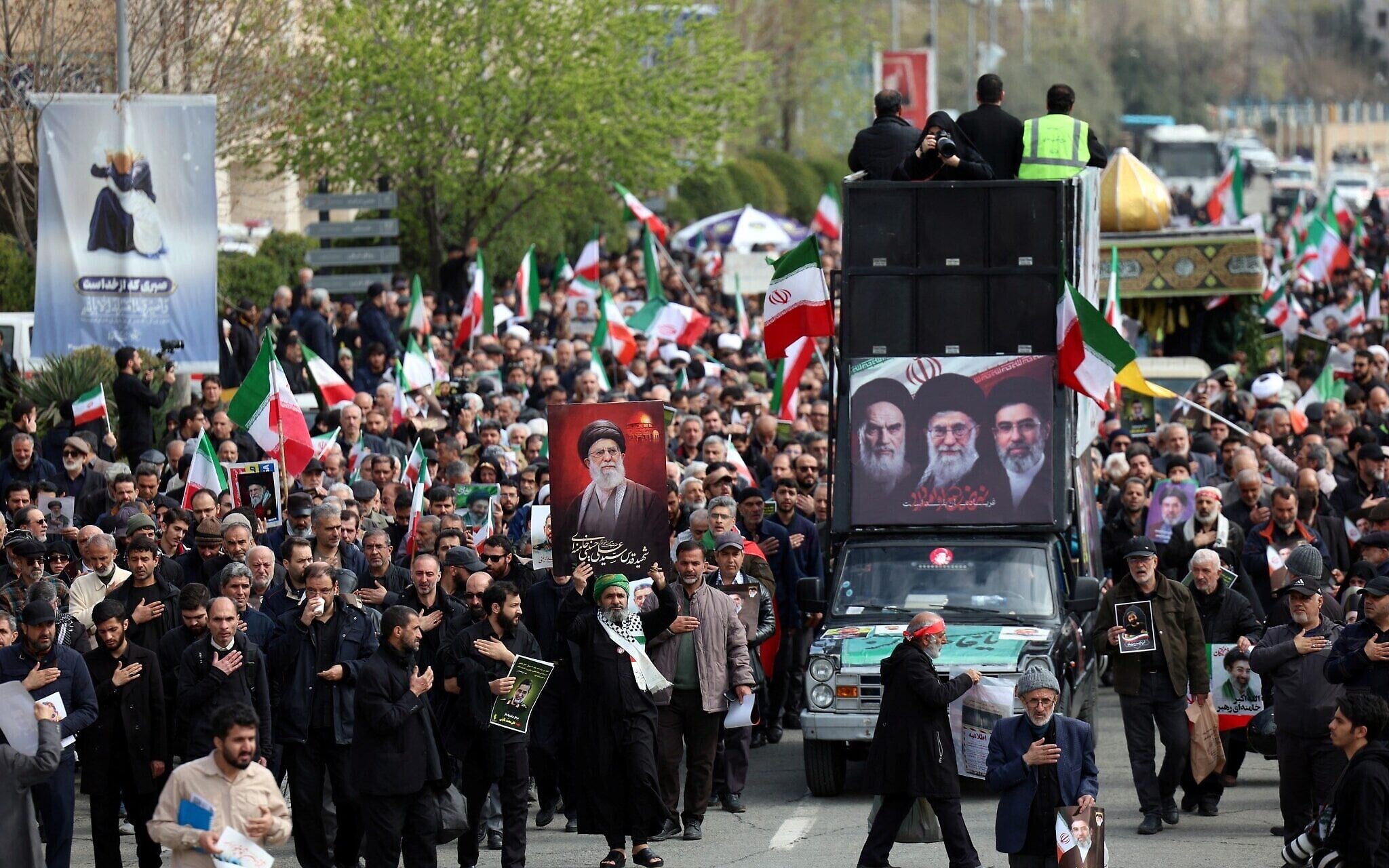
A hearse decorated with pictures of (L-R) Iranian spiritual leader Ayatollah Ruhollah Khomeini, Iran’s slain supreme leader Ayatollah Ali Khamenei and Iran’s new Supreme Leader Ayatollah Mojtaba Khamenei drives past Iranians attending the funeral ceremony of Iran’s Revolutionary Guards spokesperson Gen. Ali Mohammad Naeini, who was killed in US-Israeli strikes, in Tehran on March 21, 2026. (AFP)
Iran has responded with missile and drone strikes across the region, and the conflict has spilled over into Lebanon, where Israeli airstrikes have killed hundreds and displaced over a million after Iran-backed terror group Hezbollah renewed its attacks on Israel on March 2.
Multiple Jewish community sites abroad have been targeted in attacks linked to both Hezbollah and Iran since the start of the US-Israeli bombing campaign.
On Friday, Iran’s top military spokesman threatened that “parks, recreational areas and tourist destinations” worldwide would not be safe for enemies of the Islamic Republic.
You appreciate our wartime journalism

You clearly find our careful reporting of the Iran war valuable, at a time when facts are often distorted and news coverage often lacks context.
Your support is essential to continue our work. We want to continue delivering the professional journalism you value, even as the demands on our newsroom have grown dramatically during this ongoing conflict.
So today, please consider joining our reader support group, The Times of Israel Community. For as little as $6 a month you’ll become our partners while enjoying The Times of Israel AD-FREE, as well as accessing exclusive content available only to Times of Israel Community members.
Thank you,
David Horovitz, Founding Editor of The Times of Israel