
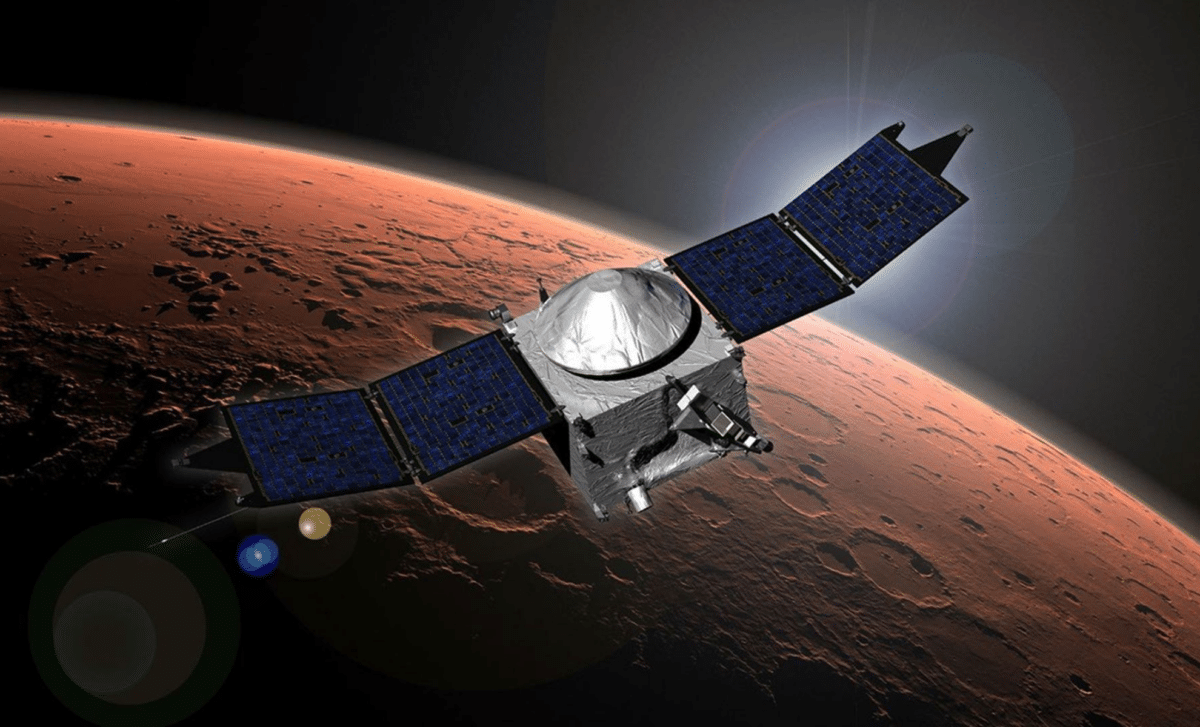
NASA’s MAVEN (Mars Atmosphere and Volatile Evolution) spacecraft, which has been exploring Mars for over a decade, is currently silent after unexpectedly losing contact in December 2025. Despite a relentless effort by the agency’s experts, MAVEN remains unreachable, with NASA’s ongoing search efforts still focused on locating the missing probe. The situation has raised questions about the future of Mars exploration and what lies ahead for spacecrafts that, like MAVEN, help unravel the mysteries of the Red Planet.
The Silent Probe: MAVEN’s Unexpected Loss
NASA’s MAVEN mission has long been a cornerstone of our understanding of Mars. Launched in 2013, it was originally designed for a one-year mission, but MAVEN defied expectations, contributing a wealth of knowledge about Mars’ atmosphere, weather systems, and its transformation into the cold, barren world we see today. Yet, after more than a decade of success, the spacecraft vanished from communication, leaving scientists and engineers in a state of uncertainty.
On December 6, 2025, MAVEN was expected to emerge from behind Mars during its orbit and send data back to Earth. Instead, it disappeared, and despite a few attempts to locate it, NASA’s efforts to re-establish contact have so far been unsuccessful. Louise Prockter, the director of NASA’s planetary science division, confirmed that while MAVEN’s situation is dire, they have not officially declared the spacecraft lost.
“We haven’t officially said MAVEN is lost yet. We’re still looking for it,” Prockter said.
The search for MAVEN has been far from simple. After the spacecraft lost contact, NASA attempted to recover the signal with the help of the Deep Space Network, and even deployed additional assets, including the National Science Foundation’s Green Bank Observatory, to track down the missing probe. In addition, NASA directed the Curiosity rover to look for MAVEN from Mars’ surface, but the search yielded no results. Despite these setbacks, Prockter remains optimistic, acknowledging the dedicated work of the team:
“I did want to take a moment just to celebrate the entire MAVEN team for all they’ve achieved, and for their absolutely heroic efforts during the recent spacecraft recovery efforts.”
MAVEN’s Vital Role in Mars Exploration
MAVEN’s contributions to Mars exploration cannot be overstated. The spacecraft has provided crucial data on how Mars lost its atmosphere and why the planet turned from a once warmer, wetter world into the dry desert we know today. The data gathered from MAVEN’s instruments has helped shape our understanding of the Martian environment and its history, which could eventually inform future missions that may even involve sending humans to the planet.
Beyond its scientific achievements, MAVEN also serves an important role in relaying communications between Earth and various Mars surface missions. About 20% of all communications between Earth and Mars are facilitated by MAVEN, including messages from rovers like Curiosity and Perseverance. This vital function of communication relay is not something that can be easily replaced, making MAVEN’s silence a significant challenge for NASA’s ongoing operations on the Red Planet.
“We know that they’re not all going to last forever,” Prockter said, reflecting on the longevity of spacecraft like MAVEN. It’s clear that NASA is already planning for the future of Mars exploration. The agency is exploring ways to maintain its Mars communications infrastructure, even considering launching a replacement for MAVEN if the spacecraft is ultimately lost.
What’s Next for Mars Exploration?
NASA’s efforts to locate MAVEN are ongoing, but the possibility of failure remains. Despite the challenges, the agency continues to focus on planning for the future. Prockter emphasized that while MAVEN’s current situation is uncertain, NASA is committed to securing the next step for Mars exploration: “The agency is thinking about what is next for Mars.” In the face of setbacks like this, space agencies always push forward, learning from the past and preparing for future missions.
NASA has already started exploring the possibility of launching a new Mars telecommunications orbiter. This new spacecraft would help fill the communications gap left by MAVEN, ensuring that surface missions like Curiosity and Perseverance can continue to relay data back to Earth. In fact, a recent budget bill allocated $700 million to fund a “high-performance Mars telecommunications orbiter,” which could become a cornerstone of NASA’s Mars mission infrastructure in the coming years. With MAVEN’s uncertain future, this new project could play a vital role in ensuring communication with future Mars missions remains uninterrupted.
NASA’s forward-thinking approach reflects the agency’s deep commitment to exploring and understanding Mars, even if that means replacing aging infrastructure and adapting to the challenges posed by deep space exploration.