
Galaxies don’t arise overnight; they develop, merge, and change over billions of years. But how does this complex and tumultuous history trail along from a single moment in time?
Astronomers have made impressive progress on that question by piecing together the biography of a galaxy very far outside our own. Using chemical ‘fingerprints’ imprinted in cosmic gas, they followed the formation and evolution of an entire distant galaxy over billions of years.
Research led by Lisa Kewley at the Center for Astrophysics | Harvard & Smithsonian, this study is the first of its kind to apply such detailed galactic archaeology outside the Milky Way. The results appeared in Nature Astronomy.
Galactic archaeology is the study of ‘fossil’ records used to study how galaxies form and evolve. That means looking at the chemical compositions, ages, and motions of stars. Historically, this strategy has focused on our own Milky Way. More recently, though, astronomers have used this methodology on another galaxy, NGC 1365, which is roughly similar to the Milky Way.
This pioneering approach opens a new field, ‘extragalactic archaeology’. It could change how scientists study the origins of galaxies across the universe.
Lisa Kewley, lead author, Harvard professor, and director of the Center for Astrophysics, said, “This is the first time that a chemical archaeology method has been used with such fine detail outside our own galaxy. We want to understand how we got here. How did our own Milky Way form, and how did we end up breathing the oxygen that we’re breathing right now?”
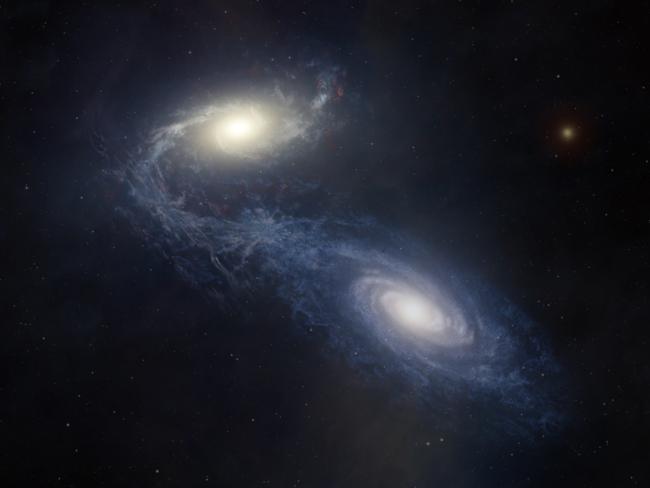
The team learned that NGC 1365 began as a small galaxy and slowly transformed into a gigantic spiral disc over the last 12 billion years. Its core formed early and became oxygen-rich, while the outer regions grew over time through repeated mergers with smaller dwarf galaxies.
These collisions helped create the galaxy’s long, sprawling spiral arms. By painstakingly measuring oxygen levels across more than 4,500 regions of NGC 1365, they have assembled one of the most complete records of chemical history ever constructed beyond our Milky Way.
Using data from the TYPHOON survey on the Irénée du Pont telescope, scientists examined the light produced by sequences of stars forming throughout our galaxy. The disk-like appearance of NGC 1365 means we have a face-on view of it from our vantage point on Earth. Because of the telescope’s sharp resolution, scientists could isolate and study individual star-making clouds within the galaxy.
Hot young stars stir nearby gas, causing elements such as oxygen to emit distinctive light signatures. By tracing these chemical patterns, the researchers followed the flow and evolution of the material itself.
Astronomers used oxygen patterns in NGC 1365 to map its growth over 12 billion years. Comparing their observations against IllustrisTNG cosmological simulations, they found that the core in this galaxy had formed early and was oxygen-rich. Mergers with dwarf galaxies over time fed gas into the outer parts and the spiral arms, forming the latter through additional mergers and material falling in.
“It’s very exciting to see our simulations matched so closely by data from another galaxy,” said Lars Hernquist, Mallinckrodt Professor of Astrophysics at Harvard and a CfA astronomer. “This study shows that the astronomical processes we model on computers are shaping galaxies like NGC 1365 over billions of years.”
It started life as a small galaxy, NGC 1365. After billions of years, the giant spiral we see today formed as it absorbed many smaller dwarf galaxies; each collision added new stars, gas, and structure to the ever-growing galaxy.
This study already shows that a galaxy’s chemical makeup can be read like a history book, documenting its formation, mergers, and evolution. It also gives a powerful new tool for determining whether galaxies like our Milky Way are typical or unusual in their growth behavior.
The tools of extragalactic archaeology may reshape the practice of astronomy, bringing observations and simulations closer together than was often the case in previous years. Using this technique on more galaxies, scientists hope to discern common patterns in galaxy formation and learn more about where the elements needed for life come from.
Journal Reference:
Kewley, L.J., Grasha, K., Garcia, A. et al. The assembly history of NGC 1365 through chemical archaeology. Nat Astron (2026). DOI: 10.1038/s41550-026-02808-7