
Main PointsThe price of diesel and petrol will fall from 12am on Wednesday after the Government decided to cut excise dutyThe Taoiseach had pledged there would be short-term measures to ease rising energy prices caused by the Iran war The cuts of 20 cent on diesel and 15 cent on petrol by 15 cent will be in place until the end of May The Israeli military says it has launched a new wave of strikes on TehranThe strikes came shortly after president Donald Trump signalled a pause in US attacks against Iranian energy infrastructure after what he said were “productive” talks with IranKey Reads
Órla Ryan – 0 minutes ago
Fuel price reductions should be passed to consumers ‘as quickly as possible’  11/01/2026 – News – Neale Richmond TD, Minister of State for International Development and Diaspora. Photograph Nick Bradshaw / The Irish Times
Neale Richmond, minister of state for international development and diaspora, has said the Government will work with fuel operators to make sure price reductions are passed on to consumers as soon as possible, Vivienne Clarke reports.
“What we are actually doing is addressing the very real cost caused by an energy crisis caused by the war in the Middle East in a manner that I would say is perhaps more ambitious than many other European countries,” Richmond told Newstalk Breakfast.
He defended the timing of the cut that will see excise duty on diesel cut by 20 cent and by 15 cent on petrol until the end of May.
“We’re introducing these measures tonight at midnight. Pretty much every other EU country is initiating them this week as well,” Richmond said.
“Now is the responsible and sensible time to introduce measures that will benefit individuals, that will benefit motorists, that will benefit the most vulnerable, but is also backdated to make sure hauliers who help make the economy and the society go round will also get that relief.”
When asked about comments by Fuels for Ireland chief executive Kevin McPartland – who said it may take up to a week for the price cut to come through at the pump because of fuel already being pre-bought – Richmond said the emergency measures will be passed at Cabinet this morning and voted on in the Dáil this afternoon.
“From a legislative and policy point of view, it’ll be effective from midnight. They were quick enough to increase the prices when the crisis happened.
“We’ll work with them to make sure it is possible. The CCPC will have powers and responsibilities to make sure that these cuts are passed on to the consumer as quickly as possible.”
Órla Ryan – 15 minutes ago
UK energy minister urges drivers not to change behaviour
The UK’s energy minister has urged motorists not to drive slower nor buy fuel differently because of the Iran oil crisis, insisting there was no need to change their behaviour.
Michael Shanks was asked by Times Radio if drivers should change their habits as a result of the oil restrictions caused by the conflict in the Middle East.
He told the broadcaster: “They should do everything as absolutely normal because there is no shortage of fuel anywhere in the country at the moment. We monitor this every single day, I look at the numbers personally. There’s no issue at all with that.”
Shanks added that people shouldn’t change their behaviour or their habits in the slightest, saying: “People should go about their business as normal… It’s really important people do that. There’s no shortage of fuel and everything is working as normal.”
In Ireland, the price of diesel and petrol will fall from 12am on Wednesday after the Government decided to cut excise duty.
– The Guardian
Órla Ryan – 34 minutes ago
15 people killed in strike in Iraq
Airstrikes targeting a site belonging to Iraq’s Shi’ite Popular Mobilization Forces in the country’s Anbar province killed at least 15 people, including the PMF’s Anbar operations commander, and injured 30 others, sources said.
The PMF confirmed the death of its Anbar commander, Saad al-Baiji, and 14 others. It accused the US of being behind the attack, saying an American airstrike targeted a command headquarters while personnel were on duty.
The PMF is an umbrella group of mostly Shi’ite paramilitary factions that was formally integrated into Iraq’s state security forces and includes several groups aligned with Iran.
Tehran-backed armed groups have launched attacks on US bases in Iraq since the outbreak of the US-Israeli war on Iran in late February, raising fears of a wider regional escalation.
– Reuters
Órla Ryan – 44 minutes ago
Negotiations may happen in Pakistan this week
Amid contradictory statements from the US and Iran about negotiations, a European official said that while there had been no direct negotiations between the two nations, Egypt, Pakistan and Gulf states were relaying messages.
A Pakistani official and a second source told Reuters that direct talks on ending the war could be held in Islamabad as soon as this week.
The Pakistani official said US vice-president JD Vance, as well as Trump’s special envoy Steve Witkoff and his son-in-law Jared Kushner, were expected to meet Iranian officials in Islamabad this week, following a call between Trump and Pakistan’s army chief Asim Munir. The White House confirmed Trump’s call with Munir. The Pakistani prime minister’s office did not immediately respond to requests for comment.
Iranian media reported that Iran’s president Masoud Pezeshkian and Pakistani prime minister Shehbaz Sharif discussed the impact of the war on regional and global security. “If the parties desire, Islamabad is always willing to host talks. It has consistently advocated for dialogue and diplomacy to promote peace and stability in the region,” Tahir Andrabi, a spokesman for Pakistan’s foreign ministry, said.
Although there was no immediate confirmation that talks had taken place as described by Trump, Iran’s foreign ministry described initiatives to reduce tensions.
It said Iran’s Foreign Minister Abbas Araqchi had reviewed developments related to the Strait of Hormuz with his Omani counterpart and agreed to continue consultations between the two countries.
– Reuters
Some photos are emerging from the earlier strikes on Beirut and Tel Aviv.
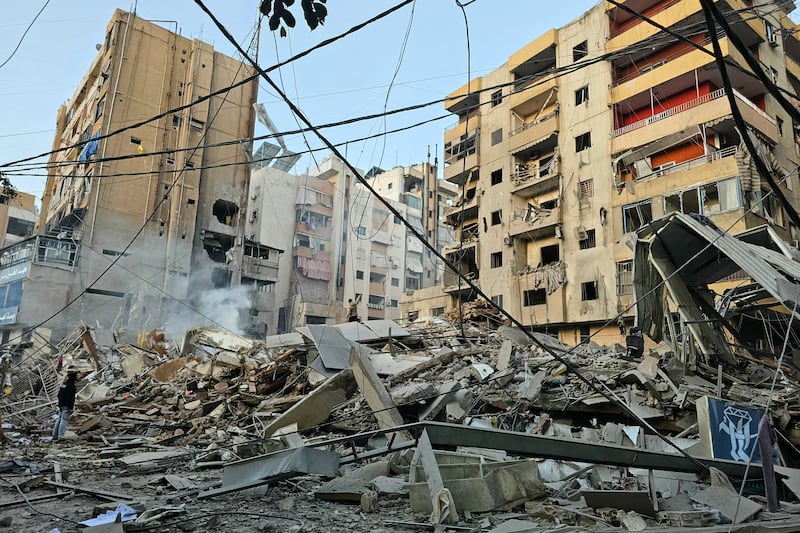 An Israeli strike south of Beirut killed two people on Tuesday, Lebanon’s health ministry said, while strikes on the capital’s southern suburbs continued throughout the night. Photograph by AFP via Getty Images
 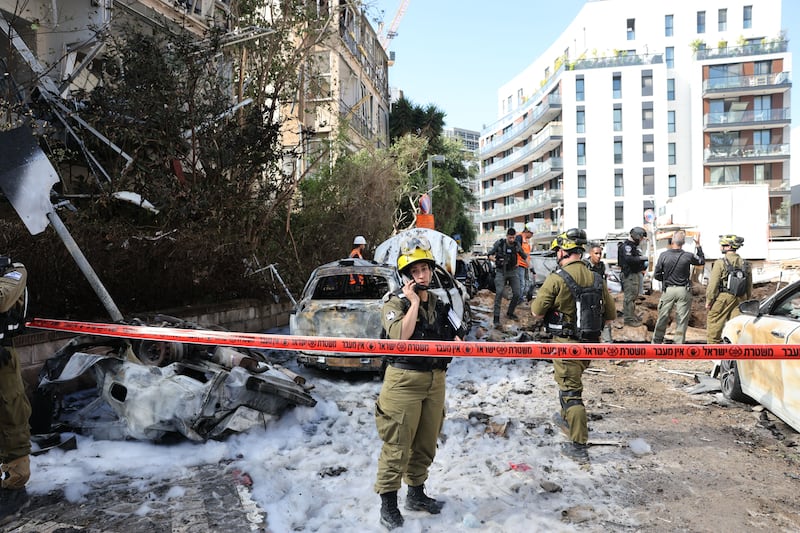 At least six people were injured in an Iranian missile attack in Tel Aviv on Tuesday, Israeli media is reporting. Photograph: Abir Sultan/European Pressphoto Agency
 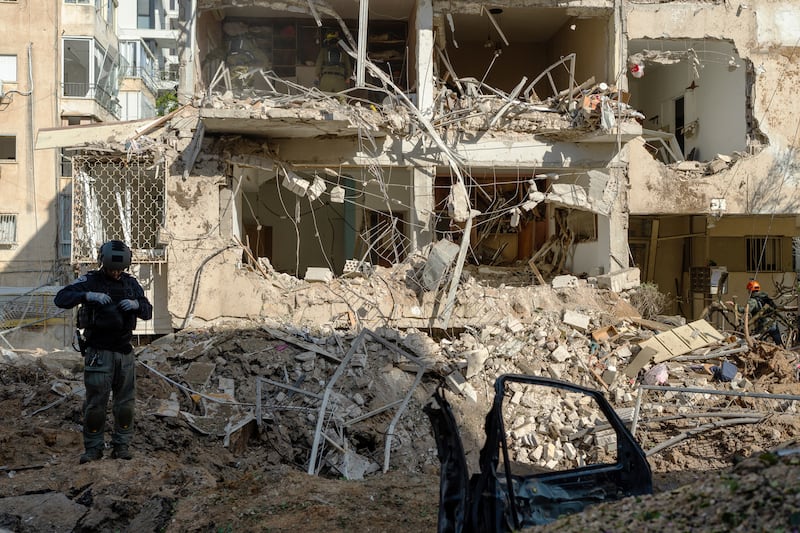 Emergency services attend the impact site of an Iranian missile on Tuesday in Tel Aviv, Israel. Photograph: Erik Marmor/Getty Images Global energy situation now ‘critical’ – von der Leyen
 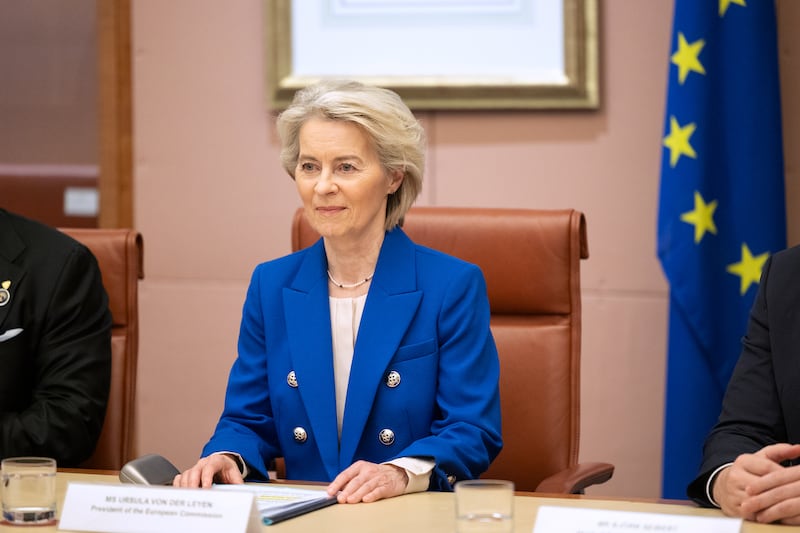 Ursula von der Leyen, pictured at Parliament House in Canberra, Australia on Tuesday, said it was “of utmost importance” that a solution is negotiated. Photograph: Hilary Wardhaugh/Bloomberg
On Tuesday, European Commission president Ursula von der Leyen said it was time for negotiations with Iran, given the global energy situation was now “critical”.
Speaking in Australia at the conclusion of a new free-trade agreement between the EU and Australia, she said: “The situation is critical for the energy supply allies worldwide. We all feel the knock-on effects on gas and oil prices, our businesses and our societies, but it is of utmost importance that we come to a solution that is negotiated, and this puts an end to the hostilities that we see in the Middle East.”
– The Guardian
High cost of using fighter planes to down cheap Iranian drones
Advanced fighter jets have been mobilised across the Gulf this month to hunt down enemies they were never designed to fight: waves of slow-moving and low-flying attack drones fired by Iran.
Fighters have been the Gulf nations’ main means of intercepting drones, analysts and western officials said. But while they have been highly effective, this round-the-clock fighter defence has come at high cost both financially and for the overworked pilots and planes.
“It is not sustainable in the long-run in any way, shape or form,” said Lauren Kahn, a former Pentagon adviser now with the Center for Security and Emerging Technologies in Washington.
The Gulf states and their allies face a stark problem: Iran’s drones are cheap, but using fighter planes to defeat them is ferociously expensive.
Read the full report here.
Price of crude oil increasing again
Oil resumed gains — paring a steep drop from Monday — amid concerns other nations may be drawn into the Middle East war.
Brent climbed toward $104 (almost €90) a barrel, after plunging by 11 per cent on Monday as US president Donald Trump delayed a threat to strike Iran’s energy infrastructure for five days, claiming there were talks with Tehran. Iran denied negotiations were taking place, while Israel kept up attacks. US crude benchmark West Texas Intermediate advanced about 4 per cent .
US allies in the Persian Gulf were inching toward contributing to the fight, the Wall Street Journal reported. Among them, Saudi Crown Prince Mohammed bin Salman is now eager to re-establish deterrence and is close to a decision to join the attacks, the newspaper said, citing people familiar with the situation.
– Bloomberg
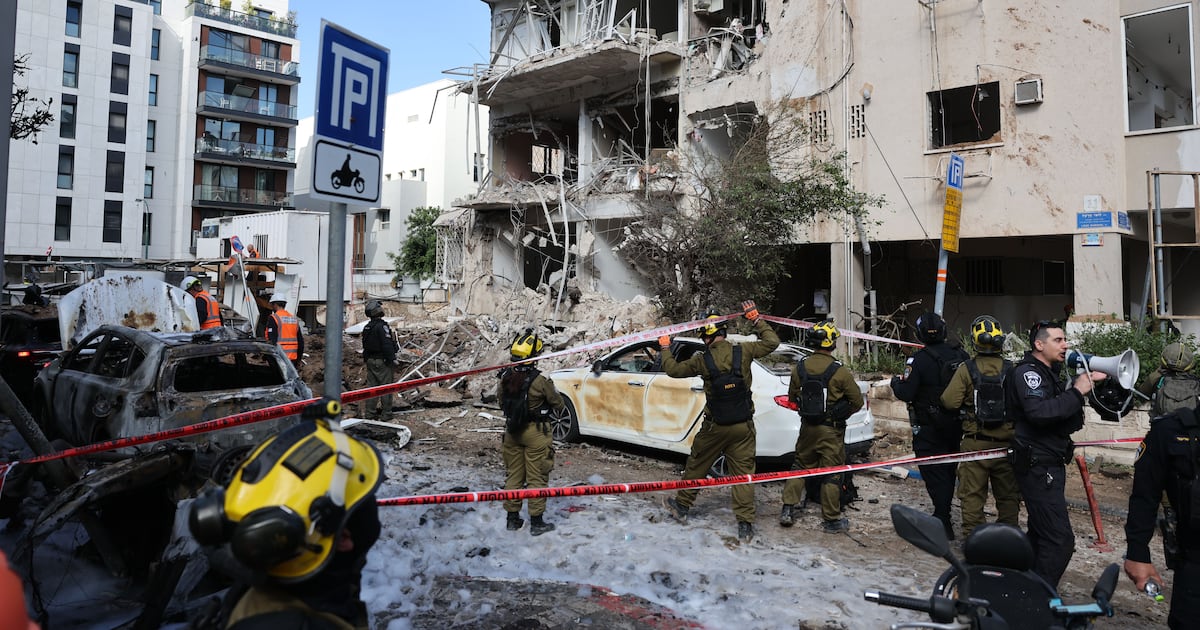
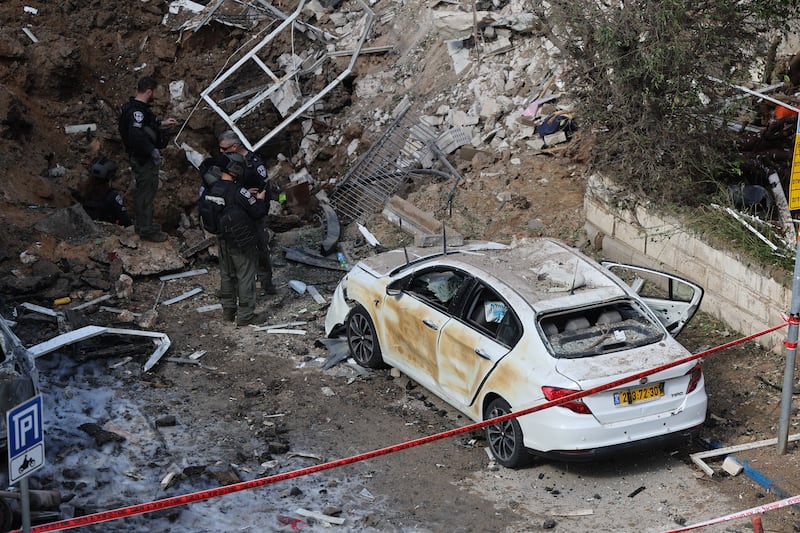 Israeli emergency service personnel gather at the site of an Iranian missile strike in Tel Aviv on Tuesday. Photo by Jack Guez/AFP via Getty Images
At least six people were injured in an Iranian missile attack in Tel Aviv on Tuesday, Israeli media is reporting. Iran earlier launched a fresh wave of missiles against Israel just hours after Donald Trump hailed “very good” talks to end the war, although Tehran denied any discussions took place.
Trump’s claim came ahead of his 48-hour deadline on Iran to reopen the Strait of Hormuz shipping lane or see the US “obliterate” its power plants.
An Israeli strike south of Beirut killed two people on Tuesday, Lebanon’s health ministry said, while strikes on the capital’s southern suburbs continued throughout the night.
– The Guardian
Iran disputes Trump’s ‘fake news’ claim of talks
Trump wrote on his Truth Social platform on Monday that the US and Iran had held “very good and productive” conversations about a “complete and total resolution of hostilities in the Middle East”.
As a result, he said, he was postponing for five days a plan to hit Iran’s energy grid. His announcement sent share prices higher and oil prices sharply lower to below $100 a barrel, a sudden reversal to a market swoon caused by his weekend threats and Iran’s vows to respond.
Those gains were in jeopardy today however, after Iran’s powerful parliament speaker Mohammad Baqer Qalibaf – who an Israeli official and two other sources familiar with the matter said was the interlocutor in the talks on the Iranian side – said no negotiations had taken place.
“No negotiations have been held with the US, and fakenews [sic] is used to manipulate the financial and oil markets and escape the quagmire in which the US and Israel are trapped,” he wrote on X.
Iran’s elite Revolutionary Guards (IRGC) said they were launching fresh attacks on US targets, and described Trump’s words as “psychological operations” that were “worn out” and having no impact on Tehran’s fight.
Global markets rallied in relief overnight Monday after Trump added five days to his Saturday ultimatum for Iran to reopen the Strait of Hormuz – a conduit for about 20 per cent of the world’s oil and liquefied natural gas – within 48 hours.
– Reuters
Iran sends waves of missiles into Israel
Iran has fired fresh multiple waves of missiles at Israel, the Israeli military said, after US president Donald Trump postponed a threat to bomb the Islamic Republic’s power grid because of what he described as productive talks with Iranian officials.
The missiles triggered air raid sirens in parts of Israel, including Tel Aviv where blasts from interceptions were heard. In one attack, homes in northern Israel were damaged by falling debris following an interception. No deaths were reported.
– Reuters
Price of diesel and petrol set to fall
The Government is set to cut the price of diesel and petrol from 12am on Wednesday.
Minister for Finance Simon Harris will bring forward proposals at Tuesday’s Cabinet meeting to cut excise duty on diesel by 20 cent and on petrol by 15 cent until the end of May.
These excise measures will take effect from 12am on Wednesday, subject to a financial resolution being passed in the Dáil.
Additionally, expected changes to the National Oil Reserve Agency (Nora) levy will mean an effective cut in Government levies of an extra 2c each on diesel and petrol. The timing of the changes to this levy have not yet been announced. The changes to the Nora levy require primary legislation, but Government sources have said that it will be pushed through the Oireachtas this week.