
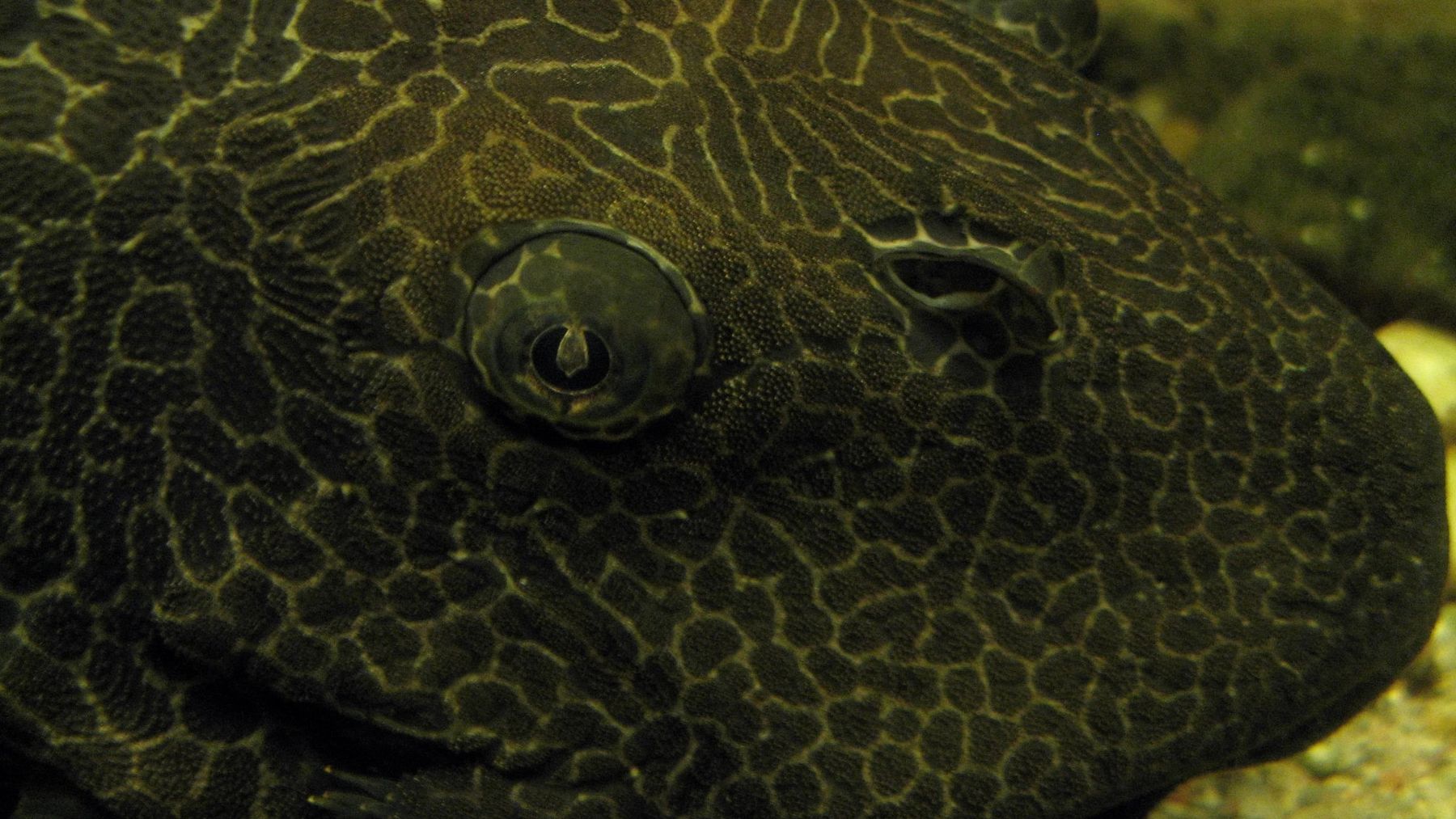
For years, it lay motionless at the bottom of murky rivers, blending perfectly into its surroundings. With thick armored skin and small watchful eyes, it waited patiently for prey—almost invisible to the untrained eye. Scientists had seen it before, or at least they thought they had. It was assumed to be just another example of a known widespread species. But something didn’t quite add up. Tiny differences began to emerge. And what researchers uncovered would completely change the story.
A Predator Hidden In Plain Sight
Deep within the rivers of Yunnan province in southern China, a powerful predator has been lurking for decades. These waterways, stretching across a region bordering Laos, Myanmar, and Vietnam, are rich in biodiversity—but also notoriously difficult to study.
Between 2004 and 2024, a team of scientists conducted long-term surveys of aquatic wildlife in these rivers. Over the course of 20 years, they encountered just over a dozen large, cryptic-looking catfish.
At first glance, nothing seemed unusual. The fish resembled members of the Bagarius genus, a group of large, bottom-dwelling predators already known in Asia.
But these individuals had something different about them. Their appearance didn’t fully match existing descriptions. The differences were subtle—but consistent.
And in science, that’s often where the biggest discoveries begin.
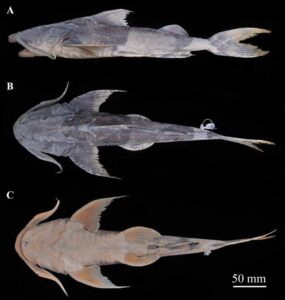 A preserved Bagarius protos, or protos catfish. Photos from Shu-Sen Shu via Zeng, Pu, Lei, Oo and Chen (2025)
The Clues That Changed Everything
The deeper researchers looked, the more the mystery grew. Careful examination revealed distinct physical traits that set these fish apart.
They had a wide head, a long snout, and unusually small eyes. Their bodies were covered in thick, hardened skin with bumps of various sizes, giving them a rugged, almost prehistoric appearance.
Coloration also stood out. The fish displayed a pale yellow body covered in gray dots and faint band-like markings—a pattern not fully consistent with known relatives.
But the real breakthrough came through genetic testing. DNA analysis revealed at least 8% genetic divergence from closely related species—strong evidence that this was not just a variation, but something entirely new.
What had been hiding in plain sight for years was, in fact, a previously unknown species.
A Giant Of The River With A Mysterious Life
What makes this discovery even more fascinating is the sheer size of the animal. The specimens collected by scientists measured around 19 inches (about 48 cm) in length—but local reports tell a much bigger story.
According to people living in the region, some of these fish can reach or even exceed 220 pounds (100 kilograms). That makes it one of the most impressive freshwater predators in the region.
Like its relatives, this fish is a bottom-dwelling ambush predator, spending most of its time resting on the riverbed. It likely feeds on other fish and aquatic animals, using patience rather than speed to hunt.
Interestingly, it was once considered a high-value food fish. Local fishing methods involved using a thick nylon rope tied to a boulder, leaving bait overnight and retrieving the catch the next day.
Despite its size and presence, much about its behavior, ecology, and life cycle remains unknown—adding even more intrigue to the discovery.
The Moment Scientists Realized The Truth
After years of observation, analysis, and comparison, researchers reached a conclusion they hadn’t expected when they first began their surveys.
They had discovered a completely new species: Bagarius protos, also known as the protos catfish.
The name “protos” comes from the Greek word for “original”, reflecting its position as the most primitive lineagewithin the Bagarius family tree. In evolutionary terms, this species may represent one of the earliest branches of its group.
So far, the protos catfish has been identified in several rivers across Yunnan province, but scientists believe it may also exist in neighboring countries like Myanmar and Thailand.
Even more remarkably, the same research team identified another new Bagarius species in Myanmar, highlighting just how much biodiversity in these river systems remains undiscovered.
In a world where we often assume everything has already been found, this discovery is a powerful reminder: even massive predators weighing over 220 pounds can remain hidden in plain sight. And sometimes, the biggest scientific breakthroughs are waiting right beneath the surface.