
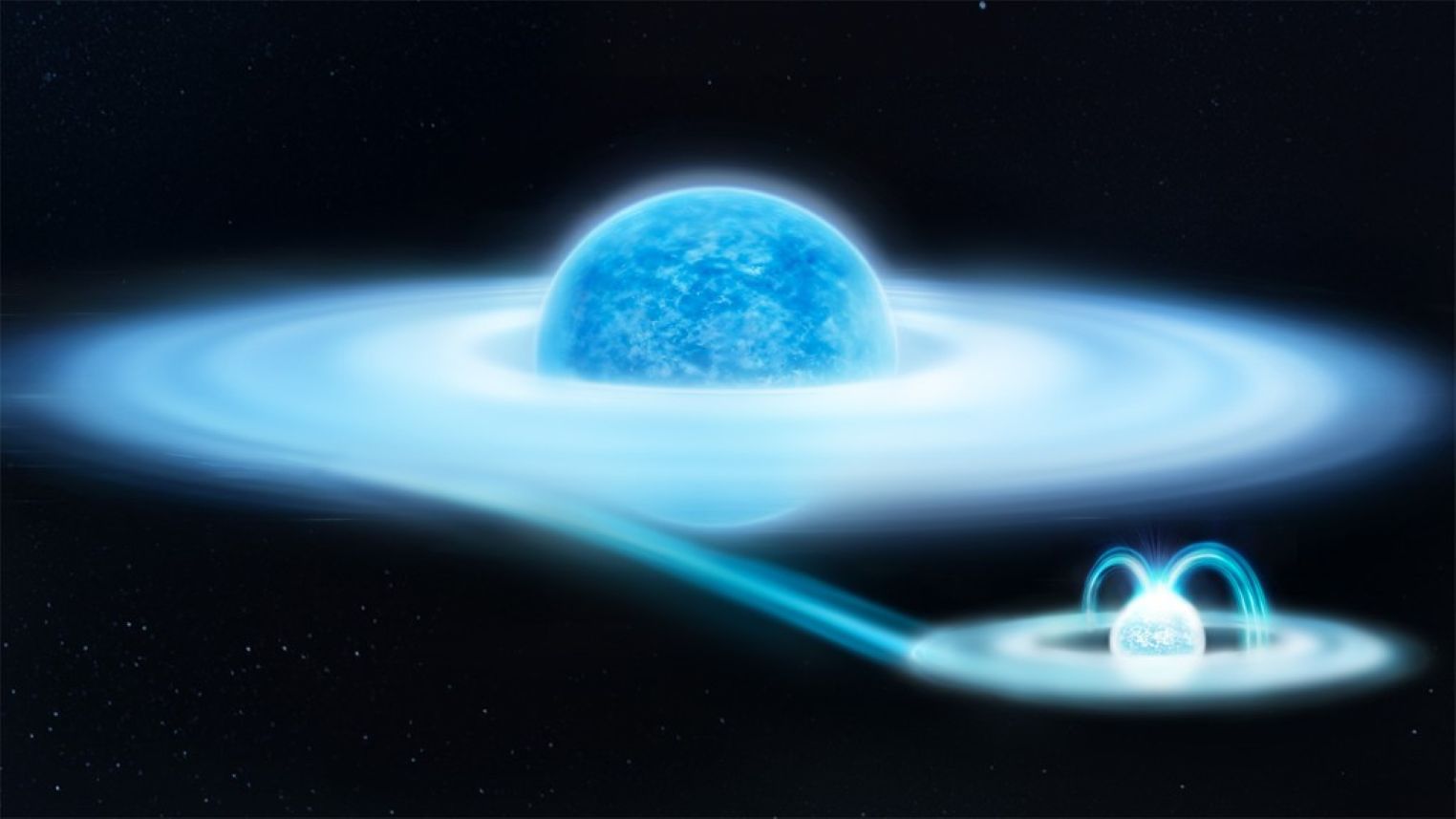
Stars shine not only in light but in X‑rays. For the biggest ones, over ten times the Sun’s mass, this comes from turbulent winds blasted out by their intense radiation. These unstable winds crash into one another, creating shocks that heat the gas and spark high‑energy emission.
But massive stars rarely live alone. They often have companions, and in these stellar duets, one star can strip material from the other, reshaping their fates. Such interactions are now seen as the main way Be stars, rapidly spinning stars wrapped in glowing discs, are born.
These rapidly spinning stars wear glowing discs, fed by bursts of stellar material. Their “e” label comes from the bright emission lines these discs produce. Because they’re born from binary interactions, Be stars are key testbeds for understanding how stars evolve in pairs.
One famous example, γ Cassiopeiae, shines with unusually intense X‑rays that puzzled astronomers for decades. Thanks to Japan’s XRISM telescope, scientists now traced this power to a hidden white dwarf companion. This discovery confirms a long‑predicted family of binary systems, stars whose extreme behavior is driven not by solitude, but by partnership.
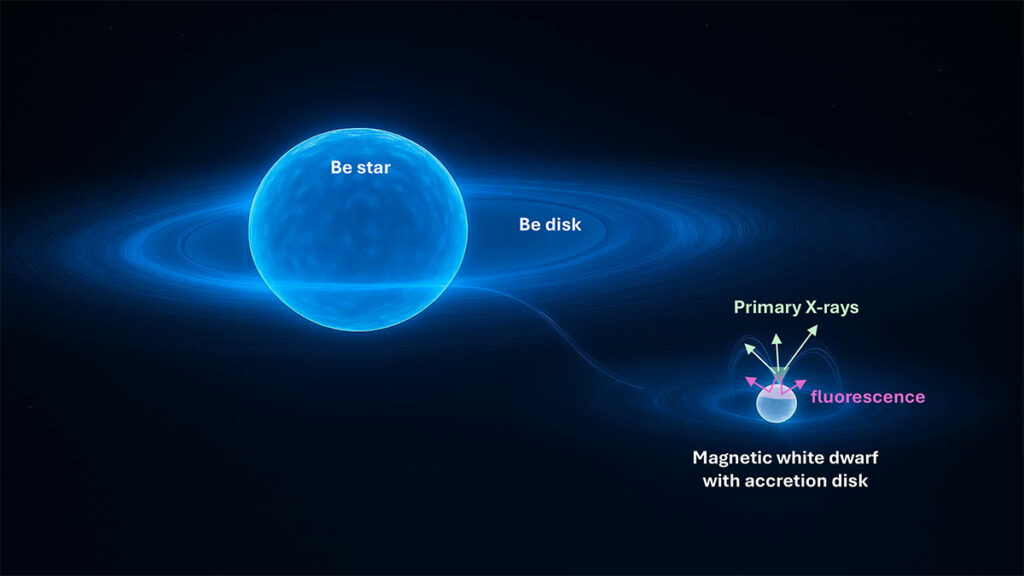 Gamma Cas consists of a Be-type star surrounded by a disk of material; some of this material flows toward the companion; a second disk forms around the companion, and the material eventually flows toward the poles, where it emits X-rays (green arrows). Some of these X-rays are reflected by the surface of the white dwarf (purple arrows). | © Université de Liège / Y.Nazé
γ Cassiopeiae was the first Be star identified, and in 1976 it stunned astronomers with X‑rays forty times brighter than expected, plasma hotter than 100 million degrees, and rapid flickering. Long‑term monitoring later uncovered about twenty more stars with the same extreme traits, now known as γ Cas analogues.
As Yaël Nazé of the University of Liège explains, scientists debated whether these X‑rays came from magnetic clashes between the star and its disc, or from hidden companions like stripped stars, neutron stars, or accreting white dwarfs.
For years, astronomers had wondered why γ Cassiopeiae was shining with X‑rays so much hotter and brighter than those of any ordinary massive star. Using Japan’s XRISM telescope and its ultra‑precise Resolve instrument, scientists monitored the system over 203 days as it orbited.
The spectra showed that the velocity shifts of the hot plasma matched those from a hidden white dwarf companion, not the Be star itself. This is the first direct evidence that the intense X-rays come from the compact partner. It settles a long-standing debate and confirms the existence of a new class of binary systems.
Hubble captures the ghost of Cassiopeia
Data showed that the X-ray gas around γ Cassiopeiae is pulled toward its hidden white dwarf, not toward the Be star. The narrow velocity signatures rule out a non‑magnetic dwarf and instead point to a magnetic white dwarf, whose field funnels material onto its poles, lighting up the system with extreme X‑rays.
This discovery conclusively recognizes γ Cas and its analogues as Be + white dwarf binaries, a long-predicted but elusive population. This group has been predicted for a long time, but has been hard to find. Surprisingly, it mostly includes massive Be stars, around 10% of them, while theories suggested there would be more low-mass stars.
“This discrepancy suggests a revision of binary evolution models, particularly regarding the efficiency of mass transfer between components, a conclusion that aligns with that of several recent independent studies. Solving this mystery, therefore, opens up new avenues of research for the years to come!”
“Understanding the evolution of binary systems is crucial for comprehending, for example, gravitational waves, as it is indeed massive binaries that emit them at the end of their lives,” concluded Yaël Nazé.
Journal Reference:
Yaël Nazé, Masahiro Tsujimoto, Gregor Rauw, and Sean Gunderson. Orbital motion detected in γ Cas Fe K emission lines. Astronomy and Astrophysics. DOI: 10.1051/0004-6361/202558284