
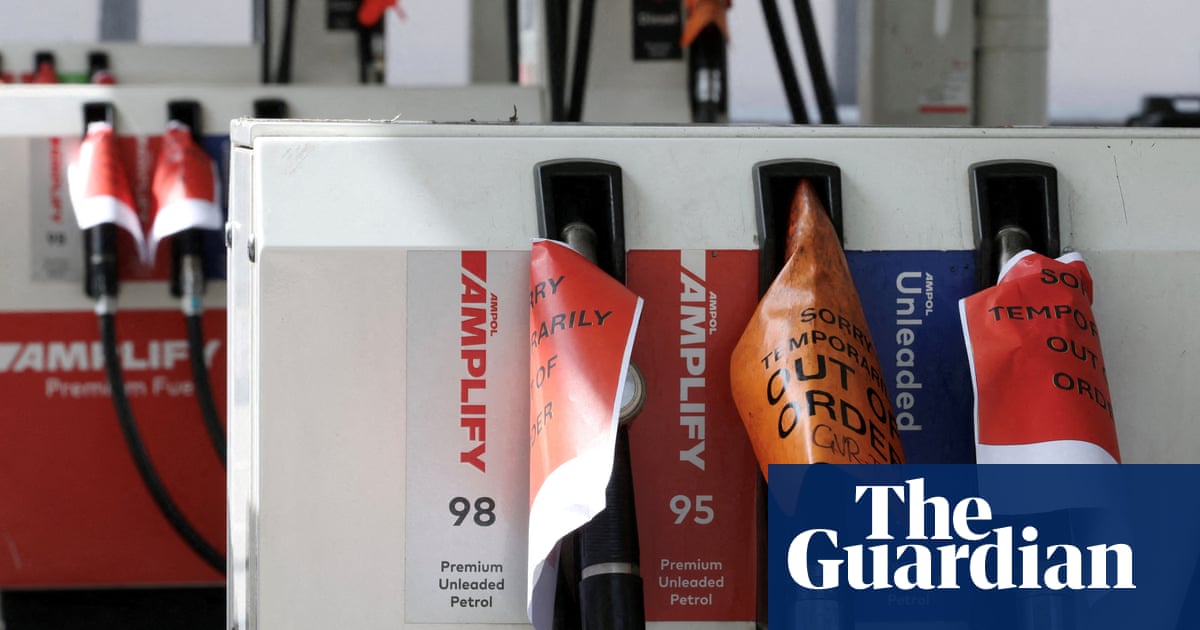
The federal government will consider an increase in ethanol levels in fuel to boost fuel supplies as farmers warn food prices will soon jump amid threats of economy-wide shocks from the oil crisis.
Guardian Australia can reveal ministers are now considering increasing ethanol levels in fuel to boost petrol supplies and avert potential shortages – a move backed by the NRMA.
It comes as smaller miners have already started scaling back operations.
The fuel supply and price crisis sparked by the ongoing Middle East war is being felt across the economy, hurting consumers and escalating the political pressure on the Albanese government.
The treasurer, Jim Chalmers, told business chiefs on Tuesday night that the end of the war “can’t come soon enough” for the Australian economy.
“We are well placed and well prepared, but we will be buffeted,” Chalmers told a Business Council of Australia dinner.
The National Farmers’ Federation president, Hamish McIntyre, said food prices could “get very serious” for customers over the next month due to the surging cost of production.
“We’ll be passing that on. We have to, in order to remain viable,” McIntyre told Guardian Australia.
“It’s really going to drive inflation in Australia, and interest rates, which hurts everyone in Australia, but including farmers.”
The energy minister, Chris Bowen, on Tuesday announced a six-month loosening of diesel standards that will allow Australia to source supplies from more markets, including the US, Canada and the EU.
Soaring diesel prices and supply constraints are already hitting several sectors of the economy, including the mining industry, which consumed about 35% of diesel used in Australia in 2023-2024.
While large miners are shielded at this stage, industry leaders confirmed that some smaller companies that rely on independent fuel distributors were scaling back operations due to supply shortages.
“While no disruptions to major member operations have occurred, shortages in some regional areas are placing pressure on explorers and smaller operators,” Aaron Morey, the chief executive of the Chamber of Minerals and Energy WA, said.
“Some smaller mining operations have already reduced non-essential activities to manage fuel supply. Any further constraints will increasingly come at the expense of day-to-day operations, with flow-on impacts for jobs and taxation revenue.”
The Association of Mining and Exploration Companies chief executive, Warren Pearce, called on governments to put pressure on major fuel wholesalers to ensure supplies flowed to the smaller distributors.
Miners want to be considered an essential service if the crisis worsens and fuel rationing is implemented, guaranteeing the sector can keep operating as it did during the Covid-19 pandemic.
“Western Australia’s resources sector is the engine room of the national economy – and that engine cannot function without diesel and jet fuel,” Morey said.
The resources minister, Madeleine King, would not be drawn on the prospect of fuel rationing but stressed that “Australia’s very well supplied right now with fuel”.
Peter Khoury, spokesperson for the NRMA, said state and federal governments could be encouraging motorists to use E10 fuels, and backed even higher ethanol concentration – noting E15 fuel was sold in the US and countries such as Japan and India were considering E20.
In a statement to Guardian Australia, a spokesperson for Bowen confirmed his department and the fuel standards body were examining whether increased ethanol levels could help bolster fuel supplies without compromising safety.
Australian producers make ethanol from either wheat starch or molasses sugar, with ethanol blended into refined petroleum.
Proponents argue it is a more renewable source that helps existing petrol stocks stretch further. Only New South Wales and Queensland have mandated the use of E10 in their fuel supplies, but ethanol producers have suggested other states follow suit.
“Australia isn’t Christopher Columbus here, a number of countries are looking to increase the amount of ethanol they use,” Khoury said.
“It’s an undersold fuel, people haven’t been using it who could be… Encouraging people to use it as an option is something we can do in the short term. Ramping up production is a longer term strategy, and there’s clearly merit in doing that in Australia.”
Nationals senator, Bridget McKenzie, said states without an ethanol mandate could consider such a move, in pursuit of unlocking extra petrol supply; shadow energy minister Dan Tehan said all options should be on the table.
Shahana McKenzie, CEO of Bioenergy Australia, said even existing mandates were not being strictly adhered to, claiming petrol sold as E10 could have a far lower ethanol concentration. She said a national mandate, even applied temporarily, could boost the ethanol industry to stretch fuel supplies further.
“A situation like this is a good time for reflecting on how resilient we’re operating in our fuel system. In Australia we’re not operating at capacity on any of our refining, either ethanol or biodiesel,” McKenzie said.