
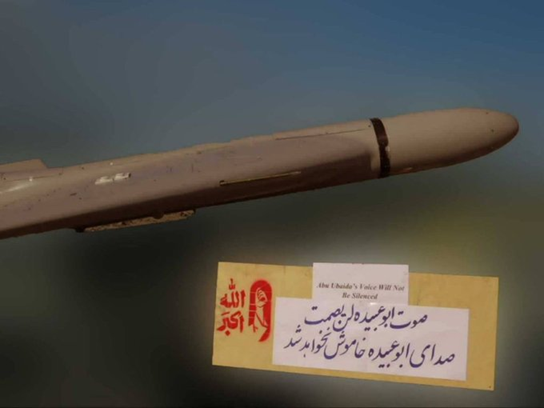
 An Iranian UAV with caption “The voice of Abu Obeida will not be silenced” (X account of Iran News in Arabic, March 20, 2026)
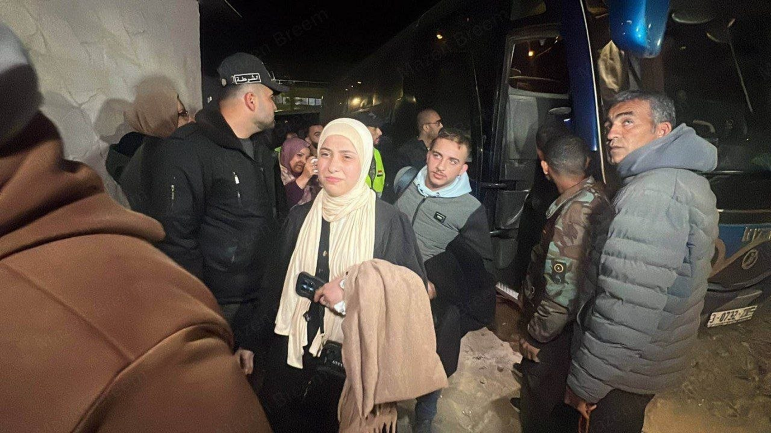 Palestinians return through the Rafah Crossing (Palestinian Media Center, March 20, 2026)
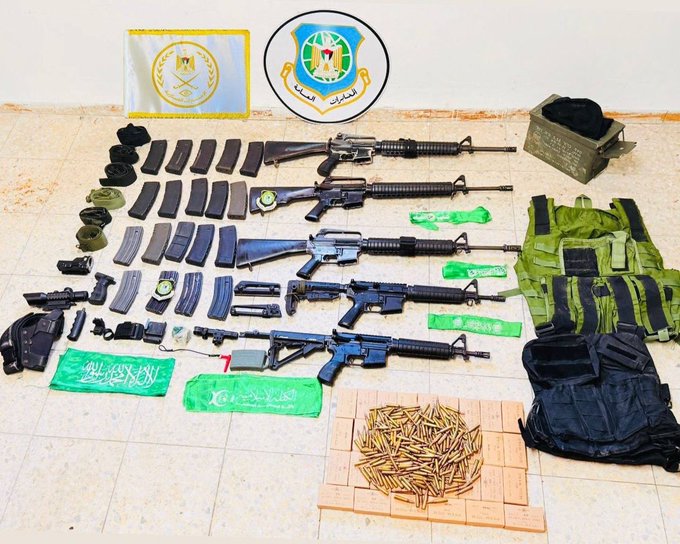 Confiscated weapons (X account of QudsN, March 17, 2026)
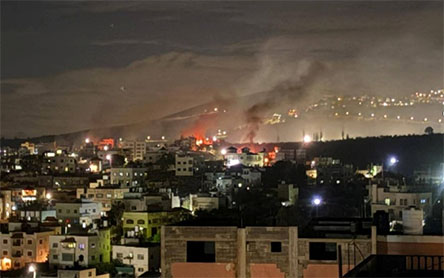
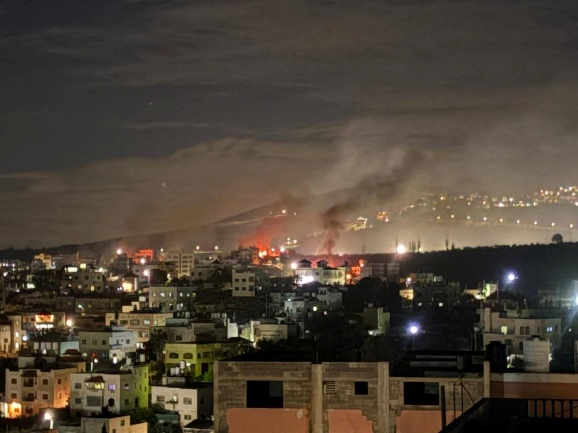 Burning houses and vehicles in Deir al-Hatab (Ramallah News Facebook page, March 22, 2026)
The spokesperson for the Hamas military wing praised the Iranian missile attacks on Israel, while the Palestinian Islamic Jihad (PIJ) tried to downplay the significance of reports about an Israeli attempt to target its senior figures in Tehran.
Despite the deadlock in implementing the second phase of the ceasefire agreement in the Gaza Strip, the mediators continue to try to persuade Hamas to disarm. The movement still refuses complete disarmament and is waiting for the end of the war in Iran.
IDF forces continued operating within the Yellow Line in the Gaza Strip to locate terrorists and destroy weapons and terrorist infrastructure and assets, and eliminated Hamas and PIJ terrorist commanders.
The Rafah Crossing was reopened for the passage of Gazans. Despite the entry of humanitarian aid, Hamas continued to promote its “hunger” propaganda.
Hamas continued to exploit the delay in implementing the second phase of the ceasefire agreement to tighten civilian and “security” governance in areas under its control.
According to reports, because of “regional developments” Hamas will postpone the election for head of its political bureau to the end of the year.
The vehicular ramming incident in which an 18-year-old Israeli was killed near Homesh is being investigated as a terrorist attack. Four residents of Umm al-Fahm were detained on suspicion of planning to carry out shooting attacks.
This past week attacks by Jewish settlers on Palestinians in Judea and Samaria escalated.
Bassem Na’im, a member of the Hamas political bureau and head of its office for Arab and Islamic relations, spoke on the phone with the Iranian foreign minister, Abbas Araghchi. Na’im offered the condolences of the Hamas leadership and the Palestinian people for the death of Iran’s leader, Ali Khamenei, and other members of the Iranian leadership. He congratulated the Iranian government and people on selecting Ayatollah Mojtaba Khamenei as the new Iranian supreme leader and condemned the “American and Zionist military aggression” against Iran, noting Iran’s right to “defend itself.” Araghchi thanked Hamas for its condolences and solidarity and stated Iran’s position to continue its “comprehensive defense of the homeland” (Arabic X account of the Iranian foreign ministry, March 18, 2026).
Abu Obeida, spokesman for the Hamas military wing, praised the Iranian missile attacks on Israel, calling them a “natural response,” not only to the “Zionist-American attack” on Iran but also to the killing of Gazans. He claimed Israel understood only force, and only by exacting a heavy price would it be possible to stop its “aggression.” He further claimed that Iran was currently a forward line of defense for the entire Islamic nation and called on the peoples of the region to unite against the “real enemy” and act together for the nation’s most important issues, especially the “liberation of Palestine” (Telegram channel of Abu Obeida, March 21, 2026).
An Iranian UAV with caption “The voice of Abu Obeida will not be silenced”
(X account of Iran News in Arabic, March 20, 2026)
A source in the PIJ tried to minimize the significance of reports in Israel about an attempted attack in Tehran which targeted the PIJ deputy secretary general Muhammad al-Hindi, Akram al-Ajouri, in charge of the organization’s military wing, and other operatives. He claimed it was unlikely that al-Hindi was at the site of the attack or in Iran at all. A source in the PIJ admitted that there had been no contact with al-Ajouri since the beginning of the war in Iran, while another source claimed that al-Ajouri had recently been in contact “electronically,” but no one knew where he was. Sources said that shortly before the war began in Iran al-Ajouri had requested to leave Lebanon, but several Arab and Islamic countries had refused to accept him, despite attempts at persuasion by PIJ secretary general Ziad al-Nakhalah. In their assessment he may be in Iran (al-Sharq al-Awsat, March 17, 2026).
Hamas sources reported that Qatar recently took measures against several well-known Hamas figures because of their positions supporting the Iranian attacks (al-Sharq al-Awsat, March 22, 2026).
The foreign minister of the UAE, Abdallah bin Zayed al-Nahyan, called the deputy chairman of the Palestinian Authority, Hussein al-Sheikh, to condemn the Iranian attack which killed four Palestinian women who were in a beauty salon in the village of Beit Awa (Sama Telegram channel, March 19, 2026).
Despite the deadlock in negotiations for implementing the second phase, efforts continued to persuade Hamas to disarm in accordance with the terms of the agreement:
A source close to Hamas stated that the issue of disarming the movement was raised in one of the discussions held by a Hamas delegation in Cairo with senior Egyptian intelligence officials and with the high commissioner of the Board of Peace, Nikolay Mladenov. However, a decision was postponed until the deployment of the Palestinian police and the international stabilization force in the Strip. A source from the committee for managing the Strip said the committee had not met with the Hamas delegation (al-Sharq al-Awsat, March 17, 2026).
An American official stated that the mediators had presented Hamas representatives in Cairo with a formal proposal calling on the movement and the other armed [terrorist] organizations in the Gaza Strip to lay down their arms. Another official who had been briefed on the proposal described it as a comprehensive framework to ensure full handover and complete disarmament, and noted that if Hamas accepted the proposal, it would ensure large-scale reconstruction of the Strip. He said Hamas “had been asked” to respond to the proposal within a week, after Eid al-Fitr. A senior Hamas figure said a written document had been received and he criticized it as a take it or leave it proposal. He said that Hamas would first wait to see the results of the war in Iran before responding (United States public radio website, March 19, 2026).
Two sources confirmed that the Board of Peace had conveyed a written proposal to Hamas for disarmament during the meetings in Cairo. Mladenov said all the mediators had agreed on a working framework which could advance reconstruction, and it was now on the table. He said it required only one thing, full disarmament by Hamas and all “armed groups,”[2] without exception. According to American officials, Hamas could be offered amnesty as part of an agreement in which it agreed to lay down all its heavy and light weapons, including rifles. However, in the assessment of sources close to Hamas, the movement will refuse to give up rifles, fearing attacks from rival armed groups inside the Strip, some of which are supported by Israel (Reuters, March 21, 2026).
Sources from Hamas and the other Palestinian terrorist organizations stated that Hamas leader “abroad,” Khaled Mashal, had been in contact with other operatives in the movement and the other [terrorist] organizations in the Gaza Strip in an attempt to formulate a unified Palestinian position on the issue of the weapons of the “resistance.”[3] A source from one of the organizations in Gaza said several senior organization figures claimed they no longer had “heavy weapons as Israel classifies them,” such as long- or even short-range rockets, only “very basic means,” such as a small number of anti-tank missiles, explosive devices, small arms and machine guns. According to the source, Mashal was told that the “resistance” was prepared to transfer the pickup trucks with machine guns, but would retain its small arms with mediators’ guarantees. The sources alleged that “most of the tunnels in the Strip had been almost completely destroyed” by Israel. They further said the organizations would not agree to unilateral, enforced disarmament (al-Sharq al-Awsat, March 19, 2026).
Due to the regional escalation and uncertainty, Indonesia announced that it would suspend the deployment of its forces to the Gaza Strip as part of the planned international stabilization force, after it had planned to gradually send 8,000 soldiers (Indonesian News Agency in English, March 18, 2026).
IDF forces inside the Yellow Line in the Gaza Strip continued locating terrorists and destroying weapons, tunnels and terrorist infrastructure and assets. Terrorist operatives who were involved in the October 7, 2023 attack and massacre and in planning new attacks on IDF forces and the State of Israel were eliminated, including the head of military intelligence in the Khan Yunis Brigade, the commander of the northern Gaza Brigade in Hamas’ naval array and operatives in the naval wing who planned to attack from the sea, a Hamas operative who dealt with the procurement and transfer of weapons and a commander in the PIJ’s military wing (IDF spokesperson, March 17-24, 2026).
Local sources and eyewitnesses reported that the IDF was digging a deep trench, which according to them created a new border in the Strip. According to the report, the trench is six meters deep and ten meters wide, and begins in the area east of Deir al-Balah, extends northward to the outskirts of the Netzarim corridor, and southward toward the northern part of the city of Khan Yunis (al-Ayyam, March 19, 2026).
Hamas spokesperson Hazem Qassem alleged that Israel had increased its attacks in the Gaza Strip during Eid al-Fitr with “continuous killing” throughout the Strip. He claimed it was a blatant violation of the ceasefire agreement and disregard for the feelings of Muslims around the globe. He further claimed that Israel was exploiting the global media preoccupation with the war in Iran to continue killing Gazans (Telegram channel of Hazem Qassem, March 22, 2026).
The Situation in the Gaza Strip
The Rafah Crossing was reopened for limited movement for the first time since the beginning of the war in Iran. The Crossing reportedly operates in both directions and allows Gazan patients to leave for Egypt for medical treatment, and Gazans who were stranded outside the Strip to return in coordination with Egypt, subject to Israeli security approval and under the supervision of the European Union mission. Passengers entering the Strip are required to undergo additional screening in an area controlled by the IDF (al-Sharq al-Awsat, March 19, 2026). Subsequently, the European monitoring mission announced it was suspending its activity in protest over the detention of a Gazan by Israel upon his return to the Gaza Strip, claiming it was a clear violation of the agreements regulating the operation of the Crossing. According to the report, contacts are being held between the sides to secure the detained Gazan’s release and prevent recurrences (Quds, March 23, 2026).
Palestinians return through the Rafah Crossing (Palestinian Media Center, March 20, 2026)
Despite the entry of humanitarian aid, Hamas continues to spread its “hunger” propaganda. The local network of civil organizations warned of a threat of “famine” in light of a decline in the volume of aid entering the Strip. According to the network, only about 200 aid trucks enter the Strip daily, whereas at least one thousand trucks per day are allegedly necessary to meet the needs. It was further alleged that there were restrictions on the entry of essential products such as food, proteins, tents and cleaning materials (Gaza Now, March 19, 2026).
While claiming an alleged “risk of hunger,” the Hamas ministry of national economy announced there had been a significant improvement in the flow of frozen meat through the border crossings. Accordingly, at the end of the month of Ramadan it announced the cancellation of the quota system for such goods, in order to ease access to basic products and promote their flow without restrictions, in a way which would contribute to balance and stability in the markets (Facebook page of the Hamas ministry of national economy, March 19, 2026).
The outgoing UNRWA commissioner general, Philippe Lazzarini, claimed that the agency could soon cease to exist, given its severe funding crisis, the ongoing damage to its activity and the absence of a permanent replacement before his departure at the end of March 2026. In a letter to the president of the UN General Assembly, he claimed that the collapse of UNRWA would have severe consequences for Palestinian refugees and regional stability, and could even require Israel to assume humanitarian responsibility for the Gaza Strip and the “occupied territories” (Reuters, March 20, 2026).
Gazans marked the first Eid al-Fitr without war after two years, as the effects of destruction, loss and hardship remained present and overshadowed the holiday atmosphere. Holiday prayers were held in squares and near tents of displaced persons due to the destruction of mosques. Some Gazans did not visit relatives and had to make do with phone calls because of the severe transportation crisis and extensive destruction of vehicles, with most transportation reportedly carried out by animal-drawn carts. The economic crisis and shortage of funds also prevented many families from giving holiday gifts to children (al-Sharq al-Awsat, March 21, 2026).
Hamas Governance
Hamas continued to exploit the deadlock in implementing the second phase of the ceasefire agreement to tighten “security” control and civilian governance in the areas under its control. Hamas police and representatives of the Hamas ministry of national economy patrolled markets and shops to monitor price increases an “irregular conduct” by merchants, the security forces acted against those marked as “collaborators” and members of militias supported by Israel, while armed operatives of Hamas’ military wing appeared publicly and distributed pastries and candy in honor of Eid al-Fitr.[4]
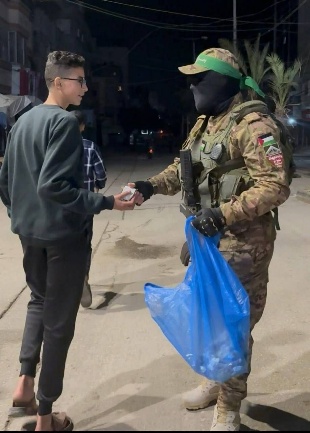
An operative of Hamas’ military wing distributes pastries
(Telegram channel Murasel Kataeb al-Qassam, March 21, 2026)
According to reports, Talal Badawi, commander of the police station in the al-Zeitoun neighborhood, of Gaza City, was shot by unidentified individuals riding a motorcycle and was killed or critically wounded (Telegram channel of journalist Saed al-Za’anin, March 17, 2026; al-Mowaten website, March 17, 2026). The Popular Defense Forces in the al-Shuja’iyya area (the militia of Rami Hallas, which operates in the area) claimed responsibility and stated that one of its units had attacked the Hamas military security operative, Talal Mustafa Saleh Badawi (Facebook page of the Popular Defense Forces, March 17, 2026).
The Khan Yunis municipality carried out a maintenance and infrastructure project to improve the operational efficiency of water wells around the al-Rahma reservoir, which serves as a central water source for large areas in the city. Electricity networks were expanded over 1,200 meters to connect the wells to a single central power source. According to the head of the municipality’s maintenance and operations department, the objective of the project was to ensure the continuity of the wells’ operation, improve monitoring and operational capability, and reduce shutdowns caused by malfunctions or fuel shortages in separate generators (al-Risalah, March 17, 2026).
A Hamas delegation headed by Nizar Awadallah, a member of the political bureau and the movement’s leadership council, met in Istanbul with the head of Turkish intelligence, Ibrahim Kalin. They discussed developments in the Palestinian arena, primarily the fighting in the Gaza Strip, Israeli “violations” and measures in Judea, Samaria and in east Jerusalem, and in particular the [alleged] ongoing attempts to damage the status of al-Aqsa Mosque, including its closure during the Muslim religious month of Ramadan and on Eid al-Fitr, for the first time since 1967. According to reports, they also discussed the steps required to complete the first phase of the ceasefire agreement in the Gaza Strip, as well as progress toward the second phase, reiterating the need for an immediate halt to all forms of “aggression,” and the acceleration of the entry of humanitarian aid, medical equipment and infrastructure needs into the Strip (official Hamas Telegram channel, March 23, 2026).
Sources in Hamas stated that the movement was considering postponing the election of the head of the political bureau until the end of 2026, after it had previously been reported that the decision would be made during the month of Ramadan. They noted that the postponement was caused by the security and political situation in the region, especially since the candidates for the position, head of Hamas “abroad” Khaled Mashal, and Hamas leader in the Gaza Strip Khalil al-Hayya, were not present in the Strip. According to assessments within the movement and outside it, al-Hayya enjoys broad support among Hamas operatives in the Strip and among operatives of the military wing, while Mashal enjoys support among members of the movement in Judea and Samaria and abroad (al-Sharq al-Awsat, March 22, 2026).
Terrorist Attacks
Vehicular ramming in the Homesh area suspected as a terrorist attack: On March 21, 2026, an 18-year-old Israeli was killed and his brother was wounded after a pickup truck driven by a Palestinian from the village of Beit Imrin, near Nablus, struck the off-road vehicle in which they were traveling in the Homesh area in northern Samaria. During the investigation, suspicion arose that it was a terrorist attack due to findings discovered at the scene and after it had been found that the Palestinian suspect published numerous incitement videos, including support for Hamas terrorist operatives and calls to murder Jews (IDF spokesperson and Israeli media, March 21, 2026).
Counterterrorism Activity
Palestinian media reported that Israeli security forces had recently carried out extensive raid, search and detention operations in several districts in Judea and Samaria, primarily in Tulkarm, Nablus, Qalqilya, Ramallah, Bethlehem, Hebron and east Jerusalem. It was reported that Palestinians had been detained, including released prisoners (Quds News channel, March 24, 2026).
Israeli security forces detained four suspects from the Bedouin town of Tuqu’ in the Palestinian Authority, on suspicion of involvement in throwing Molotov cocktails and rocks at vehicles and security forces (Israel Police spokesperson, March 22, 2026).
Israeli security forces detained four men from Umm al-Fahm on suspicion of training with guns to carry out attacks in Israel. During the investigation, pistols, an automatic weapon and ammunition were seized (X account of Israel Police, March 22, 2026).
According to reports, a 20-year-old man from east Jerusalem was detained on suspicion of involvement in terrorist activity. He had used social media to contact an individual in Yemen, and the two encouraged each other to carry out attacks and become shaheeds. The suspect also maintained contact with a terrorist operative in Turkey, and during the conversations they expressed joy and praise for the October 7, 2023 terrorist attack and massacre (Police spokesperson and ISA, March 23, 2026).
Activity of the Palestinian Authority Security Forces
According to reports, during Ramadan, the Palestinian Authority security forces arrested more than six wanted senior members of the Jenin Battalion in the town of Silat al-Harithiya. Among those arrested was a PIJ operative who admitted to hiding weapons belonging to Alaa al-Bitawi, commander of the Izz al-Din al-Qassam Brigades in the battalion. The security forces located and confiscated weapons, including five M16 rifles, 19 magazines and 1,200 rounds of M16 ammunition, military equipment and uniforms. In addition, Palestinian General Intelligence located the hiding place of Muhammad Omar Salim Hawashin, an operative of Hamas’ military wing in the Jenin Battalion and who was involved in shooting at the security forces (Aman News Facebook page, March 18, 2026). It was also reported that
Confiscated weapons (X account of QudsN, March 17, 2026)
Friction between Settlers and Palestinians
This past week report continued of Jewish settler violence targeting Palestinians in Judea and Samaria. A 29-year-old Palestinian man from Hamza in the Jordan Valley claimed he was beaten by a large group of masked settlers, stripped and “sexually humiliated” in front of his family, and that 400 sheep were stolen from the village (Reuters, March 20, 2026). Israel Police reported that seven suspects had been detained for offenses of assault, armed robbery, severe violence and indecent acts (Police spokesperson, March 23, 2026). After the vehicular ramming in Homesh, a series of attacks and arson incidents were reported in Funduqomiya, Silat al-Dhahr, Masafer Yatta and in the northern Jordan Valley, and rocks were thrown at Palestinian vehicles at junctions and main roads near Ramallah, Jerusalem, Salfit, Bethlehem and Nablus; at least three Palestinians were injured (Wafa, March 22, 2026). At least 14 people were injured in the village of Deir al-Hatab, including one who was shot and six who were stabbed. In addition, at least nine vehicles and four houses were set on fire (Ramallah News Facebook page, March 22, 2026).
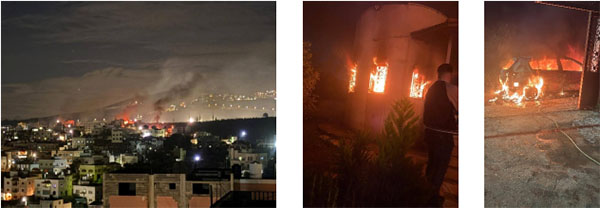
Burning houses and vehicles in Deir al-Hatab (Ramallah News Facebook page, March 22, 2026)
The office of the chairman of the Palestinian Authority condemned the terrorist attacks by “colonial Israeli gangs” on villages, communities and [refugee] camps in Judea and Samaria and called it an escalation for which the Israeli “occupation” government was responsible. The office praised condemnations by a number of European countries, calling it an important step which had to be reflected in actions (Wafa, March 22, 2026). Hamas figure Hussam Badran described the settlers’ attacks as “open war” against the existence of the Palestinian people on their land, and called to establish and strengthen national and popular committees for defense in every village and locality, and to coordinate a broad effort among all forces and popular bodies to support Palestinians living in the conflict areas (Hamas Telegram channel, March 23, 2026).
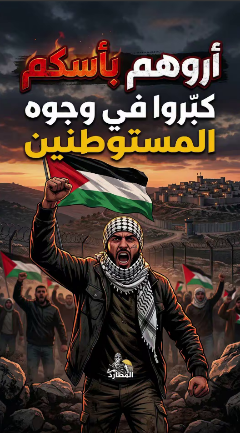
“Show your strength. Stand up to the settlers” (Nablus News Telegram channel, March 23, 2026)
The PA chairman, Mahmoud Abbas, spoke with the president of Indonesia, Prabowo Subianto, to discuss developments in the Palestinian territories and the region, and ways to strengthen bilateral relations. Abbas expressed his appreciation for Indonesia’s support of the Palestinians and for providing aid to the Gaza Strip. He noted the importance of a ceasefire and a full Israeli withdrawal from the Strip, alongside the need for coordination between the executive bodies of the Board of Peace and the PA government for the purpose of rebuilding the Gaza Strip. Abbas also warned of the “dangerous situation” in Judea and Samaria, which he claimed was the result of Israel’s policy of expanding settlements, and called for international action to stop the “occupation’s” policy and enable the Palestinians to achieve their “freedom.” Subianto reaffirmed Indonesia’s support for the Palestinians and pledged to continue providing humanitarian aid and cooperate in rebuilding the Strip (Wafa, March 23, 2026).
The PA deputy chairman, Hussein al-Sheikh, spoke with the Egyptian foreign minister, Badr Abdelatty, about events in Judea, Samaria and the Gaza Strip, especially the escalation in violence by Jewish settlers and its implications for stability. Al-Sheikh expressed appreciation for Egypt’s role in supporting the Palestinian cause. Abdelatty condemned the escalation in settler attacks and noted the need to advance the implementation of all components of the second phase, including the deployment of an international stabilization force and the entry of the management committee into the Gaza Strip as preparation for the return of the PA a fully responsible for it (Wafa, March 23, 2026).
[1] Click https://www.terrorism-info.org.il/en to subscribe and receive the ITIC’s daily updates as well as its other publications.
[2] Terrorist organizations.
[3] The organizations actively seeking to destroy the State of Israel.
[4] See the March 2026 ITIC report, Hamas Exploits the War in Iran to Tighten Its Civilian and Security Control of the Gaza Strip.
Related Articles