
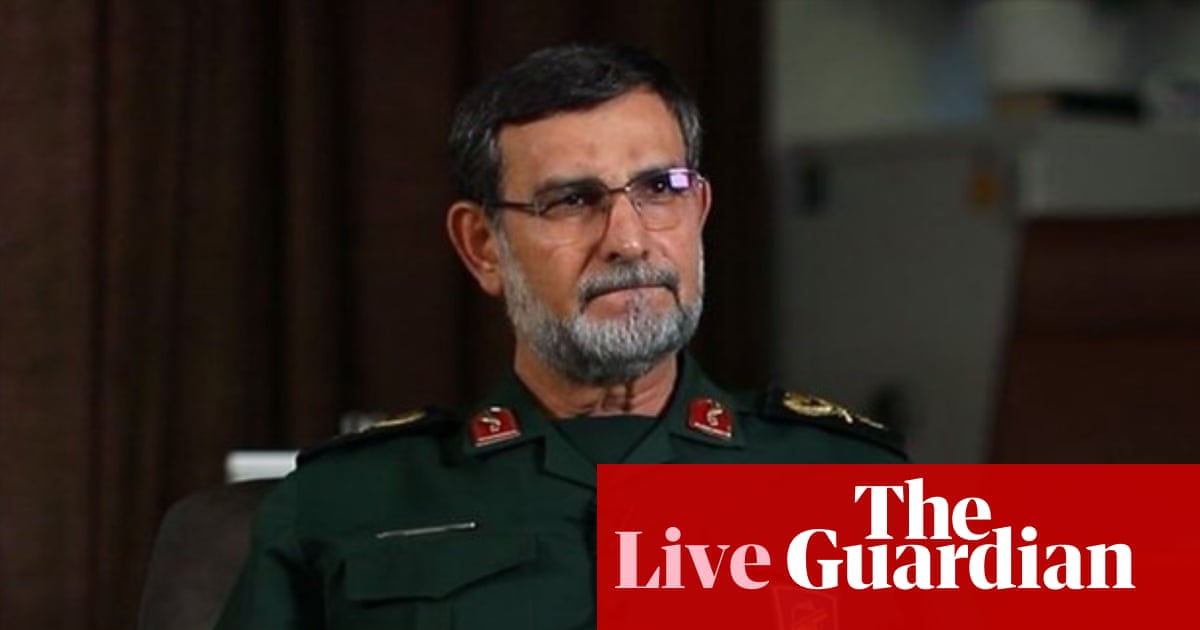
IRGC navy commander killed in airstrike, says Israel defence minister
The Israeli defence minister, Israel Katz, said the Iranian naval commander of the Islamic Revolutionary Guards Corps (IRGC), Alireza Tangsiri, has been killed along with other “senior officers of the naval command” in a strike overnight.
Tangsiri was “directly responsible for the terrorist operation of mining and blocking the strait of Hormuz” and has been “blown up”, Katz said in a video statement, according to AFP news agency.
Iran has yet to comment.
If confirmed, Tangsiri would be the latest in a string of senior Iranian officials targeted and killed since Israel and the US began their joint attacks against Iran on 28 February. Among the high profile assassinations are supreme leader Ayatollah Ali Khamenei and security chief Ali Larijani.
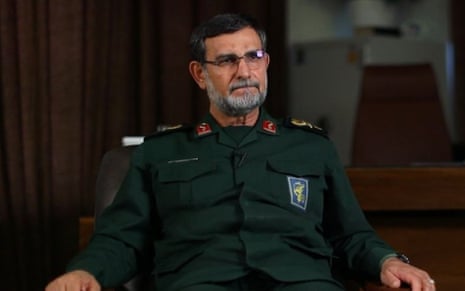 Commander of the Islamic Revolution Guards Corps (IRGC) navy, Alireza Tangsiri. Photograph: TasnimShare
Updated at 07.30 EDT
Key events
Show key events only
Please turn on JavaScript to use this feature
The prime minister of Malaysia, Anwar Ibrahim, said Iran has allowed Malaysian tankers to pass through the strait of Hormuz after talks with Iranian, Turkish and other regional leaders.
“We’re now in the process of releasing the Malaysian oil tankers and the workers involved so that they can continue their journey home,” Anwar said in a televised address, according to Reuters news agency. He also thanked Iranian president Masoud Pezeshkian for the safe passage of Malaysian ships.
“But it is not easy, as Iran feels it has been deceived repeatedly and finds it difficult to accept steps toward peace without a clear and binding security guarantee for their nation,” he added.
Iran said earlier this week that it would allow “non-hostile” vessels to pass safely through the critical shipping route, which has been effectively closed to tankers since the US-Israeli military campaign began last month. Iran’s foreign affairs ministry defined non-hostile vessels as those that “neither participate in nor support acts of aggression against Iran” or belong to the US or Israel.
Some nations have said their ships have been allowed to pass through the narrow waterway, including India and Thailand.
ShareUS-Iran indirect talks ‘are taking place’, says Pakistan foreign minister
The Pakistani foreign minister, Ishaq Dar, confirmed his country has been relaying messages between the US and Iran as part of mediation efforts, saying that “indirect talks are taking place” between the warring parties.
It follows reports that Pakistan, a key intermediary in the current bout of diplomacy between the US and Iran, has delivered Washington’s 15-point ceasefire plan to Tehran.
According to Dar, Iran has been “deliberating” on the proposal, although no Iranian official has publicly confirmed this.
In a post on X, Dar wrote:
double quotation markThere has been unnecessary speculation in the media regarding peace talks to end ongoing conflict in the Middle East. In reality, US-Iran indirect talks are taking place through messages being relayed by Pakistan. In this context, the United States has shared 15 points, being deliberated upon by Iran.
ShareIRGC navy commander killed in airstrike, says Israel defence minister
The Israeli defence minister, Israel Katz, said the Iranian naval commander of the Islamic Revolutionary Guards Corps (IRGC), Alireza Tangsiri, has been killed along with other “senior officers of the naval command” in a strike overnight.
Tangsiri was “directly responsible for the terrorist operation of mining and blocking the strait of Hormuz” and has been “blown up”, Katz said in a video statement, according to AFP news agency.
Iran has yet to comment.
If confirmed, Tangsiri would be the latest in a string of senior Iranian officials targeted and killed since Israel and the US began their joint attacks against Iran on 28 February. Among the high profile assassinations are supreme leader Ayatollah Ali Khamenei and security chief Ali Larijani.
Commander of the Islamic Revolution Guards Corps (IRGC) navy, Alireza Tangsiri. Photograph: TasnimShare
Updated at 07.30 EDT
Iran must respond to US proposal to end war ‘before it’s too late’, Trump warns
Donald Trump has again repeated the claim that Iran is “begging” for a deal to end the war, warning that Tehran “better get serious soon, before it is too late”.
Iran has given mixed signals over the prospect of negotiations following reports that the Trump administration has offered a 15-point ceasefire plan that was presented to Tehran via Pakistan earlier this week. Publicly, Iranian state media has reported that Tehran has rejected the proposal, while privately some media reports suggest Iranian officials are at least reviewing it.
Iran’s foreign minister Abbas Araghchi told state media that his government has not engaged in talks to end the war and that it does not plan on any negotiations. While he acknowledged the US had tried to send messages to Iran through other nations, he said that was “not a conversation nor a negotiation”.
Writing on his Truth Social app, Trump said:
double quotation markThe Iranian negotiators are very different and “strange.” They are “begging” us to make a deal, which they should be doing since they have been militarily obliterated, with zero chance of a comeback, and yet they publicly state that they are only “looking at our proposal.” WRONG!!! They better get serious soon, before it is too late, because once that happens, there is NO TURNING BACK, and it won’t be pretty!
Updated at 07.45 EDT
While Nato has not had direct involvement in the escalating conflict in the Middle East, it has shot down Iranian missiles directed at Turkey and many alliance members have pledged “appropriate efforts” to restart shipping through the strait of Hormuz.
Nato allies have largely refused Donald Trump’s call for military action to secure the strait, and have been generally apprehensive in joining a war that they were not consulted on.
Some nations have been critical of the US and Israel’s decision to strike Iran, with Germany being the most vocal. “This war violates international law,” German president Frank-Walter Steinmeier said on Tuesday. “There is little doubt that, in any case, the justification of an imminent attack on the US does not hold water.”
Nato secretary general, Mark Rutte, has attempted to calm tensions, saying he understood Trump’s anger and stressed that European countries are “coming together” to help secure the strait.
ShareNato has done ‘absolutely nothing’ to help US in Iran war, says Trump
In an all caps Truth Social post, Donald Trump has railed against Nato allies for doing “absolutely nothing” to help the US in its military campaign against Iran.
He wrote:
double quotation markNATO NATIONS HAVE DONE ABSOLUTELY NOTHING TO HELP WITH THE LUNATIC NATION, NOW MILITARILY DECIMATED, OF IRAN. THE U.S.A. NEEDS NOTHING FROM NATO, BUT “NEVER FORGET” THIS VERY IMPORTANT POINT IN TIME!
Kat Lay
A total stop to hostilities in the Middle East is needed to halt a “health crisis unfolding in real time”, the World Health Organization’s (WHO) chief in the region has said.
Hospitals and other healthcare facilities must be treated as “safe havens”, urged Dr Hanan Balkhy, the WHO’s regional director for the Eastern Mediterranean.
She said officials were updating guidance and preparing in case of any impact on nuclear sites, and that attacks on water desalination plants would be “a disaster”.
The region’s 22 countries and territories include Iran and the Gulf states, as well as Gaza, Sudan, Afghanistan and Pakistan.
“The situation has been quite difficult for some time, but what we’re seeing today is just an actual regional health crisis unfolding in real time in multiple parts of this region,” Balkhy told the Guardian.
“It’s not just about lives being lost. It’s about a collapse of access [to healthcare] in many, many dimensions way above and beyond what we would have imagined.”
Read the full report here:
ShareIsrael targets IRGC navy commander in airstrike – NYT
Alireza Tangsiri, commander of Iran’s Islamic Revolutionary Guard Corps (IRGC) navy, was reportedly targeted in an Israeli airstrike this morning in southern Iran, according to the New York Times, citing three Israeli officials.
The Israeli military targeted Tangsiri while he was in an apartment hideout alongside other IRGC officers, the officials told the newspaper, claiming that the Iranian navy chief has played a key role in shutting down the strait of Hormuz to most international shipping.
Some Israeli media outlets have reported that Tangsiri was killed in a strike in the southern Iranian city of Bandar Abbas, which sits on the coast of the strait of Hormuz and houses the headquarters of the Iranian navy. There has been no official comment from Iran or Israel.
Updated at 05.58 EDT
Iran’s foreign minister ‘taken off Israel’s hit list at request of Pakistan’ – report
Israel has reportedly taken Iran’s foreign minister, Abbas Araghchi, and the Iranian parliament speaker, Mohammad Bagher Ghalibaf, off its hit list after Pakistan requested the US not to target them, according to Reuters news agency, citing a source from Islamabad with knowledge of the matter.
Araghchi had been heading Iran’s delegation in nuclear talks with the US and is one of Iran’s most experienced diplomats, while Ghalibaf is supposedly seen by some in the White House as a workable partner.
“The Israelis had their coordinates and wanted to take them out, we told the US if they are also eliminated then there is no one else to talk to, hence the US asked the Israelis to back off,” the Pakistani source was quoted as saying by Reuters.
The Wall Street Journal, which first reported the claim, cited American officials as saying the two Iranian men were removed from the US and Israel’s target list for up to four or five days, as Donald Trump attempts to reopen negotiations with Iran. The report did not mention any Pakistani involvement.
A number of senior Iranian officials have been killed by Israel since the onset of the current war, including supreme leader Ayatollah Ali Khamenei and security chief Ali Larijani. Israel has vowed to continue hunting down Iran’s leaders, while Trump has acknowledged that many potential interlocutors, including negotiators involved in talks before the war, have been killed in strikes.
“We killed all their leadership, And then they met to choose new leaders, and we killed all of them,” he told reporters on Tuesday. “And now we have a new group, and we can easily do that, but let’s see how they turn out.”
Updated at 05.05 EDT
Markets drop amid doubts over US-Iran peace deal
In London, the FTSE 100 share index has dropped by 64 points, or 0.63%, in early trading, to 10,042 points. Mining companies, a gauge of economic growth prospects, are among the top fallers on the index with copper producer Antofagasta down 3.9%.
Jim Reid, market strategist at Deutsche Bank, says:
double quotation markFor markets, the issue is there’s still plenty of doubt about whether a US-Iran deal can be reached, given how Iran have publicly rejected the US on several occasions. So that’s seen markets become increasingly sceptical about positive headlines from the US side, because we haven’t seen similar noises from Iran.
Germany’s DAX dropped by 0.9% at the open in Frankfurt, with France’s CAC 40 down 0.65% in Paris.
You can follow our business live blog for updates on the financial markets and the world economy here:
Here are some images on the newswires from the Arab-Israeli town of Kfar Qasim, which came under attack this morning. The Israeli military said air defences shot down missiles launched from Iran, leaving six people injured and causing damage to properties.
The majority Arab town lies about 12 miles east of Tel Aviv and less than a mile from the “green line” that separates Israel from the occupied West Bank.
Israeli rescuers and security personnel survey the site struck by a projectile in the Arab-Israeli city of Kfar Qasim. Photograph: Ilia Yefimovich/AFP/Getty ImagesThe Israeli military said air defences responded to missile attacks from Iran that left six people lightly wounded and caused some damage. Photograph: Ilia Yefimovich/AFP/Getty ImagesA man surveys the damage to a car in Kfar Qasim. Photograph: Ilia Yefimovich/AFP/Getty ImagesShare Lorenzo Tondo
It’s been an intense morning in Jerusalem, with heavy explosions in the sky and non-stop air raid alerts, as any prospect of a peace deal feels more distant than ever.
Iran has launched at least six missiles in the past two hours, including some reportedly carrying cluster munitions. At least six people have been injured. Sirens also sounded across central Israel in the early hours of the day.
According to videos and photos circulating on Telegram, some fragments are said to have struck the outskirts of Jerusalem, though this cannot be independently verified at this stage. Missile debris has also reportedly landed in the Modiin area, about 20 minutes from Jerusalem.
Elsewhere, two people have been killed in Abu Dhabi after debris from an intercepted missile fell on Sweihan Road, according to the emirate’s media office. Three others were injured and several vehicles damaged.
ShareIsraeli soldier killed in combat in southern Lebanon, IDF says
The Israel Defense Forces (IDF) said one of its soldiers was killed during combat in southern Lebanon, amid ongoing fighting with Hezbollah militants along the border.
This brings the number of Israeli soldiers killed in southern Lebanon to three, after the military said two were killed on 8 March.
Authorities in Israel have provided an update on the Iranian missile attack in the central town of Kfar Qasim, saying six people were “lightly injured by blast effects”, increasing an earlier toll of two injured.
A spokesperson for Israel’s Magen David Adom emergency medical service said paramedics were providing treatment to the wounded.
The city’s mayor, Haitham Taha, said the blast this morning was caused by cluster munitions. Cluster bombs are designed to release dozens of smaller bombs, called submunitions, over a wide area. Smaller munitions do not always explode immediately, posing a further risk to civilians.
An upturned car at the missile impact site in Kfar Qasim after Iranian missile barrages were launched at Israel amid the US-Israel conflict with Iran. Photograph: Rami Amichay/ReutersShare
Updated at 04.09 EDT
Two people have been killed by falling debris in Abu Dhabi after a missile was intercepted in the UAE capital, according to local media.
In a post on X, the official Abu Dhabi Media Office said three others were injured in the incident. It did not say where the missile was launched from or provide the nationalities of the victims.
Since the US-Israeli war on Iran began, at least 10 people have been reported killed in the UAE from Iranian attacks. In its last update on Saturday, the UAE defence ministry said eight people have died, including two members of the armed forces and six civilians of Pakistani, Nepali, Bangladeshi and Palestinian nationalities.
Updated at 03.34 EDT
Interim summary
In case you’re just joining today’s live coverage of the US-Israel war on Iran, here’s a rundown on the latest. It’s 10.30am in Tehran, 9am in Tel Aviv and Beirut and 3am in Washington DC.
Donald Trump has insisted Iran is still interested in a deal after Tehran dismissed a US ceasefire proposal, countered with a plan of its own and claimed it had no intention to negotiate. The US president later suggested Tehran’s claims were because Iranian negotiators feared being killed by their own side, while the White House said Trump was prepared to “unleash hell” if Iran did not accept defeat.
Israel’s military said on Thursday it had carried out a wave of strikes across Iran, including extensively in the central city of Isfahan. It said Israeli forces “completed a wide-scale wave of strikes targeting infrastructure” of the regime.
China’s foreign minister said a “glimmer of hope” for peace had emerged amid the war, despite Tehran vowing to keep fighting.Wang Yi urged dialogue in separate calls with his Turkish and Egyptian counterparts, suggesting Tehran and Washington had both shown signals they were willing to return to the negotiating table.
Benjamin Netanyahu said Israel would expand its occupation of southern Lebanon, with what he described as a “larger buffer zone” to push back the threat of Hezbollah. Earlier this week, Bezalel Smotrich, Israel’s far-right finance minister, said Israel should “apply sovereignity” areas in southern Lebanon, signalling an expansionist vision that has alarmed critics at home and abroad.
Hezbollah chief Naim Qassem said negotiations with Israel under fire would amount to “surrender” as the Iran-backed group launched fresh attacks on the country.
Smoke rises from the site of an Israeli airstrike that targeted the southern Lebanese village of Dayr Seryan on Wednesday. Photograph: AFP/Getty Images
Uncertainty over the war has kept oil prices above the $100-a-barrel mark. At 05.30 GMT, the price of Brent crude was hovering around $104 a barrel. Asian stocks were mostly lower.
Two people were lightly hurt from a Iranian cluster bomb hit in the central Israeli city of Kfar Qasim on Thursday morning, the Times of Israel quoted medics as saying. The Israeli military earlier said air defences were responding to Iranian missile attacks and sirens were activated across central Israel, parts of Jerusalem and the occupied West Bank.
An Iranian envoy said South Korean ships could pass through the strait of Hormuz only after coordinating with Tehran, the Yonhap News Agency reported.
An Israeli solder was seriously injured in mortar fire in Lebanon, Israel’s military said.
Kuwait said it had arrested six people over an alleged Hezbollah plot to assassinate leaders in the Gulf state.
Russia is close to completing a phased shipment of drones, medicine and food to Iran, according to western intelligence reports that detail Moscow’s efforts to keep its embattled partner fighting, the Financial Times reported.
Updated at 03.31 EDT
With the war in Iran leading to a near-total internet blackout in the country, activists around the world – especially in the US – are mobilising to help Iranians stay connected via Starlink, Agence France-Presse is reporting.
Despite being banned, Elon Musk’s satellite internet system has gained ground in Iran thanks to a network of international activists, multiple people involved in these efforts told the news agency.
The digital activists’ efforts began in 2022, when mass protests broke out after the death of Mahsa Amini, who was being held by Iran’s police for violating the country’s strict dress code for women.
“As of this year, we have more than 300 devices that we have delivered to the country,” said Emilia James of the US-based organization NetFreedom Pioneers. She declined to go into further detail to protect the operation and the users.
Ahmad Ahmadian, executive director of Holistic Resilience, said his organisation purchased Starlink devices in European countries or elsewhere before moving them into Iran via “neighbouring countries”.
The government cracked down hard on the Starlink terminals in 2025, and those caught using them face imprisonment.