
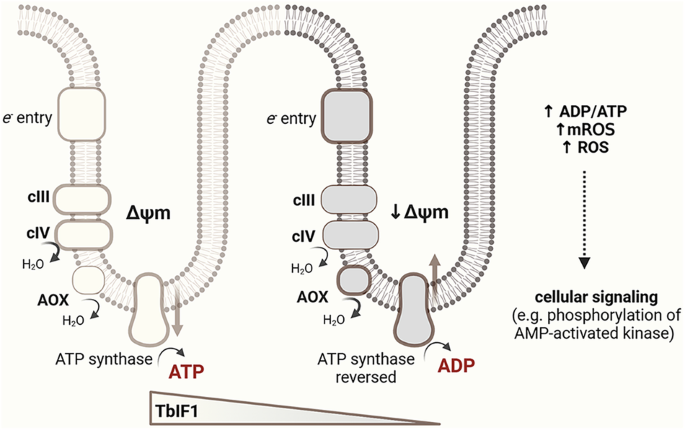
Spinelli, J. B. & Haigis, M. C. The multifaceted contributions of mitochondria to cellular metabolism. Nat. Cell Biol. 20, 745–754 (2018).
Chakrabarty, R. P. & Chandel, N. S. Beyond ATP, new roles of mitochondria. Biochemistry 44, 2–8 (2022).
Walker, J. E. The ATP synthase: the understood, the uncertain and the unknown. Biochem. Soc. Trans. 41, 1–16 (2013).
Kuhlbrandt, W. Structure and mechanisms of F-Type ATP synthases. Annu. Rev. Biochem. 88, 515–549 (2019).
Jennings, R. B., Reimer, K. A. & Steenbergen, C. Effect of inhibition of the mitochondrial ATPase on net myocardial atp in total ischemia. J. Mol. Cell. Cardiol. 23, 1383–1395 (1991).
Chinopoulos, C. & Adam-Vizi, V. Mitochondria as ATP consumers in cellular pathology. Biochim Biophys. Acta 1802, 221–227 (2010).
Pullman, M. E. & Monroy, G. C. A Naturally occurring inhibitor of mitochondrial adenosine triphosphatase. J. Biol. Chem. 238, 3762–3769 (1963).
Sinha, S. D. & Wideman, J. G. The persistent homology of mitochondrial ATP synthases. iScience 26, 106700 (2023).
Carroll, J. et al. The inhibitor protein IF(1) from mammalian mitochondria inhibits ATP hydrolysis but not ATP synthesis by the ATP synthase complex. J. Biol. Chem. 300, 105690 (2024).
Cabezon, E., Butler, P. J., Runswick, M. J. & Walker, J. E. Modulation of the oligomerization state of the bovine F1-ATPase inhibitor protein, IF1, by pH. J. Biol. Chem. 275, 25460–25464 (2000).
Boreikaite, V., Wicky, B. I. M., Watt, I. N., Clarke, J. & Walker, J. E. Extrinsic conditions influence the self-association and structure of IF(1), the regulatory protein of mitochondrial ATP synthase. Proc. Natl. Acad. Sci. USA 116, 10354–10359 (2019).
Bason, J. V., Montgomery, M. G., Leslie, A. G. W. & Walker, J. E. Pathway of binding of the intrinsically disordered mitochondrial inhibitor protein to F-1-ATPase. Proc. Natl. Acad. Sci. USA 111, 11305–11310 (2014).
Kobayashi, R., Ueno, H., Okazaki, K. I. & Noji, H. Molecular mechanism on forcible ejection of ATPase inhibitory factor 1 from mitochondrial ATP synthase. Nat. Commun. 14, 1682 (2023).
Dominguez-Zorita, S. & Cuezva, J. M. The mitochondrial ATP synthase/IF1 axis in cancer progression: targets for therapeutic intervention. Cancers 15, 3775 (2023).
Dominguez-Zorita, S., Romero-Carraminana, I., Cuezva, J. M. & Esparza-Molto, P. B. The ATPase inhibitory factor 1 is a tissue-specific physiological regulator of the structure and function of mitochondrial ATP synthase: a closer look into neuronal function. Front. Physiol. 13, 868820 (2022).
Gatto, C., Grandi, M., Solaini, G., Baracca, A. & Giorgio, V. The F1Fo-ATPase inhibitor protein IF1 in pathophysiology. Front. Physiol. 13, 917203 (2022).
Sgarbi, G. et al. The pro-oncogenic protein IF(1) does not contribute to the Warburg effect and is not regulated by PKA in cancer cells. >Biochim. Biophys. Acta Mol. Basis Dis. 1870, 166879 (2024).
He, J. et al. Assembly of the peripheral stalk of ATP synthase in human mitochondria. Proc. Natl. Acad. Sci. USA 117, 29602–29608 (2020).
He, J. et al. Assembly of the membrane domain of ATP synthase in human mitochondria. Proc. Natl. Acad. Sci. USA 115, 2988–2993 (2018).
Solaini, G. & Harris, D. A. Biochemical dysfunction in heart mitochondria exposed to ischaemia and reperfusion. Biochem. J. 390, 377–394 (2005).
Gu, J. et al. Cryo-EM structure of the mammalian ATP synthase tetramer bound with inhibitory protein IF1. Science 364, 1068–1075 (2019).
Blum, T. B., Hahn, A., Meier, T., Davies, K. M. & Kuhlbrandt, W. Dimers of mitochondrial ATP synthase induce membrane curvature and self-assemble into rows. Proc. Natl. Acad. Sci. USA https://doi.org/10.1073/pnas.1816556116 (2019).
Davies, K. M. et al. Macromolecular organization of ATP synthase and complex I in whole mitochondria. Proc. Natl. Acad. Sci. USA 108, 14121–14126 (2011).
Campanella, M. et al. Regulation of mitochondrial structure and function by the F1Fo-ATPase inhibitor protein, IF1. Cell Metab. 8, 13–25 (2008).
Faccenda, D. et al. Control of Mitochondrial Remodeling by the ATPase Inhibitory Factor 1 Unveils a Pro-survival Relay via OPA1. Cell Rep. 18, 1869–1883 (2017).
Weissert, V. et al. Inhibition of the mitochondrial ATPase function by IF1 changes the spatiotemporal organization of ATP synthase. Biochim. Biophys. Acta Bioenerg. 1862, 148322 (2021).
Dominguez-Zorita, S. et al. IF1 ablation prevents ATP synthase oligomerization, enhances mitochondrial ATP turnover and promotes an adenosine-mediated pro-inflammatory phenotype. Cell Death Dis. 14, 413 (2023).
Solaini, G., Sgarbi, G. & Baracca, A. The F1Fo-ATPase inhibitor, IF1, is a critical regulator of energy metabolism in cancer cells. Biochem. Soc. Trans. 49, 815–827 (2021).
Wolf, D. M. et al. Individual cristae within the same mitochondrion display different membrane potentials and are functionally independent. EMBO J. 38, e101056 (2019).
Salewskij, K. et al. The spatio-temporal organization of mitochondrial F(1)F(O) ATP synthase in cristae depends on its activity mode. Biochim. Biophys. Acta Bioenerg. 1861, 148091 (2020).
Rieger, B., Arroum, T., Borowski, M. T., Villalta, J. & Busch, K. B. Mitochondrial F(1) F(O) ATP synthase determines the local proton motive force at cristae rims. EMBO Rep. 22, e52727 (2021).
Acin-Perez, R. et al. Inhibition of ATP synthase reverse activity restores energy homeostasis in mitochondrial pathologies. EMBO J. e111699, https://doi.org/10.15252/embj.2022111699 (2023).
Zikova, A. Mitochondrial adaptations throughout the Trypanosoma brucei life cycle. J. Eukaryot. Microbiol. e12911, https://doi.org/10.1111/jeu.12911 (2022).
Franco, J. R. et al. The elimination of human African trypanosomiasis: achievements in relation to WHO road map targets for 2020. PLoS Negl. Trop. Dis. 16, e0010047 (2022).
Morrison, L. J. et al. What is needed to achieve effective and sustainable control of African animal trypanosomosis? Trends Parasitol. https://doi.org/10.1016/j.pt.2024.06.013 (2024).
Walsh, B. & Hill, K. L. Right place, right time: Environmental sensing and signal transduction directs cellular differentiation and motility in Trypanosoma brucei. Mol. Microbiol https://doi.org/10.1111/mmi.14682 (2021).
Naguleswaran, A. et al. Developmental changes and metabolic reprogramming during establishment of infection and progression of Trypanosoma brucei brucei through its insect host. PLoS Negl. Trop. Dis. 15, e0009504 (2021).
Mugnier, M. R., Stebbins, C. E. & Papavasiliou, F. N. Masters of Disguise: Antigenic Variation and the VSG Coat in Trypanosoma brucei. PLoS Pathogens 12, https://doi.org/10.1371/journal.ppat.1005784 (2016).
Michels, P. A. M. et al. Carbohydrate metabolism in trypanosomatids: New insights revealing novel complexity, diversity and species-unique features. Exp. Parasitol. 224, 108102 (2021).
Haanstra, J. R. et al. Proliferating bloodstream-form Trypanosoma brucei use a negligible part of consumed glucose for anabolic processes. Int. J. Parasitol. 42, 667–673 (2012).
Schnaufer, A., Clark-Walker, G. D., Steinberg, A. G. & Stuart, K. The F1-ATP synthase complex in bloodstream stage trypanosomes has an unusual and essential function. EMBO J. 24, 4029–4040 (2005).
Nolan, D. P. & Voorheis, H. P. The mitochondrion in bloodstream forms of Trypanosoma brucei is energized by the electrogenic pumping of protons catalysed by the F1F0-ATPase. Eur. J. Biochem. 209, 207–216 (1992).
Zikova, A., Verner, Z., Nenarokova, A., Michels, P. A. M. & Lukes, J. A paradigm shift: The mitoproteomes of procyclic and bloodstream Trypanosoma brucei are comparably complex. PLoS Pathog. 13, e1006679 (2017).
Taleva, G. et al. Mitochondrion of the Trypanosoma brucei long slender bloodstream form is capable of ATP production by substrate-level phosphorylation. PLoS Pathog. 19, e1011699 (2023).
Panicucci, B., Gahura, O. & Zikova, A. Trypanosoma brucei TbIF1 inhibits the essential F1-ATPase in the infectious form of the parasite. PLoS Negl. Trop. Dis. 11, e0005552 (2017).
Vassella, E. et al. A major surface glycoprotein of Trypanosoma brucei is expressed transiently during development and can be regulated post-transcriptionally by glycerol or hypoxia. Genes Dev. 14, 615–626 (2000).
Mantilla, B. S. et al. Proline metabolism is essential for trypanosoma brucei brucei survival in the tsetse vector. PLoS Pathog. 13, e1006158 (2017).
Hierro-Yap, C. et al. Bioenergetic consequences of FoF1-ATP synthase/ATPase deficiency in two life cycle stages of Trypanosoma brucei. J. Biol. Chem. 296, 100357 (2021).
Dewar, C. E. et al. Oxidative phosphorylation is required for powering motility and development of the sleeping sickness parasite Trypanosoma brucei in the tsetse fly vector. mBio, e0235721, https://doi.org/10.1128/mbio.02357-21 (2022).
Bochud-Allemann, N. & Schneider, A. Mitochondrial substrate level phosphorylation is essential for growth of procyclic Trypanosoma brucei. J. Biol. Chem. 277, 32849–32854 (2002).
Urwyler, S., Studer, E., Renggli, C. K. & Roditi, I. A family of stage-specific alanine-rich proteins on the surface of epimastigote forms of Trypanosoma brucei. Mol. Microbiol. 63, 218–228 (2007).
Rotureau, B. & Van Den Abbeele, J. Through the dark continent: African trypanosome development in the tsetse fly. Front. Cell. Infect. Microbiol. 3, 53 (2013).
Rotureau, B., Subota, I., Buisson, J. & Bastin, P. A new asymmetric division contributes to the continuous production of infective trypanosomes in the tsetse fly. Development 139, 1842–1850 (2012).
Christiano, R. et al. The proteome and transcriptome of the infectious metacyclic form of Trypanosoma brucei define quiescent cells primed for mammalian invasion. Mol. Microbiol. 106, 74–92 (2017).
Dolezelova, E. et al. Cell-based and multi-omics profiling reveals dynamic metabolic repurposing of mitochondria to drive developmental progression of Trypanosoma brucei. PLoS Biol. 18, e3000741 (2020).
Savage, A. F. et al. Transcriptome profiling of Trypanosoma brucei development in the tsetse fly vector Glossina morsitans. PLoS One 11, e0168877 (2016).
Toh, J. Y. et al. Identification of positive and negative regulators in the stepwise developmental progression towards infectivity in Trypanosoma brucei. Sci. Rep. 11, 5755 (2021).
Kolev, N. G., Ramey-Butler, K., Cross, G. A. M., Ullu, E. & Tschudi, C. Developmental progression to infectivity in Trypanosoma brucei triggered by an RNA-binding protein. Science 338, 1352–1353 (2012).
Gahura, O., Hierro-Yap, C. & Zikova, A. Redesigned and reversed: architectural and functional oddities of the trypanosomal ATP synthase. Parasitology 148, 1151–1160 (2021).
Mugo, E. & Clayton, C. Expression of the RNA-binding protein RBP10 promotes the bloodstream-form differentiation state in Trypanosoma brucei. PLoS Pathog. 13, e1006560 (2017).
Acin-Perez, R. et al. Inhibition of ATP synthase reverse activity restores energy homeostasis in mitochondrial pathologies. EMBO J. 42, e111699 (2023).
Saldivia, M., Ceballos-Perez, G., Bart, J. M. & Navarro, M. The AMPKalpha1 pathway positively regulates the developmental transition from proliferation to quiescence in Trypanosoma brucei. Cell Rep. 17, 660–670 (2016).
Zmijewski, J. W. et al. Exposure to hydrogen peroxide induces oxidation and activation of AMP-activated protein kinase. J. Biol. Chem. 285, 33154–33164 (2010).
Hinchy, E. C. et al. Mitochondria-derived ROS activate AMP-activated protein kinase (AMPK) indirectly. J. Biol. Chem. 293, 17208–17217 (2018).
Naguleswaran, A. & Roditi, I. Rodent-free cyclical transmission of Trypanosoma brucei brucei. Mol. Biochem Parasitol. 217, 16–18 (2017).
Hirumi, H. & Hirumi, K. Continuous cultivation of Trypanosoma brucei blood stream forms in a medium containing a low concentration of serum protein without feeder cell layers. J. Parasitol. 75, 985–989 (1989).
Shi, H., Butler, K. & Tschudi, C. A single-point mutation in the RNA-binding protein 6 generates Trypanosoma brucei metacyclics that are able to progress to bloodstream forms in vitro. Mol. Biochem. Parasitol. 224, 50–56 (2018).
Garcia-Bermudez, J. & Cuezva, J. M. The ATPase Inhibitory Factor 1 (IF1): a master regulator of energy metabolism and of cell survival. BBA Bioenerg. 1857, 1167–1182 (2016).
Romero-Carraminana, I., Dominguez-Zorita, S., Esparza-Molto, P. B. & Cuezva, J. M. Ablation of Atp5if1 impairs metabolic reprogramming and proliferation of T lymphocytes and compromises mouse survival. iScience 27, 109863 (2024).
Sanchez-Arago, M., Garcia-Bermudez, J., Martinez-Reyes, I., Santacatterina, F. & Cuezva, J. M. Degradation of IF1 controls energy metabolism during osteogenic differentiation of stem cells. EMBO Rep. 14, 638–644 (2013).
Brunetta, H. S. et al. IF1 is a cold-regulated switch of ATP synthase hydrolytic activity to support thermogenesis in brown fat. EMBO J. 43, 4870–4891 (2024).
Kido, Y. et al. Purification and kinetic characterization of recombinant alternative oxidase from Trypanosoma brucei brucei. Biochim. Biophys. Acta 1797, 443–450 (2010).
Viscomi, C., Moore, A. L., Zeviani, M. & Szibor, M. Xenotopic expression of alternative oxidase (AOX) to study mechanisms of mitochondrial disease. Biochim. Biophys. Acta Bioenerg. 1864, 148947 (2023).
May, B., Young, L. & Moore, A. L. Structural insights into the alternative oxidases: are all oxidases made equal? Biochem Soc. Trans. 45, 731–740 (2017).
Luevano-Martinez, L. A., Girard, R. M. B. M., Alencar, M. B. & Silber, A. M. ATP regulates the activity of an alternative oxidase in Trypanosoma brucei. Febs Lett. 594, 2150–2158 (2020).
Brand, M. D. Riding the tiger – physiological and pathological effects of superoxide and hydrogen peroxide generated in the mitochondrial matrix. Crit. Rev. Biochem. Mol. Biol. 55, 592–661 (2020).
Garcia-Bermudez, J. et al. PKA phosphorylates the ATPase inhibitory factor 1 and inactivates its capacity to bind and inhibit the mitochondrial H(+)-ATP synthase. Cell Rep. 12, 2143–2155 (2015).
Usey, M. M., Ruberto, A. A., Parker, K. V. & Huet, D. The Toxoplasma gondii homolog of ATPase inhibitory factor 1 is critical for mitochondrial cristae maintenance and stress response. Mol. Biol. Cell 36, ar6 (2025).
Chinopoulos, C. Mitochondrial consumption of cytosolic ATP: Not so fast. Febs Lett. 585, 1255–1259 (2011).
Chinopoulos, C. The “B space” of mitochondrial phosphorylation. J. Neurosci. Res. 89, 1897–1904 (2011).
Herzig, S. & Shaw, R. J. AMPK: guardian of metabolism and mitochondrial homeostasis. Nat. Rev. Mol. Cell Biol. 19, 121–135 (2018).
Quintana, J. F., Zoltner, M. & Field, M. C. Evolving differentiation in African Trypanosomes. Trends Parasitol. 37, 296–303 (2021).
Faccenda, D., Tan, C. H., Seraphim, A., Duchen, M. R. & Campanella, M. IF1 limits the apoptotic-signalling cascade by preventing mitochondrial remodelling. Cell Death Differ. 20, 686–697 (2013).
Strauss, M., Hofhaus, G., Schroder, R. R. & Kuhlbrandt, W. Dimer ribbons of ATP synthase shape the inner mitochondrial membrane. EMBO J. 27, 1154–1160 (2008).
Spikes, T. E., Montgomery, M. G. & Walker, J. E. Structure of the dimeric ATP synthase from bovine mitochondria. Proc. Natl. Acad. Sci. USA 117, 23519–23526 (2020).
Pinke, G., Zhou, L. & Sazanov, L. A. Cryo-EM structure of the entire mammalian F-type ATP synthase. Nat. Struct. Mol. Biol. 27, 1077–1085 (2020).
Barbato, S., Sgarbi, G., Gorini, G., Baracca, A. & Solaini, G. The inhibitor protein (IF1) of the F1F0-ATPase modulates human osteosarcoma cell bioenergetics. J. Biol. Chem. 290, 6338–6348 (2015).
Gahura, O. et al. An ancestral interaction module promotes oligomerization in divergent mitochondrial ATP synthases. Nat. Commun. 13, 5989 (2022).
Muhleip, A. W., Dewar, C. E., Schnaufer, A., Kuhlbrandt, W. & Davies, K. M. In situ structure of trypanosomal ATP synthase dimer reveals a unique arrangement of catalytic subunits. Proc. Natl. Acad. Sci. USA 114, 992–997 (2017).
Muhleip, A., McComas, S. E. & Amunts, A. Structure of a mitochondrial ATP synthase with bound native cardiolipin. eLife 8, https://doi.org/10.7554/eLife.51179 (2019).
Muhleip, A. et al. ATP synthase hexamer assemblies shape cristae of Toxoplasma mitochondria. Nat. Commun. 12, 120 (2021).
Wirtz, E., Leal, S., Ochatt, C. & Cross, G. A. A tightly regulated inducible expression system for conditional gene knock-outs and dominant-negative genetics in Trypanosoma brucei. Mol. Biochem. Parasitol. 99, 89–101 (1999).
Panigrahi, A. K. et al. Mitochondrial complexes in Trypanosoma brucei: a novel complex and a unique oxidoreductase complex. Mol. Cell Proteom. 7, 534–545 (2008).
Dolezelova, E. et al. Evaluation of the Trypanosoma brucei 6-oxopurine salvage pathway as a potential target for drug discovery. PLoS Negl. Trop. Dis. 12, e0006301 (2018).
Gahura, O. et al. The F1 -ATPase from Trypanosoma brucei is elaborated by three copies of an additional p18-subunit. FEBS J. 285, 614–628 (2018).
Moos, M. et al. Cryoprotective metabolites are sourced from both external diet and internal macromolecular reserves during metabolic reprogramming for freeze tolerance in Drosophilid Fly, Chymomyza costata. Metabolites 12, https://doi.org/10.3390/metabo12020163 (2022).