
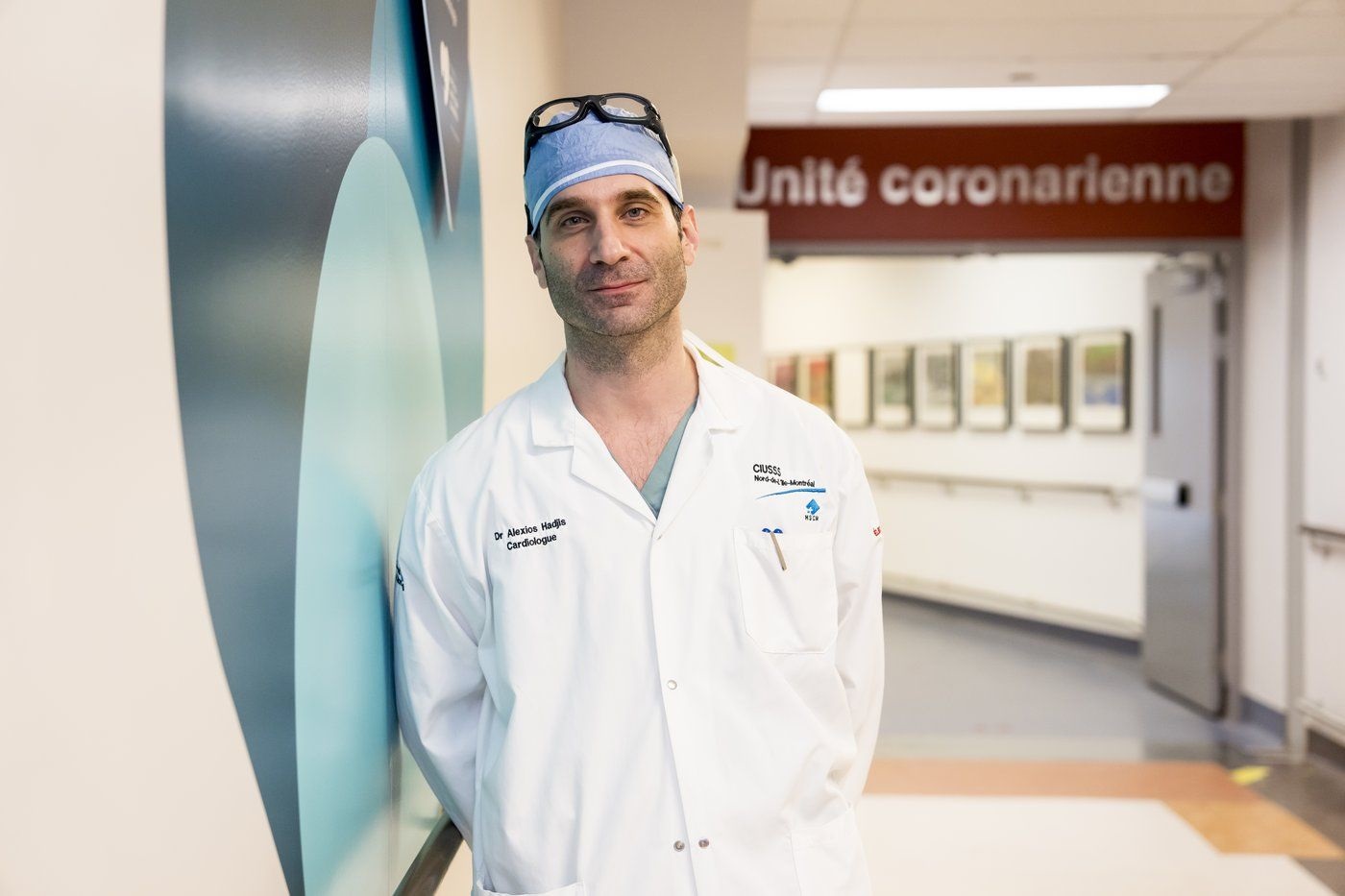
A new innovation in cardiac surgery. A patient suffering from an arrhythmia—which could not be treated with standard techniques—became the first case in Canada to benefit from a cutting-edge surgical technique. He underwent surgery on Wednesday by a team specializing in electrophysiology at Sacré-Cœur Hospital in Montreal.
The surgery, which The Canadian Press witnessed, was described as a success by the surgeon, Dr. Alexios Hadjis, a cardiologist and electrophysiologist at Sacré-Cœur Hospital in Montreal. “We are very pleased […] all of this could not have been accomplished without the efforts of the teams,” commented Dr. Hadjis, a leading expert in his field, as he left the operating room.
During the procedure, he used a special catheter for which he obtained exceptional authorization from Health Canada. The catheter combines two ablation technologies, pulsed field and radiofrequency, which makes it possible to burn areas of the heart responsible for the arrhythmia that were previously inaccessible with standard techniques.
Normally, for this type of heart problem, the doctor would cauterize using radiofrequency ablation. But the lesions in the patient’s heart were not deep enough to allow for this procedure.
Dr. Hadjis explains that the patient’s arrythmia was circular in shape and that part of the circle was inaccessible due to bypass surgery the man underwent in the 1990s. Other treatment options include radiotherapy, but this is not without risk, he says.
“So this new advanced approach, which may become the standard in the near future, is to reach the outer part of the heart, the epicardium, by burning inside the heart,” the specialist summarizes.
Specifically, the medical team performed a ventricular tachycardia ablation. This type of arrhythmia causes abnormally rapid heartbeats and is fatal if left untreated. “With this new technology that is currently being developed, we were able to create a precise map of his arrhythmia and reach its critical point,” explains Dr. Hadjis. “Even in the operating room, we managed to stop the arrhythmia during the ablation, and at the end of the procedure, there were no inducible arrhythmias. That’s very satisfying. Overall, it went very well. We are very happy for the patient that we have eliminated this problem.”
The surgery was minimally invasive, with the surgeon accessing the heart through the groin. The work of the professional team will restore his quality of life, as the man was regularly receiving shocks from his pacemaker/defibrillator. “Unfortunately, the patient was receiving repeated shocks and therapies from his defibrillator, despite receiving maximum medical treatment. So the goal—obviously, he’ll have the defibrillator just in case—but we want him to stop experiencing malignant arrhythmias, loss of consciousness, or defibrillator shocks,” explains Dr. Hadjis.
The shocks from the pacemaker are very painful, he explains. Some patients even develop post-traumatic stress disorder. “You can imagine, it feels like a bomb has gone off, like your heart is stopping. The shock isn’t subtle. It can be quite traumatic,” Dr. Hadjis points out.
Surgery surpasses medication
The need for electrophysiology is exploding in Quebec, says Judith Bérubé, clinical-administrative coordinator of the cardiovascular and respiratory health program at the Sacré-Cœur-de-Montréal Hospital.
Clinical indicators change as technologies evolve. Bérubé, who has over 20 years of experience as a cardiology nurse, points out that about 30 years ago, many medications were given for arrhythmias, but this had significant side effects.
At that time, ablation of the areas of the heart responsible for the arrhythmia was a last resort. “Nowadays, it’s the opposite,” she says. This type of surgery improves quality of life and slows the progression of the disease. “Ablation is now safer than medication,” Bérubé maintains.
For the 70-year-old patient, no other therapeutic option was conceivable, which justified Health Canada giving its approval for the procedure, in addition to existing clinical studies.
In an email, Health Canada specifies that “if this surgery were to generate widespread interest, the instrument used in this procedure would need to be licensed for sale by Health Canada” and that “the Special Access Program is not intended to facilitate early market access.”
According to Abbott, the company behind the new technology, the catheter that combines pulsed field and radiofrequency could be available in the near future, within a few years, if all goes well. It has already been approved in Europe and is on track for approval in the United States very soon.
—The Canadian Press’s health coverage is supported by a partnership with the Canadian Medical Association. The Canadian Press is solely responsible for this journalistic content.
–This report by La Presse Canadienne was translated by CityNews