
(Bloomberg) — A record month for crude, stocks in or near correction territory, bonds under pressure and a growing sense that there are few tools to shield markets from an increasingly entrenched Iran war.
That’s the backdrop facing global investors as the Mideast conflict enters a fifth week, with trading in oil, bond and stock futures set to resume in earnest Sunday night at 6 p.m. in New York.
Israel struck Tehran anew Sunday and Saudi Arabia intercepted almost a dozen drones, a day after Yemen-based Houthi militants entered the war. About 3,500 additional US troops arrived in the Middle East and regional powers including Saudi Arabia and Turkey met in Pakistan to discuss how to end the conflict, which has killed thousands and caused chaos in commodity markets and global trade.
“This escalation raises the odds that this war is going to last longer than investors were thinking and thus that oil prices will remain very high,” said Matt Maley, chief market strategist at Miller Tabak + Co. “We should expect more weakness in the markets.”
After weeks holding firm in the face of extreme volatility epitomized by tumult in oil markets as the Strait of Hormuz remained closed, risk assets showed signs of capitulating in recent sessions. The 3.6% drop in the S&P 500 over Thursday and Friday was its worst two-day decline in a year, leaving the benchmark 8.8% below its January record. The Nasdaq 100’s two-day, 4.3% slide sent it into a 10% correction.
Stocks and credit kept falling Friday even after US President Donald Trump pushed back a deadline for Iran to agree to reopen the Strait of Hormuz or face strikes on its power plants. That was in sharp contrast from Monday, when Trump’s walk-back on his threat to bomb Iran’s energy infrastructure sparked a rebound across assets.
For a fifth time, investors offloaded risk heading into a weekend. Losses spread despite Trump’s secretary of state, Marco Rubio, predicting the war would take “weeks not months” to win.
“There is little that the president can do on his own in the near term to alleviate market anxiety,” said Michael O’Rourke, chief market strategist at JonesTrading. “The global investment community wants to see progress on reopening the Strait of Hormuz. In the meantime, the selloff has reached a point where the market needs a clearing event to stabilize.”
With the conflict driving up gasoline prices, US consumer sentiment slid to a three-month low in March and year-ahead inflation expectations jumped. Economists raised estimates for US inflation through year-end, while trimming consumer spending, growth and employment projections, according to the latest Bloomberg monthly survey.
Story Continues
Heightened worries about inflation have sparked losses in government bonds, sending yields higher and putting Treasuries on track for their worst month since October 2024 as traders reassess expectations for monetary policy. Interest-rate swaps no longer signal any chance of a Federal Reserve interest-rate cut this year, and some investors are now bracing for the possibility for a hike before the year is out.
The dollar, meanwhile, has enjoyed a resurgence and is on track for its best month since December 2024. The greenback was mixed against major peers early Monday, while the risk-sensitive Australian dollar inched lower.
“The US dollar will benefit because it is a safe haven, and because the US is energy independent in contrast to most advanced economies,” Commonwealth Bank of Australia strategists led by Joseph Capurso wrote in a note to clients.
Credit Risk
In credit markets, high-yield bonds suffered their biggest price decline since Trump’s tariff offensive in April last year. A gauge of credit risk in Europe closed at the highest level since April 14, while US leveraged loans had their first two-day slide in nearly a month.
Bitcoin fell to its lowest level in more than three weeks as traders turned defensive following the year’s largest options expiry, while investors continued pulling money from crypto exchange-traded funds. The original cryptocurrency fell as much as 5% to $65,522 Friday, the lowest since March 2. It traded at around $66,650 as of 4:30 p.m. in New York Sunday.
“Market behavior reflects a clear shift toward capital preservation,” Wee Khoon Chong, a senior strategist at BNY in Hong Kong, wrote in a note to clients. “Recent outperformers are increasingly vulnerable to profit-taking and position unwinds. However, flows are unlikely to rotate meaningfully into fixed income,” given concerns over rising inflation pressures, he wrote.
In energy markets, global benchmark Brent rose 4.2% Friday to settle above $112 a barrel, leaving it on pace for the biggest ever monthly advance, while West Texas Intermediate settled above $99.
Oil may hit a record $200 a barrel if the Iran war drags on till June, with the Strait of Hormuz staying shut, Macquarie Group Ltd. warned. A conflict that stretches through the second quarter would result in historically high real prices, analysts including Vikas Dwivedi said in a note, outlining a scenario with odds of 40%. An alternative outlook, with probability of 60%, suggested the war may finish at the end of this month, they said.
Buying Opportunities?
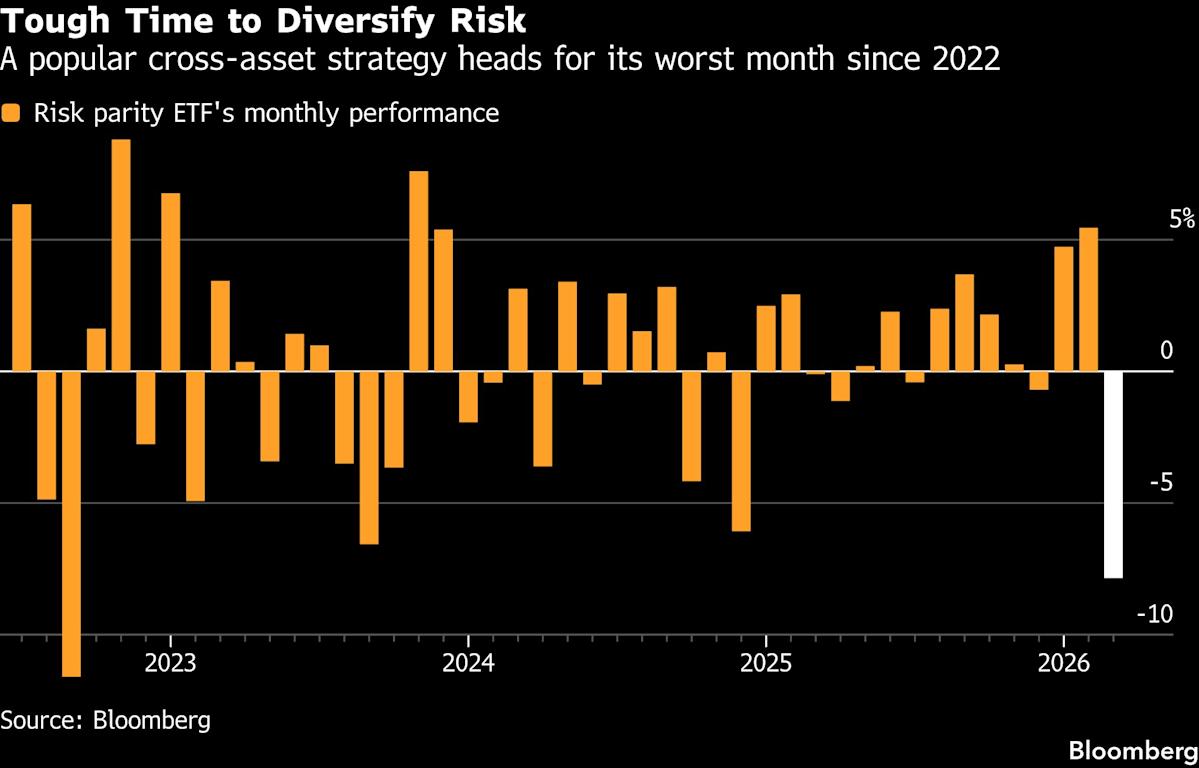
Almost nothing in the standard defensive toolkit has worked for investors to stall declines spurred by rising energy and its impact on inflation expectations. At least three of the four asset classes at the core of a diversified portfolio have fallen in unison for four straight weeks, matching the longest such stretch since May 2022.
An investor with perfect foresight on Feb. 27, the day before the attacks began — who loaded up on bonds, gold, VIX calls and S&P 500 protective options — would today be sitting on losses in virtually every position, according to Michael Purves, founder of Tallbacken Capital Advisors.
While the weekend’s developments “are going to embroil things a little bit, Friday’s close kind of felt like it was a peak pain moment for now,” said Mark Malek, Chief Investment Officer at Muriel Siebert & Co. That may prompt some to start looking for re-entry points.
“The boldest traders are definitely looking for buying opportunities here,” he said. “Many of them have been sitting around waiting for that so-called retail flush and wondering if Friday was it. I will be sitting on my hands.”
–With assistance from Elena Popina.
More stories like this are available on bloomberg.com
©2026 Bloomberg L.P.