
1. Why the heck are we profiling Mario?
Forty-five years after his first appearance, the dungaree-wearing plumber remains one of the most saleable personalities in popular culture. Star of more than 200 video games, this irrepressible personification of Nintendo Co Ltd – its Britannia, its Marianne – has retained the attention of five generational cohorts: (lateish) Boomers, Gen X, Millennials, Zoomers and the newly minted Generation Alpha.
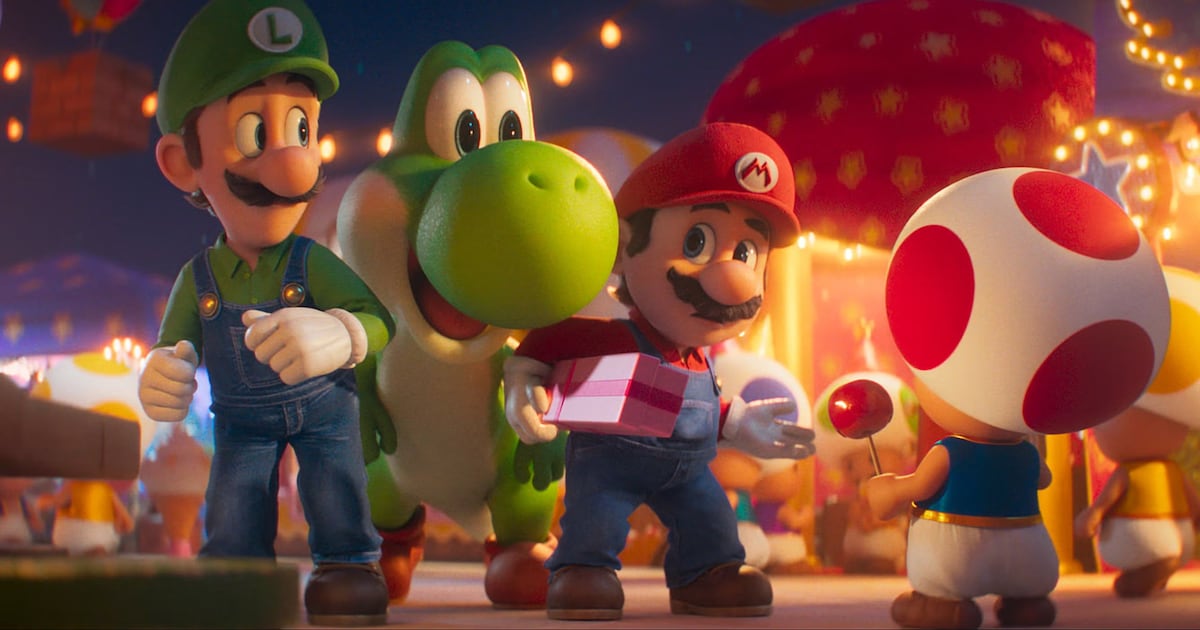
Any doubts about his continuing appeal were quashed with the release of The Super Mario Bros Movie, in 2023. Racking up $1.36 billion at the box office, the Universal release was beaten by only Barbie in that year’s charts. (Oppenheimer, the other half of the Barbenheimer portmanteau, was a relatively distant number three, with $976 million.) Next week we see Mario, again voiced by Chris Pratt, in a sequel entitled The Super Mario Galaxy Movie. It will take a squillion.
2. Boomers? Come along now. He doesn’t date as far back as Jefferson Airplane
No, but Mario first appeared when that generation was, while avoiding lectures at university, huddled around bulky arcade games that still had little ashtrays welded to the console.
In Donkey Kong, which Nintendo released in 1981, an enormous gorilla held a distressed damsel hostage at the top of an apparent building site. The poor woman’s only hope came from a little man with a barely discernible moustache who, jumping barrels and climbing ladders, made repeated efforts to ascend the 2D structure.
Players didn’t know this was a “platform game” or that the hostage was called Pauline or that the hero was the soon unavoidable Mario. The character was unnamed in the initial Japanese release and was referred to as “Jumpman” in the English-language instructions.
3. It says here he was supposed to be Popeye. How did he go from sailor to plumber?
Nintendo did, indeed, originally want to create a Popeye game. Shigeru Miyamoto, Mario’s legendary creator, sketched out a rudimentary love triangle between Olive Oyl, Bluto and the popular spinach-scoffing mariner. When the Japanese company failed to secure the rights, Miyamoto slotted Pauline, Donkey Kong and Mario (or Jumpman) into those roles and a phenomenon resulted.
Our hero was initially – not that you could easily tell – a carpenter, as that seemed a likely fellow to encounter on a building site. On reflection, he did hit things with a big hammer. So it all makes retrospective sense. The clean, simple design – red overall, blue shirt – reflected the technical limitations of the era’s hardware. We will get to the plumbing in a moment.
4. So why “Mario”? Who was Mario Segale?
When Mario Segale, an Italian-American businessman from Seattle, was born in 1934, his immigrant parents can scarcely have imagined he would become best known as inspiration for a computer-generated being who rescued princesses, raced karts and fought evil turtles.
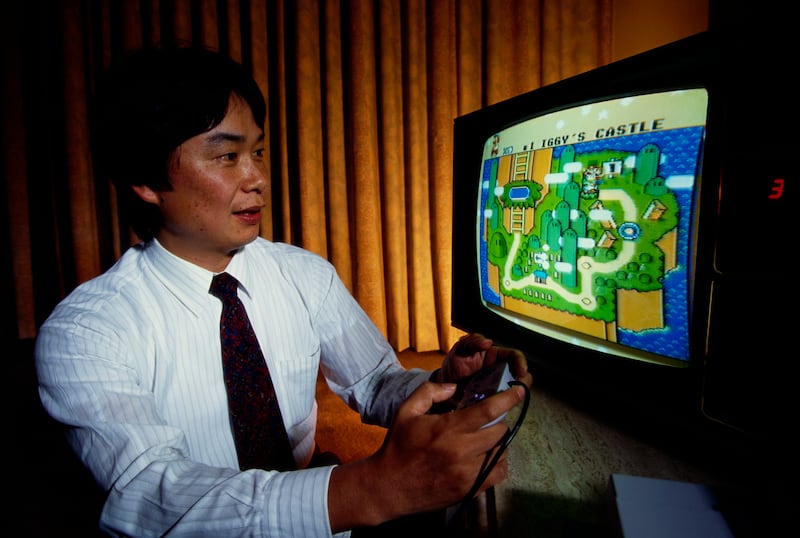 Shigeru Miyamoto, creator of Mario, plays Super Mario World on a Nintendo Super NES System. Photograph: Ralf-Finn Hestoft/Corbis/Getty
During the early 1980s, when Miyamoto was still toying with calling the character Mr Video, Segale rented warehouse space to Nintendo of America. There is disagreement as to why the team named Mario after their landlord, but nobody now seems to dispute that is, indeed, what happened.
“Mario Segale doesn’t mind at all the fact that his name inspired such an iconic character,” a friend later said. “He shows humble pride in that fact in front of his grandchildren and close-knit adult circles.”
5. So when did Mario emerge from Donkey Kong’s huge shadow?
In 1983 he and his brother, Luigi, made it into the title with that year’s Mario Bros. The arcade platformer was set in the sewers of New York; with all those pipes about the place, it seemed sensible to repurpose Mario as a plumber.
It was in the coming console age that the brothers – Luigi, in green overalls, facilitated two-player gaming – really became a cultural sensation. Super Mario Bros, for the Nintendo Entertainment System, brought the siblings into homes across the world.
Nintendo, immediately aware it had an icon, positioned him in sports games, role playing titles and puzzles. This working-class striver from Brooklyn (or the mythical Mushroom Kingdom) took on the quality of universal Everyman. It was harder to identify with the disc in Pac-Man or the blocks in Tetris. So, inevitably …
6. I hear that, by 1990, he was bigger than Mickey Mouse. Really?
When it emerged, in a national survey, that Mario was, to US children, more recognisable then Mickey Mouse, old-bloke media had a bit of a meltdown. “Generations of children had been imbued with Mickey’s message: ‘We play fair and we work hard and we’re in harmony’,” David Sheff, not yet the author of Beautiful Boy, wrote in 1993. “Mario imparted other values. ‘Kill or be killed. Time is running out. You are on your own.’” Yikes. Fan your armpits, mate.
In truth, this was not really comparing like with like. Mickey had already been long relegated to the role of corporate ambassador (how much actual Mouse content do you remember from your own youth?), whereas Mario was appearing in the most popular entertainment of the day. He still is.
7. What did he do to poor Bob Hoskins?
Until quite recently, video-game adaptations have had an appalling reputation. All got terrible reviews. Most lost money. Released in 1993, Super Mario Bros offers a model for all the things that habitually go wrong with such projects. Dennis Hopper slummed it as the evil King Koopa. The team behind the TV hit Max Headroom directed. Hoskins, seven years after his Oscar nomination for Mona Lisa, was Mario.
“It was a f**king nightmare. The whole experience was a nightmare,” he later admitted. “It had a husband-and-wife team directing, whose arrogance had been mistaken for talent. After so many weeks their own agent told them to get off the set. F**king nightmare. F**king idiots.”
The film got the odd tolerable notice, but it still made Siskel and Ebert’s “worst of 1993” show.
8. But Salman Rushdie was a fan. Right?
So it seems. The great Indian-born British author was in hiding throughout the 1990s, following an Iranian fatwa for the supposed offence of writing The Satanic Verses. These were the years of Mario’s greatest celebrity.
In his 2012 book Joseph Anton: A Memoir, for which he took on a second-person pseudonym honouring Josef Conrad and Anton Chekhov, his alter-ego admits an addiction to that season’s big Mario title. “He had grown fond of Mario the plumber and his brother Luigi and sometimes Super Mario World felt like a happy alternative to the one he lived in the rest of the time,” Rushdie writes.
“‘Read a good book,’ his wife told him scornfully. ‘Give it up.’ He lost his temper. ‘Don’t tell me how to live my life,’ he exploded.”
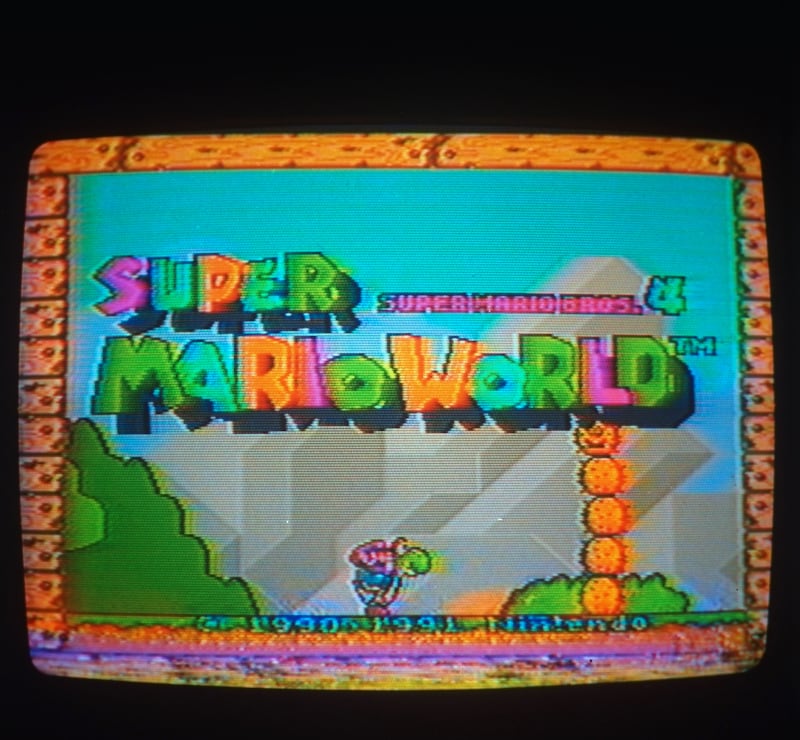 Early days: Super Mario World. Photograph: James Keyser/Getty 9. Does Mario actually have seven careers?
Nintendo has been cavalier with its most popular character’s vocation. We know he started out as a carpenter (like Harrison Ford). As long ago as 1990, for the puzzle game Dr Mario, he was brandishing a thermometer and a stethoscope. In the perennially popular Mario Kart series – still an essential for any beery student night in – he seems to drive those vehicles to professional level.
Back in 2017 the official Nintendo site implied he was no longer available for leaking cisterns. “Whether it’s tennis or baseball, soccer or car racing, he does everything cool,” a translation told us. “As a matter of fact, he also seems to have worked as a plumber a long time ago.”
A long time ago? Nintendo later clarified he, indeed, has had seven careers: plumber, doctor, racer, martial artist, basketball player, baseball player and soccer player.
10. So what can we expect from The Super Mario Galaxy Movie?
Perhaps another enormous sulk from online superfans. The divergence between critics’ and audience scores on review-aggregator sites for The Super Mario Bros Movie caused huge upset on social media. In truth the notices weren’t all that bad (certainly not in comparison with the Hoskins flick’s).
“There’s something magical about being in a cinema full of nine-year-olds who are just as excited as this writer was for the same franchise at the same age,” Tara Brady wrote in this newspaper.
What cannot be questioned is that Universal – like Paramount with the rival Sonic the Hedgehog movies – has finally mastered the art of making such video-game adaptations profitable. The animation also features voice work from Anya Taylor-Joy and Jack Black.
Which of us hunched over Donkey Kong in thick 1980s fag smoke would have thought it likely? That little bloke didn’t even have a name.
The Super Mario Galaxy Movie is in cinemas from Wednesday, April 1st