
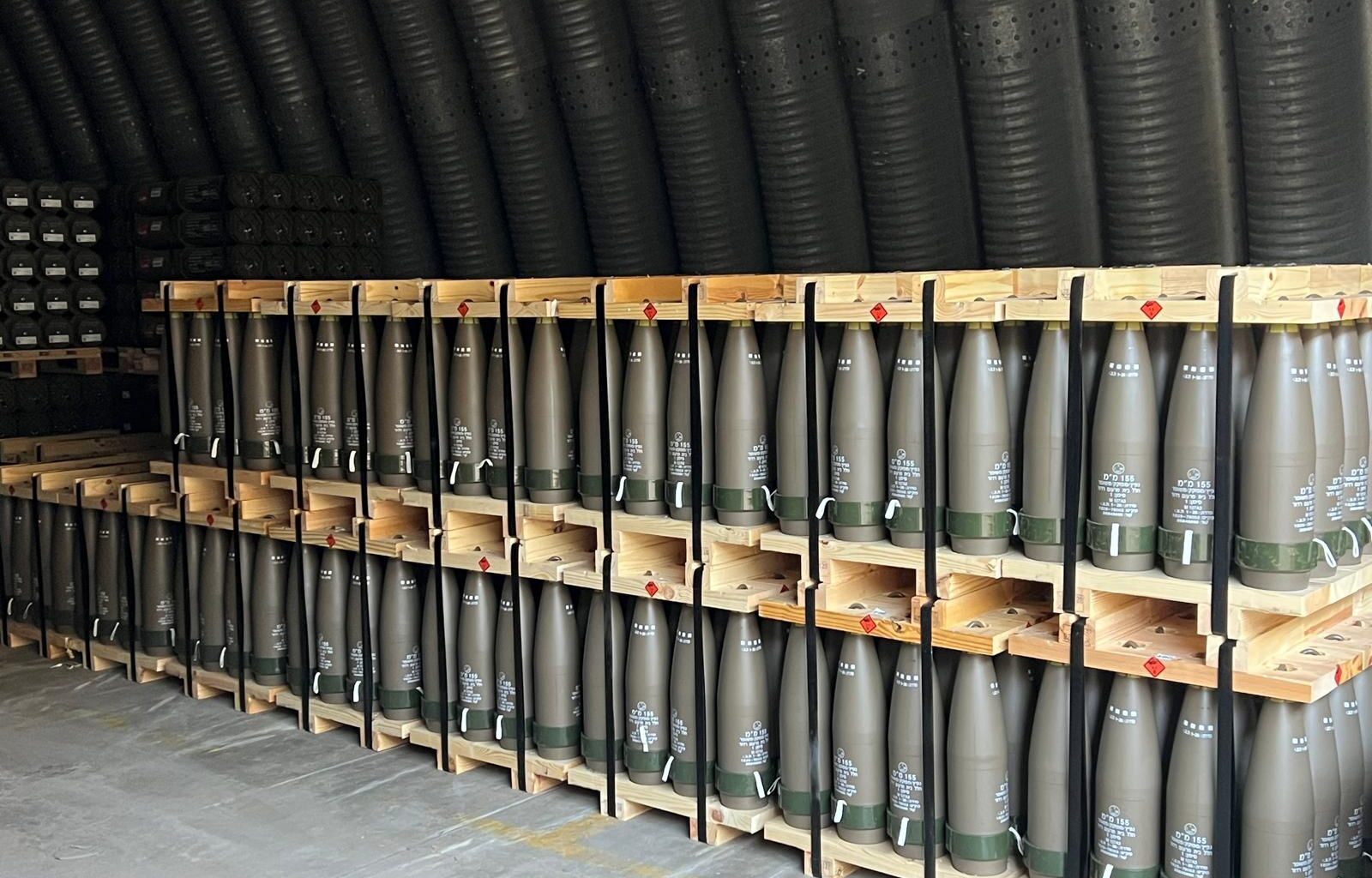
The Israeli MoD is increasing its efforts to procure and stockpile munitions as Operation Roaring Lion continues. This latest procurement suggests that a greater commitment in the land domain is possible.
By Sam Cranny-Evans, editor of Calibre Defence, published on March 30, 2026.
The Israeli Ministry of Defence has ordered “tens of thousands” of 155 mm shells from Elbit Systems, according to a March 30 press release. The order, valued at $48 million, aims to strengthen “IDF operational endurance and readiness for the evolving campaign,” the press release states.
Elbit has factories distributed around Israel that will fulfill the order, with employees already working in three shifts. Three shifts means that the factories are constantly operating, with one eight hour shift followed by another. It is common to see this approach during a major war, or when commitments are expected to outstrip stockpiles.
The exact quantity of shells is not disclosed. However, prior to 2022, a 155 mm round would cost around $600, increasing to as much as $3,000 after Russia’s invasion. This can be used as a benchmark for how many rounds are on order.
At $600/round: 80,000 shells on order
At $2,000/round: 24,000 on order
At $4,000/round: 12,000 on order.
Israel is unlikely to be paying the upper end of this tier, and could reasonably be assumed to be between the first two. Of course, Russia has spent up to 40,000 rounds in a single day of fighting in Ukraine. But that should not be taken as indicative of how far this order could go. Israel makes much greater use of its air power and other effects to achieve its military goals.
Calibre comment: Will there be a bigger land war in the Middle East?
Israel already has forces deployed in Lebanon as part of a ground campaign. Since launching the operation on March 16, the Israelis have advanced modestly into Lebanon. Their objective is control over southern Lebanon up to the Litani River, approximately 30km north of the border. Israeli forces have already targeted bridges over the river, intending to isolate Hezbollah fighters. Similar objectives formed the core of previous invasions into Lebanon and were met with varying levels of success. The differences in the past operations, however, were that Israel was not always prepared for an extended campaign. Operation Roaring Lion appears to have been thought out more carefully, with the Israeli MoD taking steps to build endurance. As a result, if there is an expanded and longer land war in the Middle East, there should be few constraints on Israel’s ability to fight that war.
To read more of our coverage of Operation Roaring Lion, check out the links below:
The lead image appears to show Israeli 155 mm artillery shells stored in a bunker. Credit: Israeli MoD.