
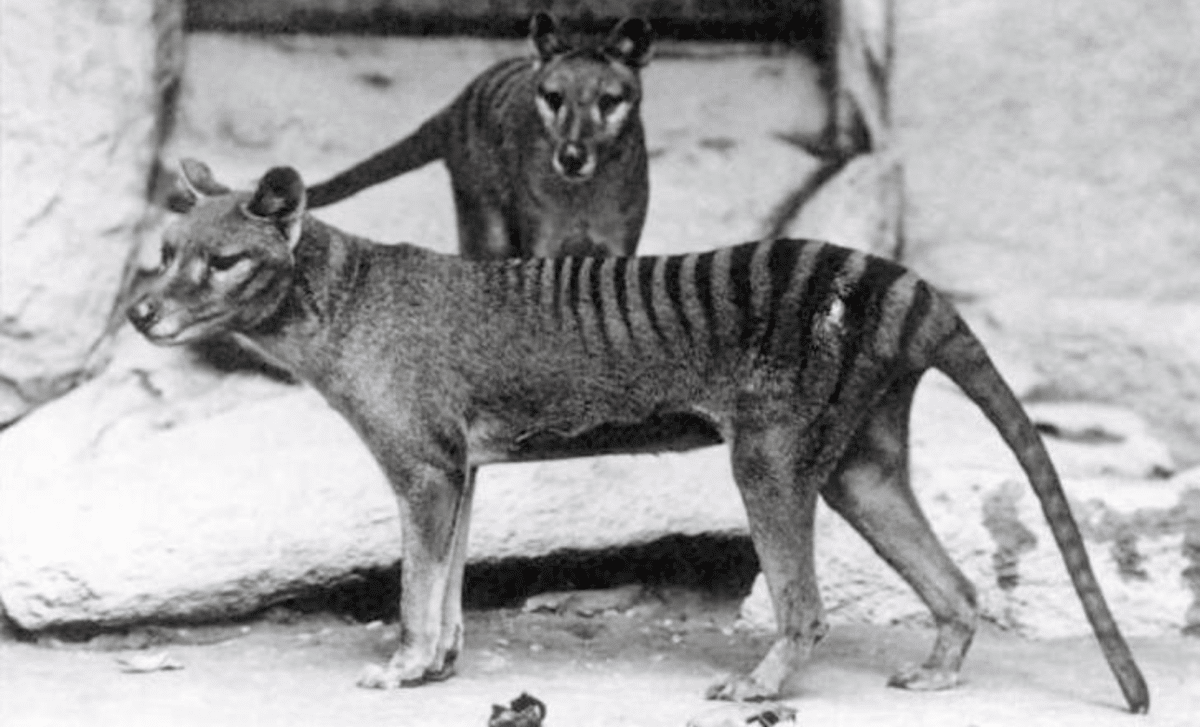
A series of fossilized footprints believed to belong to the extinct thylacine, or Tasmanian tiger, has been uncovered along South Australia’s Eyre Peninsula, revealing a rare snapshot of prehistoric life. First reported by ABC News Australia, the discovery sheds light on ecosystems that existed more than 100,000 years ago and highlights how fragile these traces of the past remain today.
Coastal Rock Layers Reveal A Hidden Prehistoric Record
detailed in reporting from ABC News Australia, the footprints were identified within the Bridgewater Formation, a geological structure known for preserving ancient environmental records across southern Australia. These layered coastal sediments, often exposed along cliffs and shorelines, act as natural archives of long-extinct ecosystems.
“Wherever you see them on the coast, they can look kind of like a pancake stack, lots of individually layered sediments, and these sediments actually have fossil footprints occurring in them right across the south coast of Australia, and we were looking for those in Eyre Peninsula,” said Dr Camens.
His description captures both the visual uniqueness and scientific value of these formations.
Within these layers lies a remarkable diversity of ancient life.
“There’s a huge range of animals represented [in the Bridgewater Formation],” Dr Camens explained. “We rarely find animals like thylacoleo (marsupial lion), sometimes some big relatives of the giant herbivore Diprotodon, but we also find some of the smaller animals, so things like Tasmanian devils and thylacines. We even get smaller animals all the way down to things like birds, like oystercatchers.”
This diversity transforms the Eyre Peninsula coastline into a dynamic fossil record, offering insights not only into individual species but entire ecosystems that have long vanished.
 Thylacine prints were found in the Coffin Bay area.
Credit: Aaron Camens
How Scientists Identified The Elusive Thylacine Tracks
The identification of thylacine footprints relies on both pattern recognition and knowledge of prehistoric fauna. Unlike bones, which provide anatomical details, footprints capture behavior, movement, and environmental interaction.
“For thylacine prints, they’re just a circular impression that is obviously, once you know what you’re looking at, made by a dog species, and there were no dingoes back over 100,000 years ago, so the only animal that existed back then that could have made it is a thylacine,” explained Mr Allen.
Researchers emphasize that individual prints can be ambiguous. What matters is repetition and spacing.
“You might not see something that you can clearly say, ‘Oh, yeah, that looks like a thylacine print, or that looks like a kangaroo print,’” Dr Camens said. “But if you see a repeating pattern, with the same shapes and the same spacing between them, then that means you’re probably looking at a trackway.”
This method allows scientists to reconstruct not just the presence of animals, but how they moved across ancient landscapes, offering a rare behavioral perspective frozen in time.
 This outcrop near Coffin Bay is protected from the open sea, making it ideal for fossil preservation.
Credit: Aaron Camens
A Race Against Time As Nature Erases The Evidence
While these discoveries are scientifically invaluable, they are also extremely fragile. Coastal erosion continuously reveals and destroys fossilized footprints, creating a narrow window for observation and study.
“We do actually see them being regularly eroded, so especially if they’re right on the coast and there’s a big swell hitting it all the time,” Dr Camens noted. “We might see that the footprints might be exposed for only a few years and then they’re destroyed, but then new ones are exposed as well.”
Some sites remain relatively stable.
“We’ve got some footprints near Coffin Bay that are in an area that isn’t seeing lots of erosion, so they can basically be seen; there’s not much changing.” Others are far more volatile: “There are other areas, like on the south coast of Lincoln National Park, where there’s a big swell hitting them and the environment’s changing all the time.”
Ironically, the most productive fossil sites are also the most dangerous. “The best areas that we find these in are actually areas that are being smashed by the waves, so they could be cliffs 20 metres high, so they can be a bit unstable, so they’re not necessarily in the safest place to look at.”