
Researchers at the University of Osaka have hit a vital milestone toward creating tabletop X-ray lasers, with the goal of building ultracompact high-energy electron accelerators.
Using high-intensity lasers, researchers have taken an important step towards miniaturisation of particle accelerators by demonstrating free-electron laser amplification at extreme ultraviolet wavelengths.
By generating high-quality, monoenergetic electron beams (i.e., beams in which all electrons have nearly the same energy), they have achieved a key milestone toward compact accelerator technologies.
“Our work has made several substantial improvements over previous techniques, allowing us to achieve free-electron laser amplification at extreme ultraviolet wavelengths,” said lead author Zhan Jin.
Using wakefield acceleration to generate stronger waves
The research team, led by the University of Osaka’s Institute of Scientific and Industrial Research (SANKEN), used a technique called laser wakefield acceleration to create plasma waves that generate extremely strong accelerating electric fields, thanks to waves within the plasma that travel at almost the speed of light.
These electric fields are more than 1000 times as strong as those in conventional particle accelerators.
Jin explained: “We have used laser pulse shaping to improve focusing accuracy. When combined with our specially developed supersonic gas nozzles, we can create more stable wavefronts, enabling precise control of the plasma source.”
More practical, high-quality particle accelerators
Using free-electron laser amplification in this way is essential for reducing the distance required to accelerate electrons.
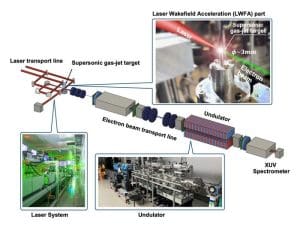 Proof-of-concept experimental setup used to generate an extreme ultraviolet (XUV) free-electron laser (FEL) driven by a laser wakefield acceleration (LWFA) electron beam. Credit: Tomonao Hosokai
Conventional systems can require hundreds of meters, but the powerful fields generated by laser wakefield acceleration can potentially reduce this to just millimetres.
These results show that laser wakefield acceleration is approaching the performance required of practical, high-quality electron particle accelerators. Demonstrating this at extreme ultraviolet wavelengths is an important milestone, but the research team intends to push this even further.
Towards compact, electron-free lasers
Demonstrating free-electron laser operation in the extreme ultraviolet range is a crucial first step toward extending the technology to shorter wavelengths, ultimately enabling compact X-ray free-electron lasers.
These exceptionally powerful light sources generate coherent X-rays that are 10 billion times brighter than the sun and produce ultrashort, femtosecond pulses.
Their use is currently restricted to large facilities, but miniaturisation of these lasers would allow their use in conventional laboratories.
Currently, laser wakefield acceleration is one of the most promising ways to accomplish this.
The future of miniaturised particle accelerators
Desktop-sized instruments are essential in day-to-day research, and developing compact accelerators and X-ray free-electron lasers will enable advances across fields such as life sciences, materials science, semiconductor development, and quantum science.
Constructing desktop-sized accelerators would allow small labs to perform research that currently requires large-scale accelerator facilities.
“Laser wakefield acceleration has long been considered impractical, because of the difficulty in stabilising the plasma it relies on,” explained senior author Tomonao Hosokai.
“We have greatly enhanced the stability and quality of our electron beams, which will allow us to dramatically miniaturise future accelerators, opening the possibility to create compact X-ray free-electron lasers.”
Overall, the research shows that laser wakefield acceleration can be on par with practical, high-quality, high-energy electron accelerators.