
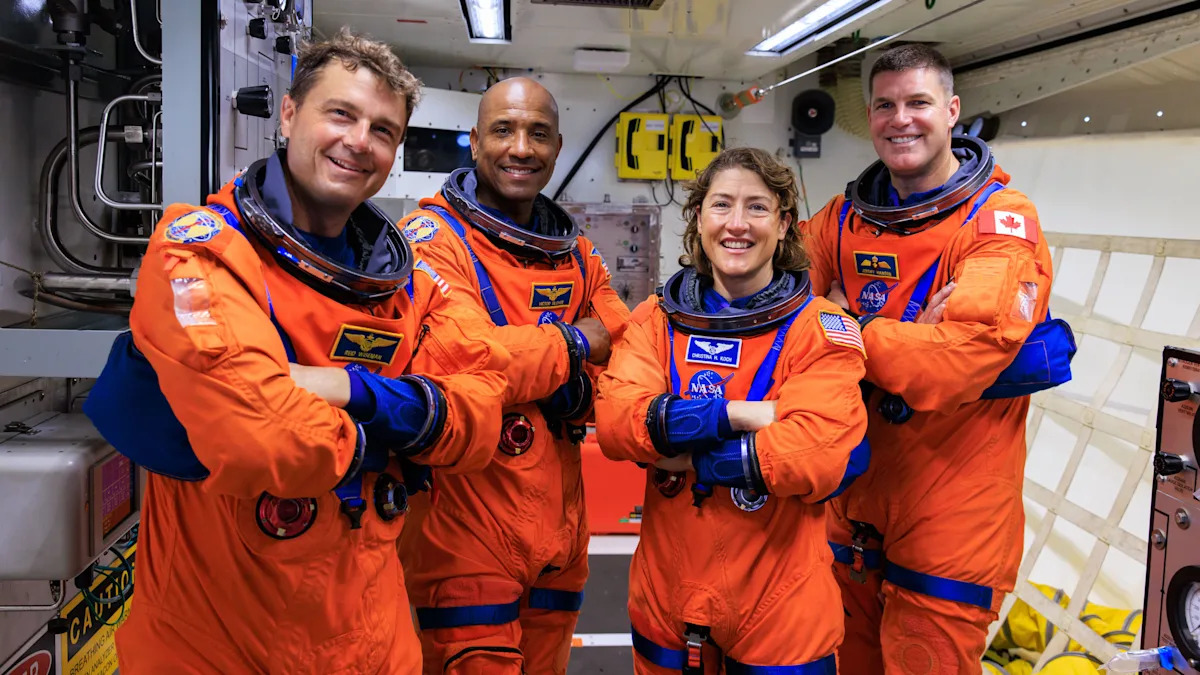
The four astronauts preparing to take part in NASA’s Artemis II moon mission will be wearing bright orange spacesuits on the Orion spacecraft for Wednesday night’s historic launch.
Officially called the Orion Crew Survival System, NASA says the spacesuits can help keep astronauts alive if they lose cabin pressure.
“Astronauts could survive inside the suit for up to six days as they make their way back to Earth,” the space agency explains on its website.
The suits are also equipped with survival gear should they have to exit the spacecraft after splashdown.
Each suit comes with its own life preserver that includes a personal locator beacon, a rescue knife, and a signaling kit with a mirror, strobe light, flashlight, whistle and light sticks.
And the reason they’re neon orange? “To make crew members easily visible in the ocean,” NASA says.
The astronauts will also be equipped with another spacesuit “that functions as a self-contained personal spaceship,” and is designed to be worn outside the spacecraft.
When is Artemis II scheduled to launch?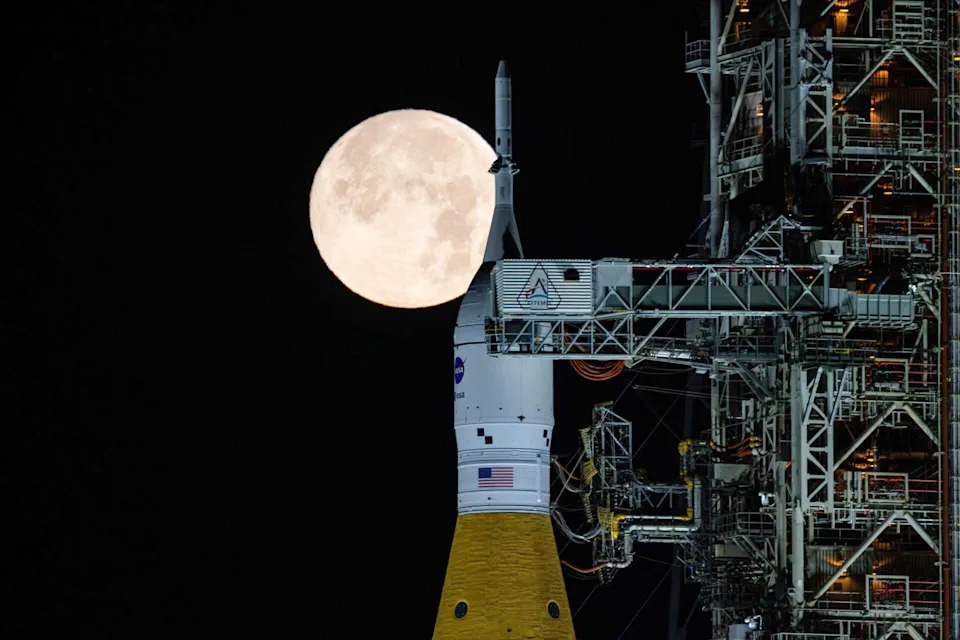
A full moon is seen shining over NASA’s Space Launch System and Orion spacecraft at Kennedy Space Center on Feb. 1.
(ASSOCIATED PRESS)
After weeks of delays, NASA is targeting April 1 for the launch of the Artemis II mission — the first U.S. human lunar spaceflight in over 50 years.
The countdown clock officially started on Monday afternoon, and a two-hour launch window opens Wednesday at 6:24 p.m. ET, with additional launch opportunities through Monday, April 6.
The crew — NASA astronauts Reid Wiseman, Victor Glover and Christina Koch and Canadian Space Agency astronaut Jeremy Hansen — won’t be landing on the moon. Instead, they’ll venture 600,000 miles around the moon and will return at 30 times the speed of sound, according to NASA.
During their 10-day trip, they’ll test life support systems in the Orion capsule for future crewed missions to the moon’s surface. A moon landing would occur during Artemis III, which is targeted to launch in 2027.
How else is the crew preparing for the mission?
The Artemis II crew arrived at the Kennedy Space Center in Cape Canaveral, Fla., on Friday and have been in quarantine ahead of launch.
The four astronauts have spent months getting to know each other while preparing for the launch, which Wiseman says has helped him as the mission’s commander.
“I can just watch my crewmates here. I know their facial expressions. They know mine,” Wiseman said during a virtual press conference on Sunday. “We know when we’re tense. We know when an immediate decision needs to be made.”
Wiseman also said that the crew has practiced restraint.
“We try to remind ourselves — every single time we fly, we say, ‘No fast hands in the cockpit,’” he explained. “You do not want to do anything too quick in this vehicle. You need to take your time. You need to process everything.”
He added: “We’re going to go slow and we have the ultimate trust in each other. And that’s how we will get through this.”
Is the crew bringing anything special to space?
The astronauts will have a mascot named Rise, designed by Lucas Ye, a second-grader from Mountain View, Calif., which will serve as a zero-gravity indicator to visually indicate when they are in space.
Ye’s design was selected from more than 2,600 submissions from over 50 countries, according to NASA.
Inside the mascot is an SD card with the names of more than 5.6 million people who participated in the “Send Your Name With Artemis” campaign.
What will the crew eat?
The quality of airline food is often the butt of jokes, but NASA’s menu for the Artemis crew is enough to make even Earth-bound diners jealous.
A total of 189 unique food items will be brought along for the journey, including beef brisket, macaroni and cheese and cobbler. The food brought on board isn’t just chosen for its taste, however. It’s carefully chosen to meet the astronaut’s needs.
According to NASA, food selections are “developed in coordination with space food experts and the crew to balance calorie needs, hydration, and nutrient intake while accommodating individual crew preferences.”
Everything also needs to last without being refrigerated, and be easy to prepare and safe to eat in microgravity — that means minimal crumbs. Even with those restrictions, NASA is able to send a surprising variety of options, including 10 different drinks; five hot sauces; nine condiments, spreads and spices; and a variety of sweets.
Why does NASA want to go to the moon again?
The Artemis program is NASA’s long-term mission to return humans to the moon to establish a continuous human presence. The goal is to develop a lunar settlement at its south pole, a region where it’s believed water ice is abundant and could be used for drinking, breathing and as a source for rocket fuel.
Another long-term mission of Artemis is to lay the foundation for future crewed missions to Mars. The program is building on the legacy of the Apollo-era missions to the moon in the late 1960s and early ’70s. The Artemis program is named for the ancient Greek goddess of the moon — the twin sister of Apollo.
“It is our strong hope that this mission is the start of an era where everyone — every person on earth — look at the moon and think of it as also a destination,” Koch said.