
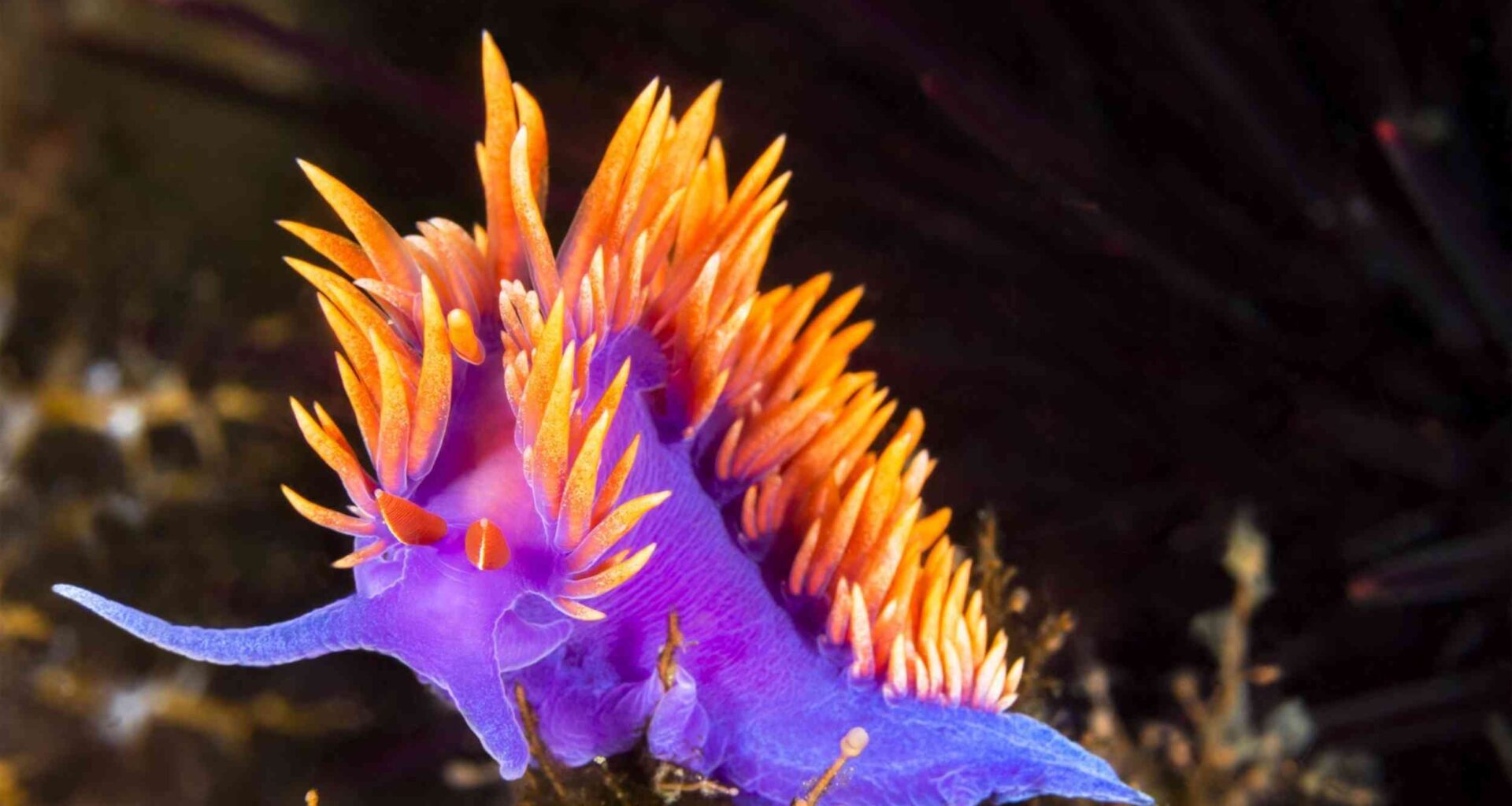
Researchers have found that many of the brightest colors in sea slugs come from microscopic crystal layers in their skin rather than pigments.
That finding recasts their vivid skin as a physical system that can generate many colors from one material.
Nudibranch color as tiny specks

In bright patches on these nudibranchs, color appears in tiny specks rather than broad, uniform fields.
Tracing those specks, Samuel Humphrey at the Max Planck Institute of Colloids and Interfaces (MPICI) linked their hues to stacked guanine plates just beneath the surface.
That same arrangement appeared across animals whose bodies look strikingly different, tying their color diversity to one shared design.
Even so, the finding explained only the common basis of those colors, leaving open how one crystal system produces such different visual effects.
How crystals shape nudibranch color
Color came from architecture rather than chemistry because layered crystals reflected certain wavelengths while muting the rest.
Each stack behaved like a tiny layered filter, selecting one visible color from white light.
Chemical fingerprinting showed the reflectors were made from guanine, one of DNA’s building blocks, in every species under the microscope.
That molecule already helps color chameleons through tuned crystal lattices, broadening a known strategy across animals.
Why color stays steady
Ordered multilayers usually flash and change with angle, yet many nudibranch patches stayed bright without obvious shimmer.
Inside one patch, neighboring stacks pointed different ways, so some always faced incoming light at a useful angle.
Simulations of the nudibranch species Chromodoris annae showed blue reflections staying in roughly the same range from view to view.
Predators would therefore see a steadier warning signal, not a flash that vanished whenever body or water moved.
Blue from spacing
In Chromodoris annae, a bright Indo-Pacific nudibranch, single blue granules reflected up to 80% of incoming light.
Beneath that skin, the team found stacks averaging about six crystals and sitting only a few cells below the surface.
Those crystal plates were thin enough that slight changes in their spacing favored blue reflection over other colors.
Small tweaks to those distances changed the color returned, helping related species land on very different hues.
Mixed light creates white
White regions were not blank at all, because they contained many differently tuned pixels spanning nearly the whole spectrum.
Orange and beige areas used the same design but weighted the mix toward longer wavelengths, turning the result warmer.
Higher in Chromodoris willani, a second scattering layer probably smoothed those mixed reflections into a cleaner white finish.
Brightness, hue, and surface finish could therefore be tuned separately within the same small patch of tissue.
Colors warn predators
Many nudibranchs – soft-bodied marine sea slugs known for vivid colors – do more than look strange, because they steal toxins, stings, or both from the animals they eat.
That chemistry often supports aposematism, warning coloration that tells predators a meal could be painful or poisonous.
Earlier work found a link between conspicuous color and toxicity in marine opisthobranchs, a broader group that includes nudibranchs.
Stable, angle-proof color would fit that job well, although this paper did not test predator behavior directly.
Color mystery resolved
The discovery also overturned a long-standing assumption that nudibranch color mainly came from pigments.
“We were surprised to find that nudibranchs use structural colors,” said Humphrey.
He claimed biologists had long assumed pigments explained those colors, which made the new result harder to dismiss.
That change in thinking recasts flashy skin as a physical system with rules rather than many unrelated causes.
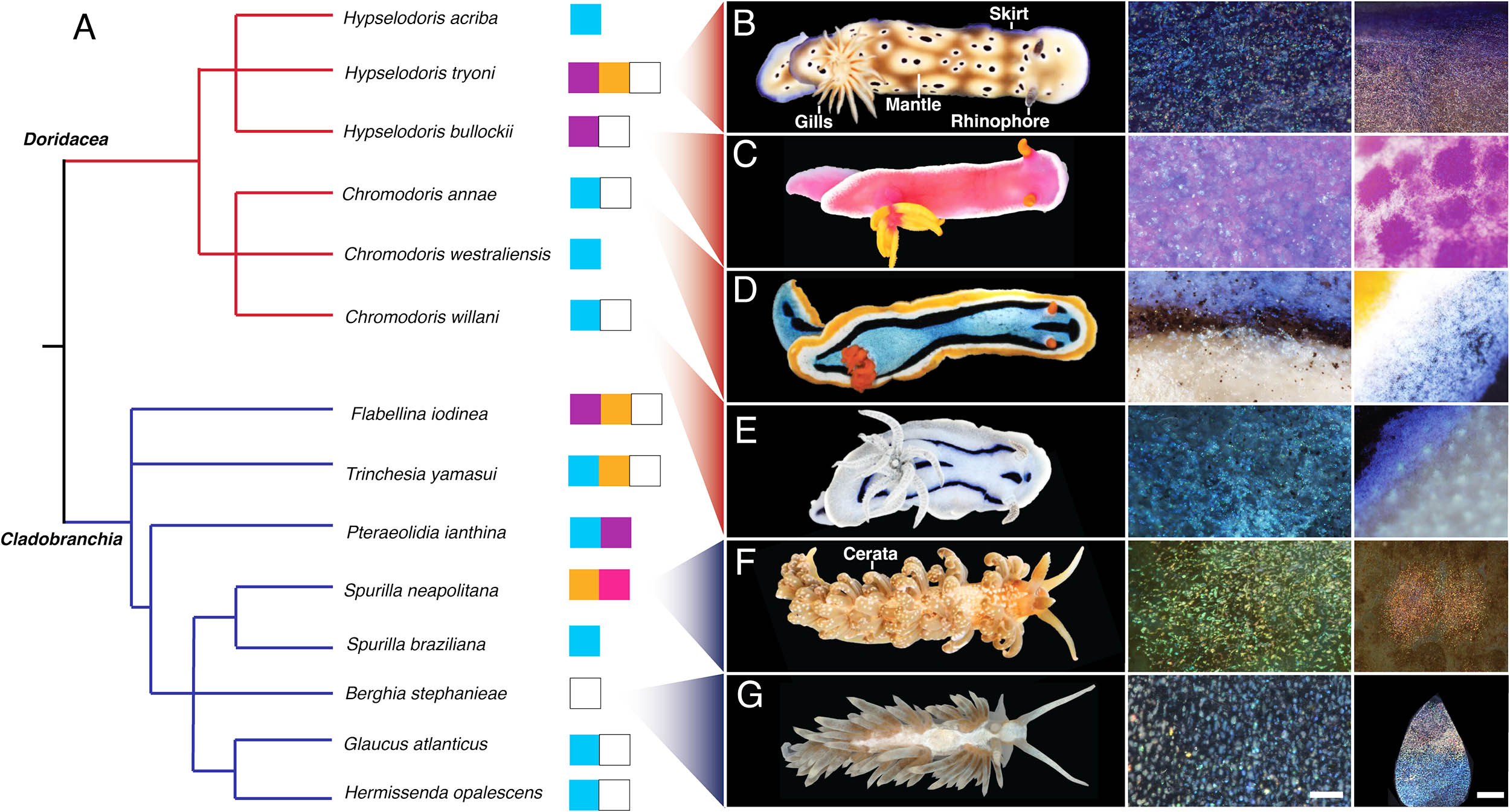 Phylogenetic tree containing 14 nudibranch species from the clades Doridacea and Cladobranchia and details about their tiny specks of color. The species studied here are visible in the photographs on the right. Credit: PNAS. Click image to enlarge.Nature inspires materials
Because these colors arise without added dyes, the mechanism immediately suggests new ideas for manufactured coatings and paints.
“We often draw inspiration from nature when developing new materials and techniques,” said Silvia Vignolini, director of Sustainable and Bio-inspired Materials at the Max Planck Institute of Colloids and Interfaces.
She added that the same principles behind nudibranch coloration could be used to develop more sustainable ways to produce color.
Any practical translation remains speculative, and unlike chameleons these sea slugs did not appear to retune color on demand.
Limits and next tests
Even with extensive imaging, the study surveyed 14 species overall and examined six of them in close detail.
That leaves open whether the same crystal design spans most nudibranch branches or evolved several times independently.
Behavior also remains unresolved, because no predator tests showed whether matte structural color deters attacks better than pigments.
Broader sampling and feeding experiments will decide how universal this mechanism is and how much survival depends on it.
Lessons from nudibranch colors
Nudibranch coloration now looks less chemically fragmented and more like the output of one adaptable crystal system.
By reshuffling microscopic stacks into different sizes, gaps, and angles, evolution built a vivid palette that engineers may borrow.
The study is published in Proceedings of the National Academy of Sciences.
—–
Like what you read? Subscribe to our newsletter for engaging articles, exclusive content, and the latest updates.
Check us out on EarthSnap, a free app brought to you by Eric Ralls and Earth.com.
—–