
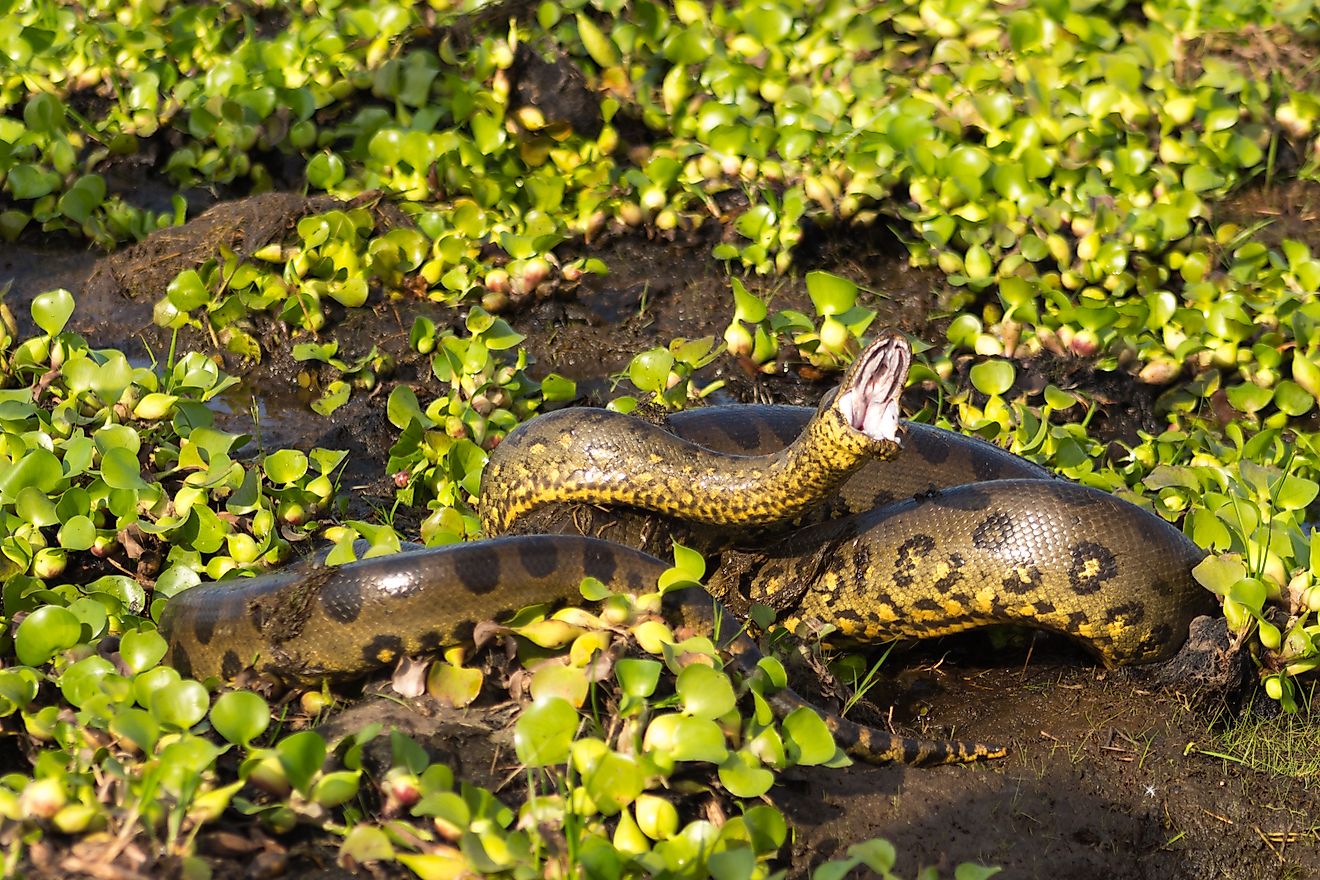
Anacondas occupy a place in the natural world unlike almost any other reptile. They are the heaviest snakes on Earth, built not for speed but for crushing power. With immense muscular strength, they can overpower prey far larger than their heads would suggest. Most of their lives unfold in and around water, within some of the most biodiverse ecosystems on the planet. In regions where rivers flood seasonally and forests dissolve into wetlands, anacondas move silently through dense vegetation and dark water. To understand this remarkable species is to understand the ecosystems it inhabits.
Taxonomic Classification
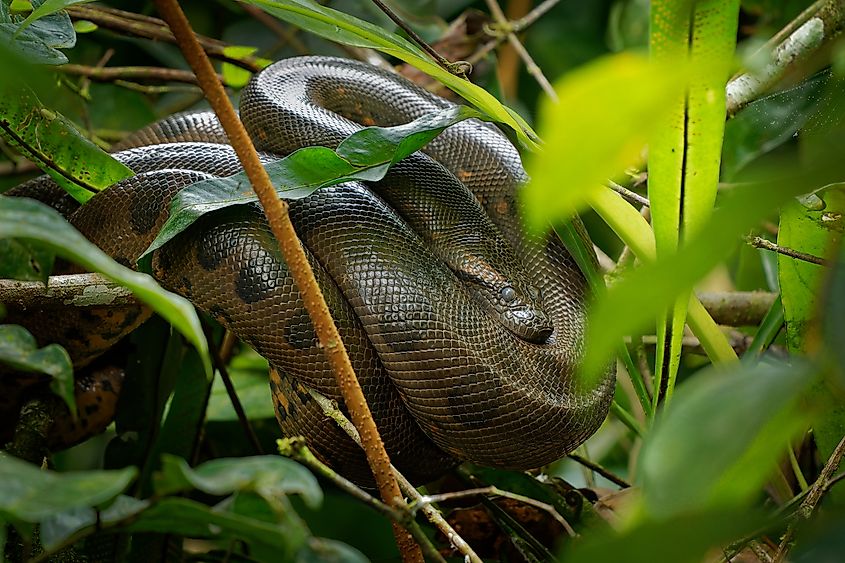 Green Anaconda – Eunectes murinus.
Anacondas belong to the family Boidae, a group that includes some of the largest constrictors alive today. They fall under the genus Eunectes, a name derived from the Greek meaning “good swimmer.”
Five recognized species currently exist within this genus. Green anacondas (Eunectes murinus) are the largest and most studied. Yellow anacondas (Eunectes notaeus) are considerably smaller. Dark-spotted anacondas (Eunectes deschauenseei) and Bolivian anacondas (Eunectes beniensis) are less commonly encountered and less thoroughly documented by researchers. In 2024, researchers proposed that green anacondas are two distinct species, northern green anacondas (Eunectes akayima) and southern green anacondas (Eunectes murinus). This proposed distinction, however, is contested and has not reached consensus among researchers.
Green anacondas are the heaviest snakes in the world, though they do not hold the record for longest. That title belongs to the reticulated python of Southeast Asia. These two groups share a common ancestry rooted in ancient constrictors, but their evolutionary paths diverged long ago across separate continents.
Range and Habitat
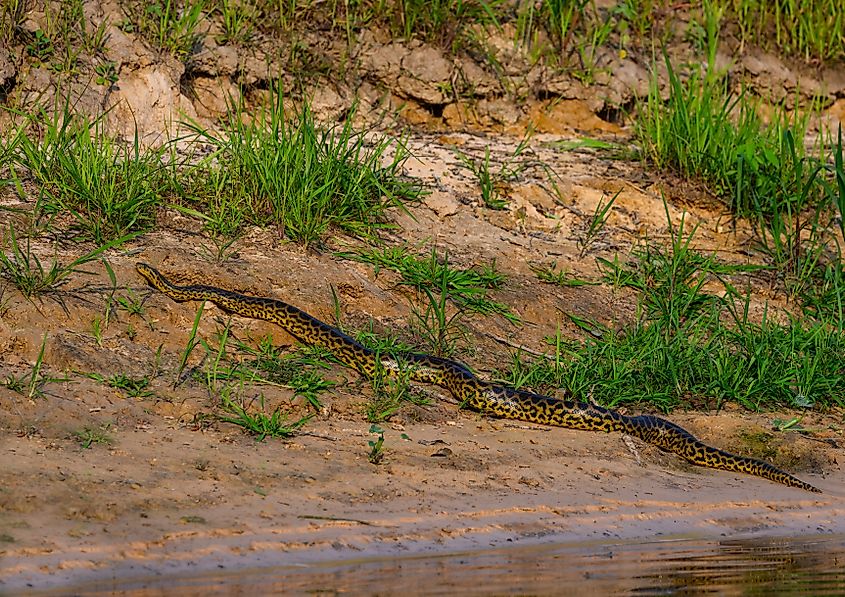 Green Anaconda, Pantanal in Brazil.
Green anacondas are native to South America, with the majority of the population concentrated in the Amazon Basin and the Orinoco Basin. The yellow anaconda has a more southerly distribution, appearing in Paraguay, northern Argentina, and parts of Bolivia and Brazil. All species throughout South America are primarily east of the Andes.
These snakes are deeply tied to water. Swamps, slow-moving rivers, flooded grasslands, and tropical forest edges define the core of their habitat. The Llanos of Venezuela, a vast seasonally flooded savanna, provides a particularly dense habitat for green anacondas. The Pantanal, the world’s largest tropical wetland, does as well.
They are capable of moving through river systems for considerable distances, and their aquatic lifestyle gives access to a wide variety of prey that congregates near water.
Diet and Hunting
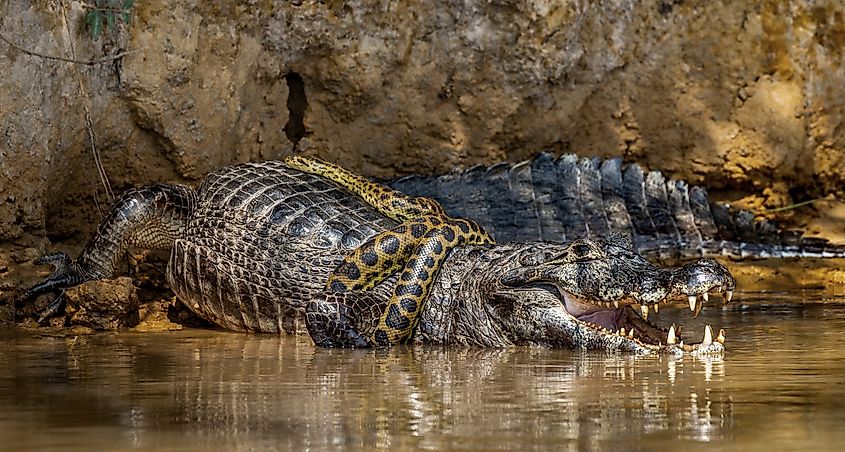 Anaconda vs caiman.
Anacondas are carnivores and opportunistic hunters. They commonly eat fish, birds, turtles, caimans, capybaras, and deer. Their slow-acting digestive system can take days or weeks to break down food. As such, these animals can spend weeks between meals.
Like all constrictors, these snakes do not use venom. Instead, they ambush prey at the water’s edge or in shallows, strike with backward-curving teeth to secure their grip, and then coil their body around their target. Constriction prevents the prey from breathing and restricts blood flow to the brain, quickly causing loss of consciousness. These snakes then swallow their prey whole head-first.
After an especially large meal, they do not need to eat again for weeks or months. Digestion is metabolically demanding and generates internal heat. During this period, well-fed individuals will rest in a secure place until the process is complete.
Physical Description
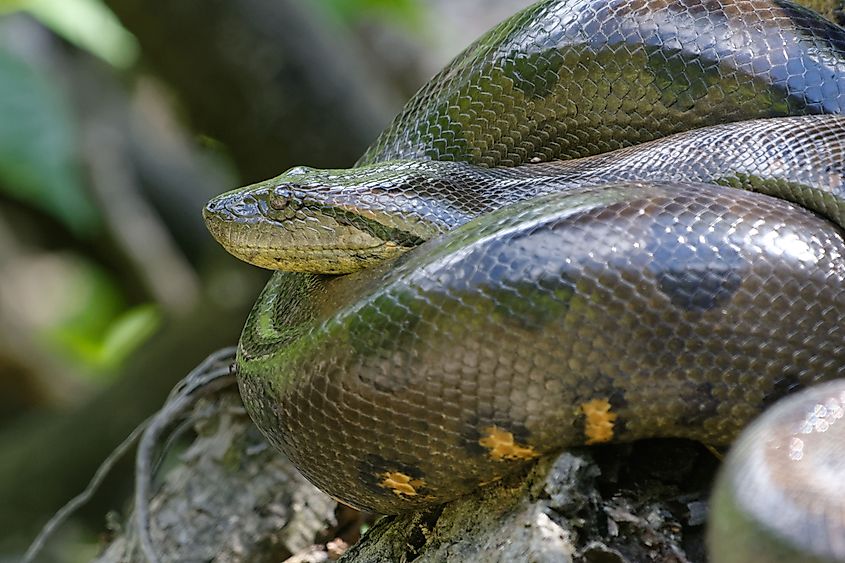
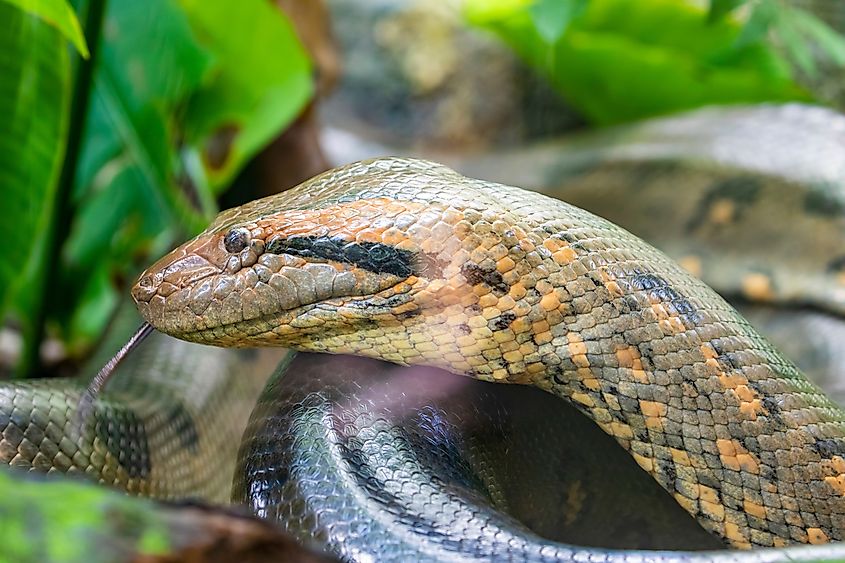 The closeup image of green anaconda (Eunectes murinus)
Females are substantially larger than males, making this species one of the most extreme examples of size dimorphism among snakes. Female green anacondas typically measure 15 to 18 feet in the wild, exceptionally large individuals can reach or exceed 20 feet in length and weigh over 300 to 400 pounds. Males are far smaller, typically averaging around 9 to 10 feet in length.
Coloration varies by species and serves as camouflage in aquatic and densely vegetated environments. Their base colors are green, yellow, or brown with darker markings along the back and smaller spots or streaks on the sides. These patterns break up the snake’s outline against murky water, submerged roots, and tangled riverbank vegetation. Their eyes and nostrils are set high on their head, an adaptation that lets them breathe and see above the waterline without exposing their bodies.
Their scales are smooth and iridescent in certain light conditions. Beneath the skin, their musculature is extraordinarily dense. Their body is thick and cylindrical with a relatively small head compared to their body mass. This proportion is part of why anacondas can swallow such large prey. Their jaws and skulls are highly flexible, with bones connected by elastic ligaments rather than fused joints.
Behavior
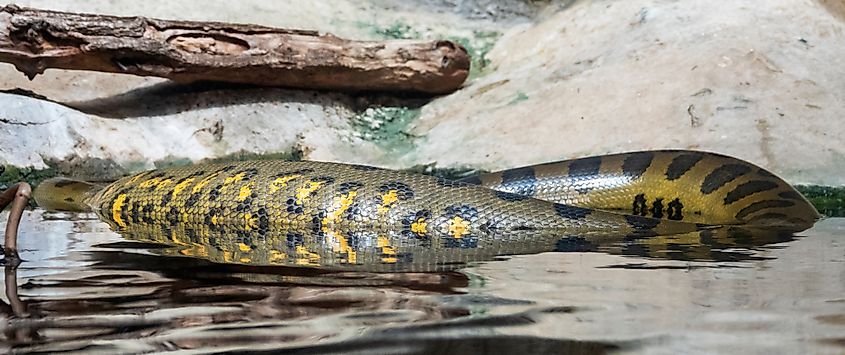 A green anaconda in the water.
Anacondas are largely solitary and spend the majority of their time in or near water. They are most active at night and at dusk, using ambush tactics rather than active pursuit to secure food. In cooler or drier conditions, they bask on riverbanks or in low tree branches to regulate their body temperature.
During the dry season, some individuals enter a state of reduced activity similar to estivation, resting in muddy areas or shallow water until seasonal rains return. The flooding of the Llanos and Amazon floodplain transforms their habitat dramatically with each annual cycle, and they adjust their behavior accordingly.
Despite their fearsome reputation, anacondas rarely interact with humans in any threatening way. Documented attacks on people are very rare and typically involve snakes that have been provoked or cornered. In the wild, they will more commonly retreat into the water when approached.
Reproduction
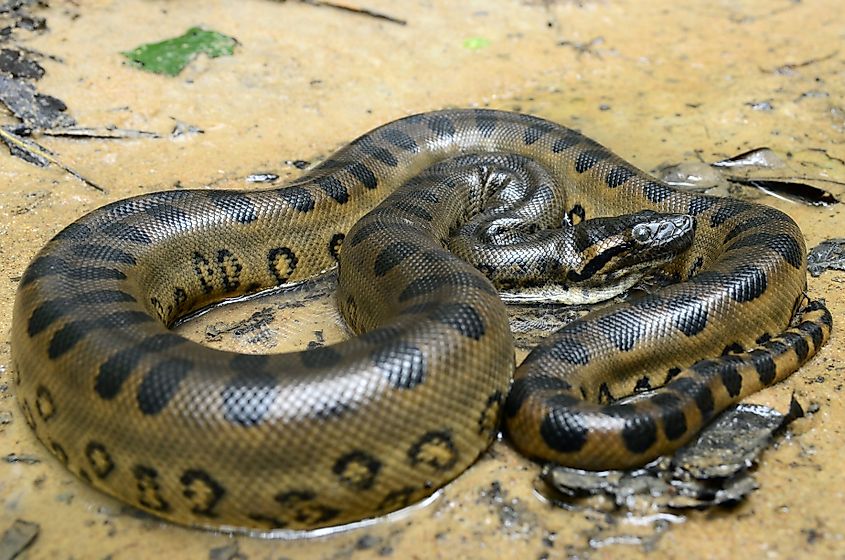 The Southern Green anaconda (Eunectes murinus)
Anacondas reproduce through a process that begins with aggregations called “breeding balls.” During the breeding season, a single female releases pheromones that attract multiple males. Several males then simultaneously attempt to court the same female, resulting in a coil of individuals.
Females give birth to live young rather than laying eggs. Litter sizes are large, averaging 20 to 40 young. Some exceptionally large females can produce more than 80 young. Neonates are already well developed at birth, measuring more than 2 feet in length and capable of hunting small prey almost immediately.
Young snakes disperse throughout their habitat independently and face substantial predation pressure from caimans, birds of prey, and larger snakes during their early months.
Threats
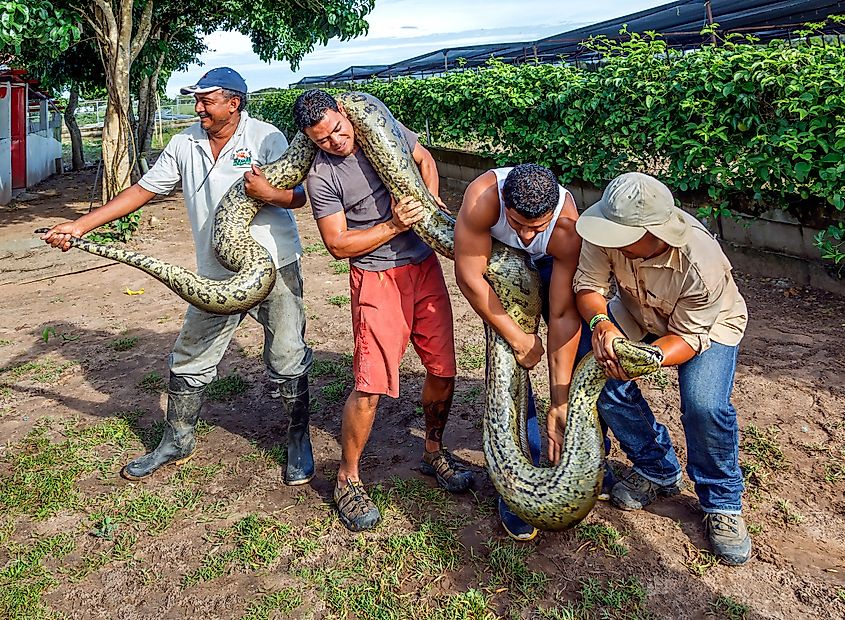 A group of staff kennel show tourists six meters anaconda.
Habitat loss presents the most sustained threat to these populations. Agricultural expansion, wetland drainage, and deforestation in the Amazon Basin and Pantanal reduce the freshwater ecosystems that these snakes depend on. As human settlements push deeper into formerly remote areas, direct conflict also increases. Anacondas are sometimes killed out of fear or to protect livestock.
Pet trade and commercial hunting for skins have historically removed anacondas from wild populations. Pollution in river systems affects the fish and other prey species that anacondas rely on. Climate change affects flood cycles in the Llanos and Amazon, which directly disrupts the seasonal rhythms that structure their hunting and reproductive cycle.
Importance to the World
 A massive green anaconda.
These animals function as apex predators in the freshwater ecosystems they inhabit. By regulating populations of capybaras, caimans, and other animals, they help maintain the balance of the broader ecological community. Their feeding activity connects terrestrial and aquatic food webs in ways that few other animals can.
They also serve as an environmental indicator. The health of anaconda populations reflects the health of the wetlands they rely on. Beyond ecology, these animals hold significant cultural importance across indigenous Amazonian communities where they appear in oral traditions and cosmology.
The Coil That Holds the River Together
Anacondas are predators defined by water and shaped by millions of years of evolution in some of the most biodiverse freshwater ecosystems on Earth. Their survival is directly tied to the health of the wetlands, flood cycles, and river systems they depend on. As those environments face increasing pressure, so do anacondas.
Their population health reflects the broader condition of the ecosystem they inhabit. The water quality, prey availability, and seasonal rhythms that hold these environments together are intertwined with the health of anacondas. Studying and protecting this species acts as a window into the health and interdependence of the Amazonian and South American wetland ecosystems.