
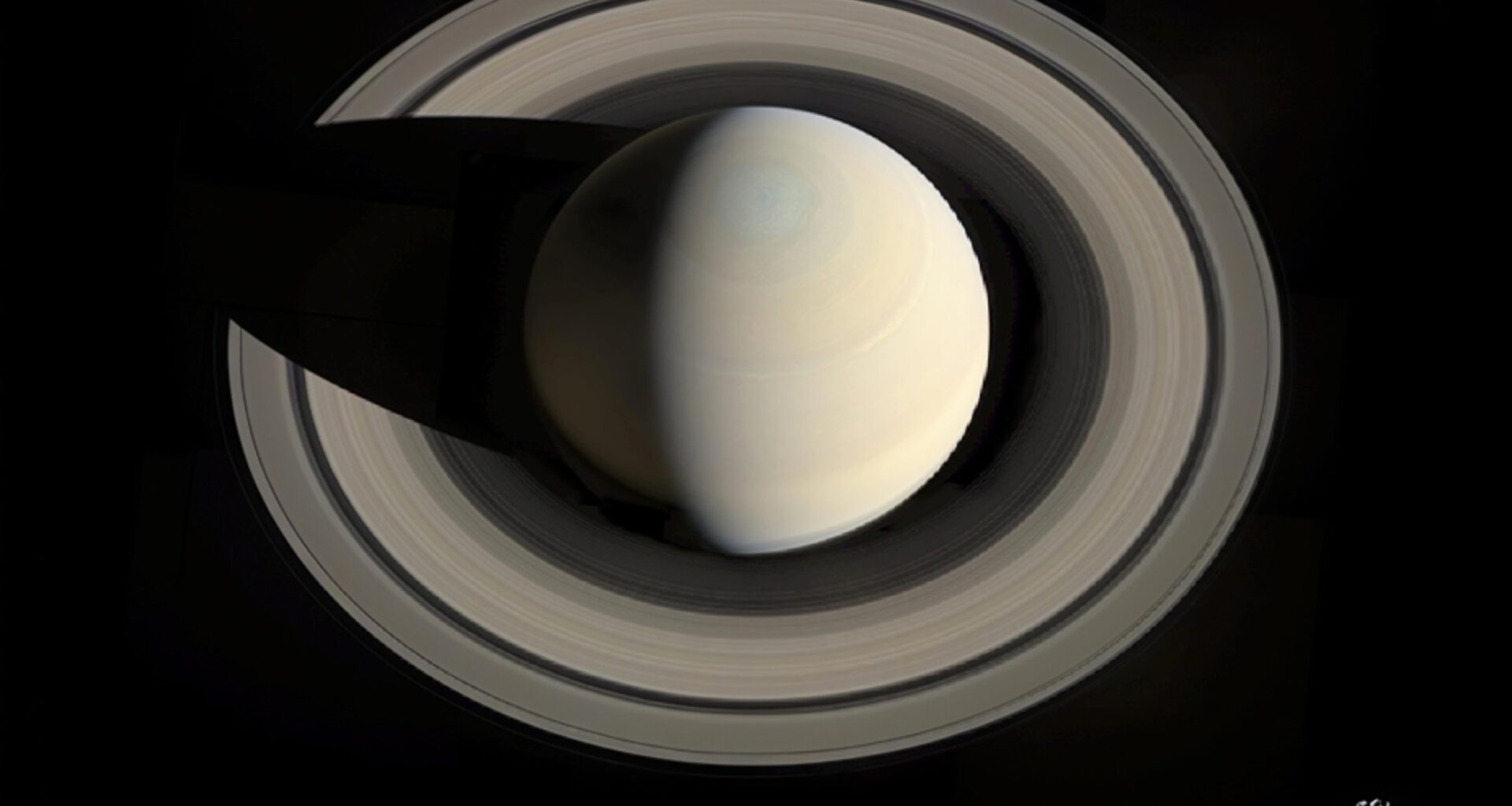
Saturn looks calm from a distance. A pale giant with rings, sitting quietly in space. But its surroundings tell a different story.
The space around the planet is busy, charged, and constantly shifting. New research shows that Saturn’s magnetic shield, the invisible barrier that protects it from solar radiation, doesn’t sit evenly around the planet the way Earth’s does.

Instead, it leans. Not dramatically, but enough to matter.
A magnetic bubble with a twist
Every planet with a magnetic field has a magnetosphere. It acts like a shield, deflecting streams of charged particles coming from the Sun.
On Earth, this shield is fairly balanced. The structure is stretched but still centered in a predictable way.
Saturn’s magnetosphere is massive, stretching more than ten times wider than the planet itself. But it isn’t evenly shaped.
A key feature called the cusp, where solar particles can slip into the atmosphere, doesn’t sit where scientists expected.
Instead of lining up around noon relative to the Sun, Saturn’s cusp is usually pushed to the right, landing between about 1:00 and 3:00 on a clock face. That small shift tells a bigger story.
What’s tugging at the magnetic field?
Scientists analyzed six years of data from the Cassini spacecraft, which orbited Saturn and studied its environment in detail. The results point to two main forces working together.
First, Saturn spins fast. One full rotation takes just 10.7 hours. That rapid spin pulls its magnetic field along with it.
Second, Saturn drags a thick cloud of charged particles, or plasma, around itself. This plasma comes largely from its moon Enceladus, which shoots out water vapor from beneath its icy surface.
Once that vapor becomes ionized, it adds weight to the system. Together, the fast spin and this heavy plasma “soup” appear to tug the magnetic field out of alignment.
Study co-author Andrew Coates is a professor of physics in the Mullard Space Science Laboratory at University College London.
“The cusp is the place where the solar wind can slip directly into the magnetosphere. Knowing the location of Saturn’s cusp can help us better understand and map the whole magnetic bubble,” said Professor Coates.
Saturn’s magnetic environment
Saturn is once again drawing attention as plans for future missions begin to take shape – especially those targeting Enceladus.
This icy moon has emerged as one of the most compelling destinations in the solar system, thanks to its hidden subsurface ocean and the tantalizing possibility that it could harbor life.
Understanding Saturn’s magnetic environment is part of that effort.
“A better understanding of Saturn’s environment is especially urgent now as plans for our return to Saturn and its moon Enceladus start to be developed,” said Professor Coates.
“These results feed into the excitement that we are going back there. This time we will look for evidence of habitability and for potential signs of life.”
The magnetosphere plays a role in how particles move, how radiation behaves, and how material from Enceladus spreads through space. Those factors all matter when planning spacecraft missions.
A different kind of planetary system
The findings also challenge a long-standing assumption. Scientists have often treated Earth’s magnetic behavior as a model for other planets. This study suggests that may not always work.
“This study also provides critical evidence for a long-held theory – that the rapid spin of massive planets like Saturn with active moons replaces the solar wind as the dominant force shaping magnetospheres,” said Professor Coates.
“It shows that Saturn’s magnetosphere, as well as the magnetospheres of other rapidly spinning gas giants, likely differ fundamentally from Earth’s.”
“Enceladus itself is a key driver of this environment, releasing huge amounts of water vapour that gets ionised, loading the magnetosphere with heavy plasma that is then pulled around as the planet spins.”
This means Saturn’s magnetic field is not just reacting to the Sun. It is being shaped from within.
Implications for other planets
The implications stretch farther than one planet. By comparing Saturn with Earth, scientists can begin to spot patterns that apply across the solar system and even beyond it.
“The differences between Saturn’s magnetic structure and that of Earth point to a unified fundamental process governing solar wind interaction across different planets,” noted study co-author Professor Zhonghua Yao from The University of Hong Kong.
“Comprehensive terrestrial observations reveal the working mechanisms of Earth, while comparative studies between planets inform us of the fundamental laws that can be applied to understand other systems, such as exoplanets.”
That broader view helps scientists understand distant worlds orbiting other stars, many of which are gas giants.
Future research directions
The study offers strong clues, but it is not the final word. Researchers still need more simulations and observations to confirm exactly how these forces interact.
Study lead author Dr. Yan Xu is a researcher at the Southern University of Science and Technology (SUSTech).
“By combining Cassini observations with simulations, we found that Saturn’s rapid rotation and the plasma from its moon Enceladus together shape the asymmetric global distribution of the cusps,” said Dr. Xu.
“We hope this gives some useful reference for future exploration of Jupiter’s and Saturn’s space environments.”
The full study was published in the journal Nature Communications.
Image Credit: NASA/JPL-Caltech/Space Science Institute/G. Ugarkovic
—–
Like what you read? Subscribe to our newsletter for engaging articles, exclusive content, and the latest updates.
Check us out on EarthSnap, a free app brought to you by Eric Ralls and Earth.com.
—–